Mount Rainier – The offspring of fire and ice born more than a half million years ago. Lava and ash surged out of the young volcano’s vent thousands of times, filling the neighboring canyons and building up a summit cone to a height of some 16,000 feet. The tallest peak in the Cascade Range that dwarfs the surrounding summits and, like Mount St. Helens and other Cascade volcanoes, an active volcano with the potential to erupt again. Unlike Mount St. Helens, however, it has been more than a century since this mountain erupted and more than a century (1899) since it was designated by Congress as a National Park.
The mountain wonderland that is Mount Rainier NP includes dense old-growth forests of Douglas Fir, western red cedar and western hemlock; seemingly endless subalpine meadows of breathtaking wildflowers; AND 25 major glaciers which form the largest collection of permanent ice on a single US peak south of Alaska.
So – into the park, where even the entrance gate is monumentally proportioned! Four cedar-log columns almost four feet in diameter and three log beams spanning the roadway were erected in 1911 to create a pergola with a clearance of eighteen feet. In 1973 the massive logs which deteriorated did have to be replaced – but, it was redone identical to the original.
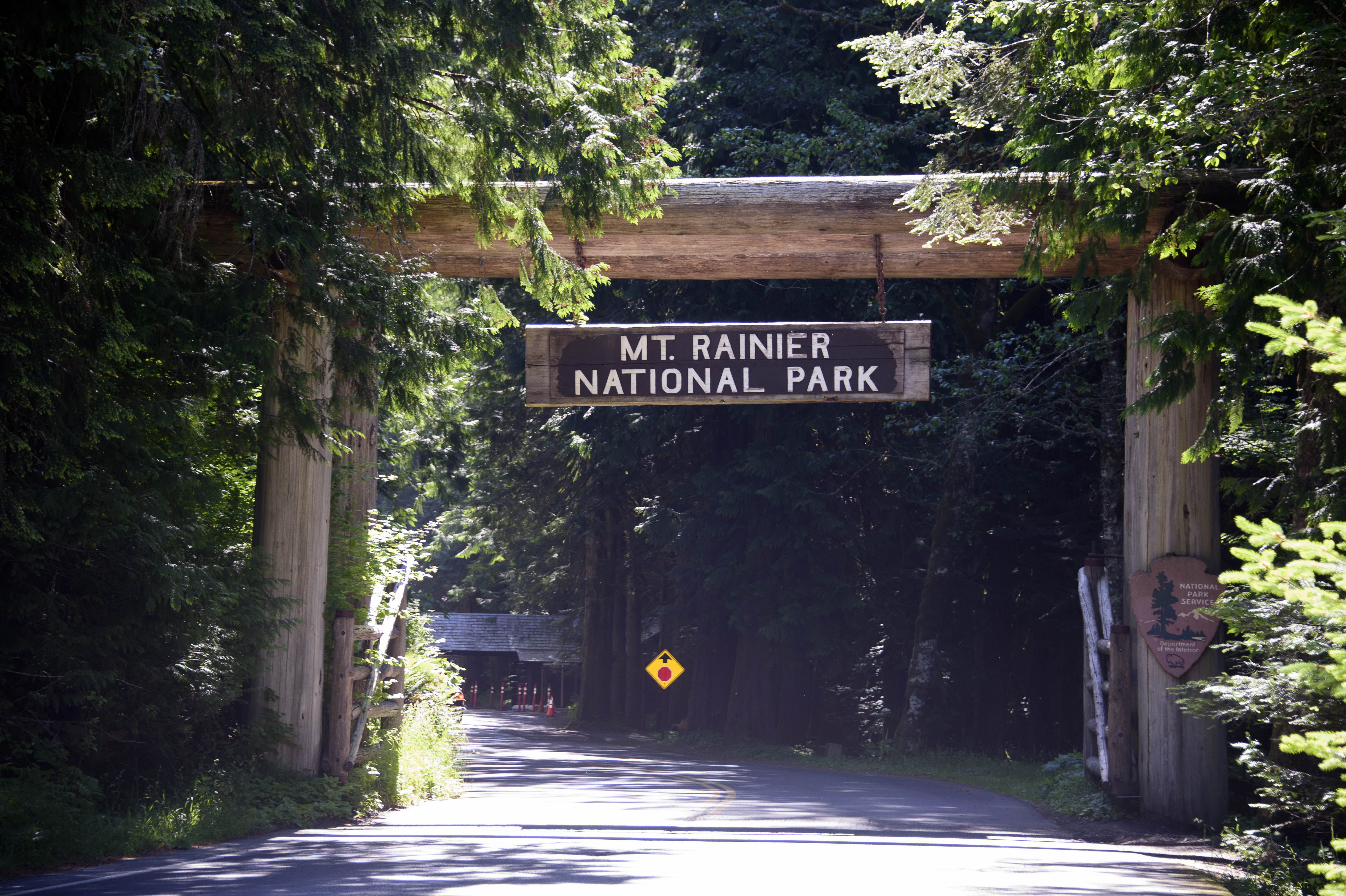
What a Grand Entry for a Grand NP
It was a beautiful, sunny day so we headed to the highest point in the park reachable by car – Sunrise;-) (The winter season misfortune of lack of snow was our fortune in that this area was already open due to the low snow pack this past winter.) The view provided here is the northeast portion of Mount Rainier with a spectacular view of Emmons Glacier, Rainier’s largest covering more than 4 square miles. The terminus of the glacier is just where you can see the stream beginning.
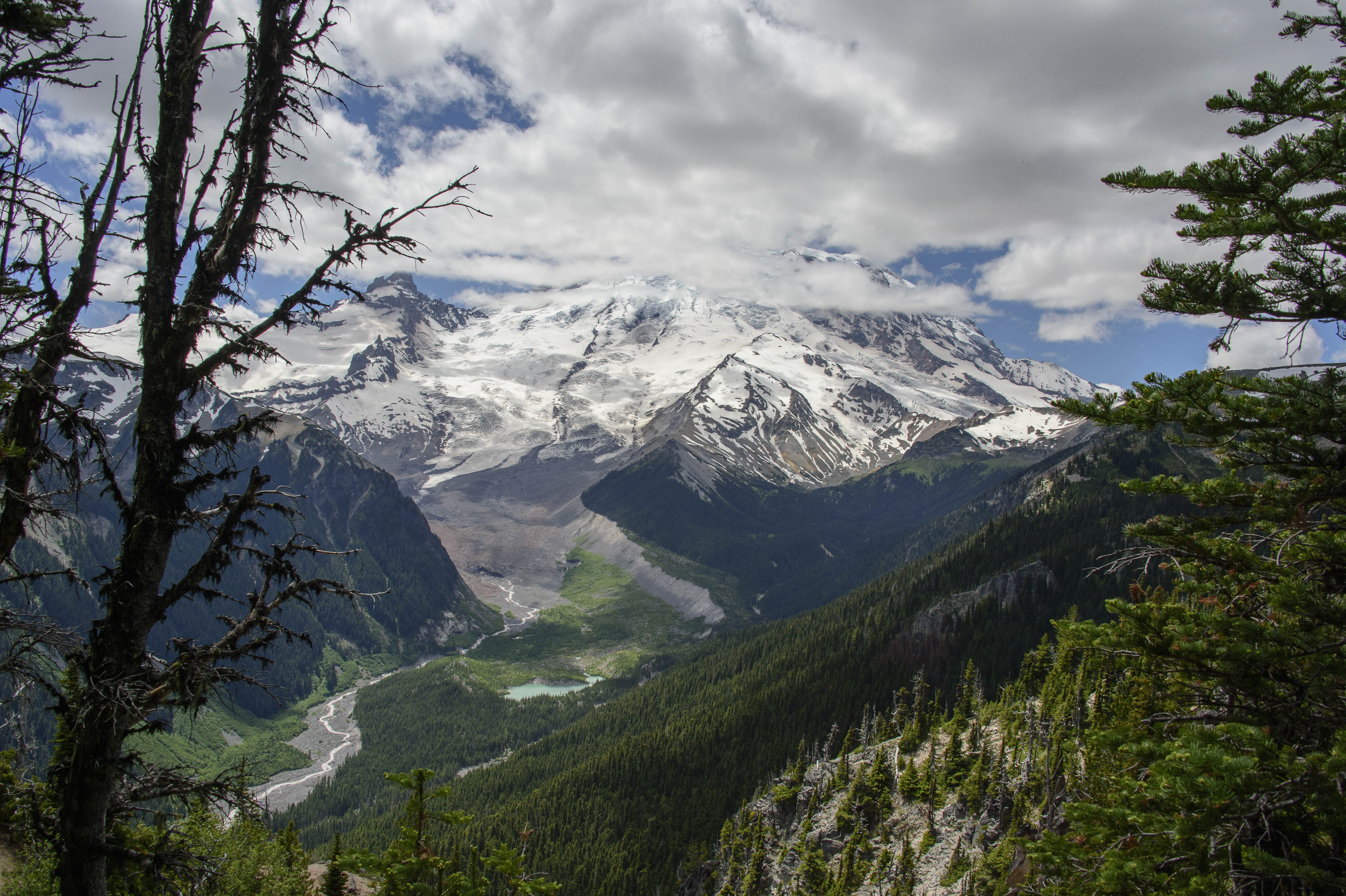
Emmons Glacier on the north east side of Mt. Rainier, taken from Sunrise.
At 6400 feet, the temps were a cool 64 degrees and we were near the tree line. At this altitude the harsh temperatures and winds stunt the trees into twisted shrubs called elfin timber. Trees only inches in diameter may be 250 years old. You can see examples in this picture of our GREAT lunch spot – –
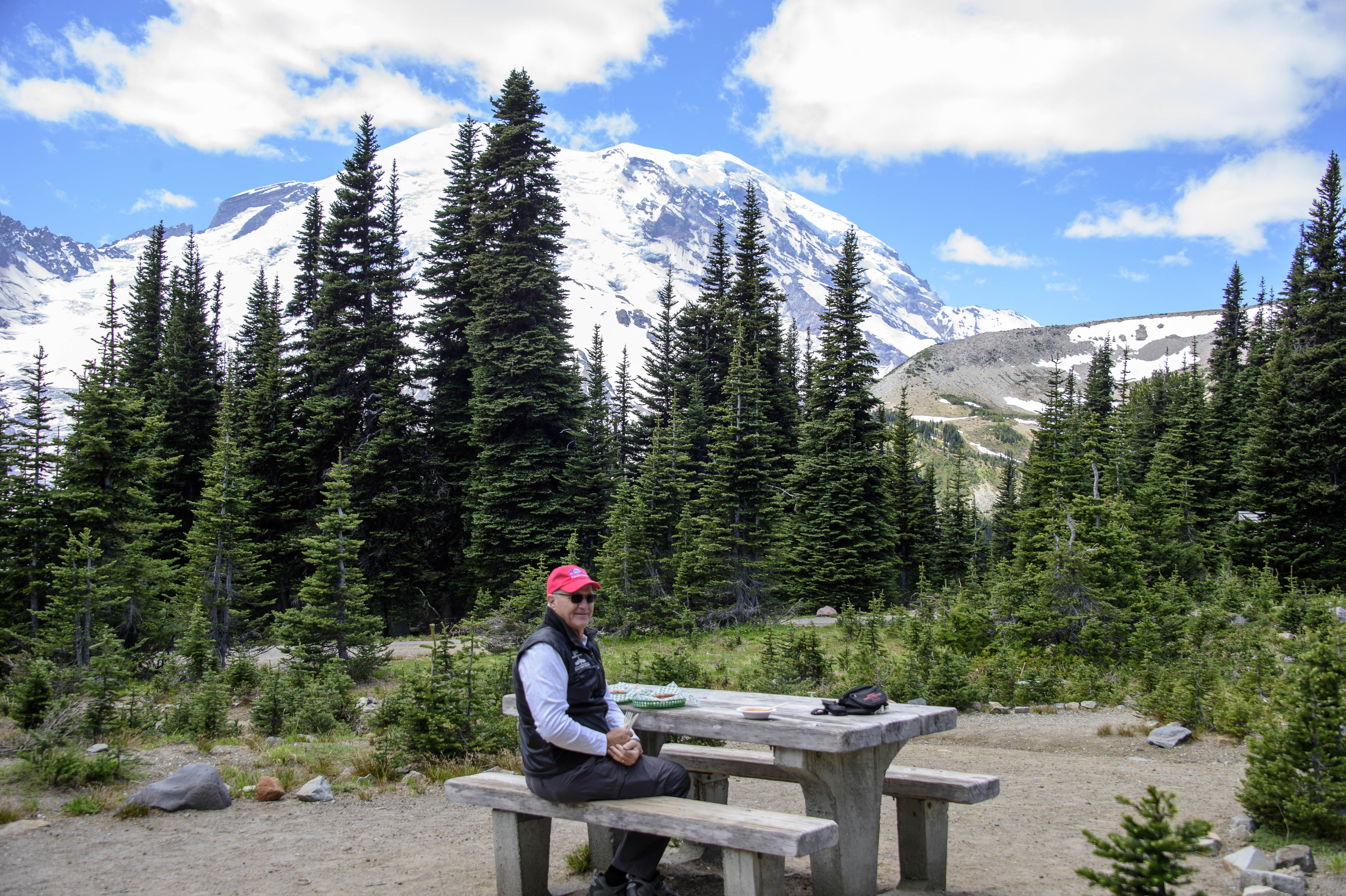
Great view from our picnic lunch near the Sunrise Visitor Center.
Time to head to lower elevations to warm up a bit and to continue our adventure. With all these mountains and glaciers – you can imagine that there were LOTS of waterfalls to provide even more beautiful sights. Here was the first of many that presented itself after a short .5 mile hike – –
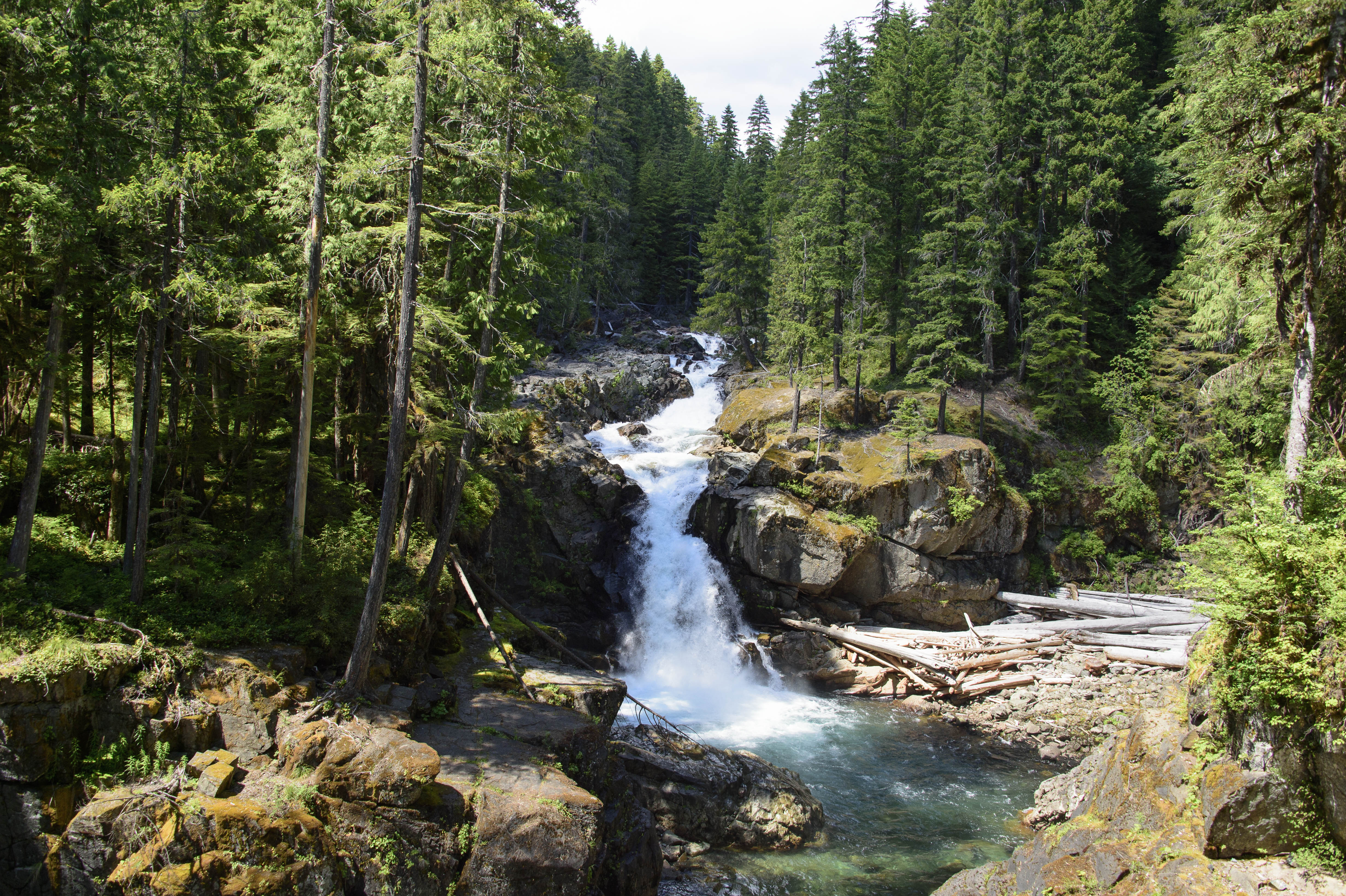
Silver Falls.
Glaciers, waterfalls – now time for the old forests. A short 1.3 mile loop through the Grove of the Patriarchs revealed grand old Douglas firs, western red cedars and western hemlocks, many of them 500 to 1,000 years old. But, in order to get there we had to go to Tom Sawyers Island (not really, of course) – –
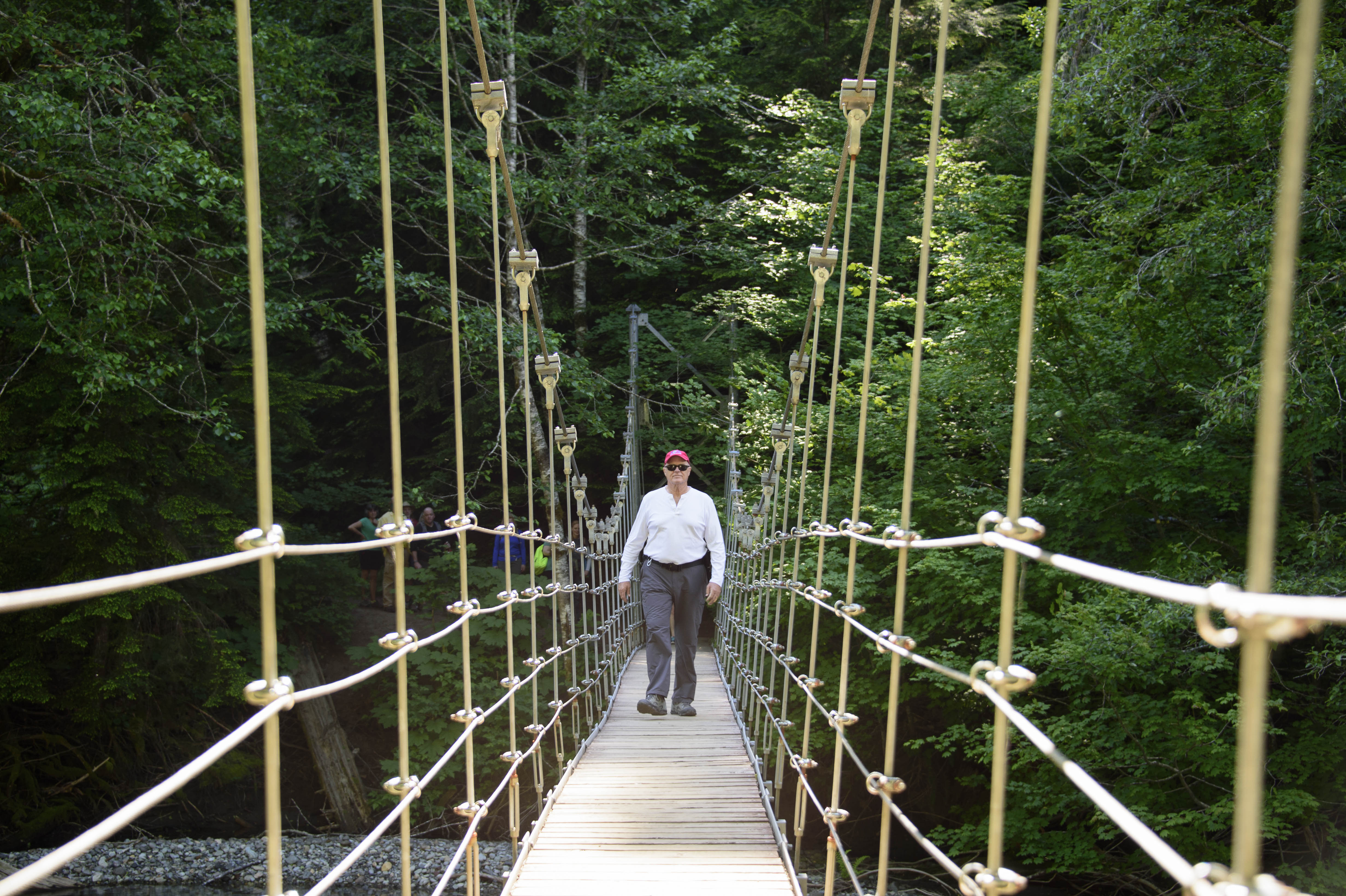
Crossing the bridge to the Grove of the Patriarchs.
Off to Paradise – really!! Martha Longmire, along with her husband the ‘discoverers’ of the park area, exclaimed in 1885 on first sighting the rolling hills of wildflowers framed by Mount Rainier’s white dome – “It looks just like paradise!” Truer words were never spoken – –
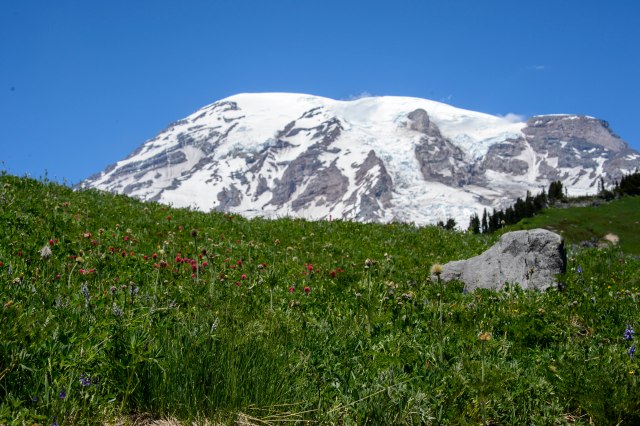
The magenta paintbrush was beautiful – although they should be in full splendor in about a month.
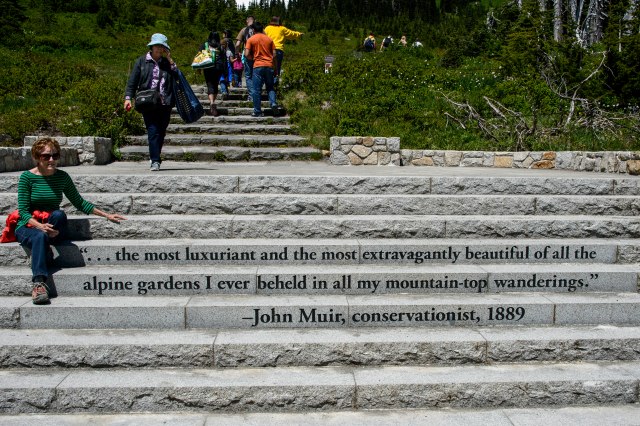
Nuf said!
The Paradise meadow areas provide the incredible fields of flowers, beautiful vistas of Mount Rainier and its many glaciers and, of course, lots of streams and waterfalls. Of particular interest to the Biaett family is Myrtle Falls – –
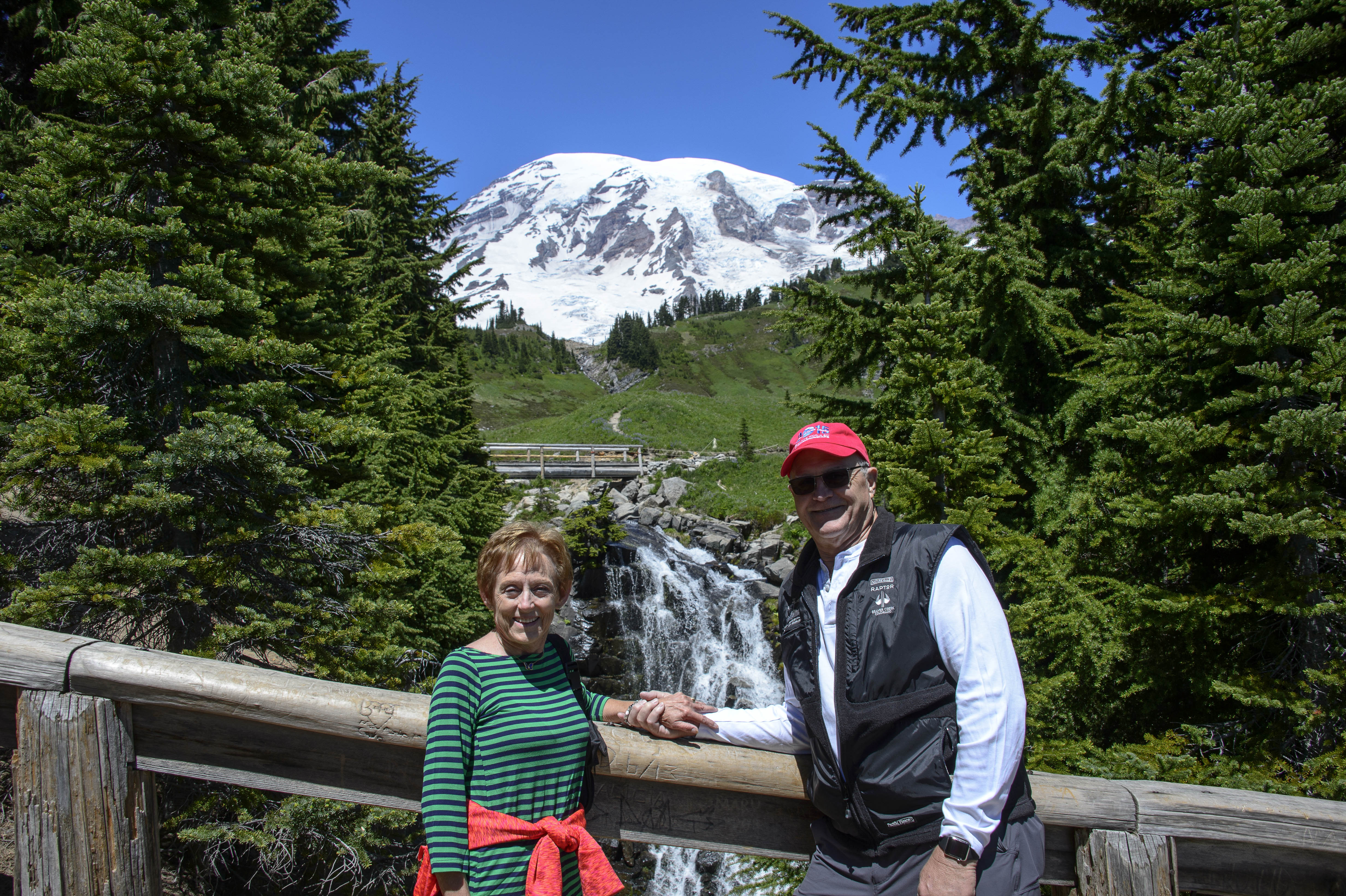
At Myrtle Falls in the Paradise area.
Above the falls an almost perfect picture presented itself – exquisite subalpine lupine, the running creek and the deer down for a drink oblivious to all the people snapping its picture;-)
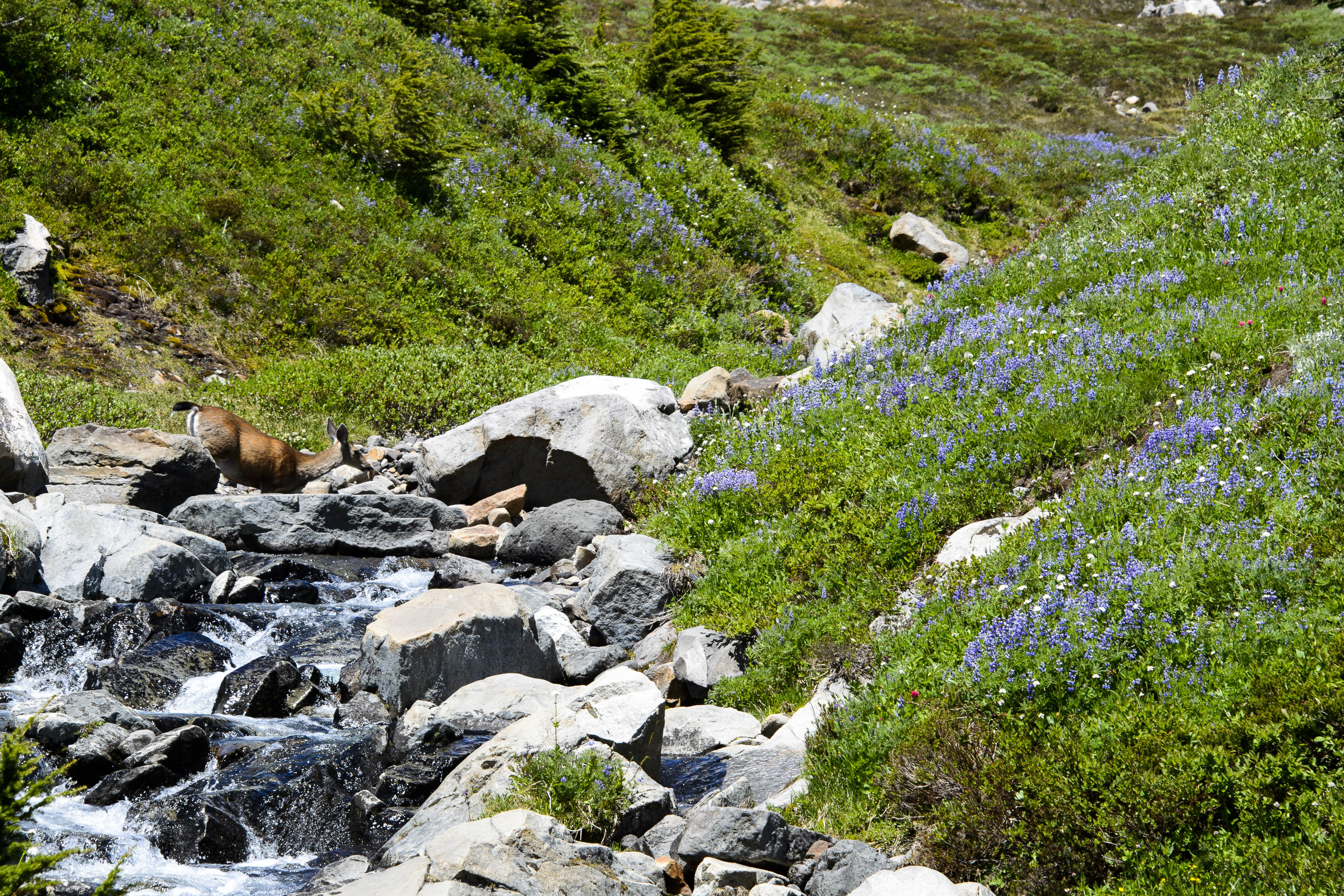
A deer, a creek and more wildflowers.
The Paradise Inn also resides at Paradise. Set on a site that provides views of the saw-toothed peaks of the Tatoosh Range (dramatic remains of lava flows that predated Mount Rainier by some 25 to 35 million years!), Mount Rainier and the valley, the Inn opened on July 1, 1917. Many dignitaries have passed through its doors – including Cecil B. DeMille, Sonja Henie, Harry S. Truman and Shirley Temple. Well seasoned timbers from the silver forest were selected to build the Inn. Huge gable roofs over the main lobby section and the dining room were more than two-thirds the height of the structure. Steeply pitched roofs were created to shed the severe winter snows. The lobby is a masterpiece of rustic framing and spatial architecture. Perhaps the most important decorative element in the lobby is the handcrafted Alaskan cedar furniture made by a German woodcrafter who stayed at the Inn during the winter of 1916-1917. Included was a grandfather clock and a piano once played by Harry S. Truman. (They serve a pretty good Sunday Brunch here too!)
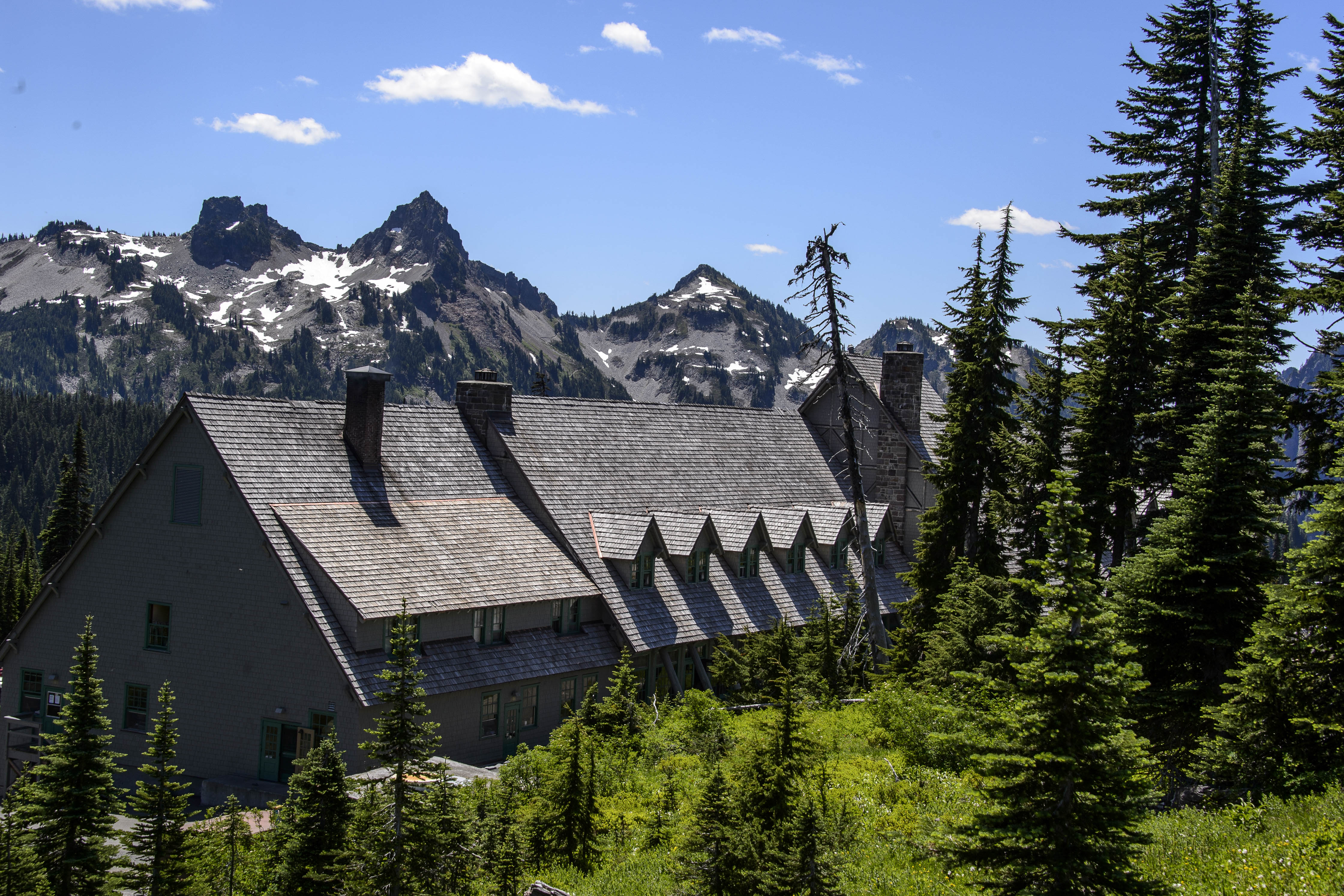
The Paradise Inn windows seem to follow the ridge line of the rugged Tatoosh Range – a result of the lava flows.
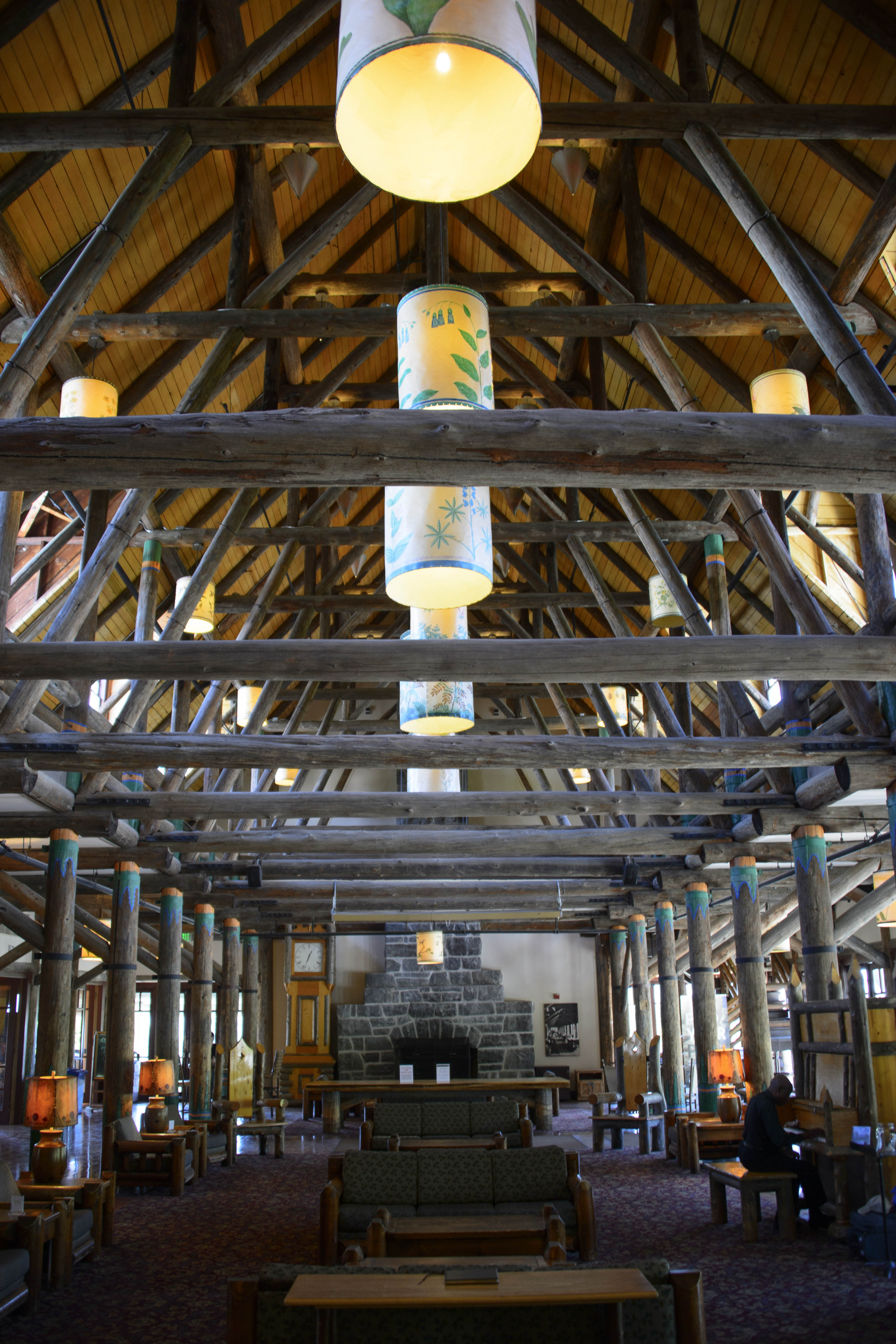
The lobby of the Paradise Inn – check out the clock next to the fireplace and the piano in the middle right.
As mentioned above, James Longmire and his wife came to this area in the 1880’s. James discovered mineral springs here in 1883 and built Mount Rainier’s first hotel. His ads for miraculous water cures helped generate early tourism and a constituency for the creation of the park. Although his hotel did not survive, a second hotel built at Longmire between 1916 and 1918 (renovated in the 1990’s) still exists as the National Park Inn. The view on the front porch is stunning.
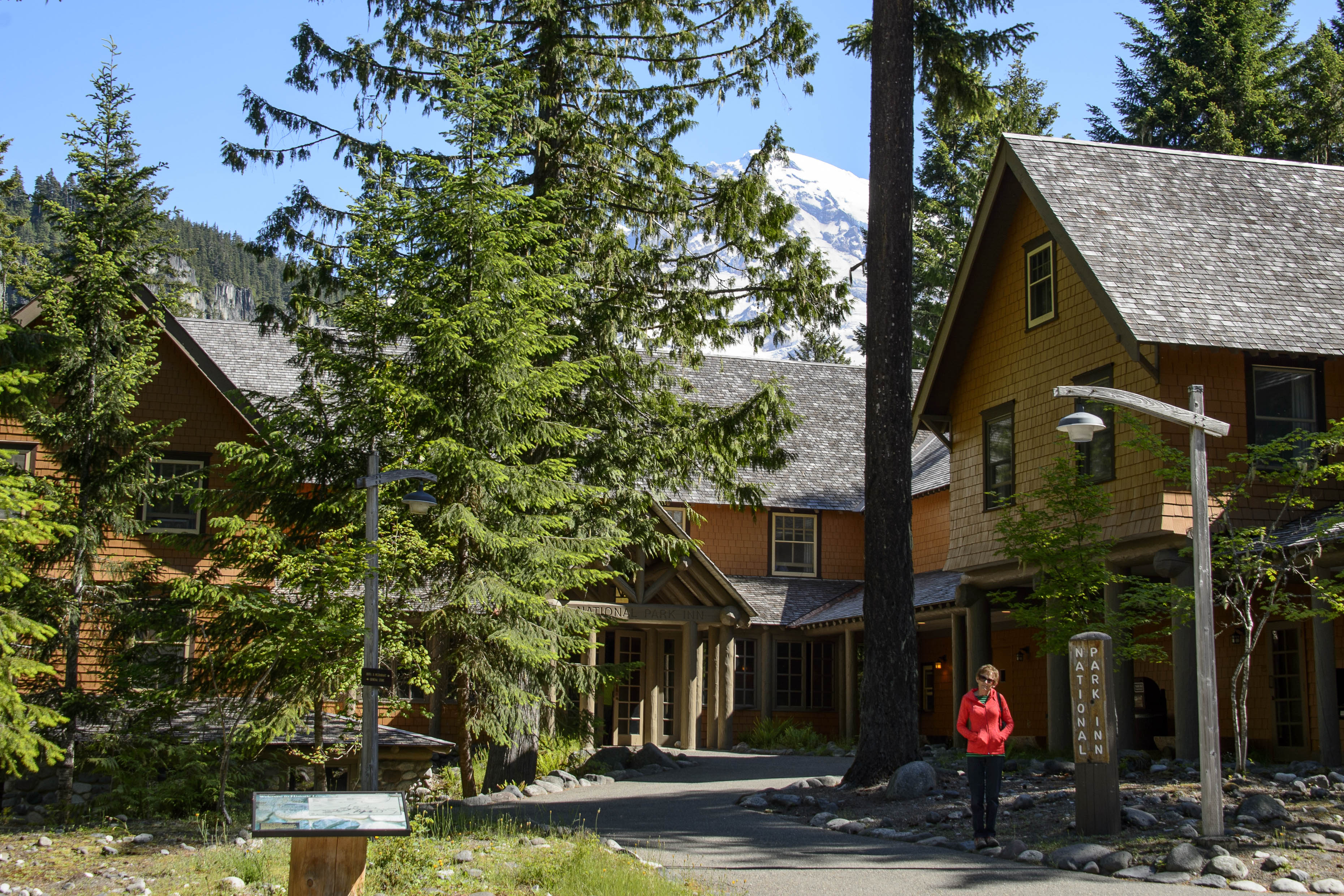
The National Park Inn in the Longmire area of the Park.
Another building of importance in this area is the Longmire Service Station completed in 1929. It was not always easy to get to Mount Rainier. Early visitors reached the park by horse or carriage. Improved roads and the arrival of the automobile in 1907 simplified access to the mountain experience. Mount Rainier was selected as the first national park to experiment with automobile access and this building was essential to those early motorists.
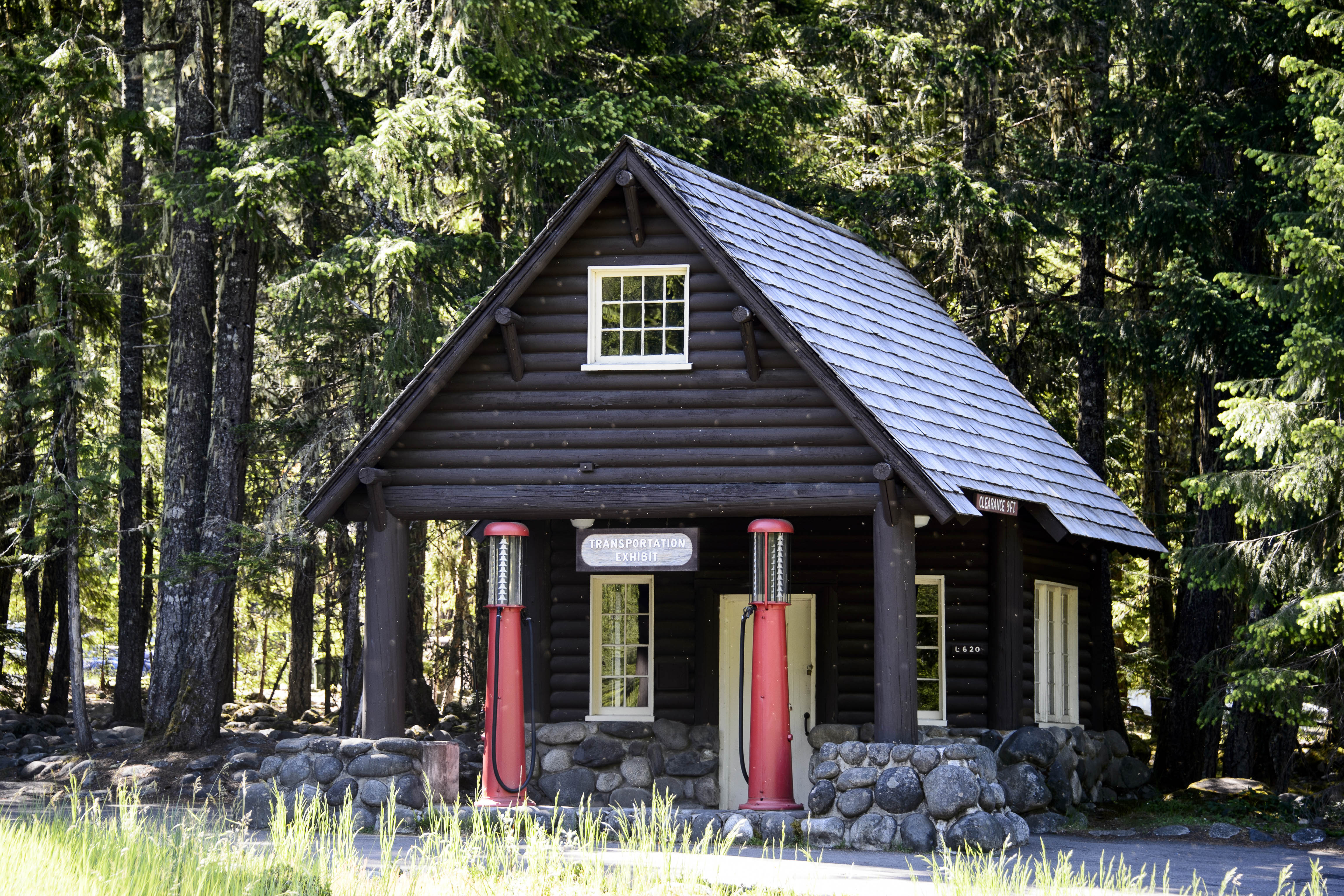
Early 1900’s gas station.
After all the history lessons, it was time to see a few remaining sights, including more Tatoosh Mountains created by those ancient lava flows.
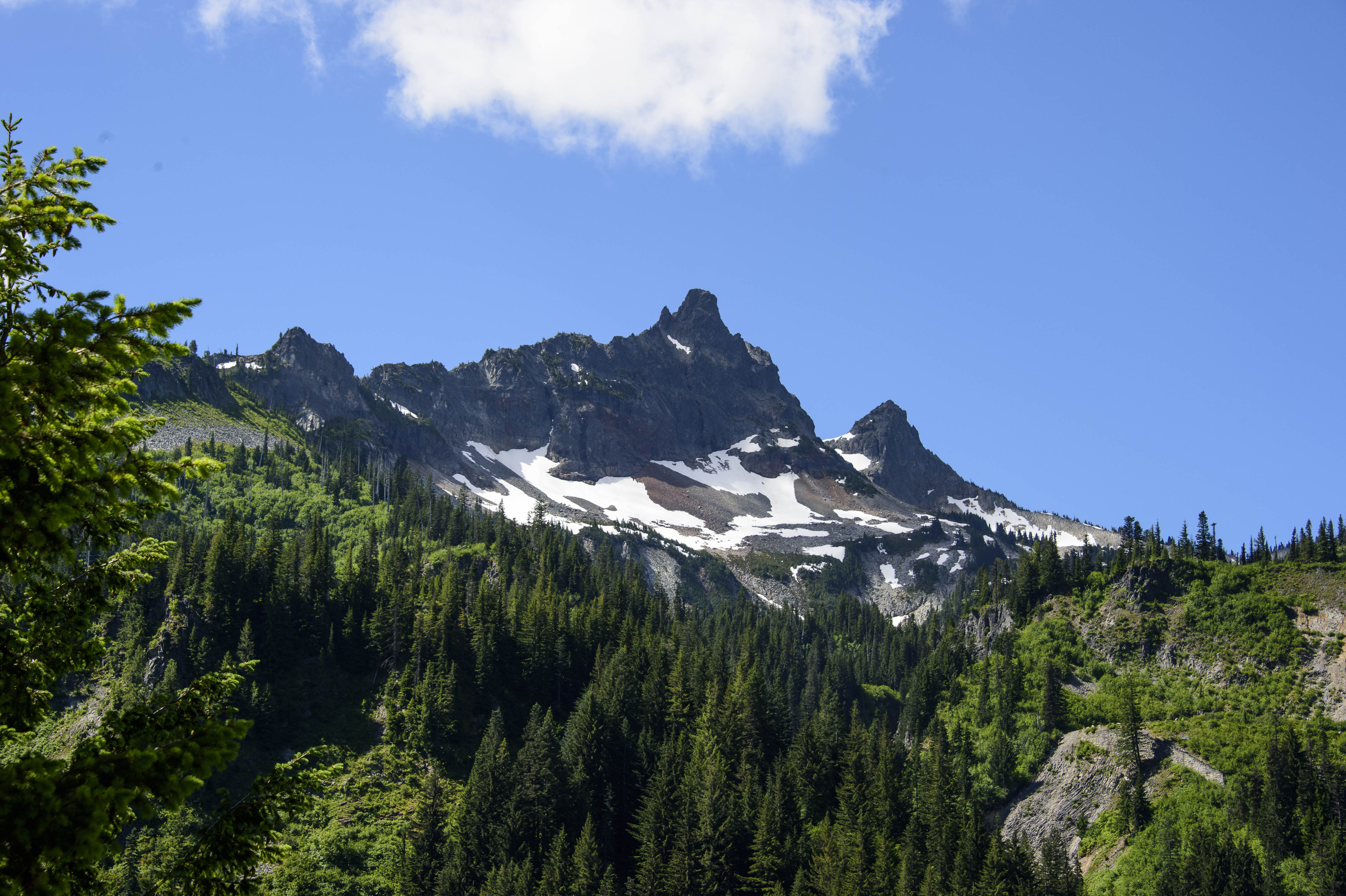
Sawtooth peaks abound in the Park.
Two more waterfalls called to us, also. First – Narada Falls, which plunges 168 feet in a beautiful display with a rainbow at the bottom – if you are lucky. The bridges over these two falls are reminiscent of those we saw at Acadia NP on the Carriage Roads.
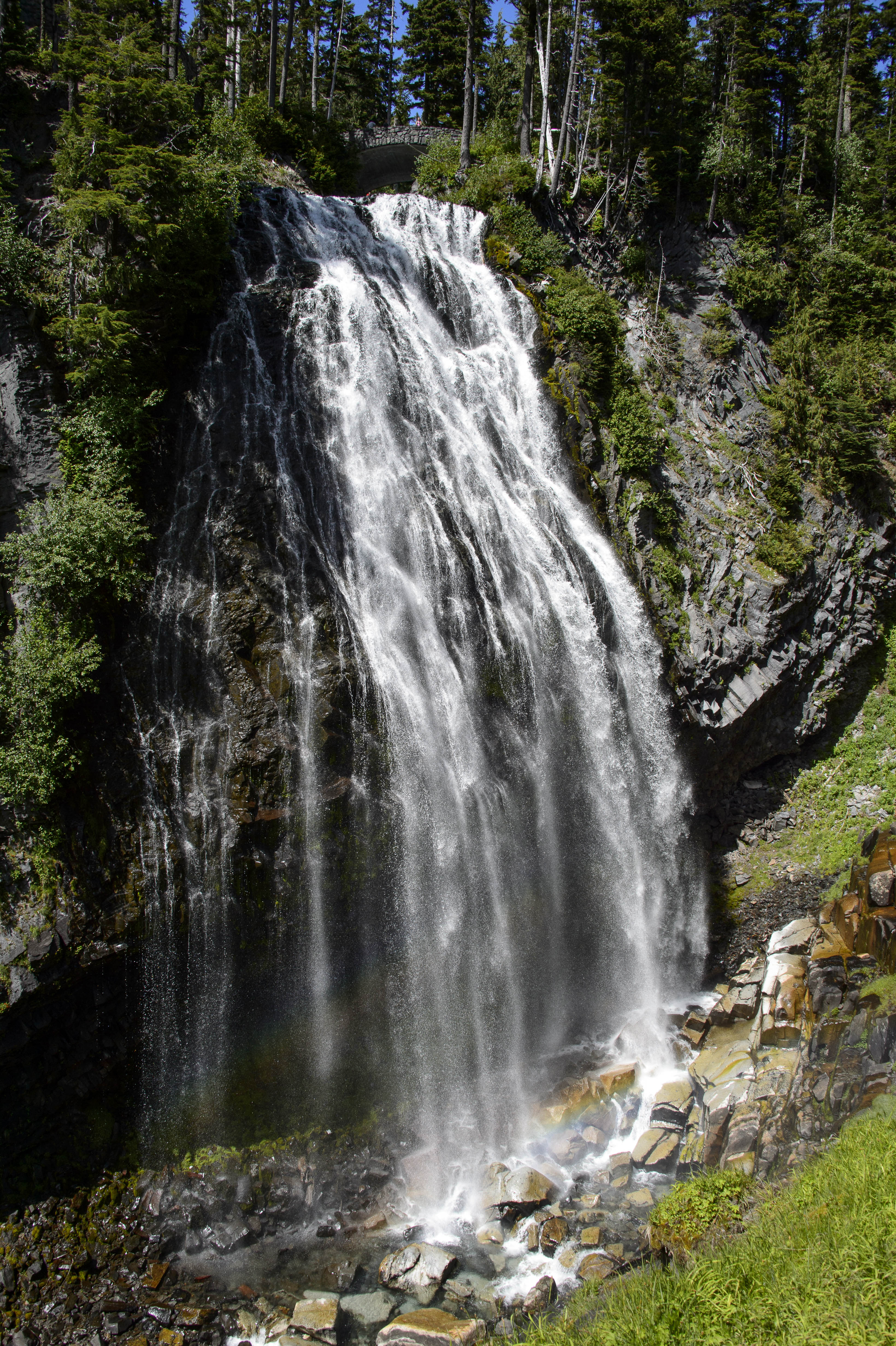
Narada Falls on the Paradise River
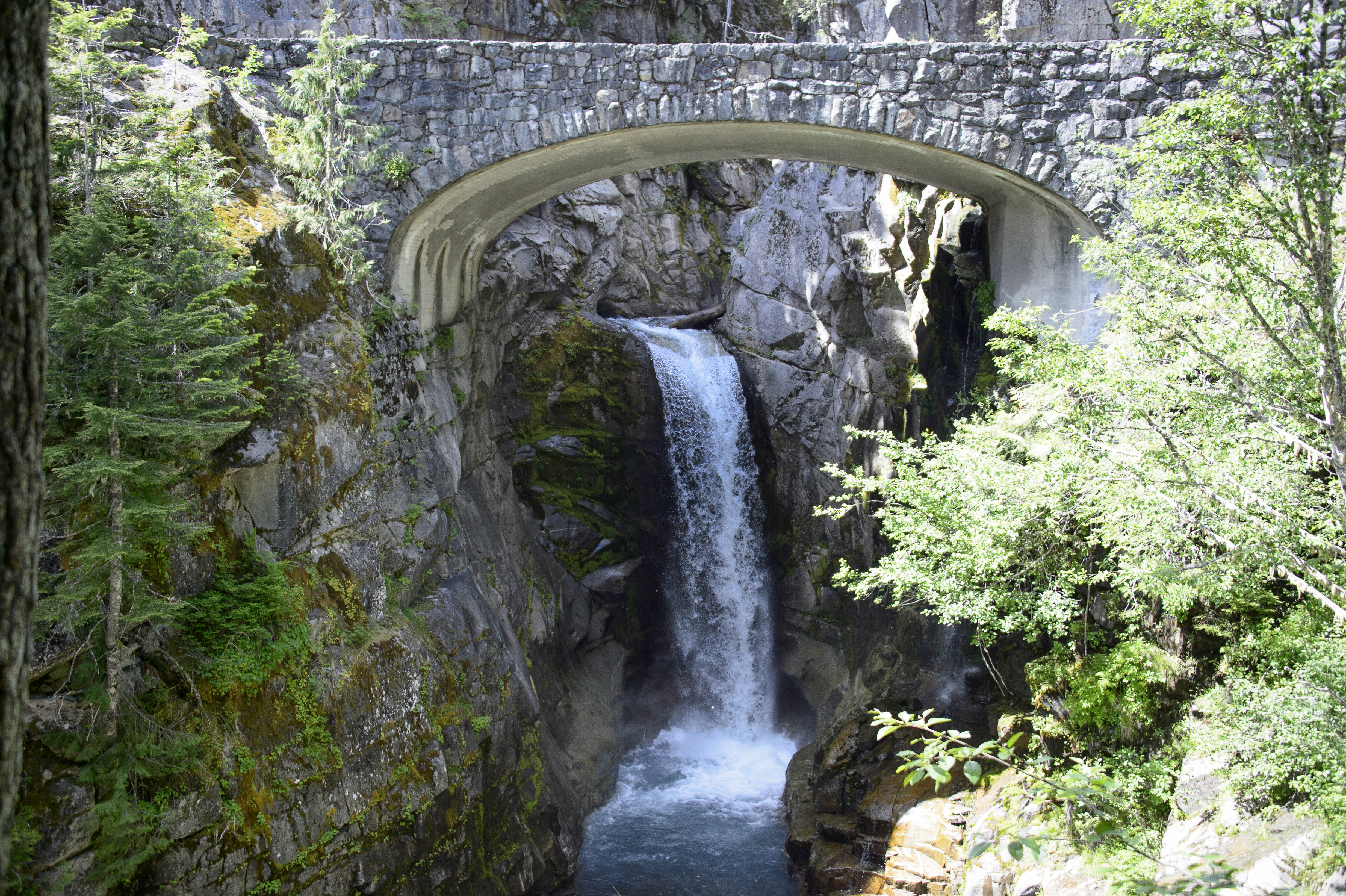
Next is Christine Falls with another great bridge that becomes the picture to see. The fifty-six foot span is one of the finest examples of a necessarily functional design that blends with the natural setting.
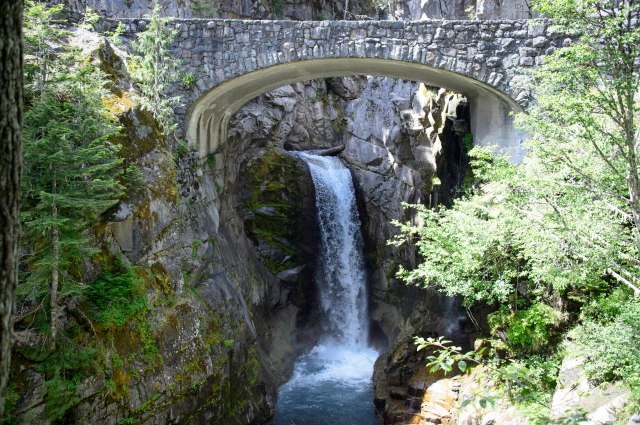
Christine Falls.
One last look at The Great Mountain and the Nisqually Glacier facing us (about 4 miles long and flows downhill 6 to 12 inches every summer’s day – –
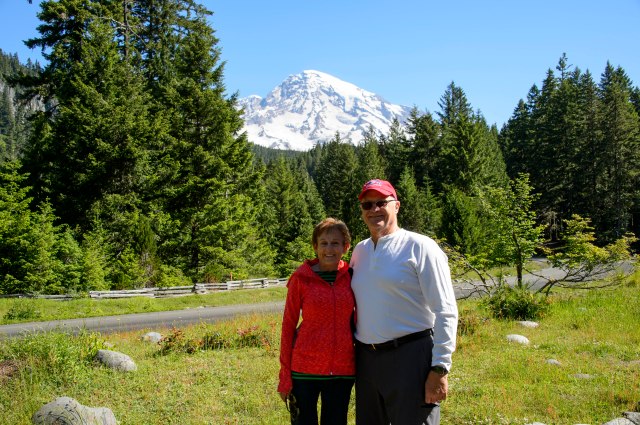
One More Look – Still Stupendous.
The breezes on the Reflection Lakes just would not cooperate with us this trip. There was just enough breeze to create the ripple that prevented us from getting that great reflection shot. But, the view was great – –
A little breezy at Reflection Lake..
And so we said good-bye to Mount Rainier;-( But, we will be back another time as there are many more hikes we did not get to AND we have to get that perfect reflection picture;-)
E & G on our way to Olympic NP – –
 Elizabeth & Gary's Magic Bus Tour