St. Andrews – often the first thought is “The Home of Golf”. Indeed, it IS thanks to St. Andrews that the game as we know it exists today. AND, it’s here that one finds the jewel in the crown and spirit home of the game – the Old Course. Famed worldwide, the Old Course is confirmed in the Guinness Book of World Records as the oldest golf course in the world.
King David I of Scotland granted the Links land to the people of St. Andrews in 1123. From that time to this, the people of St. Andrews have had the right to use the Links. When golf began to be played on the Links is not known for certain, but it was well enough established by 1457 that it was banned by King James II, who worried it was distracting his men from archery practice at the time of invasions from England! Although both James the III and IV continued the ban, James IV eventually gave in and had golf clubs made for himself in 1502 (wouldn’t you like to see those babies??).
The Old and New (1895!) courses that we see and play today were created by ‘Old’ Tom Morris who is celebrated for his pioneering work in course architecture. He was also a fantastic golfer – setting the Open record as the oldest champion, 46, in 1867 at Prestwick.
St. Andrews first hosted The Open in 1873, and the championship returned to the Old Course for the 29th time in 2015 as it now returns every five years. For many years St. Andrews players dominated the championship, as their local knowledge gave them an edge. But this changed following the victory of Bobby Jones in 1927.
Today film stars, sports celebrities, presidents and prime ministers come to St. Andrews eager to take their place on the first tee. Playing the Old Course is a privilege, but in the true Scottish tradition of the game this privilege is not the preserve of a few. St. Andrews Links remains public land allowing thousands of ordinary golfers (E & G) the opportunity to fulfill a lifelong ambition and to follow in the footsteps of golfing heroes.
As public land – the Old Course is closed to play on Sunday so that the residents (and visitors) can walk the course. This gave us the perfect opportunity to leisurely get wonderful pictures of the first and 18th fairways with the British Golf Museum, the Royal & Ancient Clubhouse and the Monument to the Martyrs of the Reformation in the background.
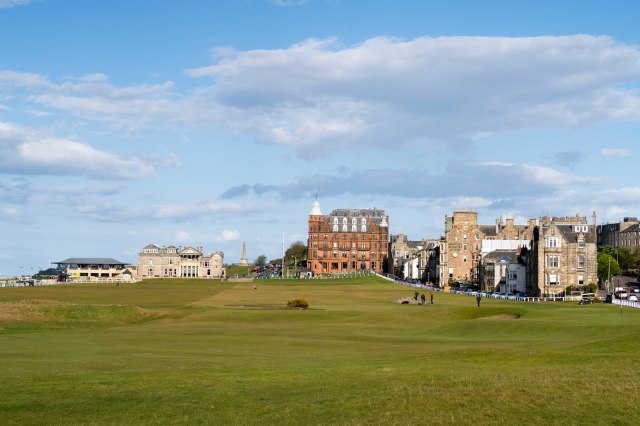
The view from the championship tees on 18th hole with the R&A Clubhouse on the left and the Swilcan Bridge on the right.
Amongst this wonderful history are the humps and bumps of the Himalayas 18 hole putting course adjacent to the second tee of the Old Course. This is for children and adults alike – –
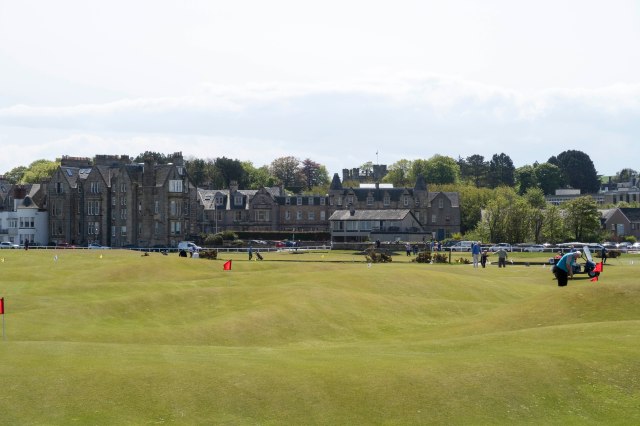
The Himalayas is a challenge.
Next stop – the British Golf Museum to learn all about the evolution of golf and the opportunity to putt with period clubs and old ‘feather’ balls. Lots of education – and lots of laughs if you read some of the quotes – –
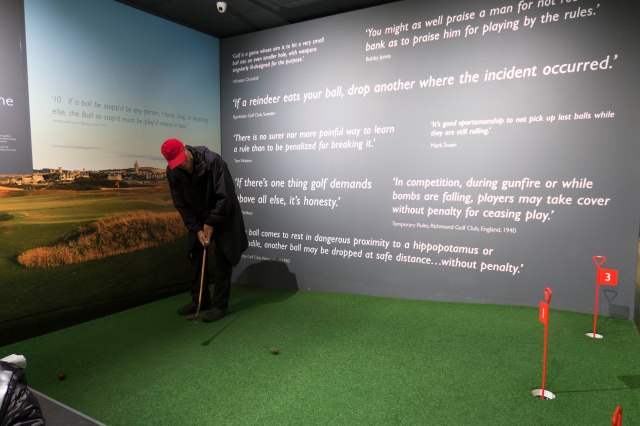
It was hard to putt we were laughing so hard;-)
St. Andrews is rich in history beyond golf – and we were off to find some of it.
St. Andrews Cathedral was (and still is even in its ruinous state) Scotland’s largest and most magnificent medieval church. When consecrated in 1318 it was the largest building in the country and dominated not just St. Andrews but the whole of Scottish religious life.
Then – the Protestant Reformation and dissatisfaction with the established church led to unrest. In 1559 John Knox gave such a fiery sermon in nearby Holy Trinity Church that the congregation was roused to rip down the rich trappings of the cathedral. By 1600 the cathedral looked much as it does today. Materials from the cathedral were utilized in other buildings around the village until finally protected.
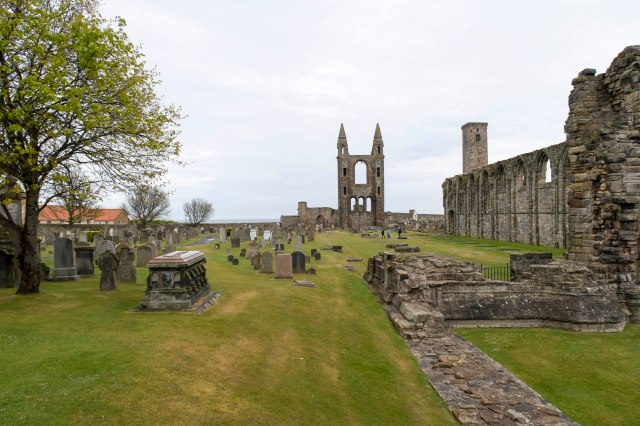
St. Andrews Cathedral.
The cathedral was built over a period of years from the front to the rear. One can see that at one point in time the architecture changed and even new window shapes were utilized – from a more pointed top with inset supports to a more rounded arched type frame.
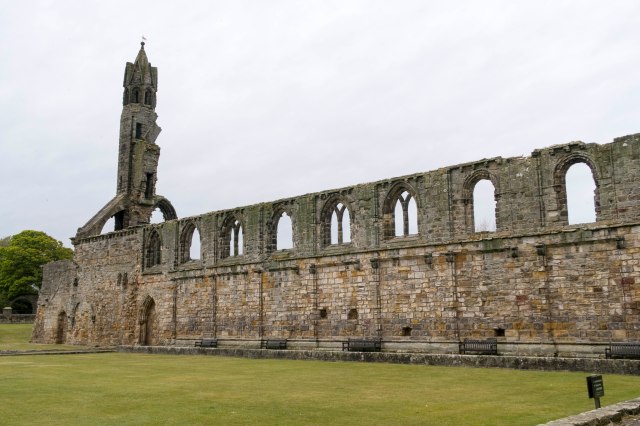
Completed in 1272.
Of course we had to climb St. Rule’s Tower, built around 1130 – all 108 ft – for great views of the town of St. Andrews, the coastline, our next stop the Castle and the golf courses in the distance.
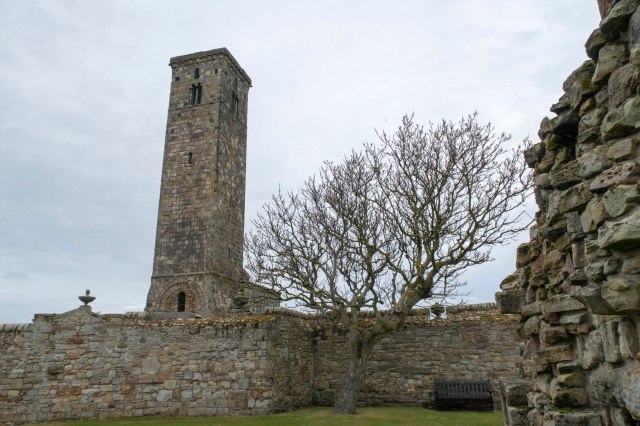
We climbed the very narrow circular stairway of this tower..
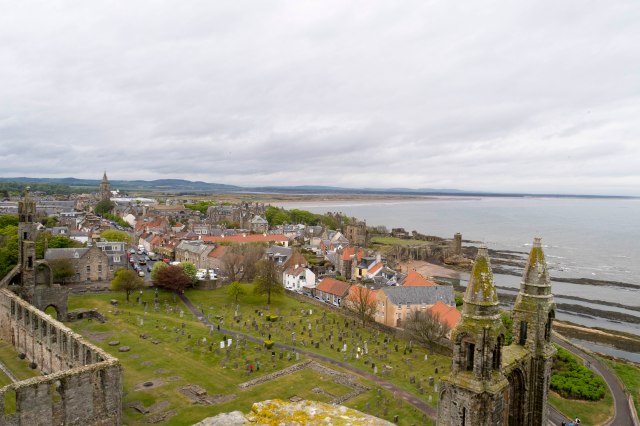
…to take advantage of the views.
The cemetery on the grounds of the cathedral contain the graves of Old Tom Morris – the creator of the Old and New courses – his son Tommy Morris (who died at the age of 24 after winning the Open 3 times) and the rest of the family.
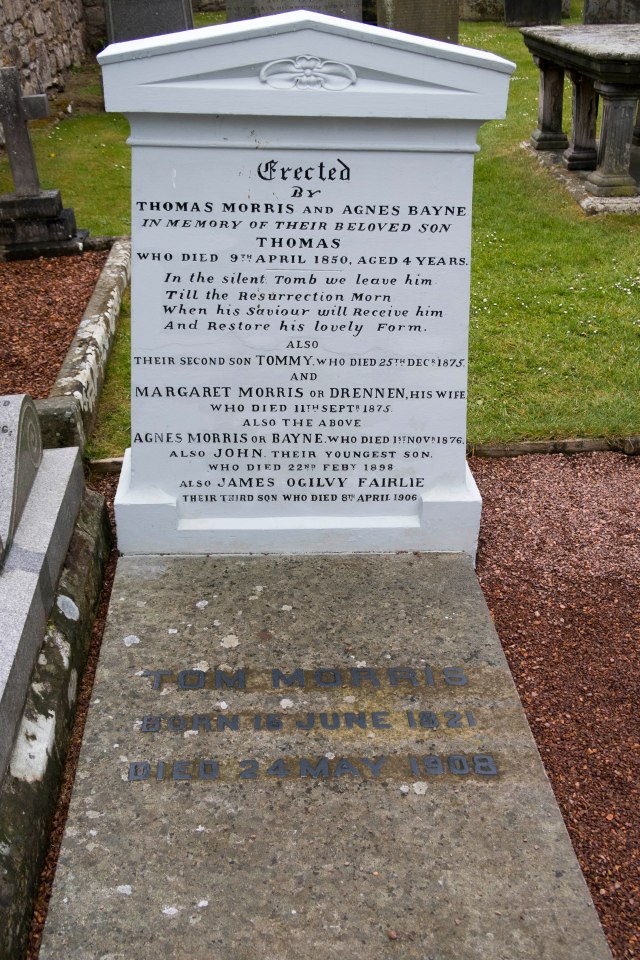
Most of Old Tom Morris’s family is buried in this spot.
Just down the road from the cathedral is St. Andrews castle, which played the roles of bishop’s palace, fortress and state prison during its 450 year life. It’s bottle dungeon was one of medieval Britain’s most infamous castle prisons and really – NOT a nice place to be;-( But, the location was advantageous and the views now are beautiful.
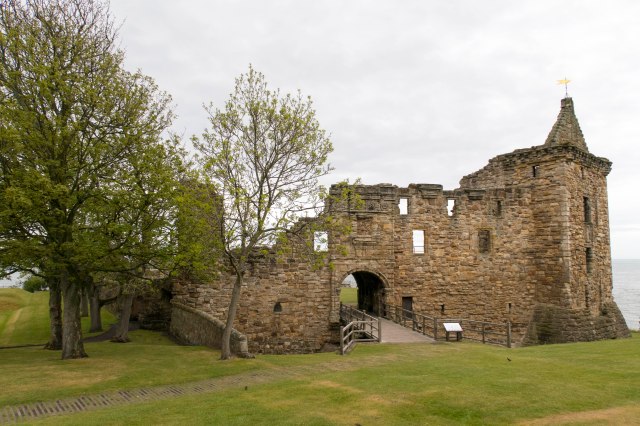
The Bishops Castle.
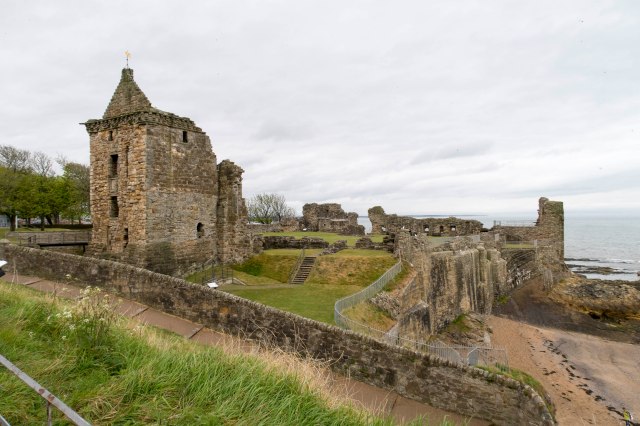
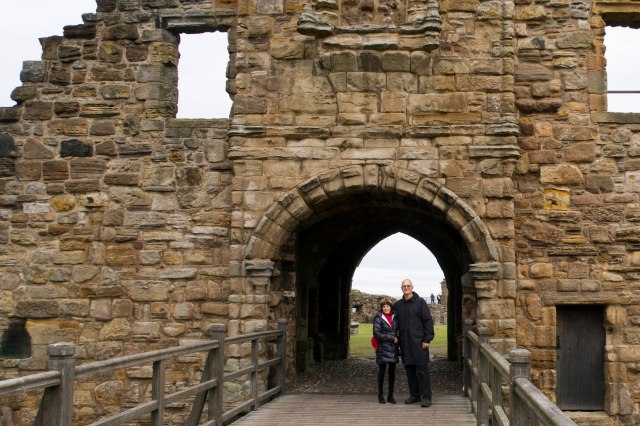
St. Andrews is also home to Scotland’s oldest university which envelopes the entire town. It is most notable in recent history as where Prince William and Catherine met – now the Duke and Duchess of Cambridge;-) Today there seems to be a bit of an initiation going on below the castle walls – –
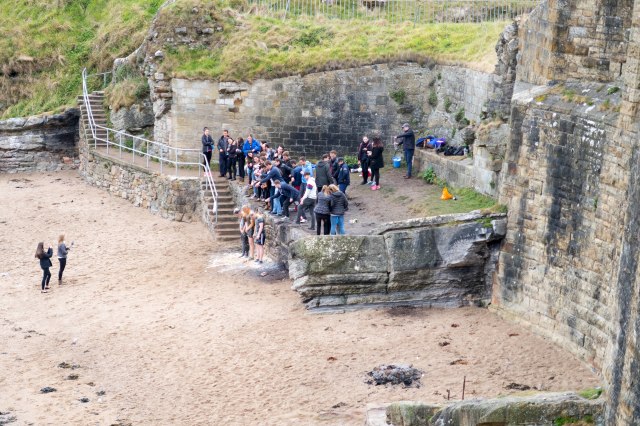
These lads stood there for a very long time while numerous things were poured over them.
A full days worth of wandering in the village. Now we must get our rest as golf is calling again tomorrow.
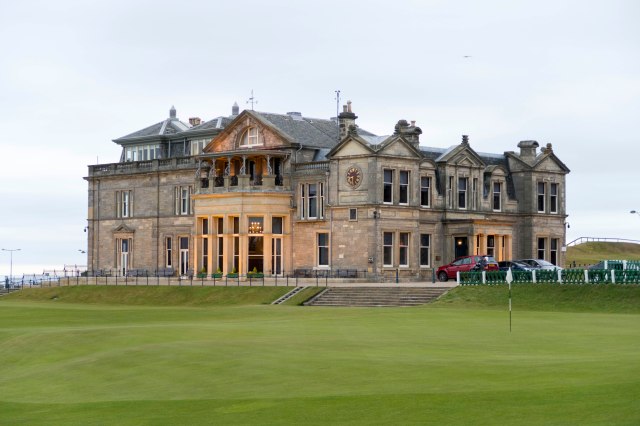
We finished up the day with a final pass of the R&A clubhouse.
The sun is setting – the lights are on at the R&A – and we look forward to another day.
E & G ready for St. Andrews;-)
 Elizabeth & Gary's Magic Bus Tour