Six days of golf in nine days – intermixed with pretty taxing travel days – had worn us down a bit. So – it was great to be energized by meeting up with ‘old friends’, Judy and Tim, for a couple of days touring in and around Dublin.
Judy did a great job of finding us an apartment between the River Liffey and the Grand Canal within walking distance to all the sights, shopping and dining that we could possibly want. She also fixed us up with Garvan, who shepherded us around the city for a morning filling our heads with all kinds of facts on Irish and English history.
First stop – Dublin Castle, which is the historic core of Dublin City in the Viking/Medieval area. Viking Defenses were established here as far back as the 10th century and it was the seat of British rule for over 750 years. It was also the location of the handover to the new Irish State – The Republic of Ireland – in 1922.
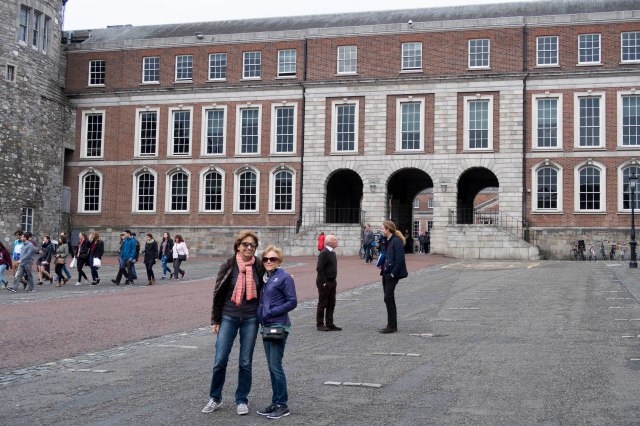
Judy, Tim, E and Garvan on our walking tour of Dublin at Dublin Castle
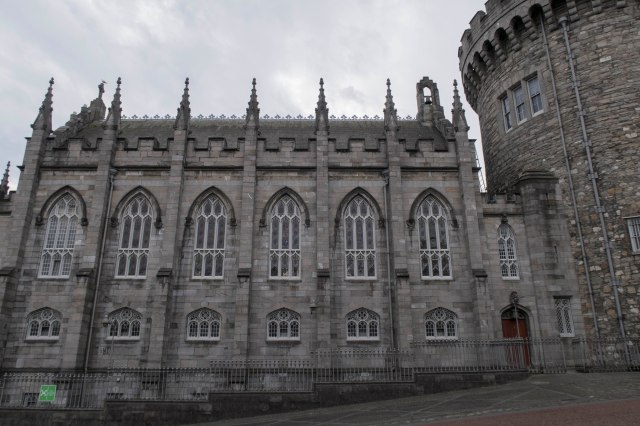
The change in stonework evidences years of additions on the tower structure.
Just around the corner is the City Hall, constructed in 1779, with beautiful ornate decoration and the obligatory statues of prominent citizens from the years.

Entry lobby in City Hall.
Still in the medieval area, our next stop was Christ Church Cathedral, Dublin’s oldest building. It is renowned for its breath-taking beauty, magnificent architectural features and stunning floor tiles and was a place of pilgrimage for almost 1,000 years. It is a protestant church – not catholic – as you might think.
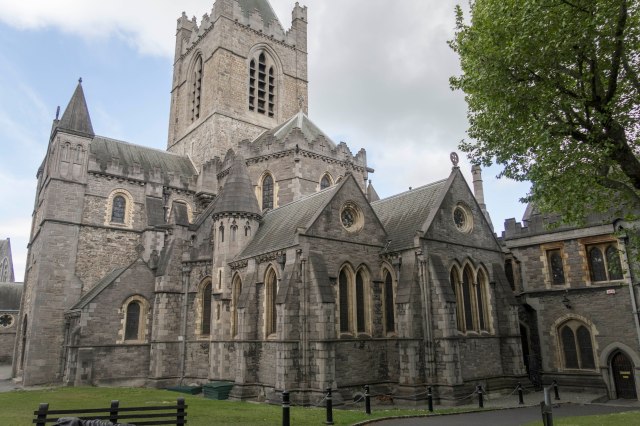
At the historical Christ’s Church the Cathedral…

… is almost dwarfed by the Bishops residence.
The Bishops residence was adjacent to the Cathedral, but across the street – Hells Hole with nefarious activities. So – a bridge was built so the Bishop could get to the church without having to subject himself to the ‘street activities’!
There are 5 items in Dublin covered by “1,000 Places to See Before You Die”. We covered 3 of them. (The 2 not seen/done included a celebration in June and a restaurant that would have broken the bank!) Trinity College, Dublin is one of those 5 and was next up on our agenda.
Trinity College, founded in 1592, is Ireland’s oldest university and boasts an impressive roster of alumni including Jonathan Swift, Oscar Wilds and Samuel Beckett. On this day the campus was bustling with students getting ready for exams and the end of the school year.
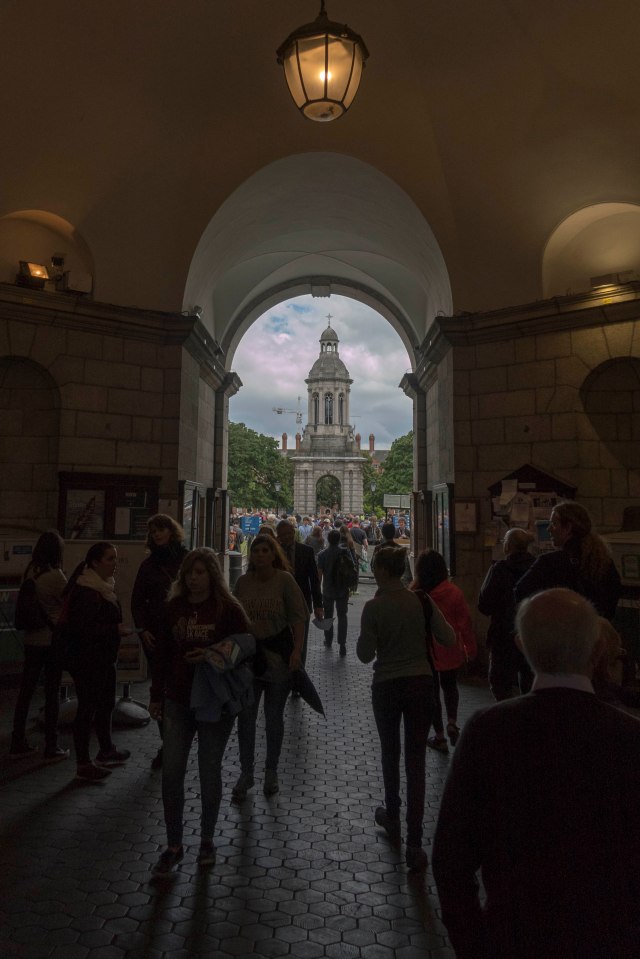
Entering Trinity College quad.

From another point of view.
Perhaps the most important role of the school today is as custodian for The Book of Kells, an early medieval manuscript – the most important and most beautiful work of art to survive from the early centuries of Celtic Christianity. Each page is magnificently decorated with elaborate patterns and mythical animals unlike any other in the intricacy and complexity that covers every one of its 680 pages. Such illumination by the scribes and monks of the monastery of Kells was called “a work not of men, but of angels”. The Book of Kells is housed in the ground floor of the college’s Old Library built in 1712. We did get to see both The Book of Kells and the Library. Unfortunately no pictures were allowed in The Book of Kells exhibit so, the view of this outstanding library will have to do.

This section of the college library is dedicated to the preservation of books and manuscripts.
The Library also houses this Brian Boru Harp – the oldest surviving Irish Harp and the model for the insignia of Ireland. It is made from willow and oak with 29 brass strings. Its elaborate designs, silver neck mount and embedded crystal suggest that it belonged to a master musician such as would have played for the nobel households of Gaelic Ireland and Scotland.
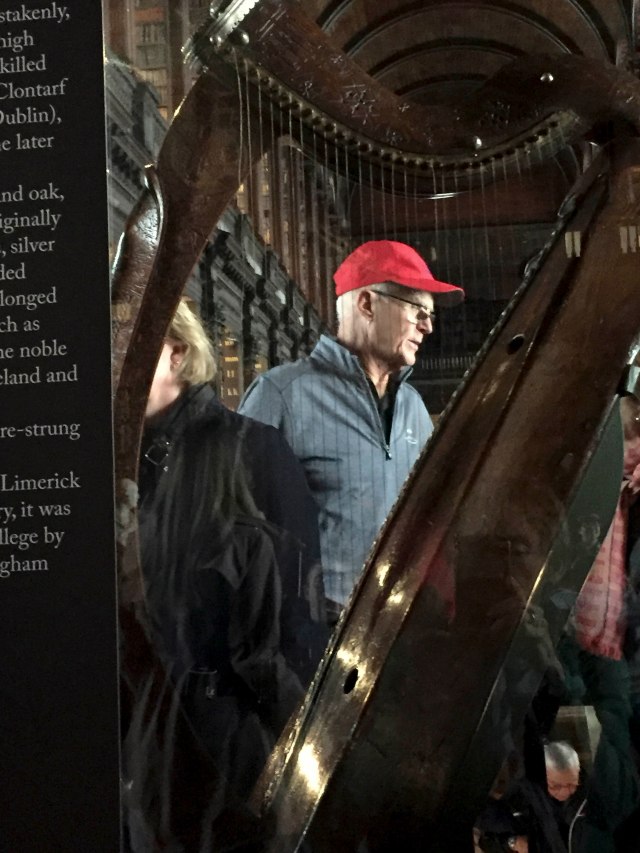
Are we in the Musical Instrument Museum?
With so much information packed into our little heads it was time to just wander and enjoy the sunshine. Ha’penny Bridge – Dublin’s oldest pedestrian crossing over the River Liffey – was on our way to finding afternoon tea. The bridge was erected in 1816 and acquired its nickname from the halfpenny toll levied on all users up to 1919.
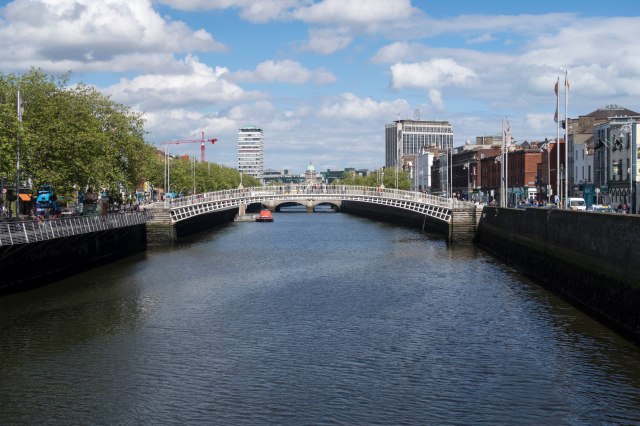
A view of the Ha’Penny Bridge over the River Liffey.
We also wandered through St. Stephen’s Green (Europe’s largest garden square), which was created in 1663. It is a lovely park in the middle of all the hustle and bustle with this attractive little gazebo calling our name.

A quick turn in the Gazebo in St. Stephen’s Green.
Just across the street from St. Stephen’s Green is Dublin’s favorite old dowager hotel – The Shelbourne. (Number 2 of The 1,000 Things to See Before You Die.) Built in 1824 it is the last survivor of Dublin’s great 19th century hotels. Steeped in tradition, the Shelbourne holds on to much of its historic grandeur as the Irish Constitution was drafted here in 1922. Nothing historic on our part – just a drink at the bar;-)
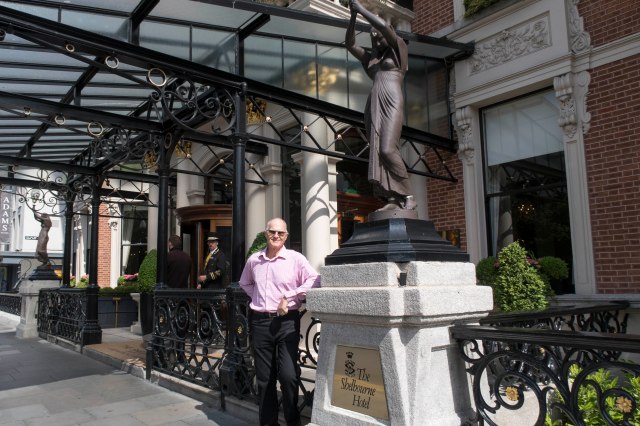
We enjoyed a drink in the Shelbourne Hotel Bar.
Another place we had a drink – the first night in town – was the Doheny & Nesbitt Pub, which just happens to be right around the corner from our apartment and Number 3 on the 1,000 Things to See Before You Die list! The Pub is a mere 130 years old and a handsome Victorian specimen of carved wood and etched glass. By the time we got there the first night it was standing room only as it was every time we passed by (sorry no pics).
After spending a day in ‘the city’, we took off for more quiet surroundings and headed to the Powerscourt Estate and Gardens via the old military road. Very different scenery than what we had seen in our travels in the days before. Brown peat bogs instead of the emerald greens. But, the sheep still liked it – –

These sheep made us think of our friends Priscilla and Steve and their Soay sheep.
Once we arrived at the Estate – all was green and lush again. Set in the wild Wicklow countryside, overlooking the Sugarloaf Mountain, Powerscourt Gardens stretch over 47 acres with magnificent views. The Gardens have 3 themed gardens, a lake, a pond, a tower and a pet cemetery. They are ranked No. 3 in the world’s top ten gardens according to National Geographic. The pictures tell the story – –
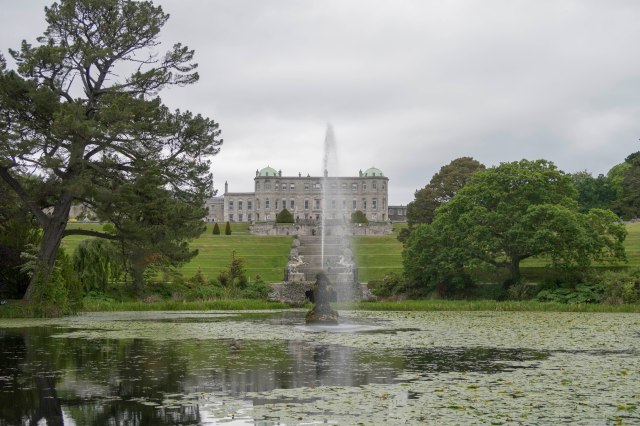
Triton Lake looking back at Powerscourt House.

One of Ireland’s largest pet cemeteries.

A view of Sugarloaf Mountain from the rear of the estate.

The Pepperpot Tower modeled on a favorite pepperpot from Lord Powerscourt’s table!
The grounds also included an Italian Garden, a Walled Garden and a Japanese Garden. The Italian and Walled Gardens were designed in the mid-1800’s with contributions from the collections of the 6th and 7th Lord Powerscourt’s. The Japanese Garden was created by the 8th Viscount and Viscountess Powerscourt in 1908 and provides a glimpse into a different world. We had fun there – –

We had a great time in Dublin with our friends Tim and Judy.
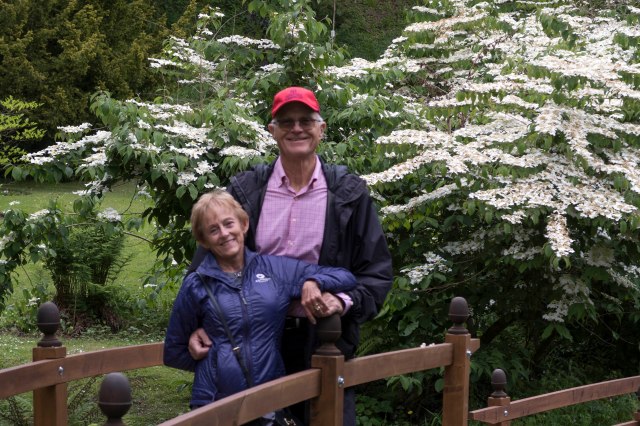
Slán (goodbye) Ireland.
And so ends our “Bucket List” trip with –
- Six days of golf at ‘famed’ courses including the Home of Golf – St. Andrews Old Course, St Andrews Jubilee, Carnoustie, Kingsbarns, Royal County Down and Partmarnock
- Five wonderful days in St. Andrews
- Three great days with friends Judy & Tim in Dublin
- Safe, on-time flights that got us to all destinations on time and in one piece – WITH OUR LUGGAGE
- AND – Unbelievable weather!!
We feel so fortunate to be able to have such an adventure and wish a fantastic “Bucket List” trip to all of you;-)
With Lots of Love – E & G
 Elizabeth & Gary's Magic Bus Tour