For many, crossing the Panama Canal is a ‘bucket list’ item – and we were no exception. So the anticipation, excitement and preparation for us was intense.
Our education and preparation began with listening to the audio version of the book by David McCullough – The Path Between the Seas. As always, McCullough does such a complete and thorough analysis of the background and detailed recounting of events that after listening to about 6 hours of the 30 hour unabridged version it was traded in for the 8 hour abridged version! The hours of listening were well worth it – as the beautiful and serene environment of the canal could not possibly provide any indication of all the pain, suffering, infections from diseases and loss of lives that occurred during its creation.
The Panama Canal is the result of a saga of human ingenuity and courage that goes back to the early 16th century when the Spaniards arrived on the Isthmus. If only a waterway could be created across this narrow expanse of land – it would save thousands of miles and many days by not having to go around the southern tip of South America.
The first serious effort to build an all-water route through the Isthmus began with the French in 1880. Panama was not the first or ‘given’ path from ocean to ocean. Once the route was chosen, the French spent approximately $150 million dollars and at least 20,000 lives over a period of approximately 20 years before the multiple bankruptcies of the effort and diseases made the initiative fail. If workers were not killed by the landslides through the Culebra Cut, they were killed by yellow fever or malaria.
As President of the United States, Theodore Roosevelt revived the effort of a canal in the early 1900’s – feeling it was important to the US to be able to shorten the Navy’s path from ocean to ocean. At that time, Panama was a part of Columbia – but wanted their independence. So – – a Navy ship just happened to show up in the harbor as those seeking independence began to ‘rebel’. All was over quickly – Panama was independent – and Roosevelt had an agreement with the independent Panama for the land to build a canal. The US also negotiated with France for any rights they might have to the land, as well as all the equipment they left behind, for $40 million.
Now nothing was in the way. EXCEPT – the same Culebra Cut that continued to ‘slide’ every time it rained (which was 3/4 of the year) and the Panama jungle full of mosquitos that carried yellow fever and malaria. Strange as it seems now – it was not known at this time that the mosquito was the carrier of these diseases. About the first year and a half of the US’s efforts were to determine/confirm this and eradicate the breeds of mosquito that were the carriers. The next several years were spent creating the infrastructure to house all the workers required to build the canal and a railroad to carry out all the ‘dirt’ that had to be dug out to create the canal. The idea of the locks to raise and lower ships also had to be accepted – instead of digging all the way to sea level all the way through the isthmus.
BECAUSE – building this canal involved digging through the mountains of the Continental Divide (The Culebra Cut), constructing the largest earthen dam ever built up to that time, building the most massive locks ever envisioned and constructing the largest lock gates ever swung. The simplest way to describe what happens is to think of a giant water elevator that lifts ships out of one ocean, moves them through the jungles of Panama, over the mountains of the Continental Divide and sets them down in the other ocean.
This effort was completed by the US from 1904 to 1914 at a cost of $350 million and another 20,000+ lives. August 15, 1914 the Panama Canal was opened with the passage of the SS Ancon in full transit from the Atlantic to the Pacific Ocean.
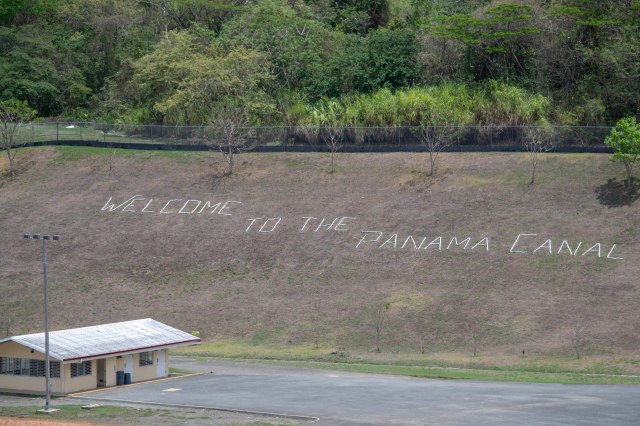
We lined up with other ships early in the morning ready for our 8-10 hour transit through the Panama Canal. On a ‘normal’ day 20-30 ships would go through the original canal and 8-10 through the expansion. However, February 29, 1968, 65 ships crossed – the most transits on a single day.
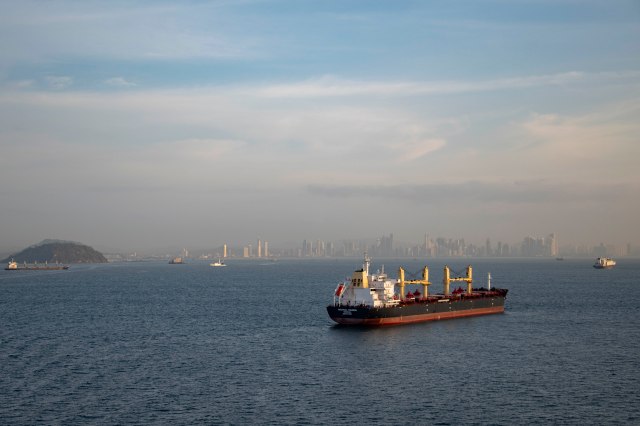
With Panama City on the horizon, the Marina gets in line for our transit through the Canal.
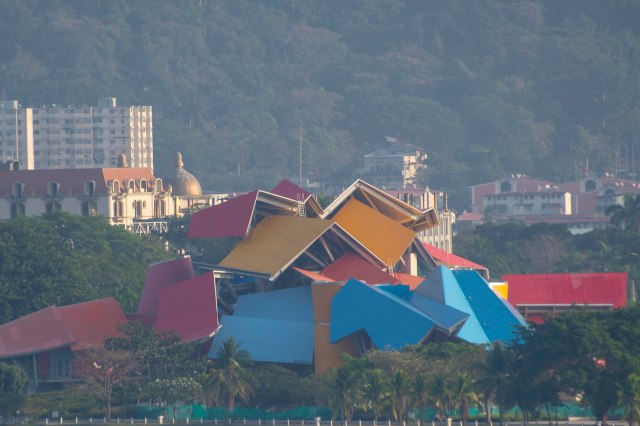
This Frank Gehry designed building sits alongside the Bay of Panama.
We are welcomed to the entry of the canal by the Bridge of the Americas, which was inaugurated October 12, 1962 and was the first bridge opened to the public over the Panama Canal – –
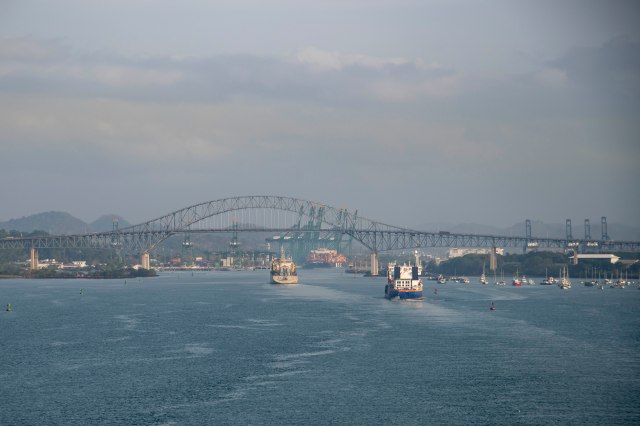
Approaching the Bridge of the Americas, the southern gateway to the canal.
Once under the Bridge, the locks of the Canal come into sight as do the locks of the Expansion (the ship on the far left of the picture is in the Expansion). In 2007 work started to add a third lane, almost parallel to the current Canal, for the transit of larger vessels. This required the deepening and widening of the Canal entrances on the Pacific and Atlantic sides as well as the deepening and widening of the Gatun Lake and the deepening of the Culebra Cut. This Expansion was inaugurated in 2016.
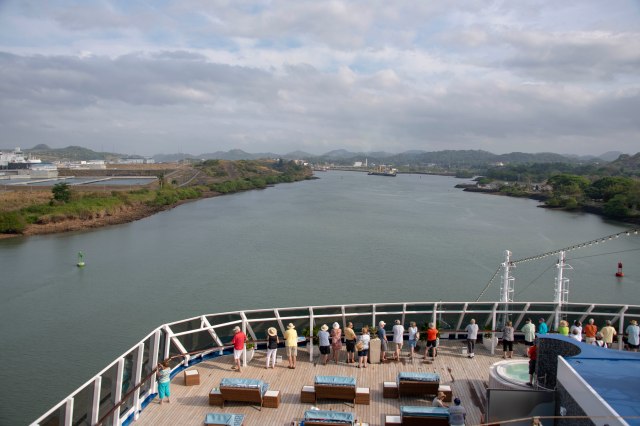
The channel continues to narrow as we approach the first set of locks.
The lock system finally agreed upon includes two sets of locks on the Pacific side – the Miraflores Locks and the Pedro Miguel Locks – and one set of locks on the Atlantic side – the Gatun Locks with the Culebra Cut and the Gatun Lake in-between. The two sets of Miraflores Locks will raise the Marina 54 feet above the Pacific level (27 feet in each lock). The picture below shows the tanker on our left about 13 feet above the Pacific level (its lock – the first of the two – is 1/2 full) and the Norwegian Star cruise ship in front of us is raised the full 54 feet!! (We were really fortunate to have these two ships along side and just in front to be able to see the operations fully with them as the examples!)
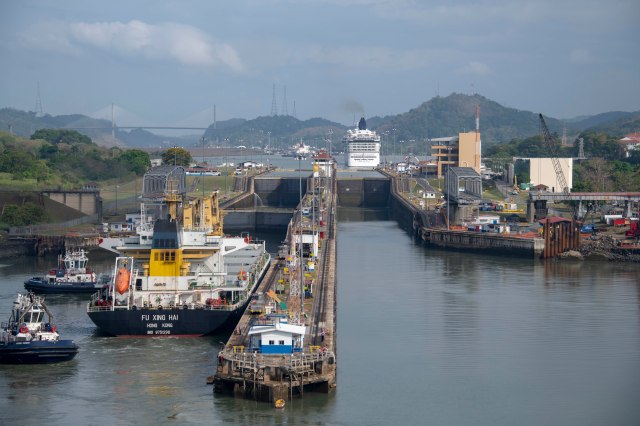
The first of the Mira Flores locks is directly ahead.
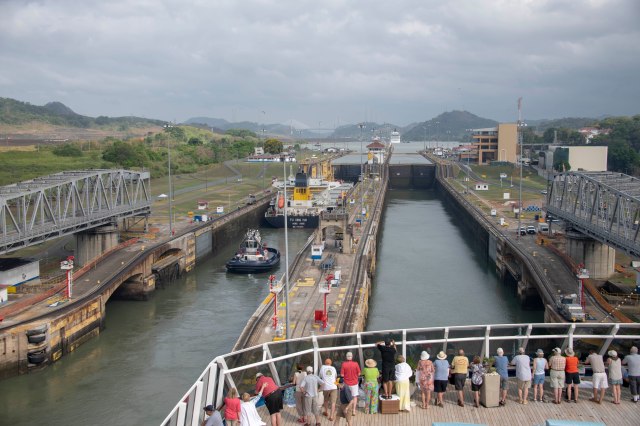
Hard to believe this big ship can fit into that little space – maybe?!?!
The tanker to our left has now been raised 27 feet and as soon as the gates are closed the water will rise in the next lock to take the tanker up another 27 feet and even with the water that can be seen at the next level.
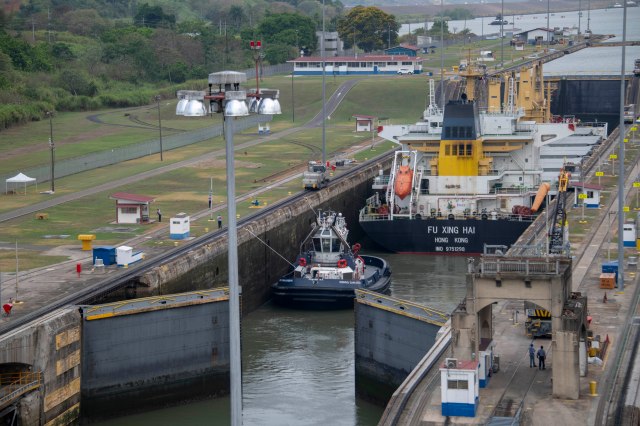
Gates are closing so that water can be pumped into the lock to equalize the water levels.
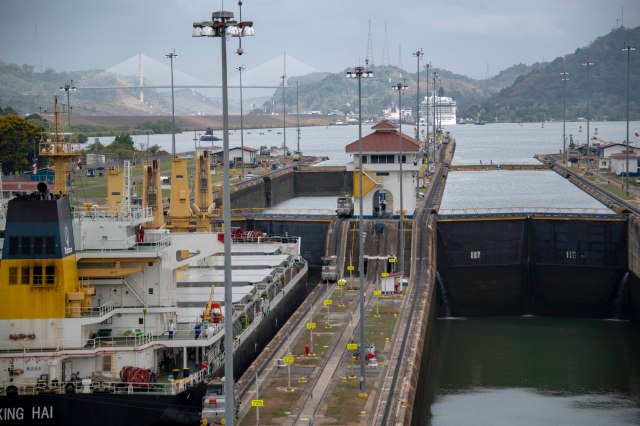
Water level almost there.
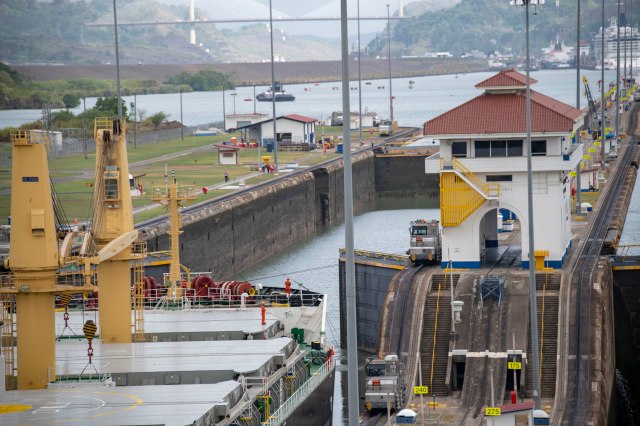
Okay, open the gates and pull into the next lock enclosure.
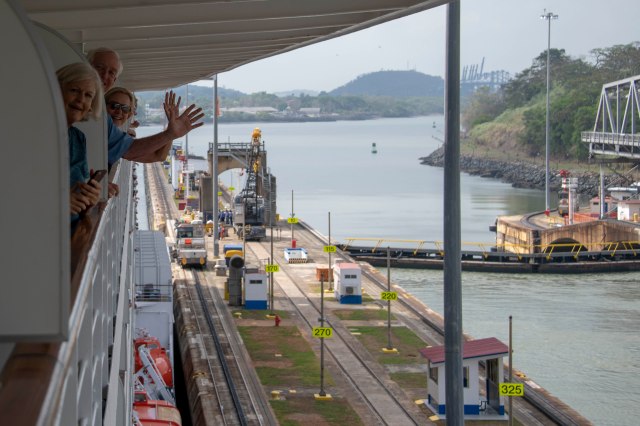
It is a very tight fit. About two feet on each side. Fingers crossed we get through.
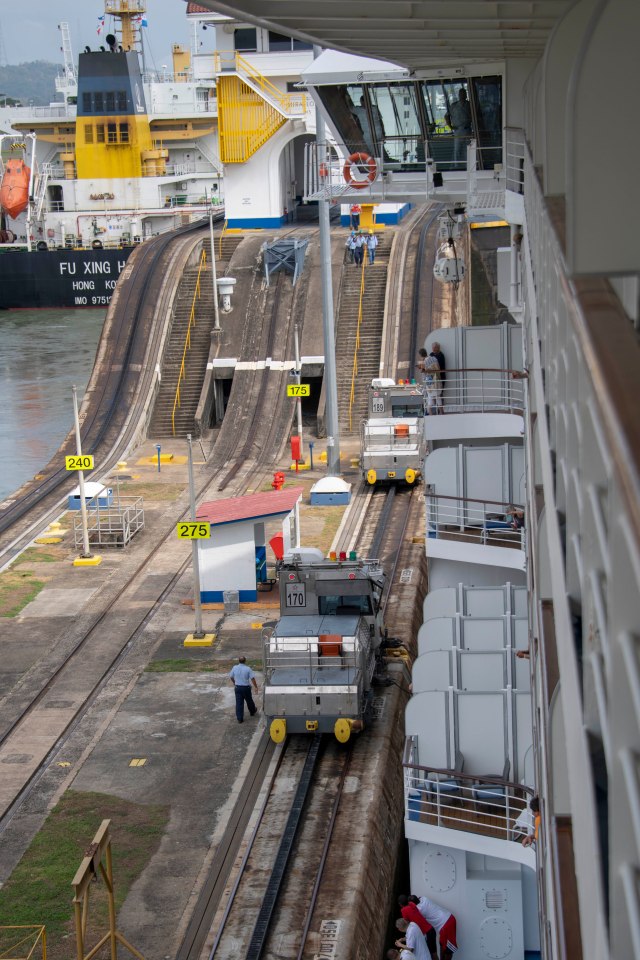
Three of these locomotives are attached to each side of the ship to stabilize side to side movement. The ship is propelled forward by its own engines.
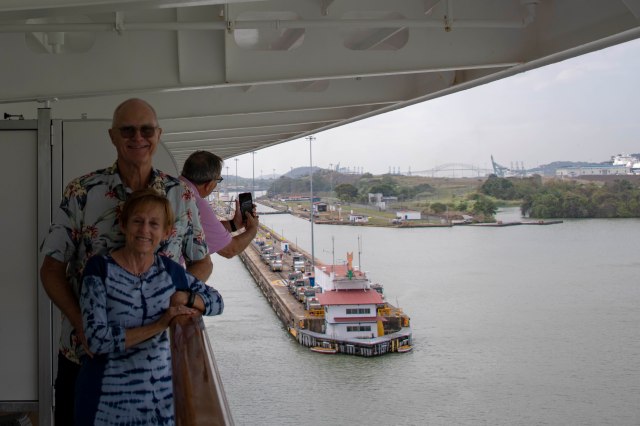
Pulling out of the Miraflores locks.
The Marina is now at the Pedro Miguel Locks, which is one lock that will raise the ship a total of 31 feet.
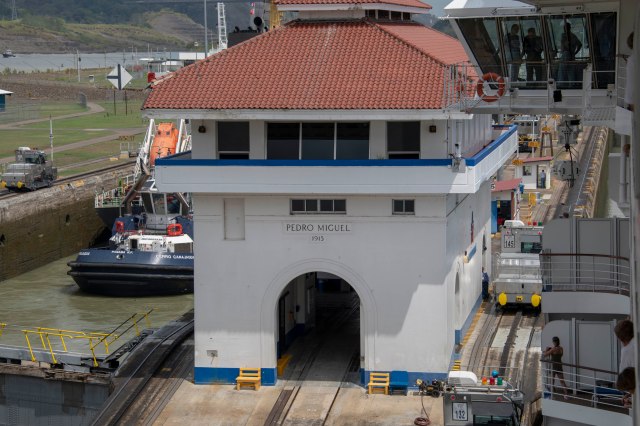
After a brief transit on Mira Flores Lake we enter the second set of locks.
The picture below also shows the Expansion and its water level behind the tanker, as well as the top of the ship that could be seen in the first picture where we were just coming up to the locks.
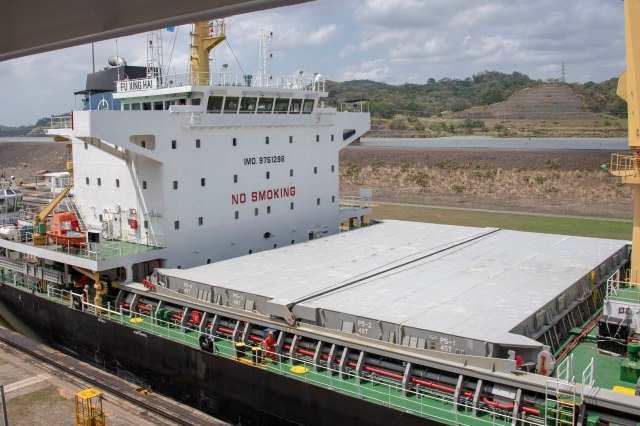
We hoped the crew on the LNG tanker were following the no smoking sign.
Once out of the Pedro Miguel Locks the Marina had been raised a total of 85 feet – the level at which it would transit the canal and go through the Culebra Cut. It looks so beautiful. Hard to believe it was the area responsible for so may deaths as the landslides here would bury the ditch as fast as it could be dug!
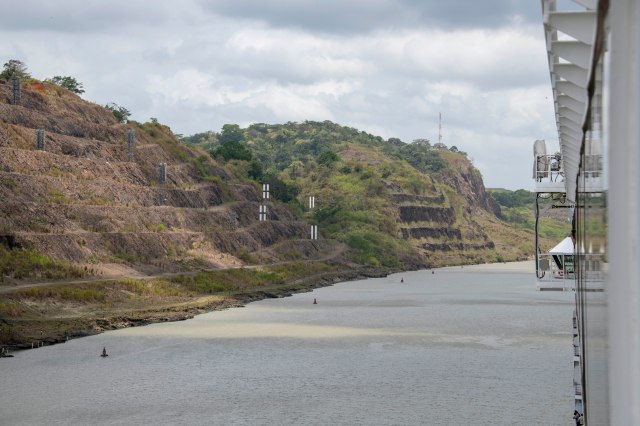
Entering the area of the canal commonly referred to as the Culebra Cut.
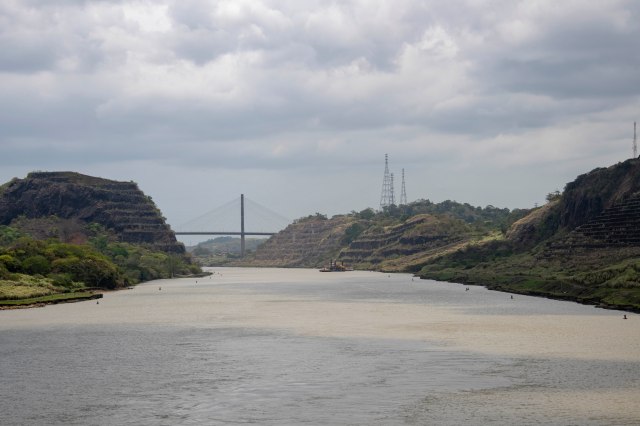
The Centennial Bridge – celebrating the anniversary of independence from Columbia
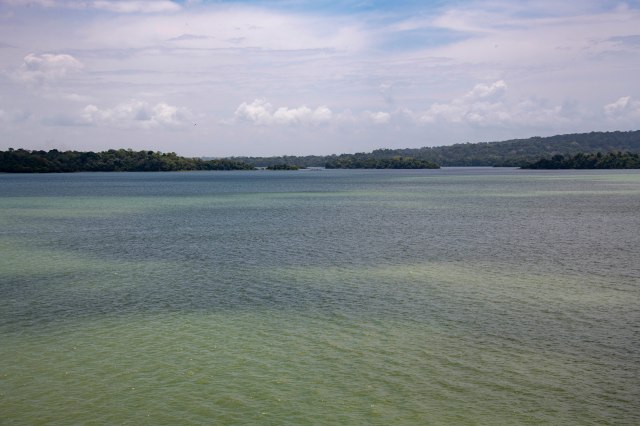
Out of the Culebra Cut – we entered Gatun Lake created by damming up the Chagres River.
After about 7-8 hours the Marina has arrived at the Gatun Locks on the Atlantic side of the Canal. These locks will take us back down the 85 feet the ship was raised. The Norwegian Star ahead of us now looks so small since it is much lower than before when it was so far above us!
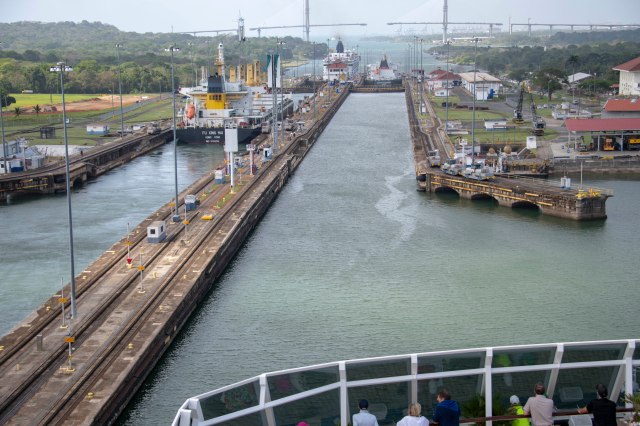
Our approach to the Gatun Locks on the northern end of the canal.
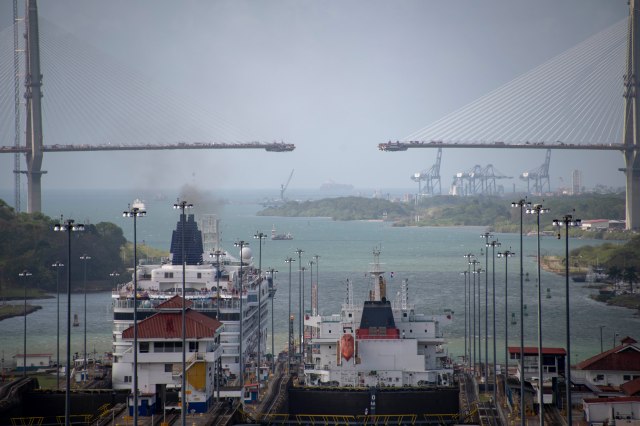
Same process, just in reverse, to get us back down to sea level.
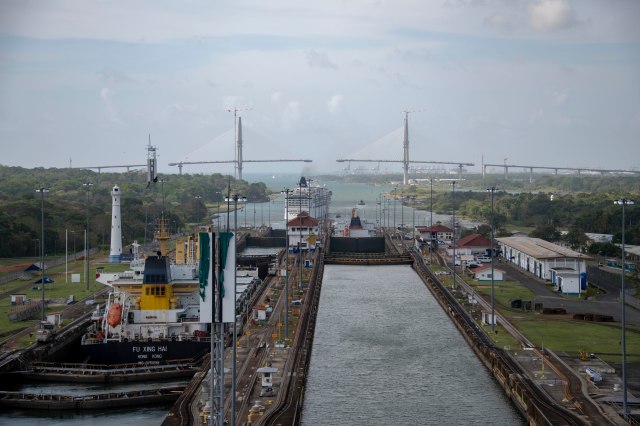
Almost there.
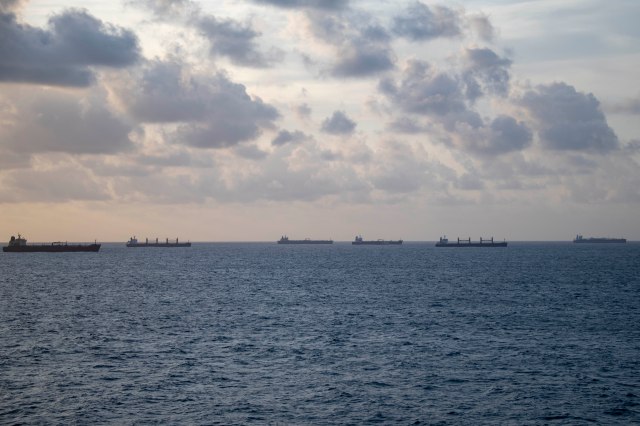
Into the Caribbean Sea where the ships are already lining up for their southbound journey tomorrow.
Each of the large ships MUST have a ‘pilot’ provided by the Canal that comes on board and guides/pilots the ship for the transit. With all the tight fits into the locks and the very narrow Culebra Cut one can understand why this would be required. HOWEVER – apparently they do not always get it right either!?!?

The ship did bump the side of one of the locks on our way through. As you can see it left a mark. AND – YES we did feel it!!
The US did control both the waterway and a large section of the surrounding land (known as the Panama Canal Zone), as if they were US territories, under a 1903 treaty. Panamanians resented this arrangement and in 1977 new treaties were signed recognizing Panama’s ownership of the canal and all the surrounding lands. Full control of the canal was turned over to Panama on December 31, 1999.
This WAS a ‘bucket list’ experience and Oceania did an awesome job of making it fabulous. There were lectures several sea days – laying the foundation of Spanish influences in Central America – and the showings of two documentaries on the making of the canal. We also had a very knowledgeable historian narrating throughout the day of transit making it an A+ day;-) Don’t know how it could have been any better.
Very impressed and grateful for the experience – E & G
 Elizabeth & Gary's Magic Bus Tour
Thankyou for the history, I remember being obsessed and reading every thing I could on the Panama Canal in 6th grade. I needed the refresher. How exciting to experience this marvel first hand. I love the pictures!
LikeLike