Today was another highlight of the trip. A visit to Olympia is incredibly interesting. To one who lived in a host city during the games, has been to Olympic events or participated – even as a volunteer – it is magical and awe inspiring.
During a visit to this ancient UNESCO World Heritage Site, one will step back over 2500 years to the days of the original Olympic Games. This center of Ancient Greek religion dedicated to Zeus hosted these Games for more than a thousand years (776 BC-393AD). Forty thousand Ancient Greeks (men only) came to this sanctuary every four years during the religious festival that featured the Olympic Games. Those who competed may have trained almost their entire lives, may be supported/sponsored by their city or community in order to afford the training and trip and all competed nude! (Does all this sound familiar – except the nude part😂?). If they were fortunate to win an event, they could have a statue placed in the ‘Hall of Fame’ – but, just as important they won a wreath of olive branches and the right to place that emblem in their city or home.
As one enters this beautiful, lush valley today, the first area seen is the remnants of the gymnasium, which was a large rectangular courtyard used for sprint, discus and javelin throwing events. This courtyard matched the length of the Olympic Stadium so athletes were training in a similar space to what they would be competing in.
At the far end of the gymnasium ruins, stairs lead to the Palaestra. This square courtyard was quite a bit smaller than the Gymnasium and used for sports such as long jump, wrestling and boxing. Around the courtyard were rooms and baths. Because the athletes were training nude – as they would be competing – and it was summer and hot, they would wear ‘sun screen’ made of olive oil and dirt. After their training, they would bathe to remove the sun screen using a stick-like tool to remove the oily grime. They would also get massages from their trainers and mental assistance from their coaches. YES – this was 2,000 years ago!! Nothing has changed.

The Palaestra..wrestling, boxing, etc school in the center open area.
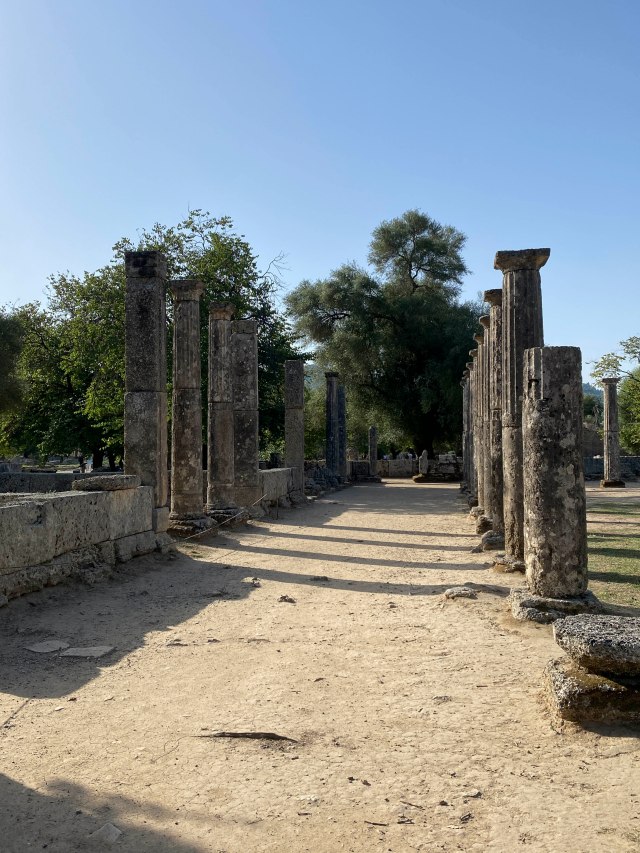
The gathering area of the Palaestra with baths just outside the columns.

.
Just beyond the training areas are the remains of the Temple of Zeus – the center of ancient Olympia. This massive temple (just a bit smaller that the Parthenon) was dedicated to Zeus, king of the gods and patron of the Games. It was built in the 5th century BC, stood for a thousand years and then crumbled in the sixth century AD. One lone standing column exists, which is a reconstruction of original pieces restacked to give a sense of scale. It is 34’ tall and weighs 9 tons! This is one of the original 34 and also gives a sense of the size of the 40’ statue of Zeus that was housed in the temple.
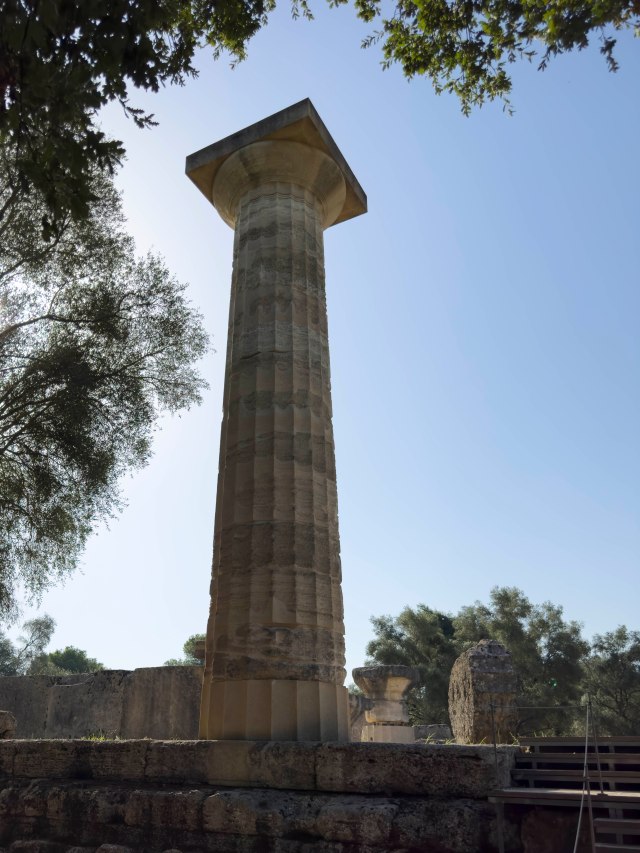
One of the 34 columns of the Temple of Zeus.
Just behind the Temple of Zeus is the winners circle, where the Olympic victors were announced, received their wreath of olive branches and would have their statues placed. To its side were the 16 pedestals that once each held a bronze statue of Zeus – paid for by those who were found to have cheated and with their names on the base! As people entered the stadium, they would spit on the names on the bases. Those named were perhaps found bribing opponents or doping! Yes – some things NEVER change.
Close by is the humble foundation of the Altar of Hera – the link from the Original Olympics to the modern Games. Since 1936, this is where athletes have lit the ceremonial Olympic torch that leaves here and makes its way to the current Olympic city.

Hera’s Alter. The lighting of the Olympic Flame takes place here before being sent to each Olympic Games venue.
From here one enters the Stadium. This place would be filled with 45,000 spectators, who sat on the banks on either side of the track, as the stadium had no seats except for those for the judges. The original marble starting blocks are still there, with two grooves – one for each bare foot. E couldn’t resist the temptation of trying this out – even winning her race, although the competition was not fierce;-)

The original Olympic Stadium with grass seating for 45,000 spectators, built in 5th Century BC.

The original starting blocks – On your mark – get set – go.
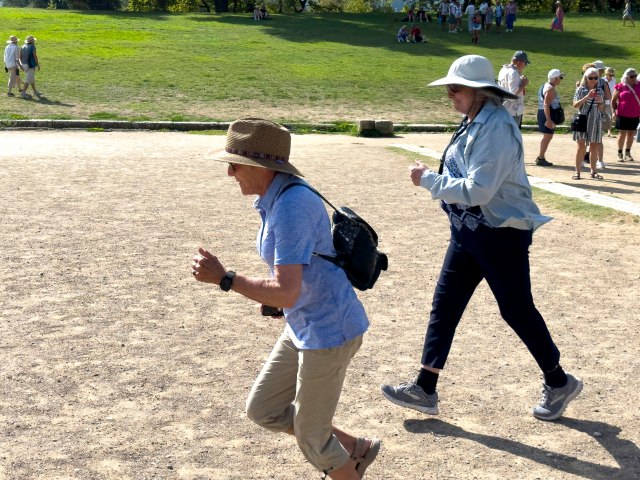
Let the games begin.

To the victor goes the olive wreath crown.
The Temple of Hera, back outside the Stadium, was built in 650BC, and is the oldest structure on the site. Before the Temple of Zeus was built, this temple honored both Hera and her husband Zeus. Though women did not compete in the Olympics, girls and maidens competed in the Heraean Games dedicated to Hera. These were also held every four years but not the same years as the Olympics.
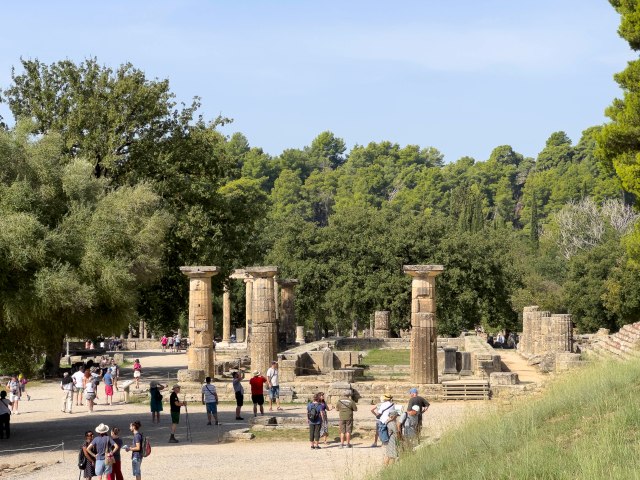
The remains of the Temple of Hera with the alter in front.
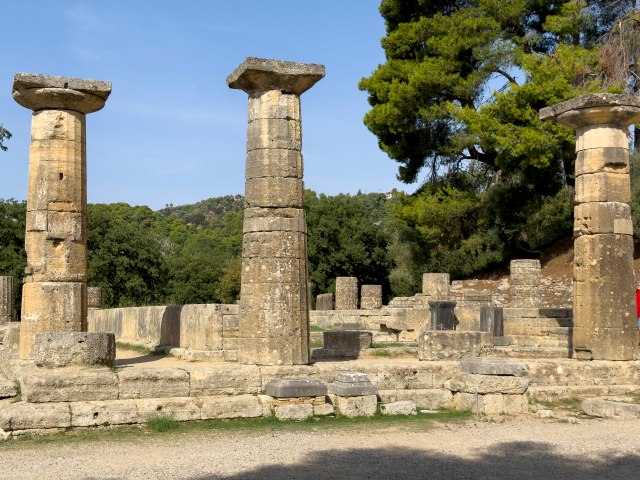
.
Then there is the Philippeion. Built by Philip of Macedonia (father of Alexander the Great) to mark his triumph over the Greeks.
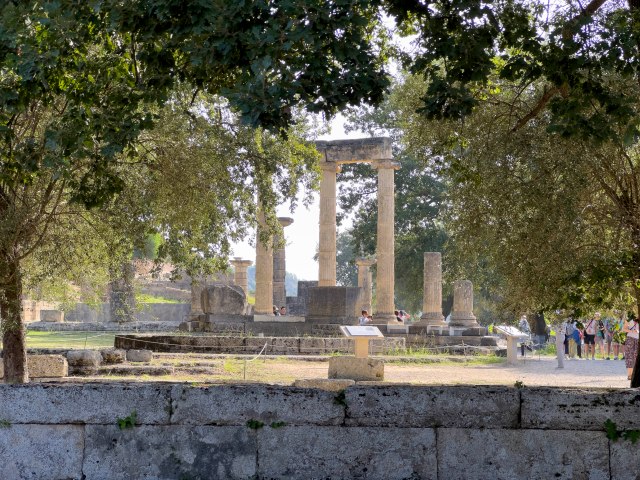
The Philippeion built by Philip of Macedon.
After this great walk through history – but feeling such a part of it since we still have the Games today – we were brought back to the present with a lively lunch and Greek dancing at Zorba’s.
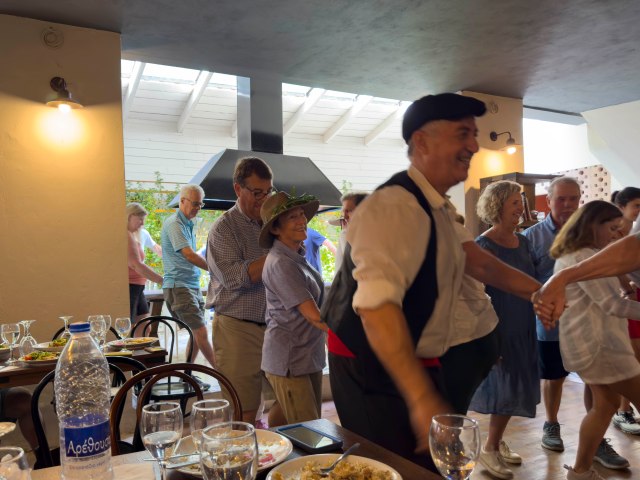
A delicious lunch with dancing.
Perhaps because there are Olympic Games still today – every four years – uniting athletes for fair games – this visit felt like a part of our current lives even though it represents 2,000 years ago. A fantastic day that will be remembered every time we see the torch being lit from this humble remnant of Hera’s Altar.

E & G – with a fond farewell to Olympia
 Elizabeth & Gary's Magic Bus Tour