Talkeetna – A Great Little Town

Talkeetna started as a railroad stop, as it remains today!  In fact – the last whistle-stop train in the US goes through Talkeetna.  In case you don’t know – a whistle-stop train is one that is stopped, literally, with a whistle from one standing along the tracks.  Much of the area around Talkeetna is only accessible by boat or the train.  So – it stops where it is flagged down;-)  Fortunately, we could get to Talkeetna in Magic and into a nice little spot for a couple of days.

Magic’s aspen lined spot in the Talkeetna Camper Park – –

 – – Next to the railroad tracks, as everything in Talkeetna is next to the tracks!


Today, Talkeetna is the major staging area for mountain climbers headed to Denali.  It is where climbers from around the world “jump off” to start their climbs.  The historic town of Talkeetna was built by miners, prospectors, adventurers and the Railroad.  It is still laid-back with authentic historic cabins and museums lining the pretty much walking only Main Street.

Downtown!  Just a few minutes walk from the campground.

The Fairview Inn, since 1923.’

Nagley’s General Store.

How long have these have been here??

G contemplating a ‘High Expedition’ –  a recent addition to the offerings on Main Street.


Talkeetna also sits at the junction of three rivers – the Talkeetna, Susitna and Chulitna.  In fact, Talkeetna means “where the rivers join” in the local Athabaskan (native) language.  A stay here would not really be complete without a river trip.  So, we were all off on the McKinley Queen (perhaps needs to be renamed to the Denali Queen now??) and two wonderful, knowledgeable guides all provided by Mahay’s.

And – we are off!

The rivers are shallow (sometimes only 2′ deep) and very fast moving.

A brief stop took us to a trappers cabin, complete with food cache and fur drying shed, and to a native fish camp.

Good thing G was not a trapper.  He would never get in these old trapper cabins.

Get that food in the cache out of reach of the bears.

An Athabaskan fish camp including work shed, ‘freezer hole’ and smoking pit.

Then we got to G’s favorite!  A very shallow part of the river where the eagles could easily fish.  And we had eagles.  The final count was somewhere around 40!!

This juvenile bald eagle hasn’t started to grow its white head feathers.  It’s colors are a work in progress.

A proud, awesome bird.

Salmon working their way upriver to their spawning grounds – if they survive the eagles.


One more day in Talkeetna and a hike around X, Y and Z Lakes seemed appropriate.  So, we were off on a perfect hiking day to get our 4 miles in amongst some beautiful scenery.  It seemed that all the animals took a break today – but we saw the most interesting array of mushrooms – and in large numbers!!

Our last day in town we took a hike around Lake X to admire the beauty one more time.

Here are only a few of the many varieties of fungi spotted along the trail.


A farewell dinner this evening at Talkeetna Alaska Lodge and we will all be on our way.  The Stinson’s are going on their way to spend a week with the kids and grandkids before we meet up again for another week and a long awaited experience (you will have to stay tuned for that one!!!!!).  E & G will head to Palmer for a little golf and hiking.

E & G saying good-bye to Talkeetna and the Stinson’s (for now) and hello to Palmer;-)

Denali NP & The BIG Five

Another 120 miles down the road to Denali NP – now six million acres of protected watershed and home ranges of wildlife populations.

But, before all that excitement, Doc and Wyatt became our new form of transportation pulling this covered wagon to a delicious chuckwagon dinner;-)

E & G and Doc and Wyatt.


G really liked this cloud formation with the “double moons”.


The next day it was into the Park to see if we could accomplish our feat of 8 years ago and see ALL of the Big 5.

Denali here we come.


Thankfully, the park service has developed a wonderful way for the thousands of park visitors every year to see the park without disturbing, plundering or conquering the land.  Buses, with informative and knowledgable guides, are boarded to transport one down the single road through the park into a wonderful world of beauty and animals;-)

For seven hours one sits on the edge of the seat scanning and/or waiting for one of the fellow travelers to shout “STOP – wildlife at 3 o’clock”!  As the bus stops everyone scans the area for that special sighting.  There are 5 animals that one crosses their fingers and hopes to have at least one sighting of each.  Today was our lucky day!!

First up – moose.  Barely in the entrance, there they were.  About 1,500 pounds munching their way through breakfast (it was about 7:30AM!).

Moose, check.

A couple of the roughly 2,000 in the park.


Second – grizzlies.  They hibernate from October to April, so at this time of year they are eating madly to build up their winter fat.  Next to wolves, these are the least populous of the animals in the park totaling around 300-350.  While we see a fair number of moose even in Park City, we rarely get to see grizzlies.  So – these guys are really special.  AND, we never get enough of them – especially when there are sibling cubs playing with Mom keeping a watchful eye on them.

Grizzlies, check.  (Yes, it is a grizzly even though it is black-see the hump on the neck.)

This bear got so close to the bus, it seemed to be looking for a ride.

A mother and two cubs grazing in the distance.

OK – where are you two now?  Get over here!!


Third – caribou.  Yes – these are the reindeer made famous by Santa.  AND, both the male and female have antlers (the only of the deer family this is true of).  AND, the female loose theirs long after the male making them the pullers of Santa’s sleigh;-)  They roam in groups and favor open tundra and ridgetops.  They are also the most populous of the animals in Denali at around 2,700.

Caribou, check.


Fourth – dall sheep.  These herbivores eat low-growing alpine plants year-round.  They tend to be in packs – always at long distances from the roads;-(

Dall sheep, check. But, boy, were they a long way off.


Five – the seldom seen wolf.  These are so seldom seen, as there are only about 70 in the park, that many of the guides now refer only to the animals above – the big 4.  BUT – today was different.  We saw ALL FIVE.  While wolves are highly social and usually live in packs, this guy was off by himself.

Wolf, check. Napping hard after lunch.


There is a number six – Denali, the high one, itself.  Unfortunately, this was a drizzly day so the mountain was engulfed in clouds.  But, perhaps it was this cloudy day that encouraged all the animals to be so active.  Since Denali is over 20,000 feet and seen from as far away as Anchorage, perhaps we will see it another day.

Denali is another of our wonderful National Parks.  Thank you to Charles Sheldon and Adolph Murie for working so hard to see that this land was preserved for us to visit.  It is up to us today to help with the challenges that remain.  Wolves are routinely shot and trapped near Denali.  The climate shifts, the air grows warmer, permafrost melts and habitats disappear.  Visit a NP and help where you can so that we can continue to enjoy!!

With Love to All – E & G loving our NP’s;-)

Bucket List ✅✅

Fairbanks, Alaska – the largest city in the interior region of Alaska, with a population of approximately 100,000 in the greater valley area, is second only to Anchorage.  While the European settlers came to the area around 1901 and established trading posts, there is evidence of native activity dating back 10,000 years!  Arrowheads excavated from the University of Alaska Fairbanks site matched similar items found in Asia, providing some of the first evidence that humans arrived in North America via the land bridge.  More recent settlement activity included trading posts and gold prospecting in the early 1900’s, the Ladd Army Airfield (now Fort Wainwright) beginning in 1939 and the construction of the Haines-Fairbanks 626 mile long petroleum products pipeline in the mid-50’s.

So – here we parked on the banks of the Chena River for 4 days and met up with friends, Linda and Jim to explore;-)  The drone was up again to give a birds-eye view – –


A drive to Chena Hot Springs, naturally hot water discovered by weary miners to soak their tired limbs, provided a full day’s worth of amusing pictures – –

Don’t know how this got here – or WHY?? – but there it was!

Every piece of old equipment was turned into a flower box;-)

Ran into this guy on the return trip.  He provided amusement for 1/2 an hour!!

I’ve got my eye on you!  DON’T come any closer!!

I’m watching – –

– – Still watching – –

– – I’m still watching you – but, these flies are driving my CRAZY!!


Located just 196 driving miles south of the Arctic Circle, Fairbanks provided the ‘jumping off spot’ for us to fulfill another Bucket List item – going to the Arctic Circle – at the only spot where it is accessible in the United States.  The Arctic Circle is the northernmost point at which the noon sun is just visible on the December solstice and the southernmost point at which the midnight sun is just visible on the June solstice.  It is located at 66 degrees 33′ north of the equator.  And – at 7PM we were off – –

Here we go with 6 ‘friends’ and our pilot Todd.

Just crossing the Arctic Circle;-)!!!

Beautiful views on a BEAUTIFUL evening – the Yukon River below.

Todd got us to Coldfoot – just north of the Arctic Circle.

This was NOT just a trip to the Arctic Circle and back.  There was also a ‘brush’ with a little visited National Park – Gates of the Arctic NP – the northernmost NP in the US situated entirely north of the Arctic Circle.  It also provided views of the Trans-Alaska Pipeline System (TAPS), which includes the trans-Alaska crude-oil pipeline, 11 pump stations, several hundred miles of feeder pipelines and the Valdez Marine Terminal.  The pipeline was built between 1974 and 1977 after the oil crises and utilized special construction techniques in order to deal with the permafrost.  The Dalton Highway was also created to transport supplies.

The Alaska Pipeline – much of it above ground in order to deal with permafrost.

A visit to Wiseman was also on the agenda.  A small (population 17) former mining community along the Middle Fork Koyukuk River in the Brooks Range, Wiseman provided a close look at life ‘off the grid’ above the Arctic Circle.  No hot water, outhouses only and wood stove or solar heat sources.  Neither E nor G would ever make it here!

Wiseman – 63 miles above the Arctic Circle

In the winter, a thick layer of snow is piled up against the cabin walls to provide insulation against the -50 degree temperatures.

The only fuel stop on the Dalton Highway between Prudhoe Bay and Fairbanks!

The Coldfoot, Alaska truck stop – fuel, dinner, supplies and a room (if you need one).

Our midnight sunset;-)

WE DID IT!!


For a little humor between ‘Bucket List’ items, North Pole was visited.  (Actually – our campground was in North Pole!!)  Santa is here year round to talk to all good little girls and boys;-)

Santa apparently did not believe we were good?!?!?!


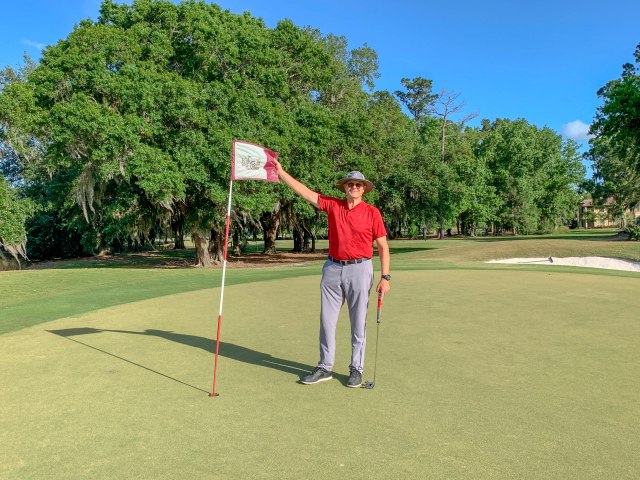
Back to the ‘Bucket List’.  The northernmost golf course in the United States is the North Star Golf Club in Fairbanks.  So – off the four of us went to give it a go and a really fun time was had by all – –

What a crew;-)


It has been a great four days with the Stinsons and fantastic that we have been able to accomplish two super ‘Bucket List’ items;-)  Now that VERY large mountain – Denali – is calling.  So, pack it up and head a little south to see what is in store.

E & G feeling very happy at having accomplished TWO ‘Bucket List’ items and seeing a little visited NP☺️👏

Lonely Stretch of Highway

Here we come Stewart-Cassiar Highway.  So bring on the scenery;-)

First up is the Glacier Highway 37A to Stewart – Canada’s most northerly ice-free port – and Hyder, Alaska – the friendliest little ghost town in Alaska.  One must head over Bear Pass in this coastal mountain range with over 20 hanging glaciers visible from the road.  And what beautiful sights they provide – –

One of 20 visible large glaciers.


The whole point of coming to Hyder is to visit the US Forest Service built viewing area to watch grizzly and black bears feed on salmon.  The good news this visit is the salmon just arrived!  The bad news is the salmon JUST arrived and the word had not spread to the bears;-(  So – the salmon and beavers provided the show – –

We went to the Fish Creek at Hyder, AK to watch for bears…

…but only found a very industrious beaver.


Back to the Stewart-Cassair Highway to a stopping off point for a night – Mountain Shadow RV Park, a very nice park in the middle of no where near Iskut.  On the way – more bridges;-)

Quackers has a good view of all the bridges.


There is not much along this stretch of road – except beautiful scenery!  No other civilization as we are now in the Yukon Territory – an area about the size of 1 and a half California’s with a population of the greater Park City area!!!  There are great overnight spots, though.  Especially Cottonwood RV Park – –

Magic’s spot on the shore of Kluane Lake near Destruction Bay, Yukon Territory.

The views from this spot were marvelous.

A sandstorm was brewing at the far end of the lake. 

G in no way agrees with this sentiment….Wellllll, maybe every once in a while.

We had great fun watching this couple perform during our brief stay.


One night stays are on the calendar for this stretch of road – so off again.  At least we got some bear sightings (as there is NO phone or internet coverage for 4 days now!!)

Siblings playing  hide and seek.


FINALLY!!  Alaska here we are.  Tok was ‘home’ for a couple of nights so we could take a day to drive to the infamous Chicken, Alaska.  What a kick – –

Just had to check out Chicken to see what all the talk was about.

We had a lunch of Chicken pot pie and chicken soup at the Chicken Creek Cafe.

This old relic is a dredge used to find gold during the Alaska Gold Rush.

This newer relic is a portable stage used during the annual Chicken Music Festival.

Best of all, this moose cow and calf made themselves at home near our lunch spot.


What a week!  The moose and grizzlies finally decided to show themselves, we stayed at a couple of RV parks with beautiful views and really fun entertainment and now we are FINALLY in Alaska and have internet and phone connections again!!  Thus – a blog posting;-)

E & G – Ready for what Alaska will bring

Port Edward – and a Little History

Just 20 miles from Prince Rupert is the village of Port Edward.  Now home to 544 people, but for the prior century it was home to several thriving fish canneries which provided thousands of jobs to a multicultural work force.  The area’s history lives on at the North Pacific Cannery National Historic Site – a collection of wooden, tin-roofed buildings spread along a tidal river bank connected by a series of boardwalks.  A guided tour here is well worth the money to learn the cannery’s history.  G’s pictures can give a good flavor of the site – –

The North Pacific Cannery – now a historical museum.

Some of the contents were both historically and photographically interesting.

G loves taking pictures of old, colorful stuff.

Each Ethnic group had their own net loft.  This was the First Nations.

Based on the condition of many of the parts and much of the equipment, it is hard to believe this cannery was actually utilized until the mid-1980’s – –

Spare cables, ropes and machinery parts were everywhere.

While the workforce was multicultural, as was typical of the early to mid 1900’s, the ethnic groups were separated and there was a definite hierarchy.  The First Nations people came seasonally to work and brought their families.  Each individual worked – including the young children.  Each family was housed in a small square (approximately 10’x10′) single room ‘box’ with a hole in the corner to act as a toilet.  While a couple of these ‘rooms’ have been reconstructed – the picture below indicates how the row looked in the early 1900’s – –

Quarters provided the workers from the First Nation tribes. Small and cramped.

The European men came – not with families – and had significantly different types of living quarters.  They also had a mess hall and store on their side of the grounds.

European workers ‘spacious’ quarters a short walk to the ‘European only’ mess hall.

The fuel pump house – separate from the main cannery to eliminate potential fires.

Many of the original pier structures are still visible on the site.


The last day in Prince Rupert was spent on the golf course.  It was quite interesting to be playing in a north coast rain forest;-)

The Prince Rupert Golf Course – located in a rain forest.

Several of the holes had blind shots to the green requiring veeerrrry tall flag poles.


The Waterside Restaurant at the Crest Hotel provided a wonderful last night supper in Prince Rupert – with a fabulous view of the harbor.  We spent the entire time of our meal watching an eagle enjoy their fish dinner;-)

Our dinner table view of the Prince Rupert Harbor.


Price Rupert provided a wonderful three days, but it was time to hit the road again.

E & G heading on up the Cassiar Highway


Another Princely City – With Wildlife!


Prince Rupert – currently a booming little port city of about 12,500 in the heart of the North Coast’s lush rainforest as well as the center of territory traditionally claimed by the Tsimshian First Nation.  It is also at the mouth of the Skeena River, one of the longest undammed rivers remaining in the world, which dumps into the Pacific Ocean a few miles west.  Its deep water harbor was touted as a future site for a world-class port in the early 1900’s by the city’s founder, Charles Melville Hays.  Hays was also the president of the Grand Trunk Pacific Railway, so had the means to make his dream come true.  Unfortunately, after Hays obtained financial support in England, he decided to return to North America on a new ocean liner – The Titanic.  The dreams for the Prince Rupert world-class port went down with Hays and the fledgling city instead evolved into just a mainstay of the fishing and boatbuilding industries.

The early 1940’s brought troops as Prince Rupert became a staging area for Allied troops and munitions on their way to the Aleutian Islands.  Today – almost 100 years after Hays’ efforts – there is a major investment movement to grow the city into his dream.  It is the shortest ocean link between North America and Asia (by 3 days), it has ice-free anchorage and the rail goes right to the harbor making it an easy sell for a world-class port.  As a result, The Prince Rupert Port Authority has spent the last decade encouraging the development of a multi-crane container port.  We shall see what the future holds.

In any event, the area around Prince Rupert is known for wildlife and fish.  The Khutzeymateen Grizzly Bear Sanctuary is just about 30 miles northeast of  town (as the eagle flies!) and was created in 1994 as the first area in Canada to be specifically protected for grizzly bears and their habitat.  It is situated at the end of Khutzeymateen Inlet and includes a lush estuary at the base of rugged mountain terrain.  When the tide is out, the grizzles come down to feast on the exposed protein rich grasses from about mid-May to the end of July.  Then they head to the salmon rich rivers to feast before hibernation.

July 28th we were off on the last tour of the season by Prince Rupert Adventure Tours (awesome tour) to see these guys in their habitat.  WHAT A DAY!!!  The pictures will tell the story – but not as good as being there;-)

We traded Magic in for the day;-)

The floating lodge for overnight stays.   Thank goodness we opted for the day trip.

A little sibling roughhousing.

Gotta go. Time for lunch!

Who knew this grass is a staple in the grizzly’s diet – 25% protein.

Moved on to watch this guy for a while.


After about three hours in the Khutzeymateen Sanctuary, it was time to think about a return to Prince Rupert.  BUT WAIT!  There was more.  Chatham Sound is an important stop on the feeding and migratory routes of several species of whale, including orcas, humpbacks and greys.  Today the humpbacks gave us a show – –

Seemed like they just wanted to show off for us!

Ahhhhh!  Just Perfect;-)


One more thing.  An incredible display by local eagles – again just for us – –

Couldn’t get enough of the bald eagles. So now let us bore you with lots of photos.

What an awesome day!!  We specifically came to Prince Rupert for this adventure and are sooooo happy we did.  If you are ever in this area – don’t miss this adventure.  It was well worth the money and Adventure Tours did everything to make it special.

In total awe – E & G with spinning heads;-)
What?? A Travel Day Blog Post!

Yes!  It is extremely rare (not sure one has ever been done!) that a blog post is done regarding a travel day.  But here it is.

It is only a hop, skip and a jump from Telkwa/Smithers to another Princely city – Prince Rupert – following the beautiful and wide Skeena River much of the way.  At Moricetown is a village of 800 Wet’suwet’en First Nation people, who salmon fish in the crashing whitewater of the Moricetown Canyon.  They were here this morning fishing with their nets.

Hold on tight.


E has a fascination for bridges and waterfalls;-)  So, while looking up Freightliner service centers along the way, she was also happily snapping away – –

127 2018 07 27 trav day 006


“While looking for a Freightliner service center?” you say.  Yes – it is true.  While our trips seem all rosy – there are days of frustration when things do go wrong.  So, for the second time in three days we were looking for Freightliner.  Thankfully ‘Mr. Premium Truck & Trailer’ owns two such facilities exactly on our travel route.  Wednesday we were in the Prince George facility and Friday in the Terrace facility.  Thankfully Magic’s issue was only that of a leaky rear axel seal (Wednesday on the driver side – Friday on the passenger side), which didn’t require ordering parts and the service people were knowledgeable and efficient.  The Terrance stop gave us 2 hours to hit the local Safeway, which had several items we were unable to find in prior stops (Canada is not BIG on Mexican food, apparently) and a Starbucks;-)


130 2018 07 27 trav day 010

131 2018 07 27 trav day 011


Magic – now good as new AGAIN – was ready for the Yukon Territory and beyond.  But, first a few nights stay in Prince Rupert.

E & G – Off to see the Grizzlies


Trekking Across British Columbia.

The beautiful Alberta Mountains have been left behind for the more rural farming area of British Columbia.  Don’t misread what was just typed as there is still beauty here – just different.  In order to meet our travel guidelines of no more than 250 miles or 4 hours on the road each day – and staying two nights in each location – Smithers/Telkwa is where Magic was parked for the last two nights.  AND – a nice spot it was overlooking the Bulkley River.

Yes – G was at it again with the drone.  Hope this one stays out of the river!!

The view from our living room.

The drone is out for a spin. Check Instagram for a video.


This little town of 5,000+ sits at the base of the Hudson Bay Mountain, which means one can be pretty sure it got its start in the 1800’s (long after the First Nation people)  when the Europeans arrived to satisfy Europe’s appetite for fur and established a Hudson Bay Trading Post.  It also means glaciers, rivers and waterfalls.  So – off we were on the suggested hike for the day to Crater Lake above the ski area.  Only to be rebuffed by the clouds of bugs 15 minutes in.  Second choice – Twin Falls on the other side of town.  Much better – –

Twin Falls.

Very LOUD – but BEAUTIFUL.


The hike was short but still worked up the lunch appetite.  Tandoori Bistro was on the way back to Magic and provided an excellent Indian meal;-)  There was other scenery on the way that just made us laugh – –

As Jeff Foxworthy once said, “if you mow your lawn and find a car…you might be a redneck.”


Smithers and Telkwa – the stay was short but you provided great sights for the day.

See ya – E & G off and running again tomorrow
Farewell Jasper…Hello Gorgeous

Just when you think it can’t get any better – there it is right in front of you – AGAIN!

The ‘farewell committee’ was out to say good-bye and to see us on our way as we left Jasper – –

The elk bid us farewell – –

– – but, really didn’t want us to leave.  So, they just blocked our way.


Today’s destination was Prince George as we began our journey along the Yellowhead Highway 16.  But, on the way was another of our fav’s – Mount Robson.  The highest peak in the Canadian Rockies it stands at almost 13,000′ and – just like Denali – creates its own weather system.  Therefore, one is not likely to see the top or the clear mountain.  Except for us;-)  It is one of those ‘you just have to wait for it’ times.

The usually shrouded peak of Mount Robson.

And then a brief FULL view of the peak.  AWESOME!!

Just another FABULOUS lunch spot!


We could spend hours looking at this incredible sight as it changes from minute to minute.  But, Prince George was calling.  An interesting city – inhabited by the Lheidli T’enneh First Nation thousands of years before any Europeans arrived.  In 1807 a fur trader by the name of Simon Fraser established a fur trading post and nearly 100 years later agricultural development began around the trading post when the Grand Trunk Pacific Railway entered the region.  Taking time off from history lessons – we just played golf in this princely city at the Prince George Golf & Curling Club.  Even though the course was in flat fields – there was still wildlife and reminders by way of inventive signs.

Our gallery at the #2 hole on the Prince George golf course.

This sign should be posted on the first hole of ALL golf courses!!

While at the Golf & Curling Club, we thought we should join the Canadians and try our hand at curling.  However, it seems that curling is only a winter activity and the curling portion of the building was closed up tight;-(  Guess they don’t have to practice year round.

Tomorrow it is back on the Yellowhead Highway 16 westward to Smithers.

See ya later – E & G from Prince George


Jasper NP – A Gem

Jasper NP is definitely one of our favorites – and it is next up on the agenda;-)  Getting from Banff to Jasper is also a real treat.  The Icefields Parkway is a continuous sight of majestic mountains, waterfalls and one of the largest accumulations of ice south of the Arctic.  Its meltwaters flow west to the Pacific, north to the Arctic and east to Hudson’s Bay and on to the Atlantic!  The pictures only give you a ‘hint’ of our fabulous drive – –

BIG Mountains!!

The cloud coming off the peak looked like a ship’s smokestack.

AND – another perfect lunch spot;-)


Jasper NP was established in 1907 and extends over 4200 sq miles.  It is the largest national park in the Canadian Rockies and is part of UNESCO’s Canadian Rocky Mountain Parks World Heritage Site.  It has it all – ice fields, peaks, hot springs and wildlife.  In fact – they call out the deer, elk and caribou (and sometimes a bear or two) to welcome all visitors.

This welcoming committee at Whistlers Campground in Jasper NP.

Their lead greeter.


Our last visit to the area enticed us to do EVERY activity on the ‘must do’ list.  So – this time we took it a little easy and just enjoyed views.  First from the fantastic Fairmont Jasper Park Lodge.  It is a mere 700 acre mountain resort which wraps around the shores of  ‘Lac Beauvert’ and Canada’s No. 1 golf resort course!

It’s history began in 1915 and consisted of ten luxury tents on the shores of Lac Beauvert, each with wooden floors and walls.  Needless to say – it was called “Tent City”.  In 1921 the Canadian National Railways took over Tent City and immediately renovated the existing camp to eight log cabins and officially opened The Jasper Park Lodge in June, 1922.  Today it is a far cry from those eight log cabins – or The Tent City – –

“Cheers” to Jasper NP & the Jasper Park Lodge!! 

The grounds of the Lodge on Lac Beauvert.

The golf course across Lac Beauvert – and us;-)


During the 1920’s the Jasper Park Lodge added the now ‘world famous’ golf course designed by Canada’s Stanley Thompson, whose philosophy has been described as ‘natural artistry’.  His fairways are carved in the surrounding forests, giving priority to the natural contours of the mountains.  Allegedly it took 50 teams of horses and 200 men one year to clear the land to accomplish Thompson’s vision.  The scenery was too beautiful to care about the golf – –

And we are off –  for our round of golf.

We would have used this vintage cart from the early 50’s – but we walked.

More great scenery out on the course.

View from the green we were contemplating yesterday.


And so – our quick couple of days in Jasper came to an end;-(  However –  we did fret about a couple of things during our stay.  The campground we love so much – Whistlers – was a little worse for the wear from our visit ten years ago.  Then we happily learned that the campground will be closed in 2019 for reconstruction.  This was a fabulous campground we loved 10 years ago and hope that in 2020 it will be that way again.

We were also quite distressed over all the dead trees in the park.  When looking at the mountains it appears that fall colors have set in.  Unfortunately, it is not colors at all – but dead trees.  The Mountain Pine Beetle, an insect native to Jasper NP, has infected about HALF the trees in the park.  They tunnel into the mature pine trees and disrupt the flow of nutrients within the tree.  About the only way to eliminate the beetle is through prescribed burns or letting nature take its course when a fire is started by lightening.

The Mountain Pine beetles’ impact on the pine trees in the park is evident everywhere!


Even with its few recent faults, we still love this National Park.  The scenery is stunning and the Canadians take good care of their campers;-)

E & G saying it is always too short a stay in Jasper