Hurray for June, 2023 and Alaska Airlines! The long awaited trip to Alaska with the Shoe Crew was finally here after being postponed a year (thanks to Delta flight cancellations in 2022!!). And – all were present and accounted for.
First stop was Fairbanks with the primary event of a flight to the Arctic Circle – but first, getting to know Fairbanks. The Knoll house was waiting for us and proved to be ‘quaint’ lodging for our stay – –
Enjoyed the Knoll house setting in the woods.
What would a trip to Alaska be without going to the North Pole?!? Yes – Santa spends time at the North Pole just outside of Fairbanks and a visit there provided a silly ‘reindeer’ picture and a shopping opportunity. AND – an old fashioned lunch at Little Richard’s Family Diner.
At North Pole with Santa and his Reindeer . . .. . . and lunch at Little Richard’s Family Diner.
A fun evening in Fairbanks is attending the Revue with a Salmon Bake dinner before at Pioneer Park. This year the dinner left a little to be desired (it could have been the VERY cold weather) but the Revue was hysterical and had everyone in stitches;-)
Another day – more activities. Today it was time to explore the downtown area. A walk along the Chena River is good exercise – with great views – that brings you to the Visitor Center with an informative museum and the moose antler arch. What a perfect photo op!
Welcome to Fairbanks.
All this walking may build up an appetite and The Crepery is the place to stop for a bite. The lunch crepes were huge and they had the BEST Chai Latte EVER!! Good thing it warmed the insides because the next stop was the Ice Museum located in an old downtown theater. The films shown were a little long but the ice sculptures were a hoot!
Come on Olivia – let’s hit it.Mush Grumps – Mush!
Ice slidin’ gramma.
Haley hauls a..
The next adventure was a drive to Chena Hot Springs for the BEST chocolate dessert ever (a lot of best foods on this trip!). Along the way was a fortuitous sighting of our first moose;-)Our first moose sighting at 8 0’clock and the sun, sort of, won’t set for another 4 hours.
An afternoon visit to the Museum at the University of Alaska Fairbanks as well as the animal research center were exceptional. The Reindeer Walk was a highlight for the ‘Grands’ and is an activity that those with children would want to include in their visit. The Alaska Pipeline runs nearby, and provided a perfect opportunity to see this construction feat that would be viewed from the air later in the evening.
Checking out the Alaska Pipeline up close and personal.
So – the BIG event – drum roll please. Off to the Arctic Circle, landing in Coldfoot and visiting Wiseman, the village of 12! The plane departs at 6:15, but that won’t be a problem as sunset (sort of) isn’t until 12:12!!
We have to wait until when to see the sunset?We filled the plane.
The flight is beautiful and mid-way thru crosses the Arctic Circle. It then lands in Coldfoot, the only provisioning/lodging place between Prudhoe Bay and Fairbanks. While on the ground one visits the small town/village of Wiseman and receives a presentation by Jack, a full time resident, on how one lives and survives here off the grid. Fascinating!!
Rainbow in the arctic circle.One of several cabins in Wiseman, AK.Jack, one of the 12 full time residents, explaining some of the intricacies of subsistence living.Thank you, Jack, for sharing your home;-)The sun sets on our return flight to Fairbanks.
And, the sun sets on the first leg of our journey. Off to Denali with fingers crossed we see her.
Have NO idea where the first five months of 2023 have gone but know there has been no time to say “Hi” to all of you. Hope your year is going well and you are all staying healthy;-)
In our continuing effort to stay well, broaden horizons and NOT fall into all the usual ruts – new discoveries were sought out in the Scottsdale area.
The Musical Instrument Museum (MIM) is very near and dear to us AND is the number 1 thing to do in Phoenix. This year MIM renewed (after Covid) its two programs for Seniors – Music and Wellness for Seniors and Memory Care with Music. E participated in the administration of both programs which involved one afternoon a week. In addition to the wonderful museum and its programs, MIM has one of the best music venues in the city – a 300 seat theater with incredible acoustics! We both became ushers for the concerts the beginning of this year, and spent a night a week assisting in that capacity and another night or two a week as ticketed viewers.
Loving music – and particularly jazz – two additional recommended venues were checked out. Very close to home in north Scottsdale is the Ravenscroft, with a state of the art concert hall and the Jazzbird lounge with $10 music on Friday evenings! Downtown Phoenix houses The Nash, which advocates and facilitates the growth of jazz thru performances, education and outreach. Attending events here gives us the opportunity to rediscover the downtown area and see some our favorite artists – such as Francine Reed;-)
Love Francine Reed – performing at The Nash Jazz Club.
Another discovery was the Riparian Preserve at Water Ranch in Gilbert. A well hidden series of about 7 ponds that have been established to promote the awareness and appreciation of Arizona’s ecology and natural history of mainly desert and riparian environments. The walking paths provide miles of trails to view birds and other wild life. A small sample of many of the species of birds encountered follow – –
Pied Avocet at the Riparian Preserve.A pod of pelicans at the Riparian Preserve.
A trip south of town took us to the Boyce Thompson Arboretum, whose mission is to inspire appreciation and stewardship of desert plants, wildlife, and ecosystems. The collections not only include plants from the US but also Mexico, Australia, Madagascar, India, China, Japan, Israel, South America, Africa and the Mediterranean. We were blown away having NO idea the size and coverage of this arboretum in the middle of the desert!
Queen Creek runs through the arboretum providing beautiful views and great walking paths!Beautiful cardinal staring us down. (His mate was just out of the camera lens.)
One more favorite in Phoenix is the Desert Botanical Gardens. This spring they had a wonderful exhibition by Rotraut that was magnificent at night with lighting. A special evening.
The Desert Botanical Gardens presented the sculptures of Rotraut. Beautiful evening stroll.
No travel is required for the neighborhood owl, who returns each year and sits just out our window – –
One of our local owls trying to ignore the harassment of the hummingbird.
Even with all these new activities, there was still plenty of family time. This year sister Barb turned the BIG 6-0 and niece Demi turned 21 and spent a night with all the old folks to celebrate in Old Town Scottsdale and at the Talking Stick Resort. A good time was had by all – –
Happy 60, Sis. Only 5 more years ’til Medicare;-)Oh to be 21!HAPPY BIRTHDAY!!
G got swept away for a relaxing weekend in Sedona for his 21++++++ birthday;-) The celebratory dinner was at Dahl & Di Luca Ristorante, which was excellent! (Hint – do NOT stay at L’Auberge de Sedona. Way overpriced and VERY dated.)
Oh no…76, really.Beautiful view on the Oak Creek Golf Club Course. Gary wishes his game was half as good as the view.
Mid-April a jaunt to Ridgecrest, CA allowed us to visit the Shoe Crew and visit another new site – Red Rock Canyon State Park. The sculpted rock formations were quite interesting and again the wildflowers were magnificent – –
A hike in Red Rock Canyon State Park in the Mojave Desert sounded like a good idea.It was.Beautiful wildflowers.
On the way back to Ridgecrest we were treated to a Navy F18 sighting – –
A Navy F18 at the tiny Inyokern municipal airport.We stopped to take a look.
Many of the usual winter and spring activities were worked into the schedule, such as hiking and walking 4-5 days a week and golf now and then. (The golf rates have gotten ridiculous since Covid – so the usual twice a week golf went by the wayside;-( ) But, the long, cold, rainy winter provided a VERY green desert with unbelievable wildflowers and lots of water. So – the hiking was spectacular!!
March snow in Scottsdale!!Wonderful hike at Bartlett Lake – which was quite full!Hillsides of wildflowers. Just beautiful!E’s favorite – An Argentine Giant in full bloom;-)Getting in as many hikes as we could manage with the Vi group before it got too hot.
Hard to believe the first half of the year is almost gone. But, June is upon us and a trip to Alaska with the grandkids is in the offing. Hurry back for the first two weeks of June;-)
Two months were needed to recover and re-energize after such a wonderful trip – AND before the holidays hit. Trying to get back to ‘normal’, the calendar was filled with the usual golf twice a week, hikes once a week, walks around ‘the hood’ and whatever else presented itself.
Enough energy was found to dress and enjoy ‘The Home’s Halloween party – perhaps one of the most fun events of the year. Amazing how silly one can act if they just put on a mask or a little makeup!!
Halloween always brings out the “characters”.
Thank goodness there is a ready made group of hikers at ‘The Home’ to get us out every Friday to enjoy the desert. The best part – one of the residents was also a steward for the area for MANY years – so he knows the trails like the back of his hand. Funny how E hated this landscape as a kid growing up – but, now thinks it is just beautiful! The friends hiked with are also;-)
Some of our hikes this Fall took us to a crested saguaro……an outcropping of boulders……and the top of a landslide.
Suddenly – birthdays and holidays hit. First up was E’s b-day, which was celebrated with niece Demi in Tucson. She played to our interest and treated to Top Golf. The evening skies were a beautiful backdrop – –
What a gorgeous threesome!
Before one could turn around, it was Thanksgiving. We joined daughter Heather, who brought her entire clan to Flagstaff for the week. We toured the NAU campus and ate, and ate and ate!! The entire Shoe Crew at Northern Arizona University with the iconic Lumberjack. Mugging for the camera:-)Enjoying the Thanksgiving feast.
Before one knows it – it is Christmas. Again, off to the Shoe Crew. This time in CA. Besides cooking, eating and doing puzzles we visited the stables where granddaughter Olivia is helping out and learning to ride for competitions. A great afternoon – although freezing!!!
Giddy – up.A musical performance (such as it was) created more laughter than music.
Back home, there was a little quieter celebration – but enjoyed just as much with sister Barb and niece Demi. After a round of putting where prizes were given for holes-in-one, lowest score and laughing the most – dinner was enjoyed;-)
Still had the obligatory Poppers – with hats for all.
And – just like that – another year was gone. The good thing these days is we get to celebrate right downstairs so we don’t have to think about what we are going to do, drive home AND we are back to our apartment to see the ball drop in NY at 10!! What more could anyone ask for. Well – perhaps a really good band to get our dancing in for the year;-)
New Year’s celebration at “the home” was great fun with dinner and lots of dancing to a live band. Happy New Year to all🕺💃🏻🎉🍸
Somehow the year got away without the usual cards to all. So – we say here – Hope you all had a fantastic year, a Very Merry Christmas and the most wonderful New Year full of all you hope for;-)
What a way to finish this trip! Think of any positive adjective and it will probably apply to Lisbon. Finally having good weather (and NO rain) helped a lot – but, Lisbon is historical, medieval, beautiful, lively, chic, vibrant, fun, etc. etc. etc.! Its building walls are tiled and its streets are paved with pavers. Wonders everywhere one looks.
Hotel My Story Rossio was home base for two days. So convenient – and with a spectacular view of Castelo de Sao Jorge, which is the number 1 sight in Lisbon!
Castelo De Sao Jorge from the Rossio area of the city.
Early history here (going back to the 7th century BC) was created by the Phoenicians, Romans and Visigoths. Then came the Arabs from northern Africa, who built the Castelo de Sao Jorge (Castle of St. George) as a walled city fortress surrounding the castle on the highest of Lisbon’s hills. Its purpose was to withstand prolonged sieges and to intimidate approaching enemies by its location and grandiosity. It was completed with a moat, curtain walls (defensive walls between towers), 11 towers, fortified gateways and many other structural elements for protection. How much more could anyone ask for than a real live castle complete with walls to climb in all directions?
Enjoyed exploring the Castle and its views over the city.Strategic views from the Castle.NOT a fierce defender – just enjoying the visit;-)
More than 4 centuries of Muslim rule came to an end in 1147 when Portugal’s first king, Afonso Henriques, enlisted the help of northern European crusaders to besiege the city. Today, the Castle is a peaceful retreat where one can spend the better part of the day investigating archeological remains from Roman and Medieval times, climbing or just taking in the views of the city and the Tagus River.
It is great fun to wander the narrow, meandering, tree-lined streets below the Castle in the Alfama area on the way to Se Cathedral. It is here that one will see the many tiled walls of buildings and granite paved streets. You might also find a wonderful little cafe to relax and have lunch.
Scene from our lunch table. Lots of visitors heading up the hill to the castle.Tight passageway for vehicles and some of those tiled walls.
All one has to do is walk downhill from the Castle and Cathedral Se will appear. This has been Lisbon’s cathedral since the 1100’s and is an impressive example of the Romanesque style with its barrel-vaulted ceiling and arched upper gallery.
Se Cathedral of Lisbon.
Another day – another area of Lisbon. Belem is the historic riverside neighborhood along the Tagus and holds monuments associated with Portugal’s Age of Discovery. Beginning in 1415, a prince who would be known as Henry the Navigator started this Age of Discovery by capturing the North African port of Ceuta. Portuguese sailors then set out to the Cape of Good Hope, to find a sea route to India and founding of trading posts in Japan, China, Indonesia and the Persian Gulf. Unfortunately, Portugal also initiated the Atlantic slave trade, delivering 6 million Africans into bondage. All of this made Portugal a very wealthy country, and this area has monuments associated with the age.
Torre de Belem (Belem Tower) is a UNESCO World Heritage site and a recognizable symbol of Lisbon. It displays a uniquely Portuguese style, Manueline, named after a king who drove the discoveries and inspired maritime motives. It was built in the 16th century to defend the entrance to the Lisbon harbor and saw action in the 1830’s when its cannons opened fire on French ships. It is an impressive structure – unfortunately overrun by tourists this particular morning;-(
Torre de Belem.
A nice walk along the Tagus takes one to the Padrao dos Descobrimentos (monument to the Age of Discovery). This 165′ high monument was erected in 1960 and is a striking landmark jutting like the prow of a sailing boat over the waters of the river. From the bow to the stern, the pure white monument is lined with outsized statues of Discoveries-era heroes including Henry the Navigator.
Padrao dos Descobrimentos. A tribute to the country’s explorers.
Just across the boulevard is the Mosteiro dos Jeronimos – a monastery built on the orders of King Manuel I in the 16th century and now a UNESCO World Heritage Site. Also, a showcase of the architectural style that takes Manuel’s name and a display of the wealth that came with Portugal’s maritime expansion.
The cloisters are elaborately decorated with Manueline carvings and the refectory walls are lined with 17th-century tiles. In 1985, the leaders of Spain and Portugal signed the treaty taking their countries into the EU upstairs in the cloisters!
The Monastery of the Jeronimos – and the line to get in;-(…and its beautiful cloisters.
The refectory was built in 1517-1518. Under thick stone ropes, the walls are paneled in tiles, which was done 1780-1785.
The above represents the Miracle of the Feeding of the Five Thousand from the New Testament.More beautiful tile work!On the tomb of writer Fernando Pessoa (1888-1935). He looks ready to leap with very scary eyes!
The Cathedral is beautiful, but not as ornate as the Cloisters. Well – maybe except for the slender columns that grace the nave. They rise from the floor like ship’s masts that bloom into flowerlike supports for the vaulted ceiling.
The church of Santa Maria de Belem.
Well – one might now need a respite. And, just the answer is right down the street at the Antiga Confeitaria de Belem. Founded in 1837 it is famed for the little custard tarts that have become one of Portugal’s best-known culinary exports. Throughout Portugal these delicious little pastries are known as pasteis de nata – but here they are pastes de Belem! Of course we indulged;-)
YUM!!!
At the very beginning of this posting the paved streets were mentioned. The sidewalks are also done with pavers. So much so there is a sculpture tribute “to the Pavers who build the ground we tread”. The walks and roads are beautiful – –
A tribute to the stone setters who “paved” the roads and walkways throughout the city.And samples of their work.
Lisbon is built on many hills – so there are many ups and downs. Luckily there are trams to assist on some of those walks and might just take one to very vibrant sections of the city.
On the way back down hill from dinner, passing the funiculars. Lots of “wall art” throughout Lisbon.
A perfect ending to quite a trip. Hope to return to Lisbon sometime for several more days of adventure – there is a lot to see.
E & G – Thankful for a wonderful trip, sad that it is ending, happy to be going home;-)
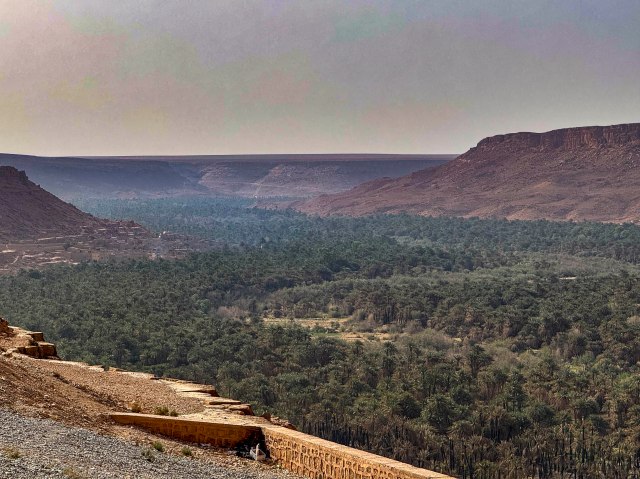
Possibly most well known for the Port it produces, Porto’s historic city center, Ribeira, is now a UNESCO World Heritage Site. At the center of this historic area is its Cathedral – another stop on the important Camino de Santiago which ends at Santiago de Compostela. The Cathedral sits high above the city giving it historically a safer place from invaders – and today beautiful views of the city.
Scenes from a rainy, foggy day around old town Porto.Another important Cathedral on the Camino.These markings are all over town to help pilgrims on the Camino de Santiago find their way.Views of the River Douro from the Cathedral.
The production of Port is very important to the city, as it IS the major producer of this wine. The Douro river is littered with boats that bring the grapes in and then take the port out for distribution. From a distance these boats look very much like the gondolas in Venice;-)
Speaking of gondolas – there are those rising from the water up the hills of Porto. Just as there are funiculars to transport residents and tourists up those same hills.
Didn’t ride the funicular but thought it was a beautiful scene.
Public Art is everywhere in Porto. Since 2001, when Porto was declared a European City of Culture, many of the streets and squares have been reconstructed and buildings restored cleaning up some of the more ‘unartsy’ visions.
Tile art.Wall art. The cats seemed unimpressed.More narrow streets.And small squares.
Finally – after walking a few miles through the city and across Porto’s famous bridges – our reward was waiting. PORT!
Port wine in process.
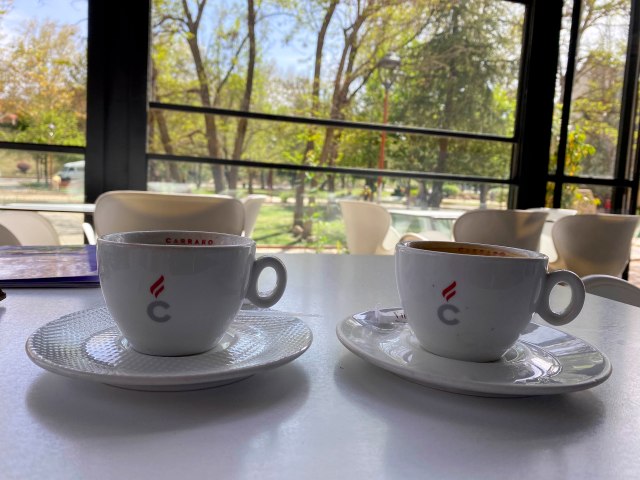
With a little extra time before returning to the ship, a brief respite along the Douro in its historic district was in order. Not sure which was stronger – the double espresso or the ‘thick’ hot chocolate;-)
Break time along the River.
This day in Porto had its challenges – especially with the continuing rain. BUT – wine can make anything tolerable!
This capital of northwest Spain’s Galicia region is known as the culmination of the Camino de Santiago pilgrimage route and the alleged burial site of the apostle St. James. This UNESCO World Heritage site houses the Catedral de Santiago de Compostela, consecrated in 1211, with elaborately carved stone facades which open onto grand plazas within the medieval walls of the old town.
Before getting to the walls of the old city, one might pass hundreds of mussel harvesting platforms. These licensed platforms have become so lucrative (each platform producing as much as 500,000 euros in revenue annually) that they are passed from family member to family member. Today, they are the second largest producer of mussels! These platforms look like their own floating army – and quite ominous coming into the port.
Hundreds of the mussel harvesting platforms in the waters offshore from the port.
Before arriving at Plaza del Obradoiro and Catedral de Santiago, one passes into the old medieval part of the city and past the Convent de San Francisco and many of the University buildings.
And then – before you is the HUGE Catedral de Santiago and the celebrating pilgrims who have just completed their 500 mile walk on the Camino de Santiago.
The cathedral of Santiago de Campostela. Destination for millions each year.Administrative offices for the University – AND celebrating hikers.
The pilgrims objective after reaching this destination is to enter the cathedral to observe the remains of St. James. AND – if one is lucky enough to arrive to Santiago de Compostela while the ‘Holy Door’ is open, it is an added plus to the experience. The Holy Door is only open in a Holy Year, which occurs when the 25th of July (feast of the Apostle) falls on a Sunday. On December 31st, the Door closes until the next Holy Year (2027). Because of Covid, the Door was not open when the previous requirement occurred but was postponed by the Pope until this year. According to Jacobean tradition, entering thru this special Door will forgive all ones sins. So – through this door we were able to enter!
There are several entrances to the Cathedral. The ‘Holy Door’ was there to receive us!
The ‘perfect’ shell is the symbol associated with the church and, therefore, with the Camino. A beautiful specimen is carved into the front entry of the church as are many other symbolic carvings. Remember – these all date back 700 years!
The interior of the cathedral takes ones breath away. Its height, size and opulence can not be adequately described. Neither do pictures do it justice – –
The interior of the cathedral is very richly finished.
When standing in front of the Catedral in Plaza del Obradoiro, to the left is Hospital Real de Santiago de Compostela. Originally built by Ferdinand and Isabella as a refuge for pilgrims who had walked miles to the Catedral and upon arrival were worn out, tired and often sick – and had no place to go once they arrived. Attached to the Hospital is the Convent de San Francisco. Today this is a luxury hotel and the site of our lunch.
Today a hotel owned by the Spanish State.
Wandering gives one an opportunity to admire the 700 years of architecture and the sights and sounds of the city – –
One of the many shopping and dining streets in the old center city area.Some passages are narrower than others.The only gate remaining of the original city wall.
What is the expression – “when given lemons make lemonade”? Well, our intended port of Biarritz – with an excursion to Bilbao – was canceled due to high seas and the Marina was diverted to Santander, Spain 😢. Expecting a ‘second class port’ there could be nothing but surprises. And surprises there were.
Santander is the capital city of the Cantabria region on the north coast of Spain. Given that the royal summer residence was once here at the Palacio de la Magdalena, it should have been known that the area would be nice and upscale. But, disappointment was on the brain and needed to be dismissed – which it was quickly with a hop on – hop off tour around the city.
Again, we were docked right at the edge of town at the bus stop. So as soon as daylight hit, it was time to be off and running.
Early morning arrival in Santander.
How could anyplace with such a beautiful setting for a golf course be bad?
Golf course on the cliffs across the way.
In the early 1900’s, the city built a beautiful Palacio for the royal family so they could spend their summers here. It was styled with architecture similar to England, which pleased Queen Victoria of Spain, a granddaughter of Queen Victoria of England.
Palacio de la Magdalena.
The city took advantage of its most outstanding natural feature – its bay – and constructed a beautiful walk from the peninsula, where the Palacio is situated, into town.
A beautiful walk into town, although Beach access is a bit steep.
The architecture is quite interesting, merging old with new. But, everything faces or pays homage to the sea and the Bay of Santander. For it is this bay that allowed the city to become an important port as far back as the Middle Ages and for trade with the new world.
Gorgeous downtown area.Mariners protecting the building. Interesting tribute to children on the quay near our dock.
Not much time here. So – after our walk, grabbed a quick bite (with a view) and it was time to be on the way again.
View from lunch table.
An enjoyable day spent in a last minute alternate port.
Another day – another city. Today it is Gijon, Spain. A small town but with roots back to the Romans. Gijon began as a simple fishing village and remained as such for hundreds of years. But, then grew into an Important port. And today is known for its Apple sidra (cider).
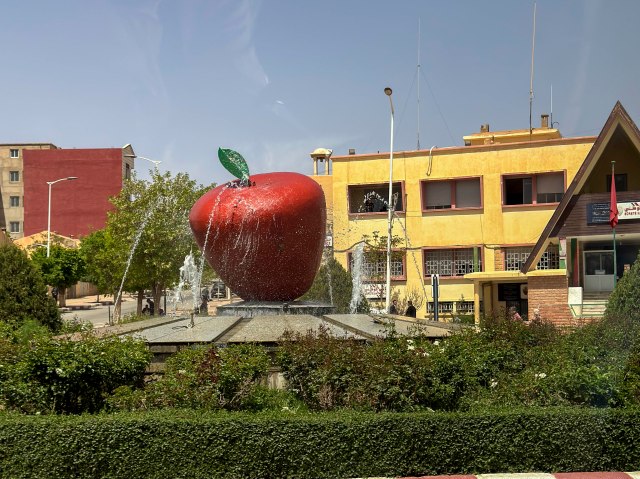
Entering the old center of the city.The Cider Tree it made of 3200 empty apple cider bottles – erected to encourage recycling.
The old part of town sits on a peninsula with one side housing the harbors and the other the beach – Playa de San Lorenzo. The beach stretches almost 2 miles and is known by the locals as The Wall. A good surf here brings out the surfers.
Rough seas and surf brought out the surfers.
A climb up the hill to the old city takes one to the Santa Catalina Headland Park for awesome views and a look at the remains of the city’s defense system.
A sculpture to honor the horizon from the top of the old fort’s location.
The city’s Roman roots can be seen at Campo Valdes – the Roman bath museum. The ruins were discovered and partially excavated as early as 1903 but more thoroughly recovered from 1990-1994. The building dates back to the end of the 1st century with several subsequent construction phases through the 2nd century.
Remains of Roman baths dating back to the 1st century.
Another lunch (with a taste of the local cider🍹), another town and time to be off⛵️
The city BORDering the water (EAU in French). Perhaps the most beautiful dock, as the water Bordeaux sits on is La Garonne River, which brought the Marina to the middle of the city!
The morning May have begun with a little fog, but the day was the most wonderful of the trip.
Morning sun trying to break through the river fog – –– – And then there was blue sky and a fabulous view of Bordeaux from our balcony.Our ship is moored on the Garonne River in the middle of the city.
Wandering the narrow, historical streets of this UNESCO World Heritage site is a delight. Around every corner is a surprise – especially the sight of Saint Andrew’s Cathedral.
St. Andrew’s Cathedral, where Elenor of Aquitaine marries King Louis VII of France.
This is the first cathedral in the world dedicated to Saint Andrew, one of the twelve apostles. While a cathedral has been on this site since the 4th century, it is around the 1100’s that the Romanesque cathedral was built and used for the marriage of Eleanor of Aquitaine to King Louis VII. (Eleanor of Aquitaine later became Queen of England marrying King Henry II). It is not the most ornate to be seen, but it’s height and wonderful organ pipes were something to see (and listen to).
Intricate Gothic buttresses are beautiful.
The organ was playing continuously – just a short sample.
Wandering beyond the Cathedral, one passes the Palais Rohan, now Bordeaux’s City Hall, then Place Tourny where the Grand Theatre is. Also, where there are many good places for lunch AND the beginning of Rue St. Catherine – THE shopping street!
Just beyond is the Place des Quinconces and an elaborate monument to the Girondins of the French Revolution.
The old, a statue remembering those who fought in the Revolution and the Ferris wheel with the carnival twice a year.
Back along the river is the Place de la Bourse, with its many official buildings, museum and stunning reflective pool!
The Place de la Bourse.Incredible reflection 👏👏
Before heading back to the ship there were a few last shots of the quaint parts of the city – –
The Porte Caillou, one of the original gates to the city.The Pl. du Palais inside the Porte.An interesting history of film cameras and other gear in the window of this shop.Young woman with a heavy load of groceries.
Bordeaux was quite fun, also, because there was an overnight here allowing more exploring a second day. Since there isn’t near enough to eat on the ship 😂😂, a Michelin starred restaurant just had to be visited. This gave the opportunity to cross the river over a marvel of a bridge, which would raise later in the day for the Marina to leave Bordeaux.
Very interesting bridge that the ship will go under later this afternoon.Bordeaux’s first bridge was built at the request of Napoleon – so that his army didn’t have to cross the River in boats.View from the grounds of the St. James – our gourmet lunch spot in the hills above the city.
St James was in an adorable little village sitting atop a hill providing fabulous views of Bordeaux, the river and the surrounding area.
Small church in the village.
And then – the lunch. Lost track of the number of courses. Thankfully – they were all small.
Awards galore. Beautiful grounds. Our restaurant is on the lower right.Our happy – very full – table mates. A couple of the courses.
Not having had enough to eat – we hurried back for a cooking class and our farewell to Bordeaux passing under that extraordinary bridge!
Learning to make crepes.Headed under the drawbridge en-route to our next port.
Truly an amazing visit! So happy to have had a couple of days in Bordeaux and would love to come back. Just a beautiful city and port.
Dublin has many interesting sights and much history. BUT, a significant amount of time was spent here five years ago on that wonderful, ‘bucket list’ golf tour, where GB friends met up to take in all the ‘must sees’, pubs and fine dining. So – this trip did little more than get off the boat and explore the market in the port town. Fortunately, it was a nice day for such exploring —
The ship anchored off the coast of Dún Laoghaire, a port city near Dublin. A walk through the local Sunday Farmer’s Market was needed.The downtown streets of Dún Laoghaire were busy with cars and people but most of the shops and restaurants were closed as it was Sunday.
The next port – Cobh, Ireland – provided its own history as well as the port city for Cork.
The dock was conveniently located at the entry to the old city AND at the station for the train to Cork. Cobh was the last port for the Titanic before it began its fateful trip across the Atlantic. One can almost visualize the bustle as the excited passengers were boarding – not knowing what awaited them. With the ship docked at the edge of town, there were awesome views of the old town from our veranda.
In Cobh, County Cork, the ship docked at the same spot used by the Titanic in 1912 to pick up its last 128 passengers.A quaint historic church which is now the City Museum.The view of colorful Cobh from our ship.
A hop on the train at the dock gets one to Cork in a quick 30 minutes. From there one can get to the historic part of the city, the iconic English Market and the shopping street of St. Patrick’s Street within a few minutes walk.
One of the city’s most iconic landmarks is Saint Anne’s Church, with its gold salmon weather vane. If you are willing to climb the 132 steps to the Shannon Bells in the tower, you can ring them and get a fantastic view of the city!
We chose not to climb the 132 steps – but to just listen and enjoy. The church’s bell tower has a clock on all four sides – none of which tell the same time. The locals refer to the tower as a four-faced liar.
Climbing up to the church worked up an appetite, so off to Oliver Plunkett Street to find food. Wandering all the funny little side streets was quite entertaining – especially since every other shop seemed to sell donuts and very inventive donuts at that!!!
Could you get any more stuff on/in a donut?!?
It was finally time to wander back to the train station for a quick trip back to the ship. A wonderful surprise was waiting as the townspeople had a band to serenade the ship as it sailed away. How fun is this when leaving a port?
As the ship was preparing to leave Cobh, a local band provided the soundtrack.
Good bye to Ireland and off to France. E & G hoping for a smoother sail than the Titanic🤞😂
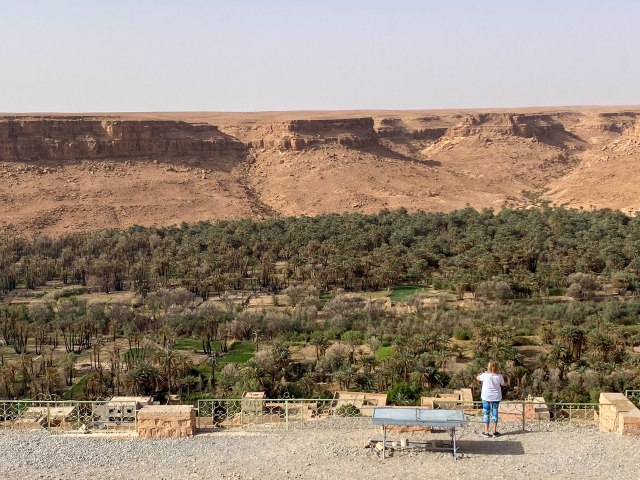
Fifty-four miles stretch from Sword Beach in the east to Utah Beach in the west. It was on these serene beaches, at the crack of dawn on June 6, 1944, that the Allies finally gained a foothold in France. Once on land, these forces had to close the 54 mile gap and meet up to March inland. They also built a floating port in the water to be able to bring in ships with supplies and more troops. Amazing feats in a different time. The following map at the theater in the round at Gold Beach was most helpful to understand the area and what allied troops landed where.
Map of code-named beaches and surrounding area.
A memorial sculpture was built for one of the anniversaries of the landing and was so well received that it was requested to remain as permanent instead of a temporary honor. Here a returning veteran looks out over the landing beach and in his memory sees himself and his Allies coming ashore.
Sculpture representing a D-Day veteran returning to look out to the landing area…..and his view in his mind.
Here, one is able to see remnants of the ‘piers’ that were built in the water to attach ‘roads’ to bring supplies ashore from supply ships!
One of the hundreds of German bunkers perched on the ridge overlooking the beaches.
If you journey to this area, be sure to employ a GOOD guide from the area. Our excursion had a phenomenal guide that provided incredible detail of operations and individuals involved in the various battles and preparations. Our brains were on overload by lunch – so a stop in a quaint little fishing village for a bite was a welcome respite.
Our lunch stop was in this cozy fishing village.
Now for the most sobering site for Americans- the cemetery of Americans killed here – resting above Omaha Beach where they came ashore. The thought that this is only 40% of those eligible to be buried here (families of the remaining 60% asked for the bodies to be returned to the states) is staggering.
Entering the American Cemetery at Omaha Beach.The veteran’s memorial, behind which is a complete listing of those missing in action.The chapel in the center of the cemetery.Inside the chapel.The mosaic inside the dome of the chapel.Both Christian and Jewish are buried here and appropriately noted. Overlooking Omaha Beach.A memorial to the special forces who landed at Pont du Hoc to scale the cliffs and take out the artillery batteries that were to fire on the allied ships off of Omaha and Utah Beaches.Omaha Beach looking east……and west. Utah Beach is 8 miles in this direction.One of the many monuments we encountered along the way.
After the very sobering stop at Omaha Beach, Pointe du Hoc was next. Here is where a German gun battery existed that was able to fire on allied ships as far as 11-12 miles. These needed to be disabled in order for allied success. First there was intense bombing of this area and the bomb-cratered, lunar-like landscape still exists. After the bombing, US Army Rangers scaled the steep cliffs to disable the gun battery. Bunkers of these guns still exist.
A stretch of the cliffs scaled by the landing troops at Pont du Hoc.Several examples of the bunkers at the top of the cliffs.Again, remnants of the floating port can be seen from this vantage point.
This visit is quite sobering in so many ways. Our guide was French (who spoke perfect English) and she commented many times about how grateful the French are for what the allies did here because that allows them to have the life they have now. And how the local citizens take care of many of the monuments, etc and make sure to take their children to see these sights so they don’t forget. Too bad that ALL Americans don’t feel the need to do the same.
E & G – so grateful for what we have – including all of you!