The book “1000 Places to See Before You Die” has 8 pages on Kyoto. This seemed to say a trip there for a few days was necessary – AND, it gave a reason to try out the ‘bullet train’ from Tokyo! The Shinkansen can travel at speeds of up to 200 miles an hour, getting you the 230 miles to Kyoto in less than two hours (with a couple of stops). It also provides quiet, no phone usage cars (how civilized!) and wonderful views of Mt. Fuji – –
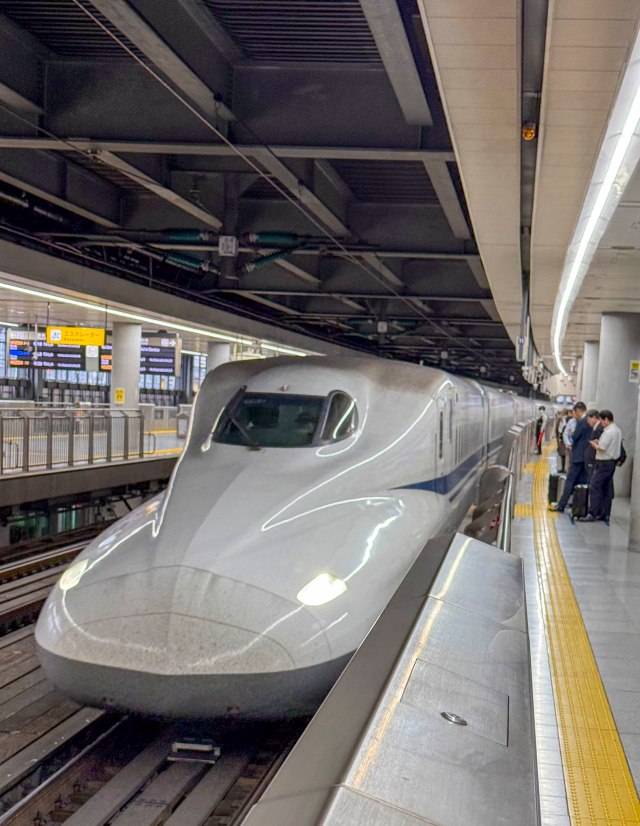
Doesn’t it look like a bullet? Don’t be late – they are ON TIME and only stop for about two minutes.
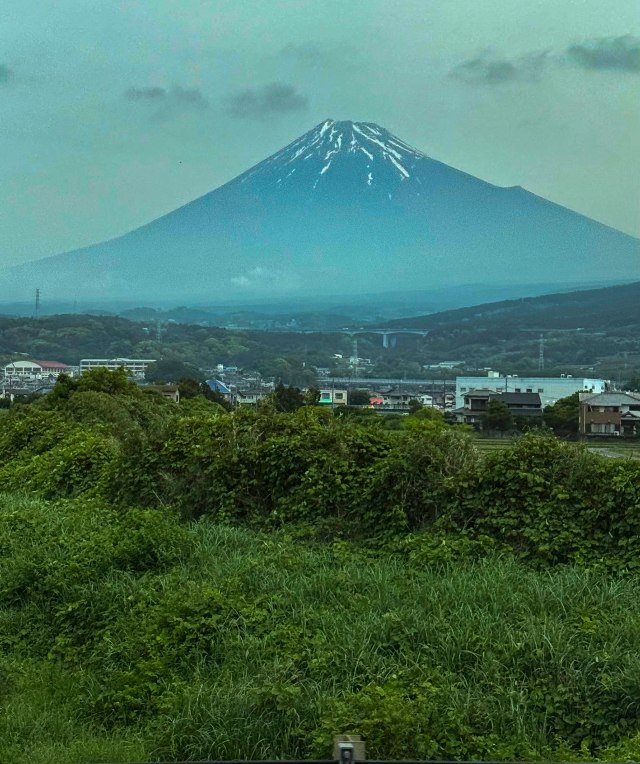
A beautiful sighting of Mt. Fuji.
Kyoto was the capital of Japan for over 1,000 years – from 794 to 1868. Being the home of the Imperial Court for so many years, it also became the center of Japanese religion, music, theater and dance. Because it was spared of Allied bombing during World War II, it still contains more than 1,700 Buddhist temples and 300 Shinto shrines many of which are UNESCO World Heritage Sites. Don’t worry – this post will only cover a few of these;-)
The Kamo-gawa (River) runs through Kyoto adjacent to the Gion District, and provides a fantastic walking path for 19 miles. Just a block west of the river is the Takase-gawa canal. Built in 1614 by two wealthy merchants, the canal carried over 100 flat-bottomed cargo boats to and from Osaka in its heyday. The cargo activities stopped in 1920, but the scenery, clear water and beautiful cherry and willow trees made it a favorite walking (and eating) street for us.
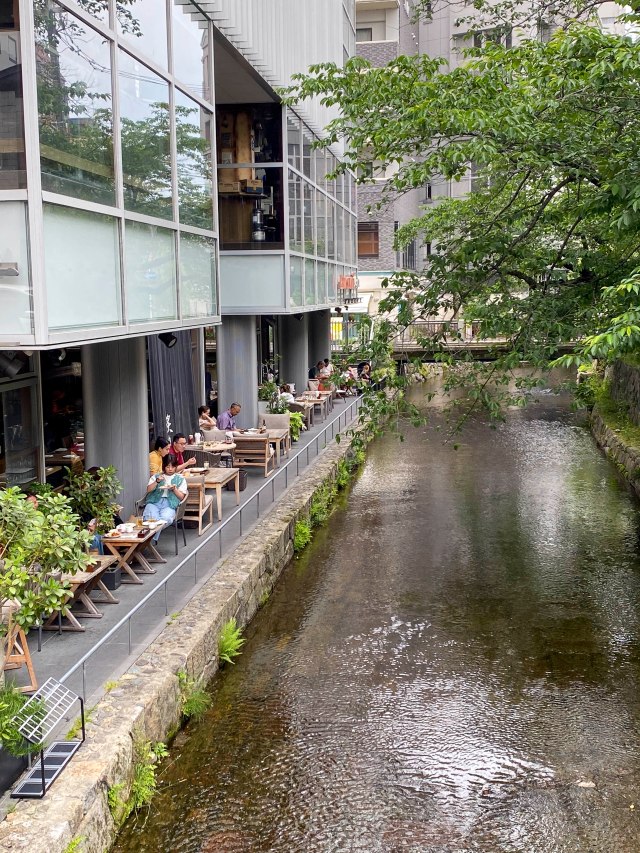
Pizza Salvatore – the first and last lunch in Kyoto along the Takase-gawa. Yes – Italian in Japan!!
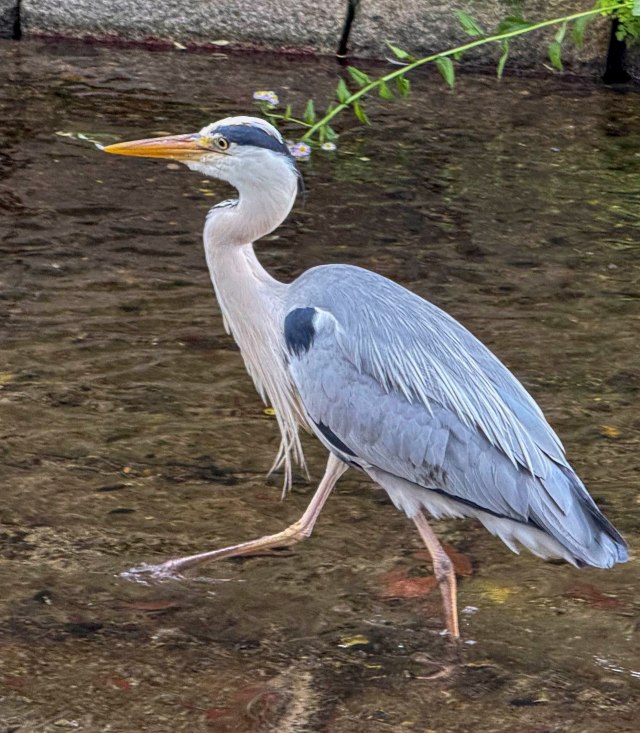
His favorite lunch spot also!
Time to get serious and head up to the Kiyomizu-Dera, one of those 1,700 Buddhist Temples and a UNESCO World Cultural Heritage Site. The Temple was founded in 778 and is associated with one of the oldest sects of Buddhism in Japan. The grounds include 30 Buddhist temple buildings – most of which have been destroyed by fire over 10 times throughout the years. The current buildings were reconstructed between 1631 and 1633 – without a single nail! The crown jewel of the complex is The Main Hall with its large wooden terrace that juts out over the valley providing beautiful views of Kyoto. There is spring water to drink – which is said to have wish granting powers – and a Jishu Shrine dedicated to love – which may help one find their life partner. It seems that the thing to do here is ‘the kimono experience’ – rent kimonos, have pictures taken and trek up to the various temples to obtain good luck – or your partner!!
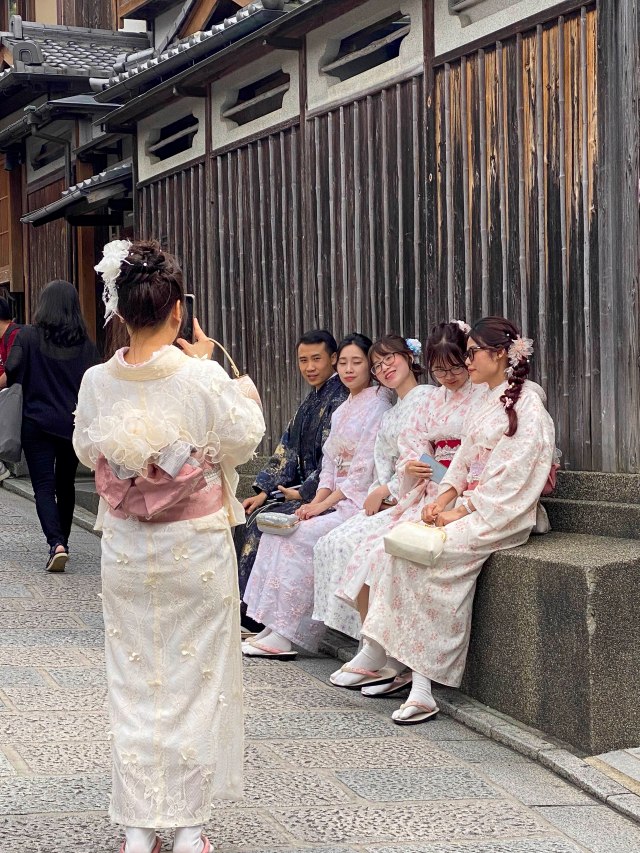
A very small sample of the Kimono clad headed for the Temple.
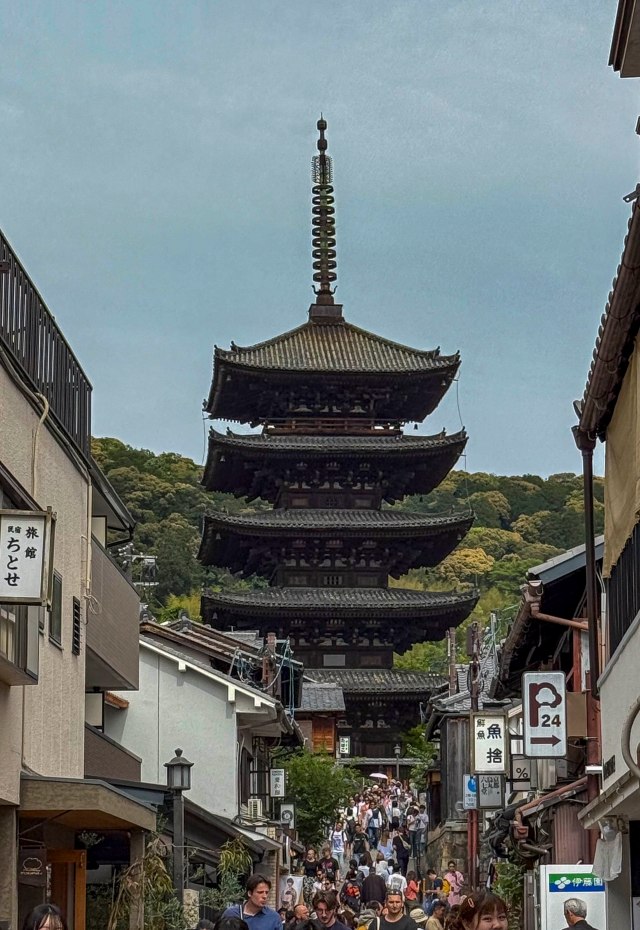
A VERY popular activity – this is Monday afternoon and packed!
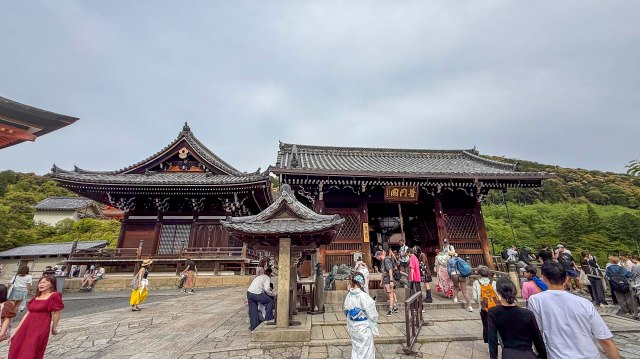
Some of the 30 temple buildings on the site.
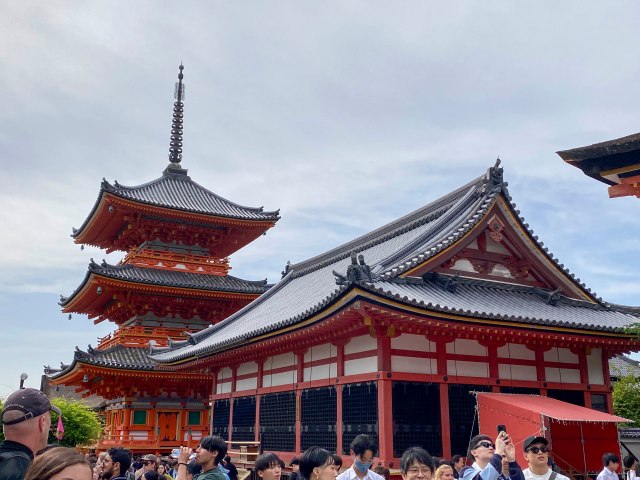
.
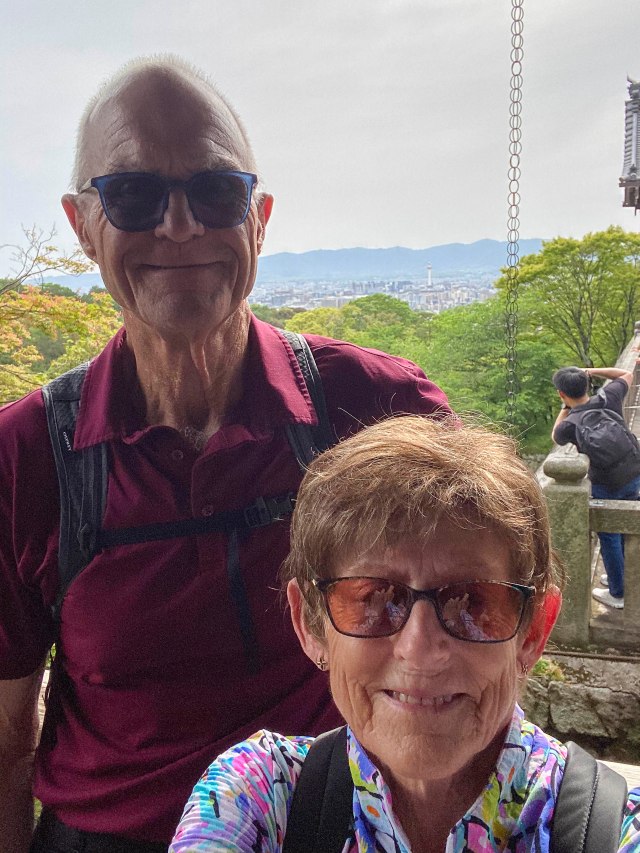
View of Kyoto from the Main Hall Terrace.
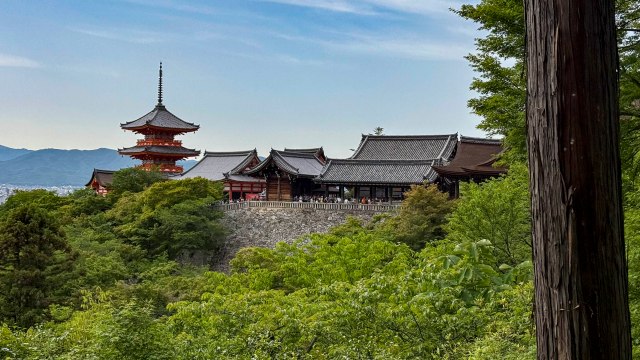
The temple complex from the trail back down to Kyoto – Main Hall to the right.
Another day – the Shinto Shrine Fushimi Inari Taisha. This Cultural Site is actually made up of five shrines named for the great virtues of Inari, and was established in 711. Inari is described as a deity who feeds, clothes, houses and protects so that ALL may live with abundance and pleasure. Simply – Inari is the Shinto god of rice and prosperity and Inari’s messengers are the fox (which are seen in great numbers throughout the Shrine). From the Shrine to the top of Inari Mountain are 10,000 vermilion (vermilion symbolizes the life force and counteracts spells) gates leading the way.
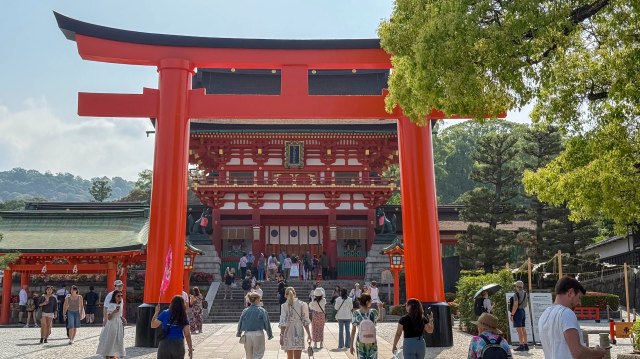
The Main Fushimi Inari Taisha Shrine.
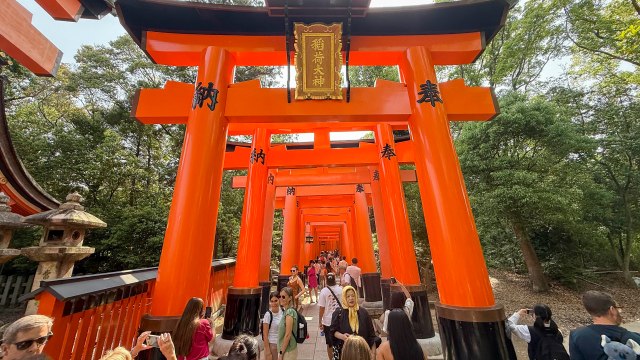
Begin the trek to the top of Mount Inari.
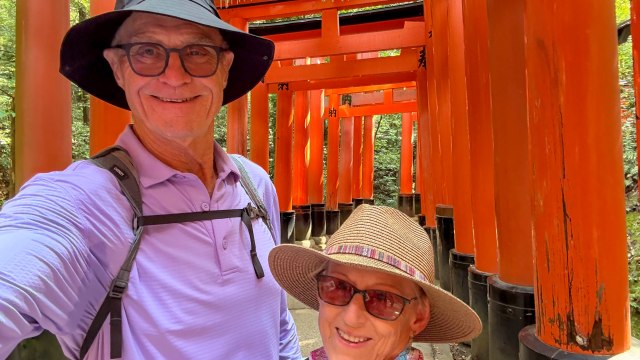
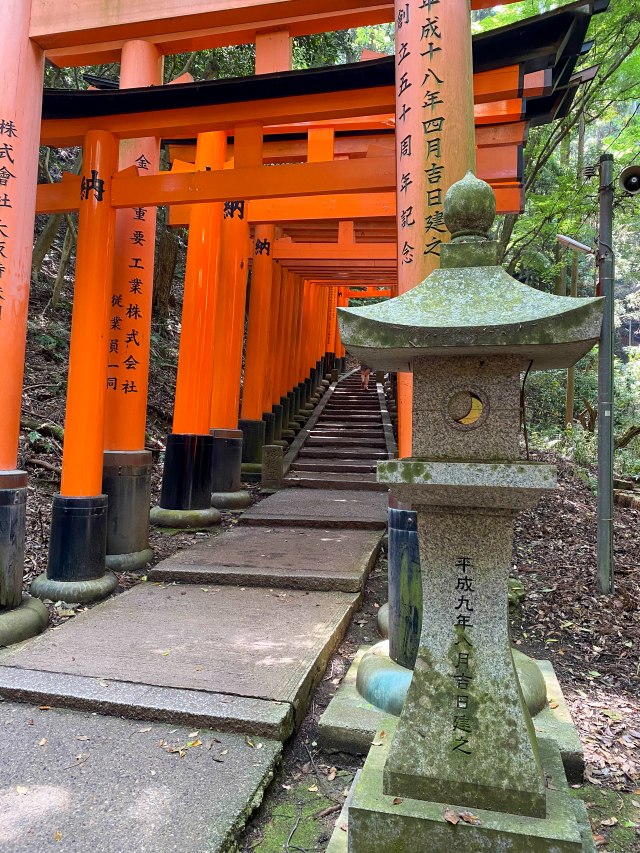
A small portion of the recorded (by Apple watch) 46 flights of stairs!
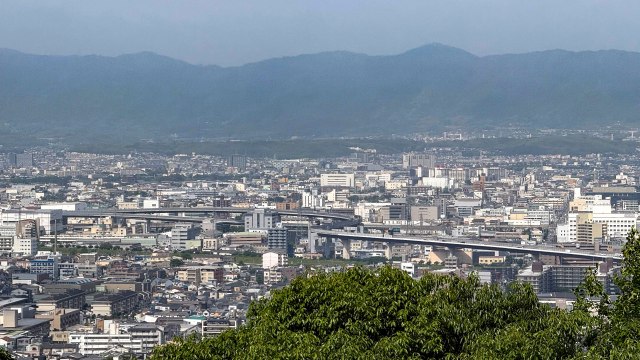
View from the top.
Another ‘must do’ in Kyoto is to experience the Gion District and have dinner and/or drinks with a Geisha and/or Maiko (a Geisha in training). Since this occurs a little later in the evening, a nice dinner might precede such an event. A great meal and wonderful experience can be had at Kobe Beef Steak Mouriya in the Gion District. The spot for two with private chef and cooking table made for a delightful experience (and our most expensive in Japan);-)
Wonderful teppanyaki dinner around the corner from the Kabuki Theater.

The Minamiza, the primary kabuki theatre in Kyoto, was founded in 1610 as Shijō Minamiza. The current building, with a 1,086 seat capacity, was built in 1929. Unfortunately, the theater was dark while we were in town.
Full stomachs and a few good sights around the Gion District, and ready for a tea and saki meeting with a Maiko – and much to our surprise a Geisha. The Maikos may begin their training as young as 14-15 years old. If they are accepted by a ‘house’ for this, they must commit to a 7 year contract. (At this age the parents must also agree to this training.) The ‘house Mother’ may invest several $100,000 in a young girl between training, kimonos and housing – thus the contract. They are trained in traditional music, dance and entertainment (nothing intimate). This was quite a fun evening especially having a young woman in training and a very experienced Geisha to ask questions of and learn about their lifestyle.
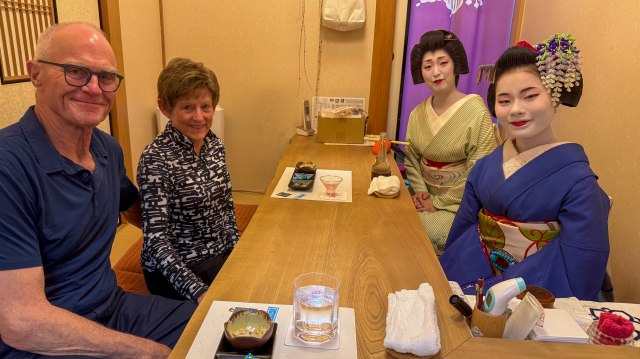
Spent a pleasant evening with Gaiko (a Geisha) and Maiko (a Geisha in training).
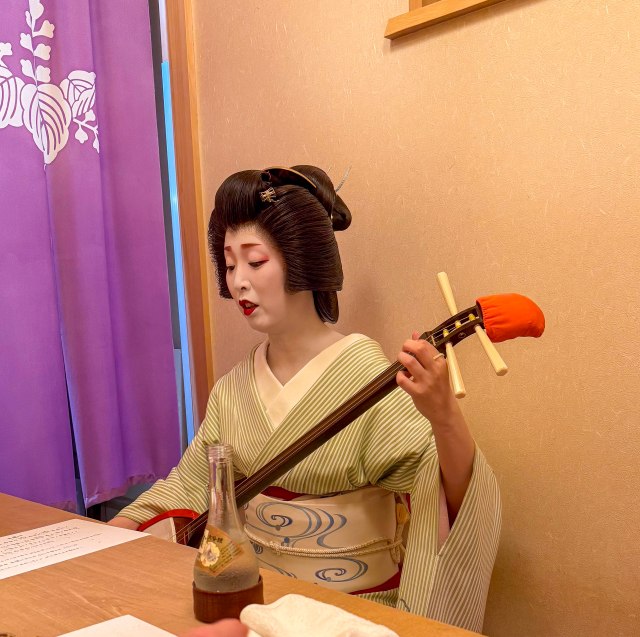
The Geisha played and sang…

…while the Maiko danced.
Sanjūsangen-dō temple is most famous for its 390 foot long hondō (main hall) dating from 1266 and the collection of sculptures it houses. In the center of the interior sits the 11.5 foot image of Kannon (one of the most beloved and widely venerated deities in Japanese Buddhism) with eleven faces and one thousand arms. On both sides of the central image stand 1,000 images of Kannon. These are wooden statues made from Japanese Cypress and plated with gold leaves standing at human height. At the front of the 1,000 statues are 28 Spirits who protect the universe. The thought of the work that has gone into the creation of these sculptures is overwhelming.
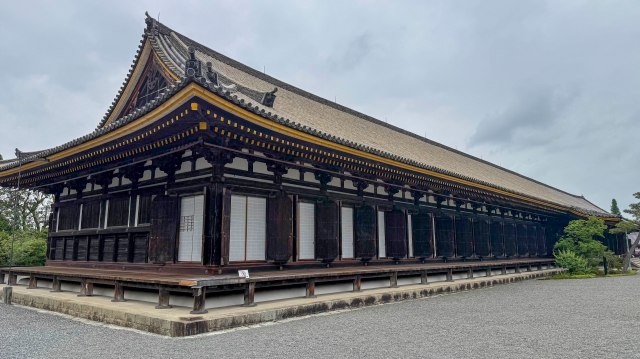
The Sanjusangen-do Temple.
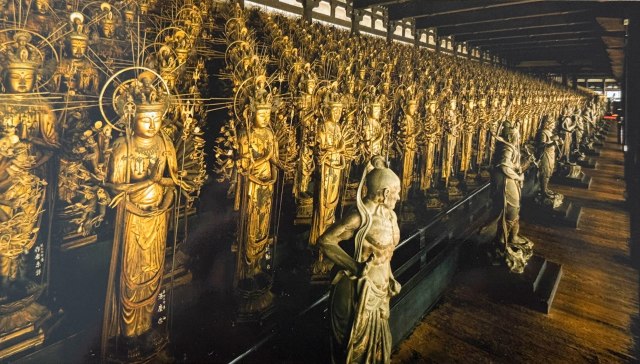
Postcard images as no photos are allowed in the Temple. (This is much better as the 100’s of years of dust and dirt that have accumulated on the statues is not seen.)
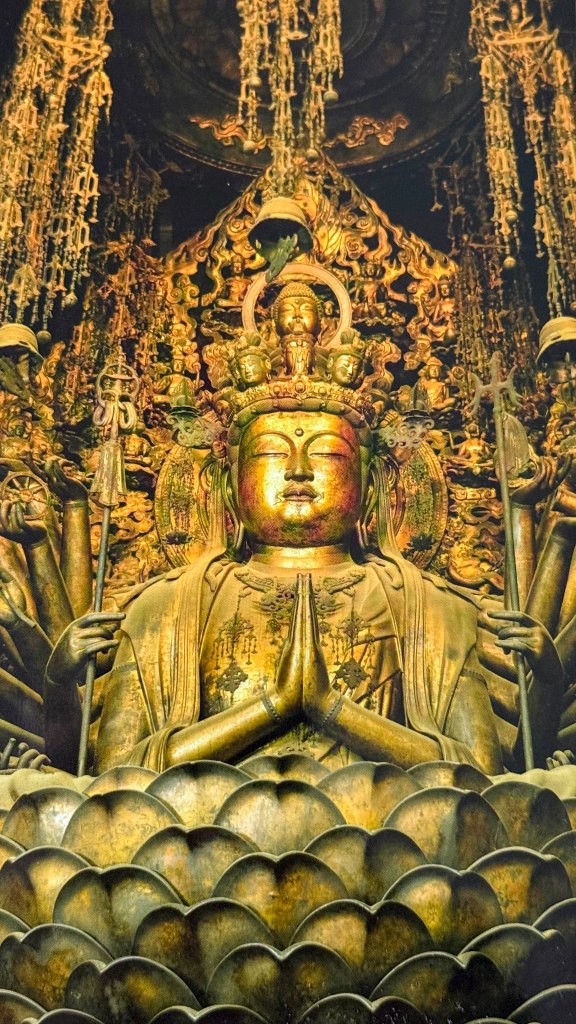
11.5 foot tall Kannon at the center of the 1,000 images.
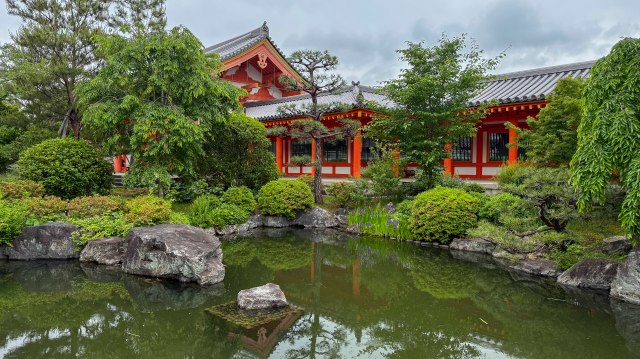
Gardens on the temple grounds.
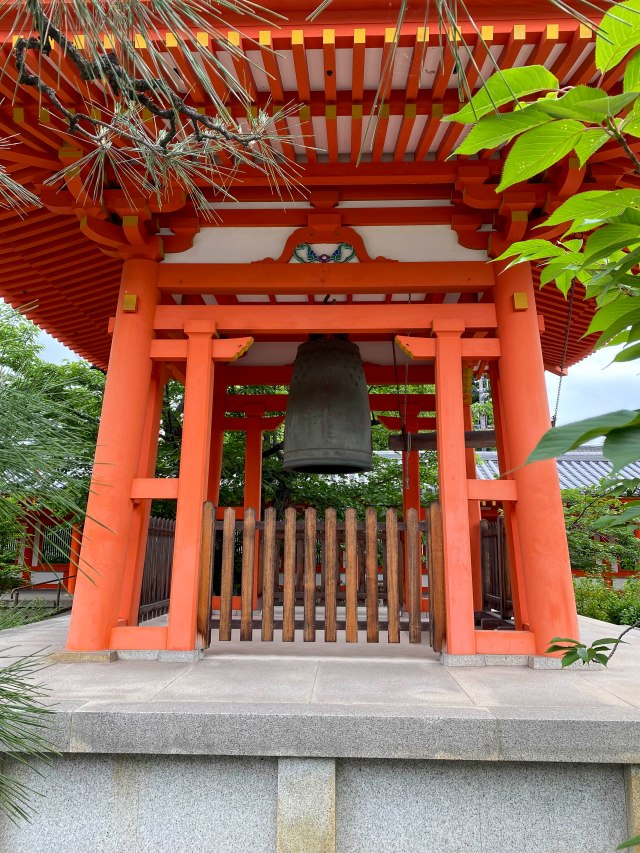
Bell tower adjacent to the temple.
So – there you have three of the most important shrines and temples in Kyoto. Perhaps if you visit, you can add more of the remaining 1,997 to your experience. For now –
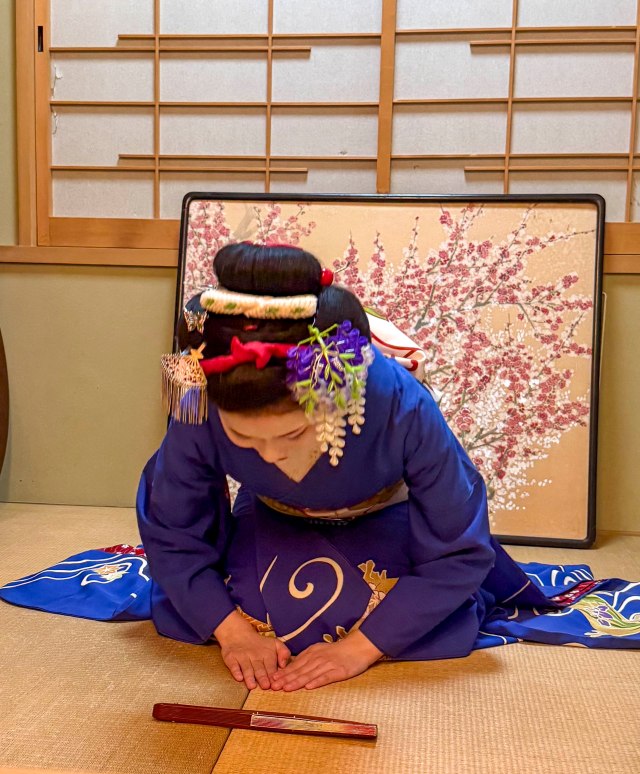
Sayonara;-)
Kyoto was awesome!! Could have spent several more days here – so glad to have experienced this wonderful city.
E & G – Happy in Japan
 Elizabeth & Gary's Magic Bus Tour
Thanks for allowing us to share your adventures
Larry & Laraine
LikeLiked by 1 person