KAISERBALL – Happy New Year!!

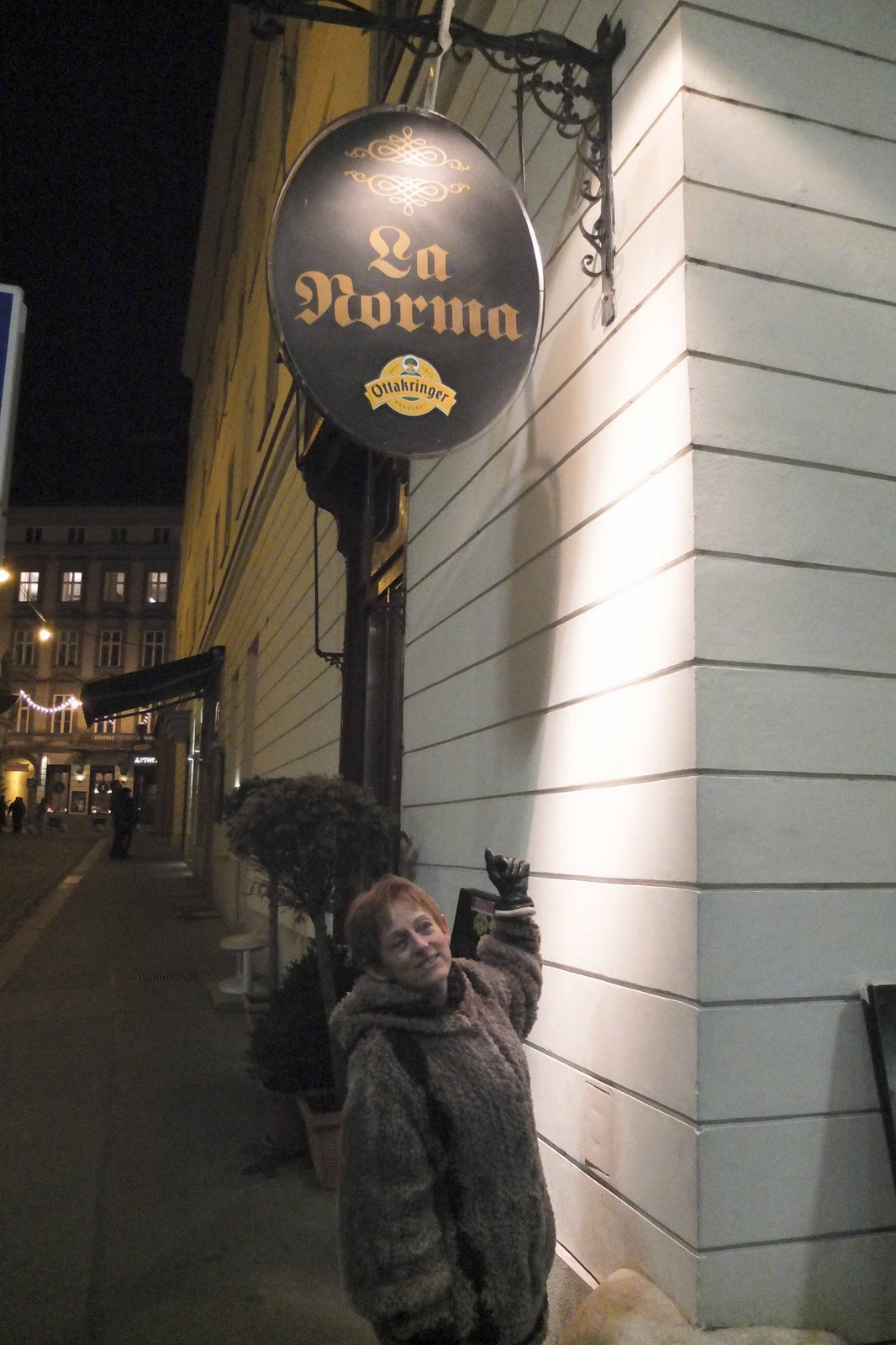
Finally – Vienna – or Wien (veen) as is said here.  ‘Everything going right’ continued as we arrived at our ‘home’ in Wien – the Marriott.  After unloading our many bags from our new Land Rover – our room proved to be ‘roomy’ (not always true here in Europe) – BUT, more important, our box with ball gown and tux was waiting, as were our tickets for ‘THE BALL’.   With our minds at ease, dinner must be around the corner.  Leave it to us to find one of the best Italian restaurants in Wien – La Norma.  A tiny place with only 9 tables and one of the BEST gorgonzola sauces (rivaled only by the gorgonzola sauce on our barge trip in France!) on their fresh gnocchi.  This was definitely worth a picture – 
 DELICIOUS!!

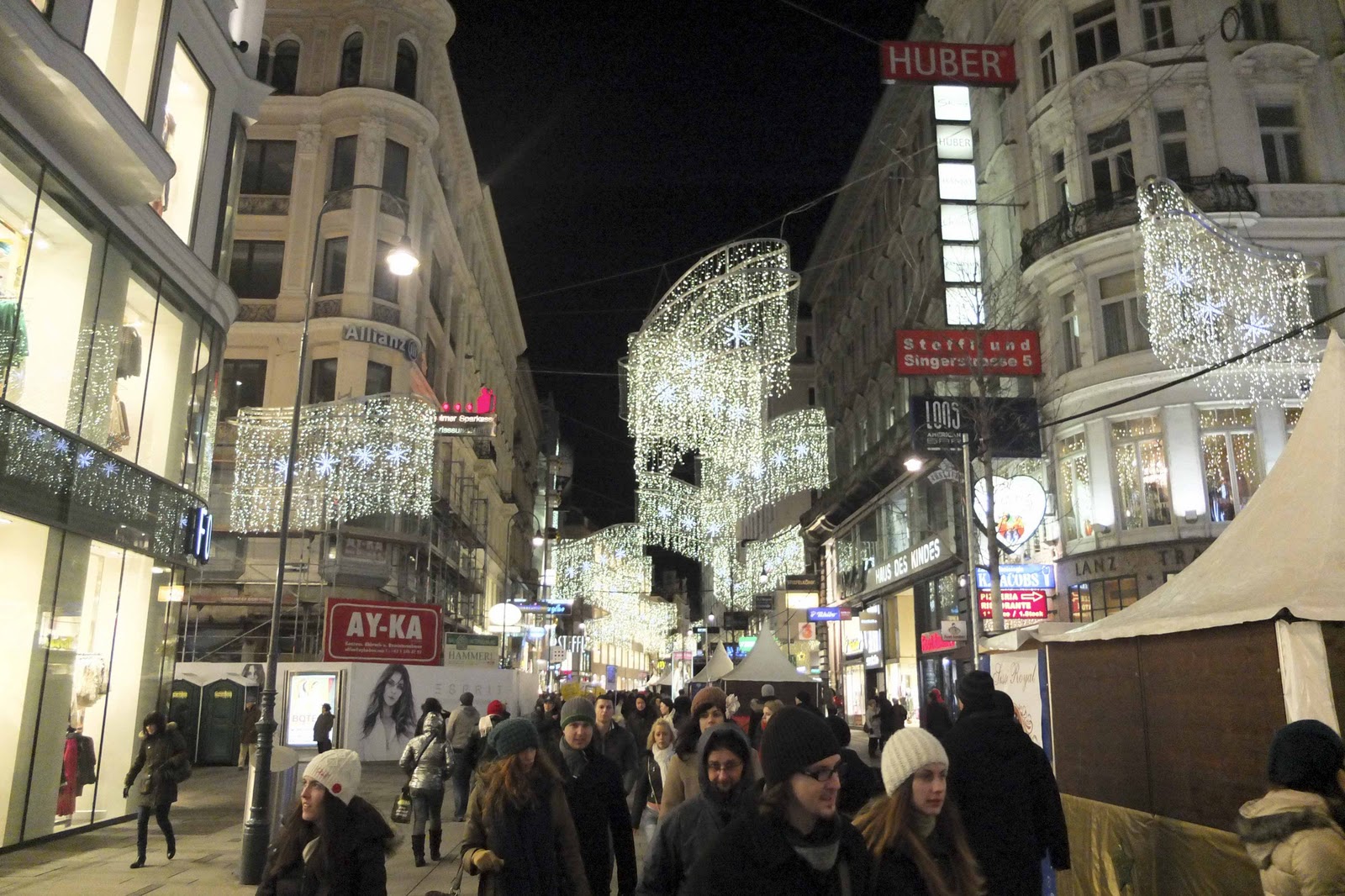
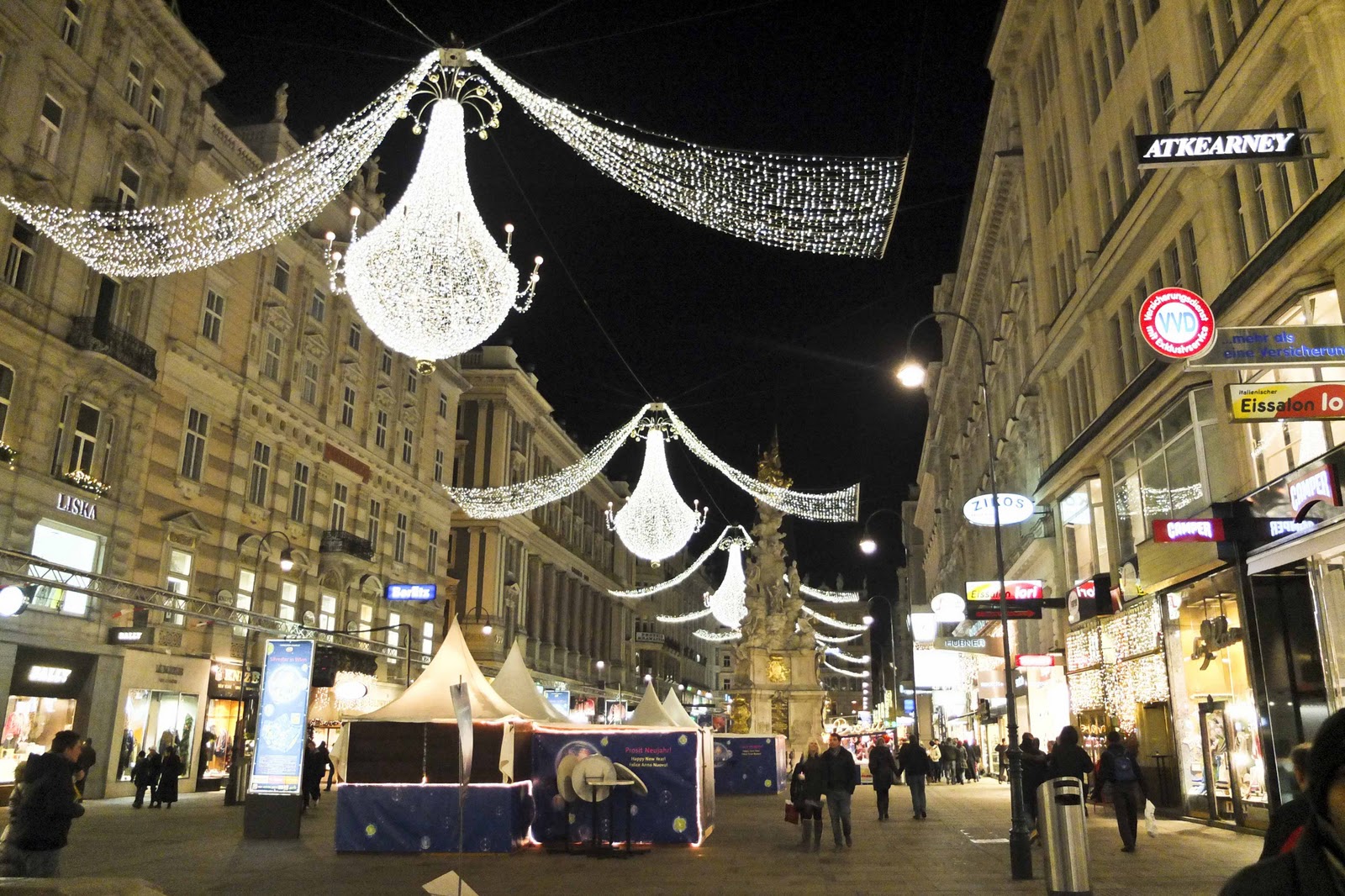
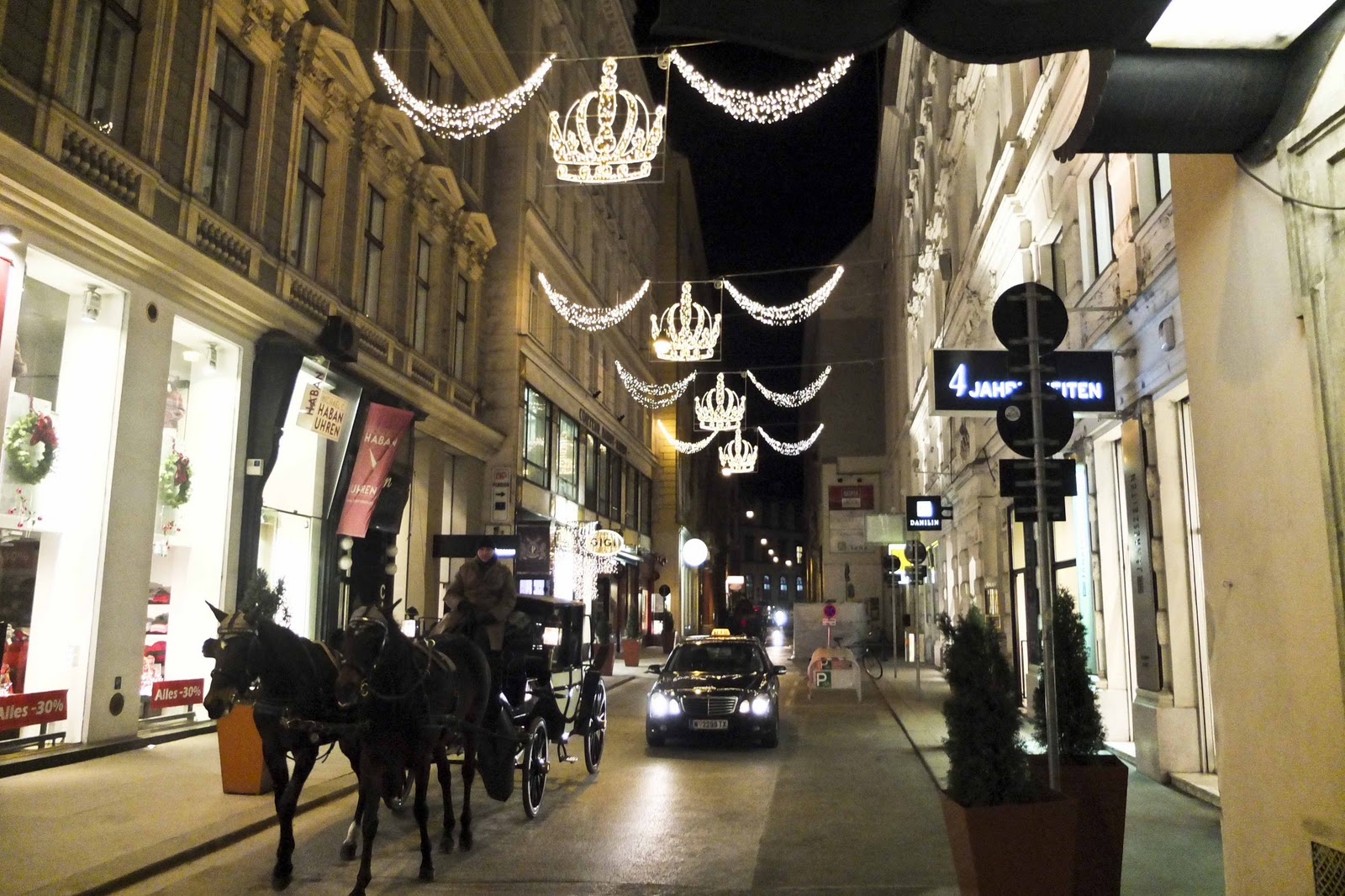
All that VERY rich gorgonzola sauce needed to be walked off – so we checked out the happening areas of Wien.  The decorations were wonderful and preparations for New Year’s Eve were everywhere –

 The many pedestrian only areas were already jammed – but stunning!
 Every street had its own theme of lights.
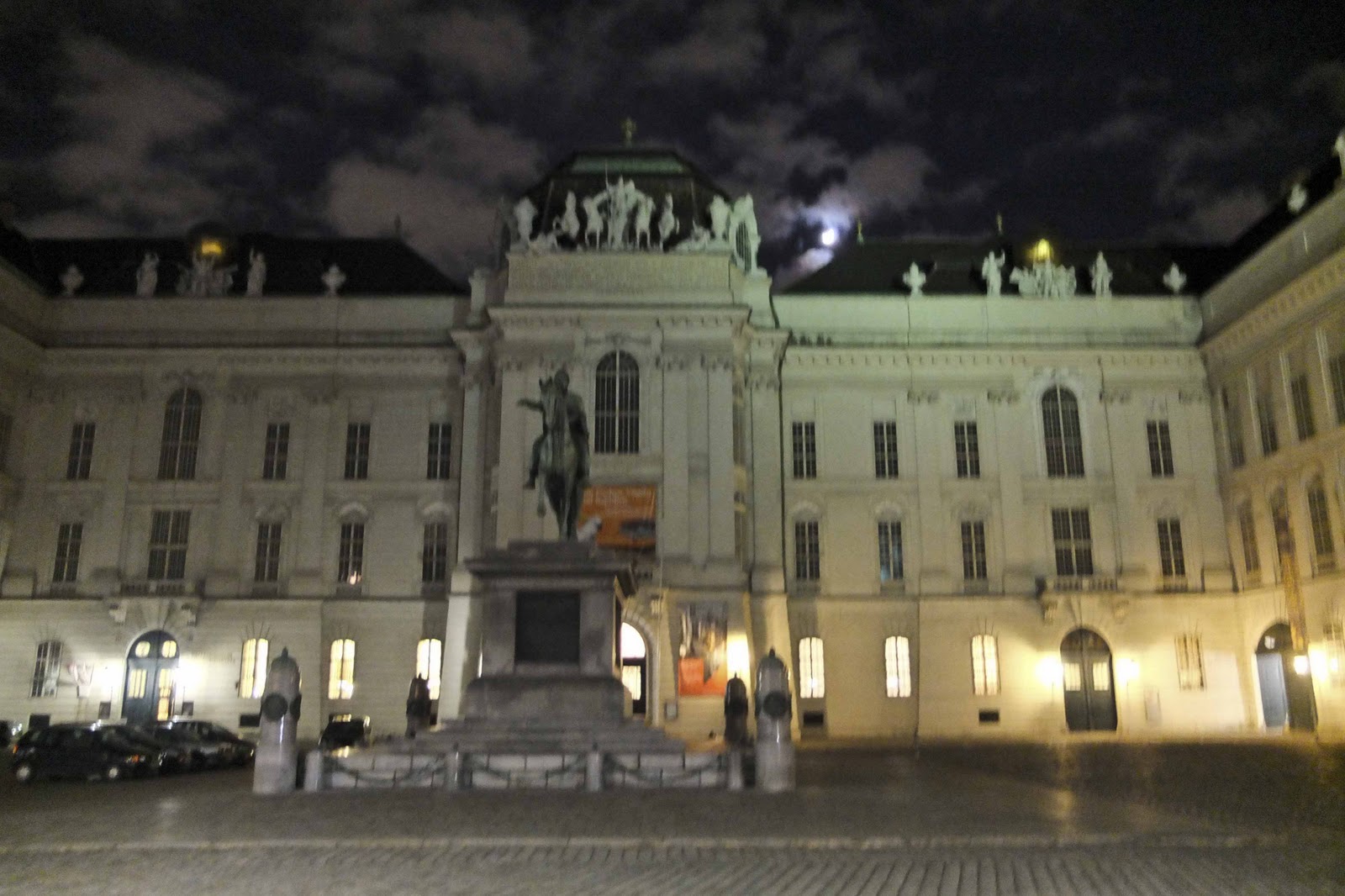
 Can you guess… this is the street that leads to the Palace?
 The backside of one part of the Palace with the moon shining brightly over it.

After almost a full year of planning – New Year’s Eve Day is finally here and we had waltz lessons at 2PM –  

The waltz lesson classroom!!
After the lesson, there was just enough time to have a wonderful true Austrian dinner of Tafelspitz (delicious boiled beef) and then get all gussied up for THE event.
When we arrived, we were admitted to the Foyer of the Palace to await our admission to the Festsaal.  A string quartet and a glass of champagne entertained – 
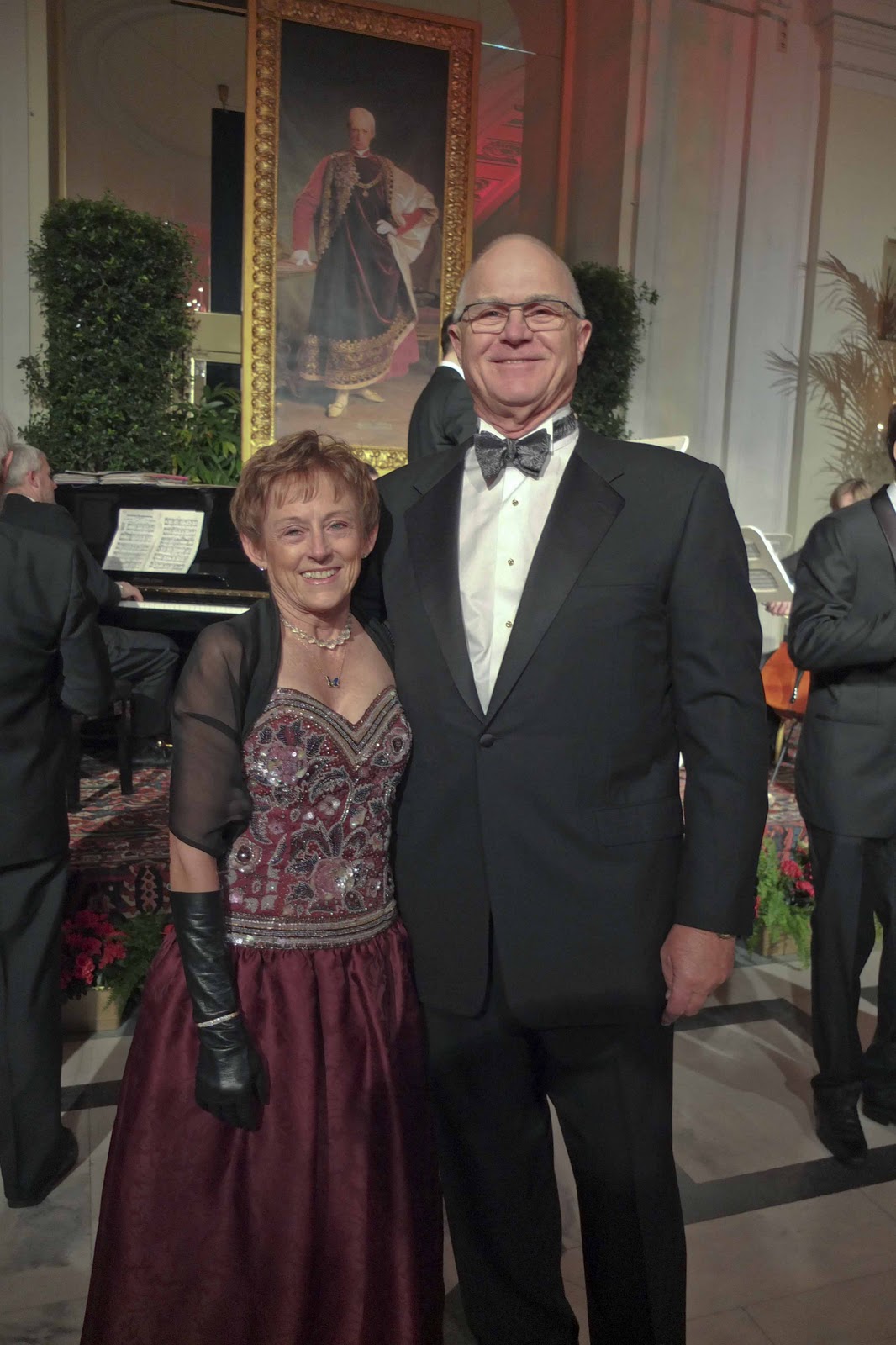
 Pure royalty – don’t you think??

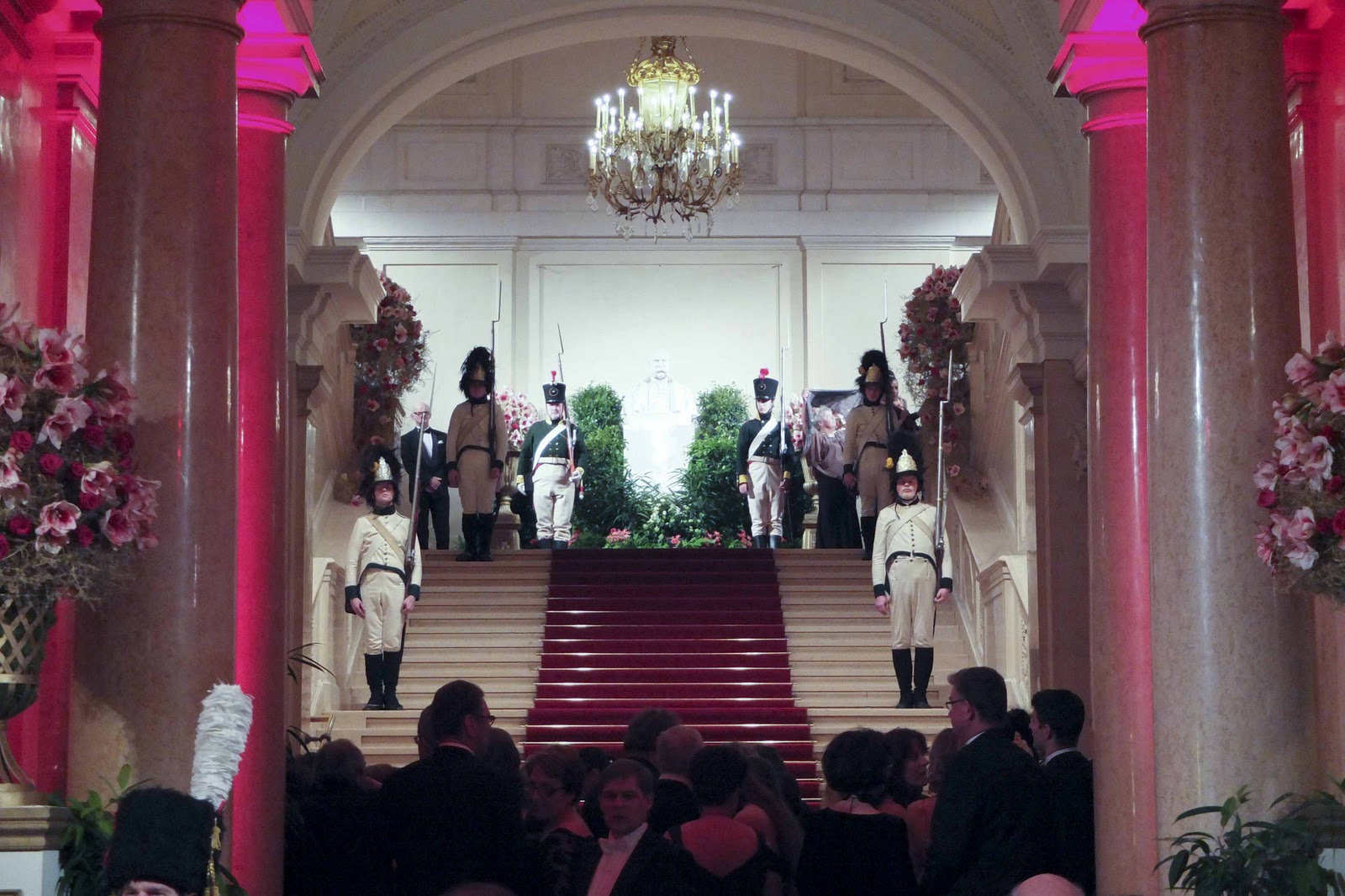
PROMPTLY at 10PM we ascended the stairs with much pomp and circumstance –

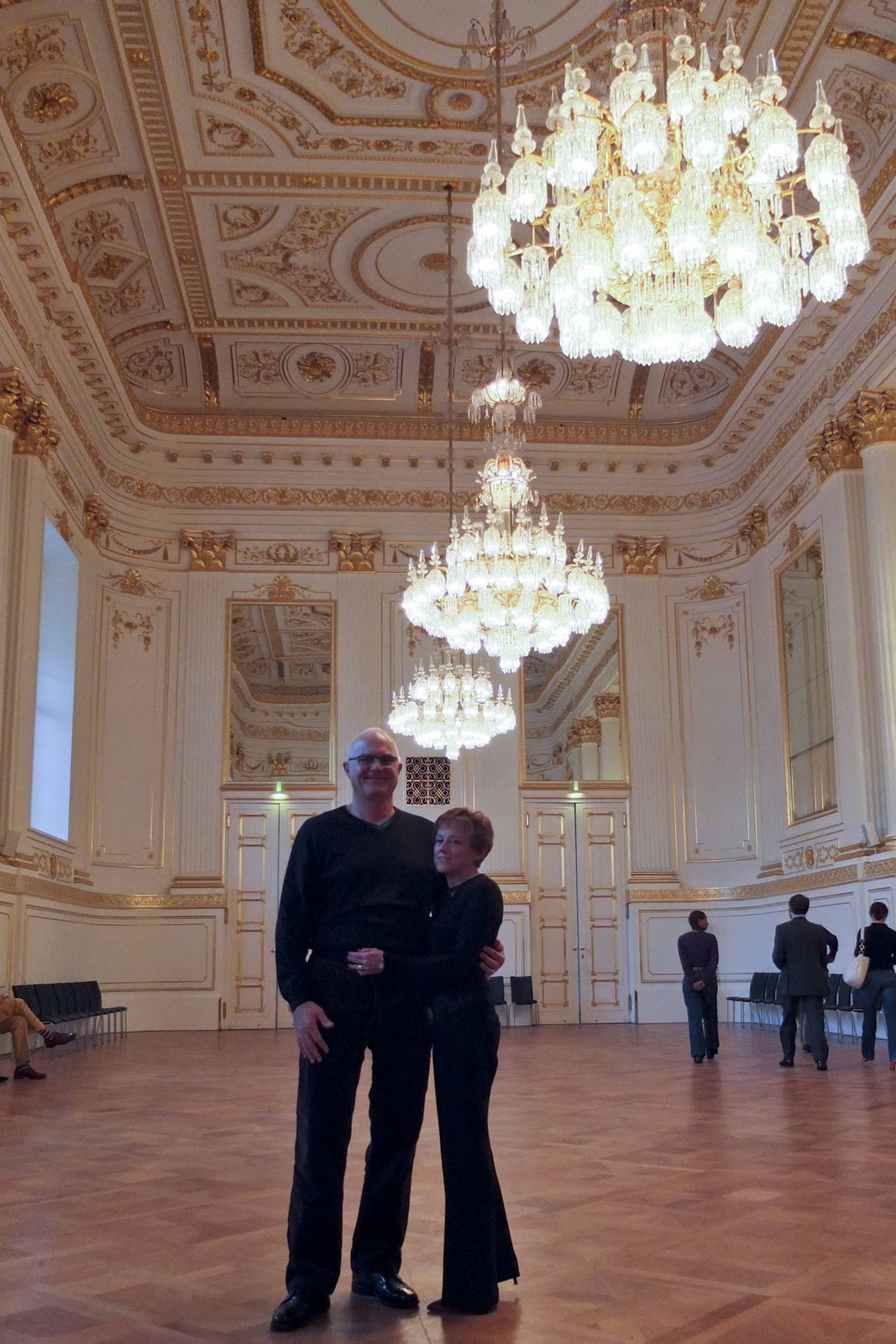
And here was the Festsaal – the main room (of the many in use) for the night’s festivities.  Our table was the third from the front on the lower section of the right side!!  VERY close to the front stage AND right on the dance floor.  What more could we ask?!?!

HAPPY NEW YEAR – THE FAIRY TALE!

Perhaps you can get a little better ‘flavor’ of the evening with the following video.  Our entry in the foyer, the presentation of the ‘debs’ at the ball and the final countdown to 2012 are presented  –

A Magic Trip – First Leg to Salzburg

Well – It was a very long day.  But, the almost 11 hour flight from Salt Lake City to Paris went fairly smoothly as did the transfer and 2 hour subsequent flight to Munich.  AND – ALL our bags arrived with us!  A REALLY pleasant surprise awaited when we walked up to our car in the Hertz lot – we had a brand new Land Rover!!  (Although one asks for a 4-wheel drive, the usual assignment is some sort of hatchback/station wagon car, which does not fit a ‘Gary’ body very well.)  
Pleasant surprise…Rental car was, as requested an SUV.  It was also brand new.  What a treat!

So – we were off on our 2 hour drive to Salzburg and were very glad it was not a minute longer;-)  The drive went well and a very nice room awaited us at the Hotel Sacher Salzburg on the river.  All we could muster that night was strength to get us downstairs to a dinner and then crawl into bed.  But, the city of Salzburg was waiting for us in the morning as we did our 4 hour ‘speed tour’.  It is a quaint little place getting ready for their New Year’s celebration.  (Needless to say – another trip would be in order to actually go into the many sights below.)

This seems to be the Rodeo Drive of Salzburg
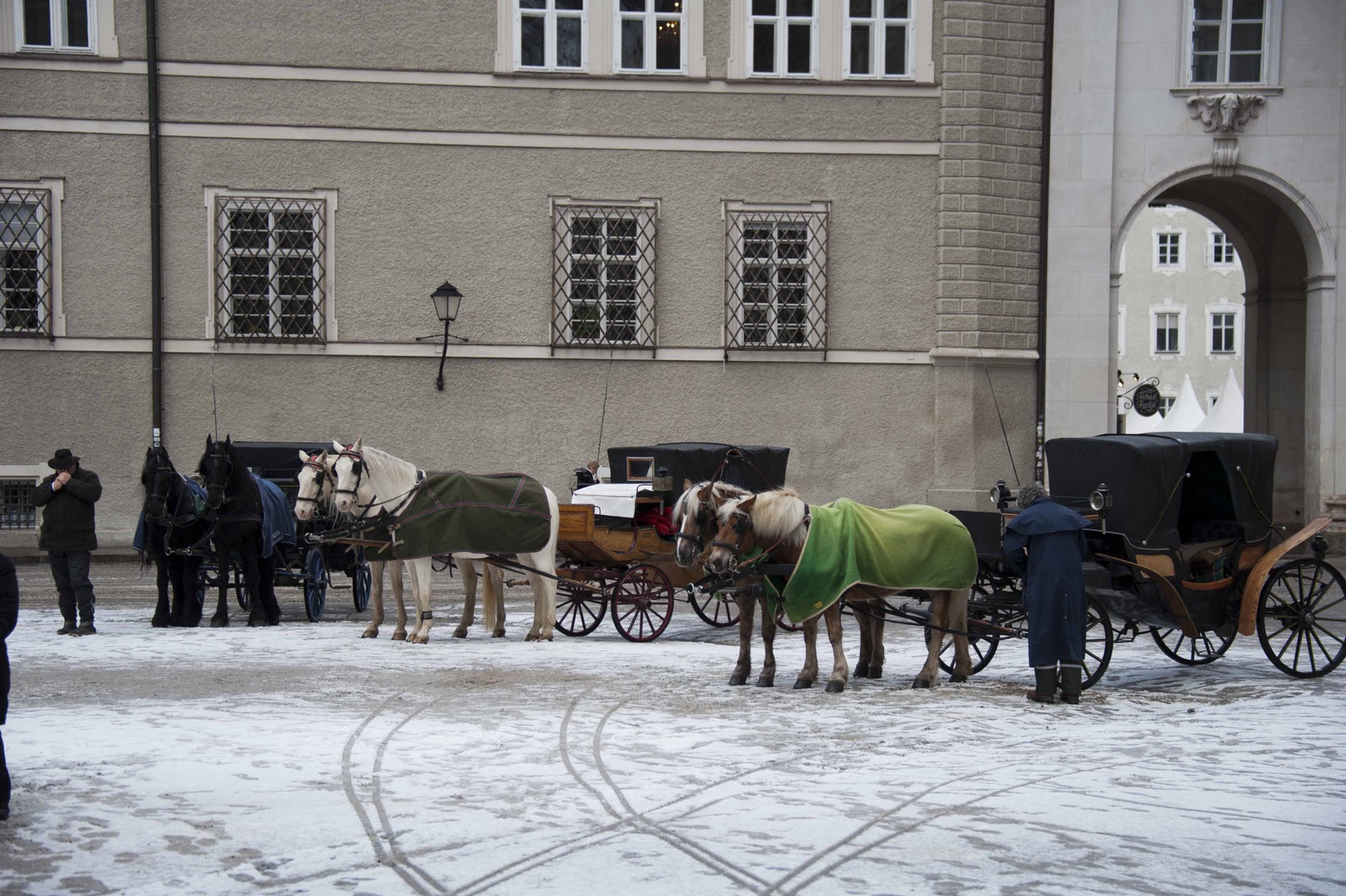
This area is called the Horse Pond-anyone up for a ride thru Salzburg??
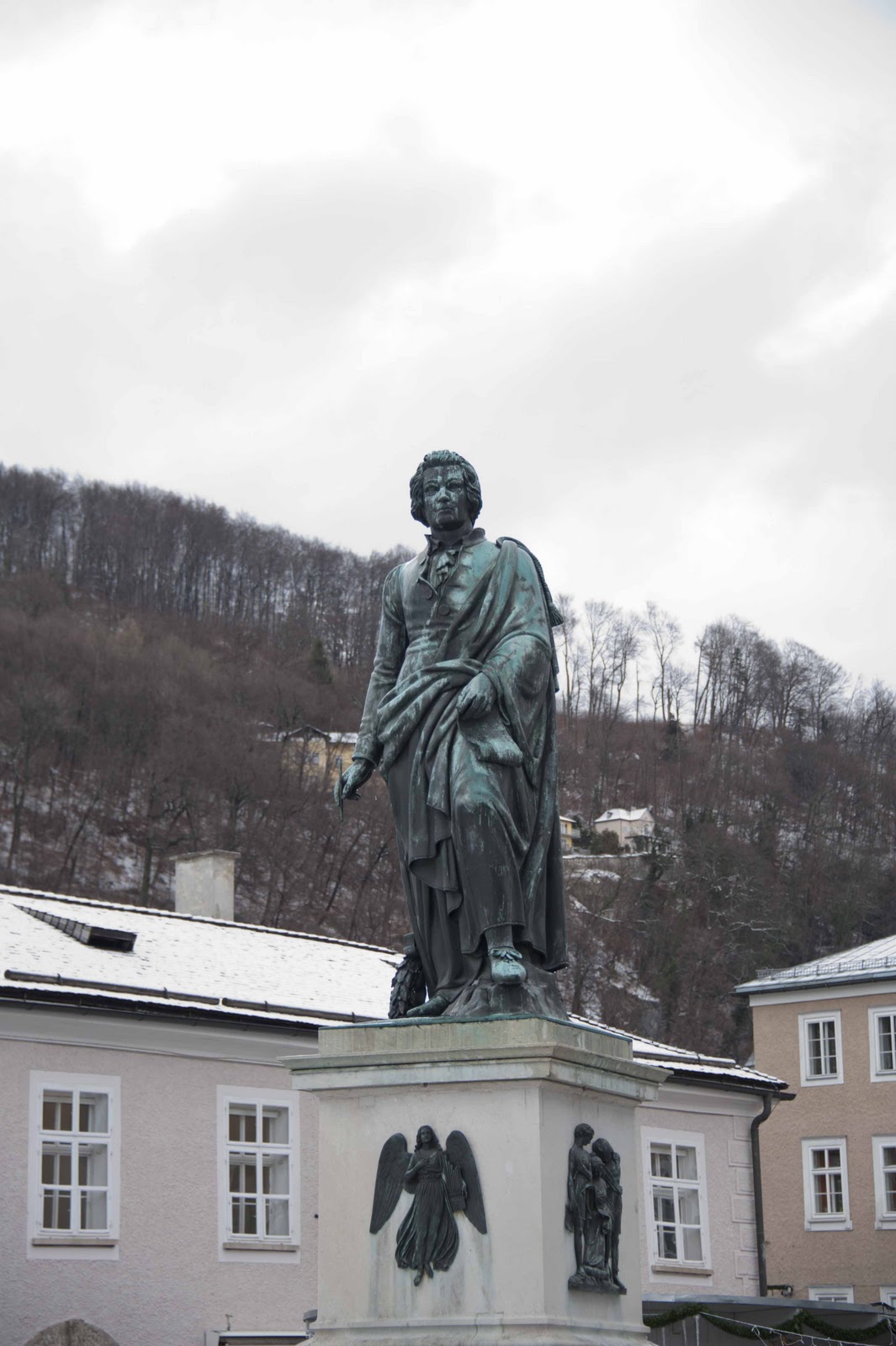
Mozart Statue.  Salzburg was his birthplace.
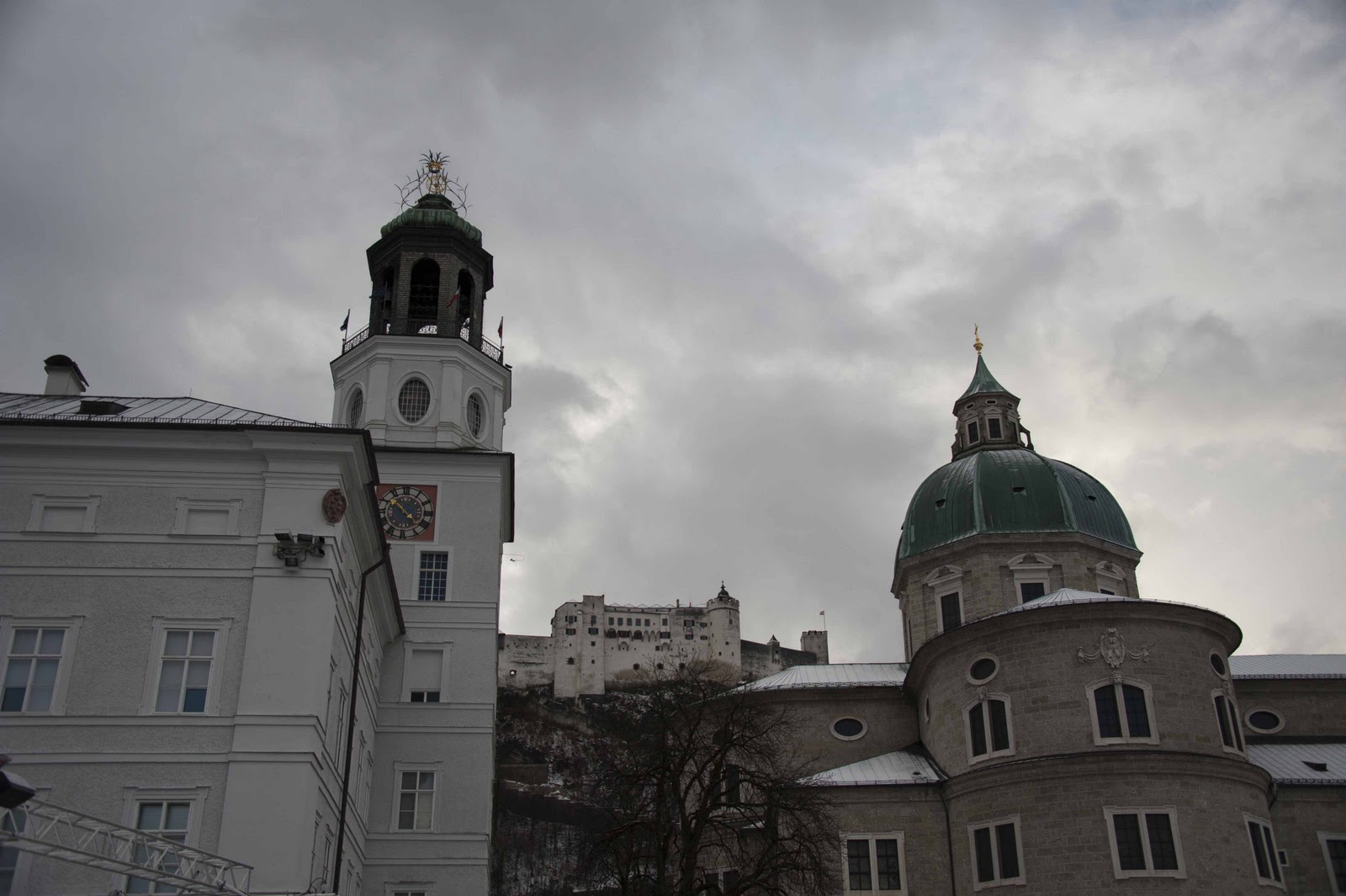
The glockenspiel in the tower on the left played a nice rendition of Silent Night.  Their Fortress is on the hill and the Cathedral is on the right.
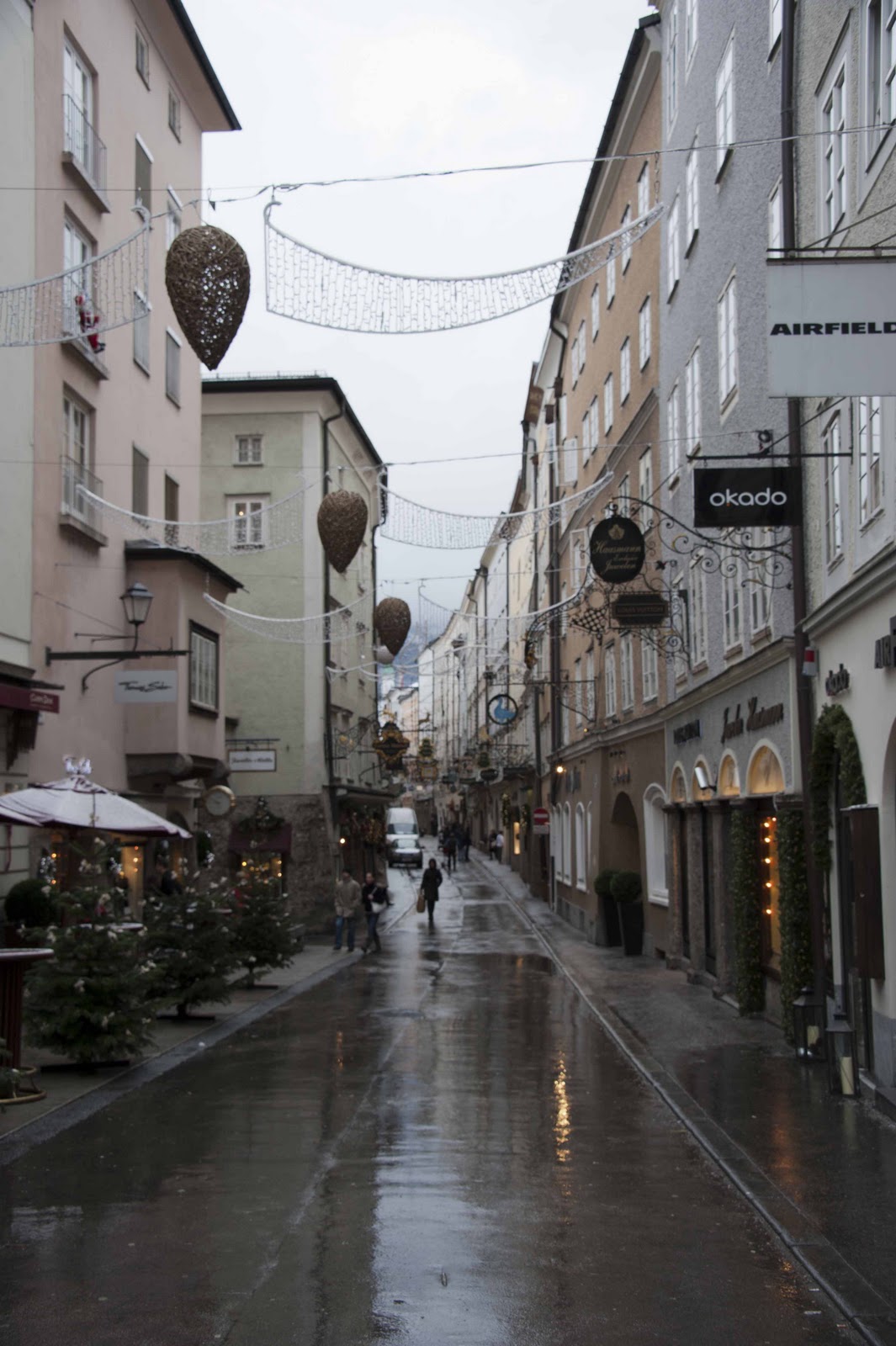
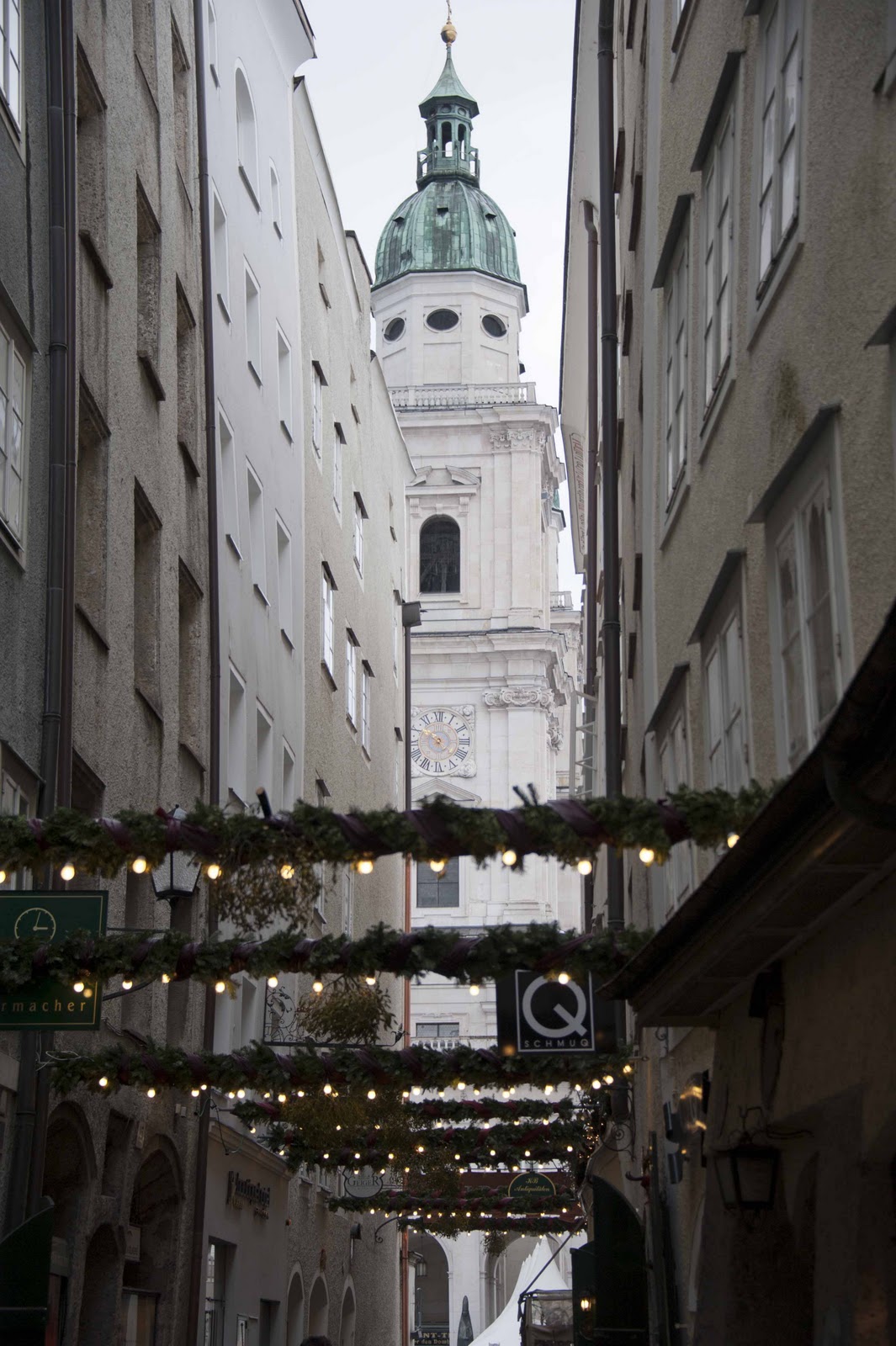
Lots of shops tucked away on the little side streets.
All the decorations were wonderful!!

It was a whirlwind tour of the city finished off by a breakfast/lunch at Cafe Tomaselli – Salzburg’s place to see and be seen!!  Next up is our 4 hour drive to Vienna.

A report on our New Year’s Waltz is up next – Much Love to All – Elizabeth & Gary

November AND December?!?!?!

Gosh – could it really be true that we have left you all hanging for TWO months?  Waiting breathlessly for tales of our next adventure?  Can’t believe we did that to you.

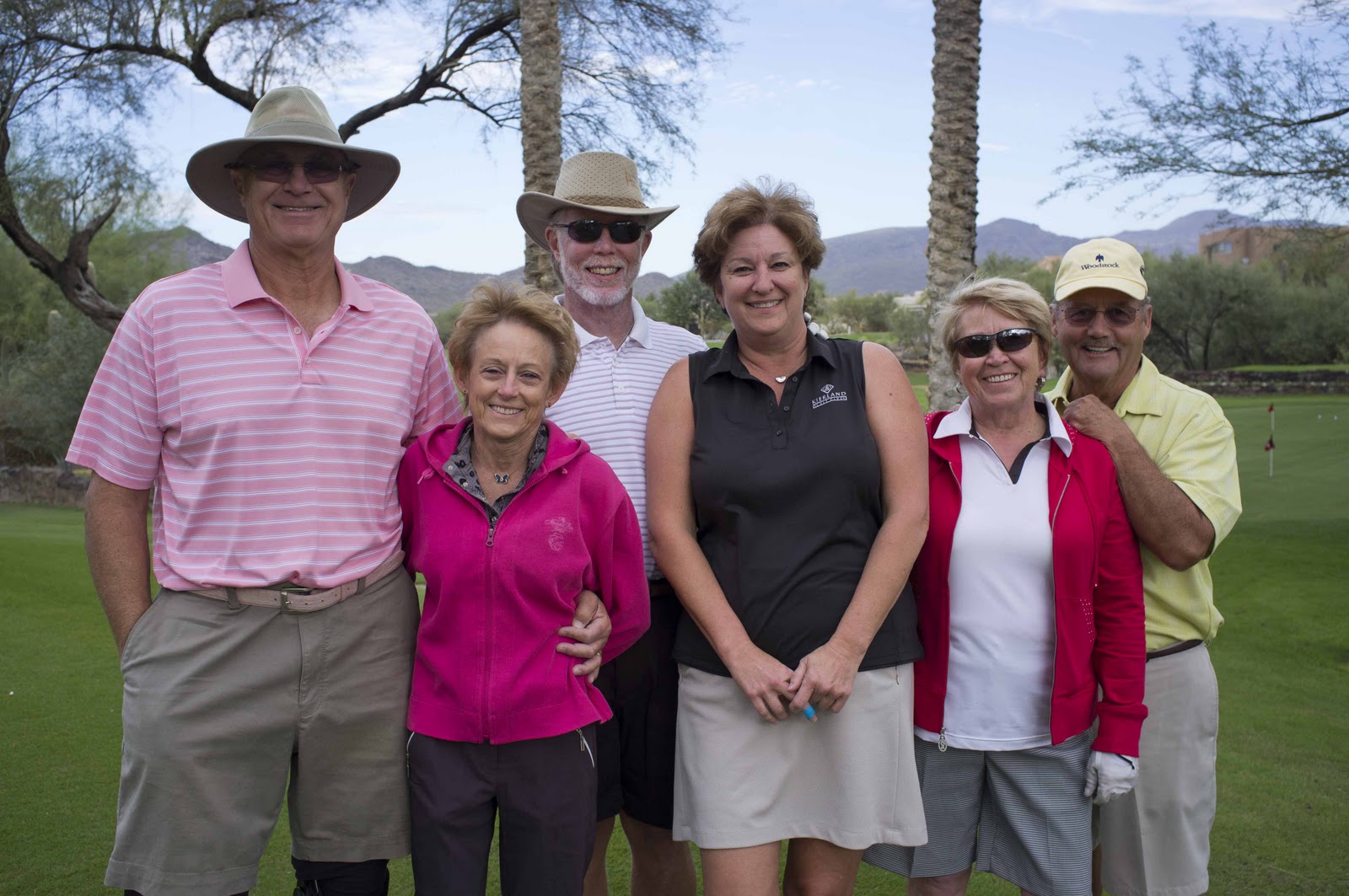
November highlights included a wonderful Birthday celebration for a couple of people with lots of friends  – on the golf course, of course!!

The Birthday Ladies.. Elizabeth and Rheta
Celebrate with a little help from their friends

And then there was a wonderful Thanksgiving Dinner at Barb & Andrew’s.

In between, we were spending a lot of time with flooring, kitchen, shutters, closet, etc. people – trying to get ideas in order for our new townhouse in the Kierland Heritage area of Scottsdale!!!  Exciting – BUT, a lot to take care of.

Immediately after Thanksgiving, we headed home to hit the road again.  Off to Beaver Creek for the World Cup ski races with lots of friends.  Our friend Ted did not disappoint – as he took second in the first GS race and won the second race.

The Ted Ligety fan club front and center in the pink and green hats.

Then it was finally back to Park City to get the house in order for showing and to get ready for a family Christmas.  On December 21st niece Deme and Mother Dorthy arrived followed by sister Barb and brother-in-law Andrew the following day.  We all had a GREAT time skiing and enjoying visiting, even though the weather did not bless us with a lot of snow;-(  In between, Gary made a quick trip to LA to celebrate with his Mother, daughter and granddaughter;-)

Four generations celebrate Eloise’s 90th birthday.
Haley enjoyed her visit with Santa.
Deme inspects her stocking.  Merry Christmas to all…

NOW – we are off to Austria for the KaiserBall on New Year’s Eve.  Will post as many pictures as we can.

HAPPY NEW YEAR TO YOU ALL – with love, Elizabeth & Gary

"Run Ragged" by Haley

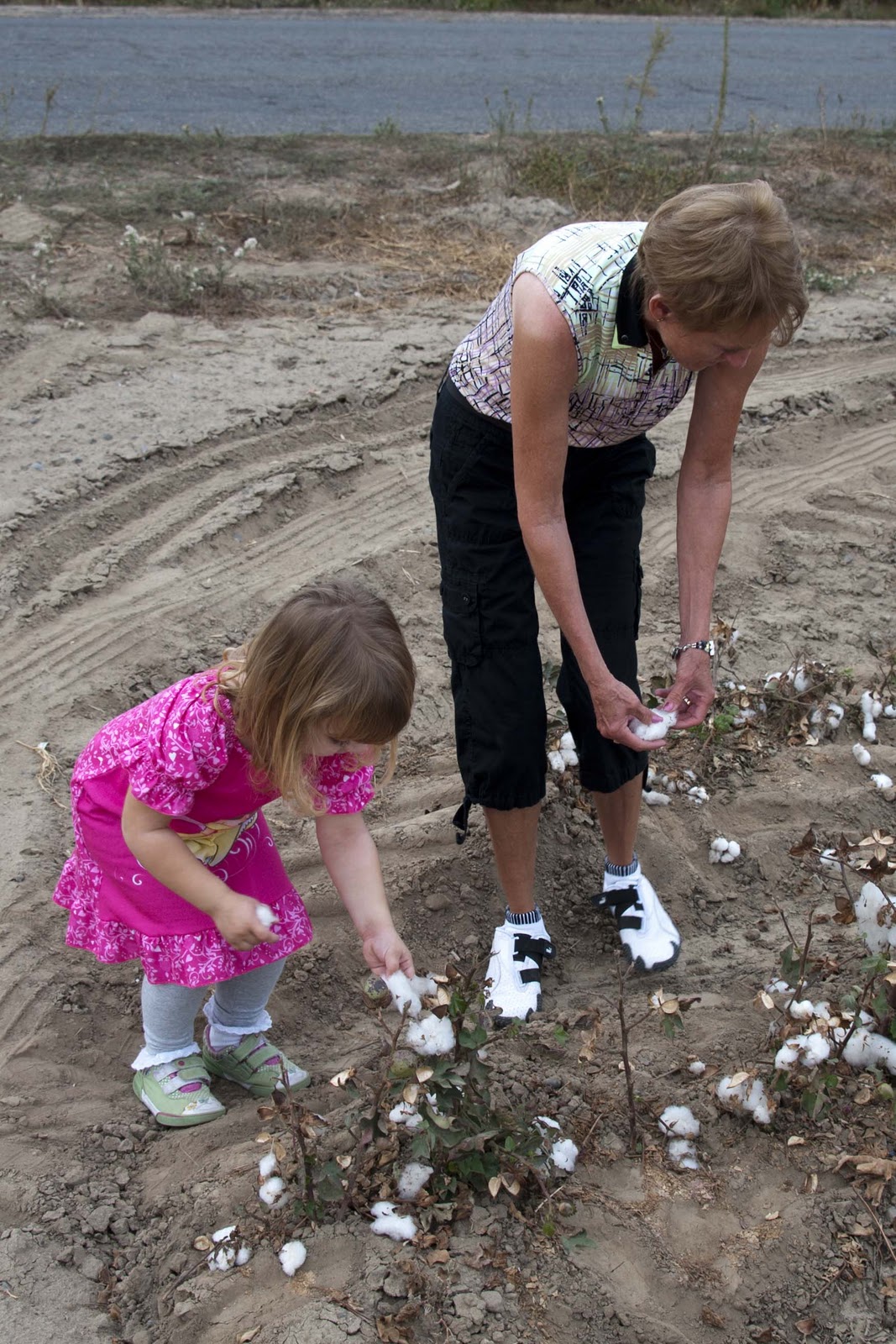
Have you missed us?  Instead of the Trail of the Ancients for the last week – we have been looking at the future with Granddaughter Haley who has kept us busy with dance classes, sleepovers, entertaining in a teepee, hunting for pumpkins, picking cotton, getting face paintings, dinners, shopping and other fun events –
Hmmm

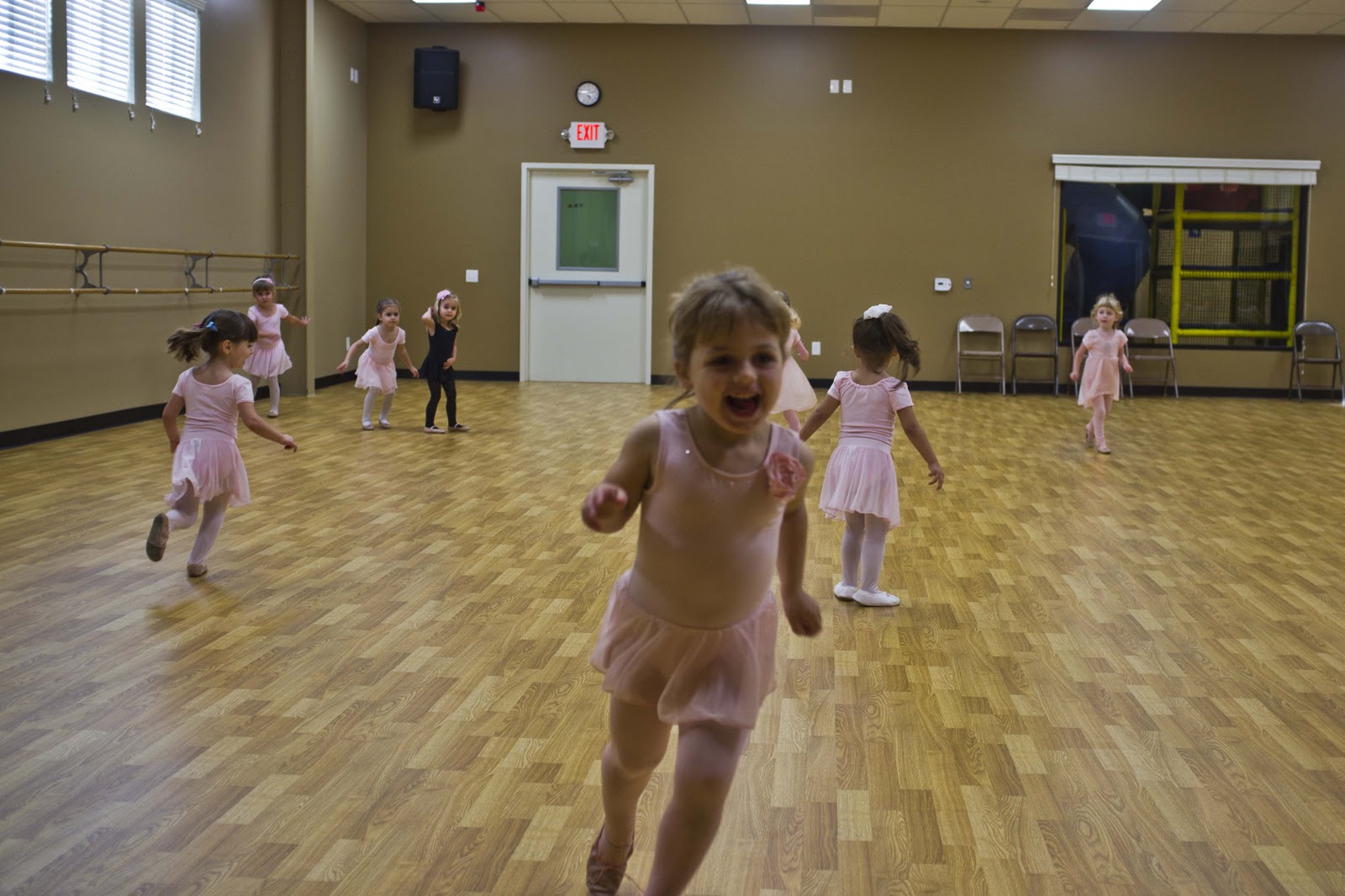
Dance class is fuuuunnnnn!

C’mon Gramps, you can at least try to fit in here.

This one..or this one..or, hey, look at this one over here.

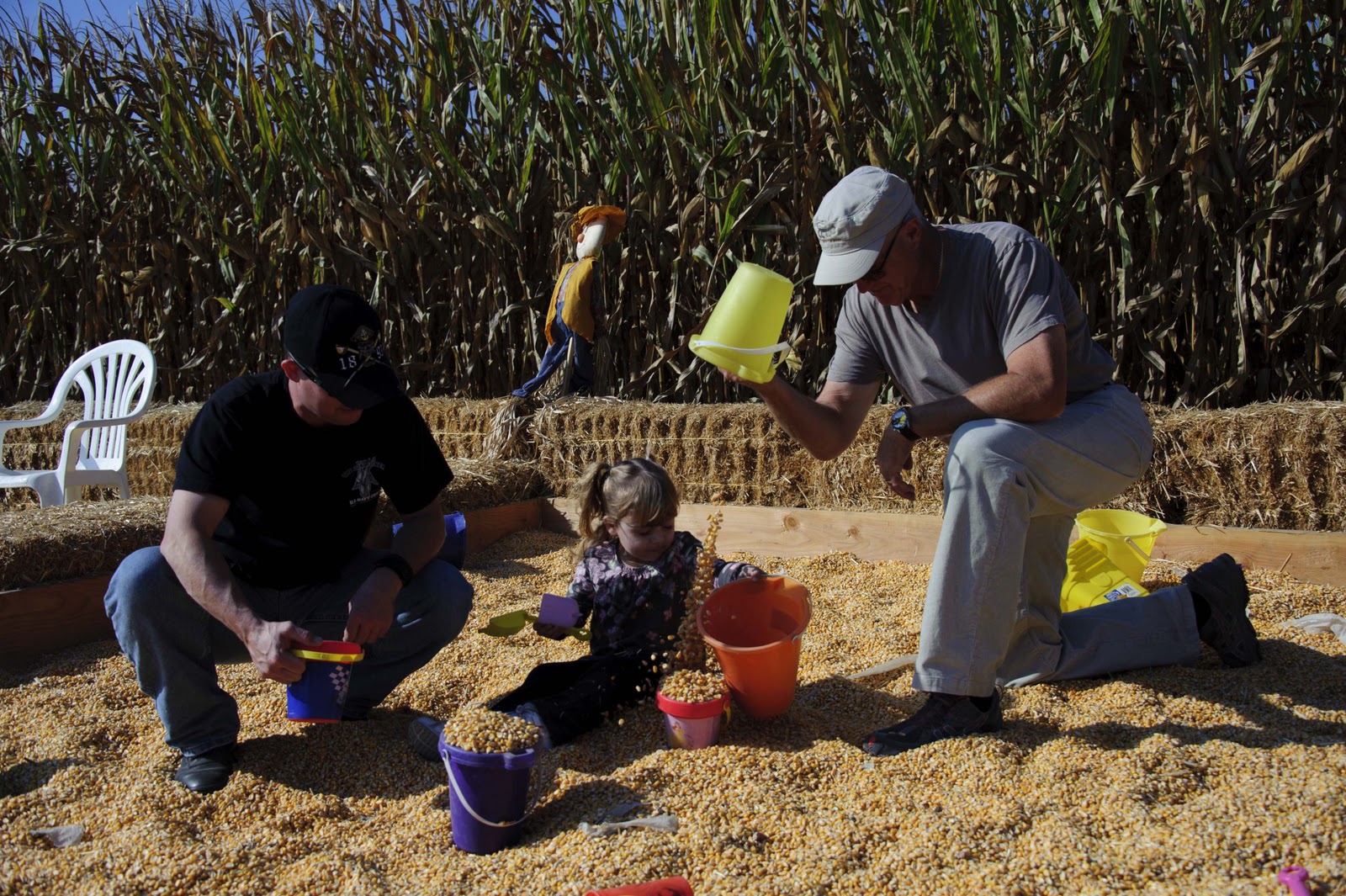
The corn box is COOOOL.

Bales of fun, or, too corny?
Cheeky bas…..ds.

Awwwwww!

We’re having a cotton-pickin good time.
Add caption

Amazing what you can’t find at the pizza parlor.

Isn’t she cute??
A couple of rounds of golf and an ‘adult’ dinner with Mom and Dad managed to find their way into the busy schedule also.  
All in all – a lot of fun in Lemoore;-)
See you in Scottsdale – E & G

More National Parks;-)


In the last five days we have visited FOUR National Monuments/Parks and Los Alamos! WHEW!

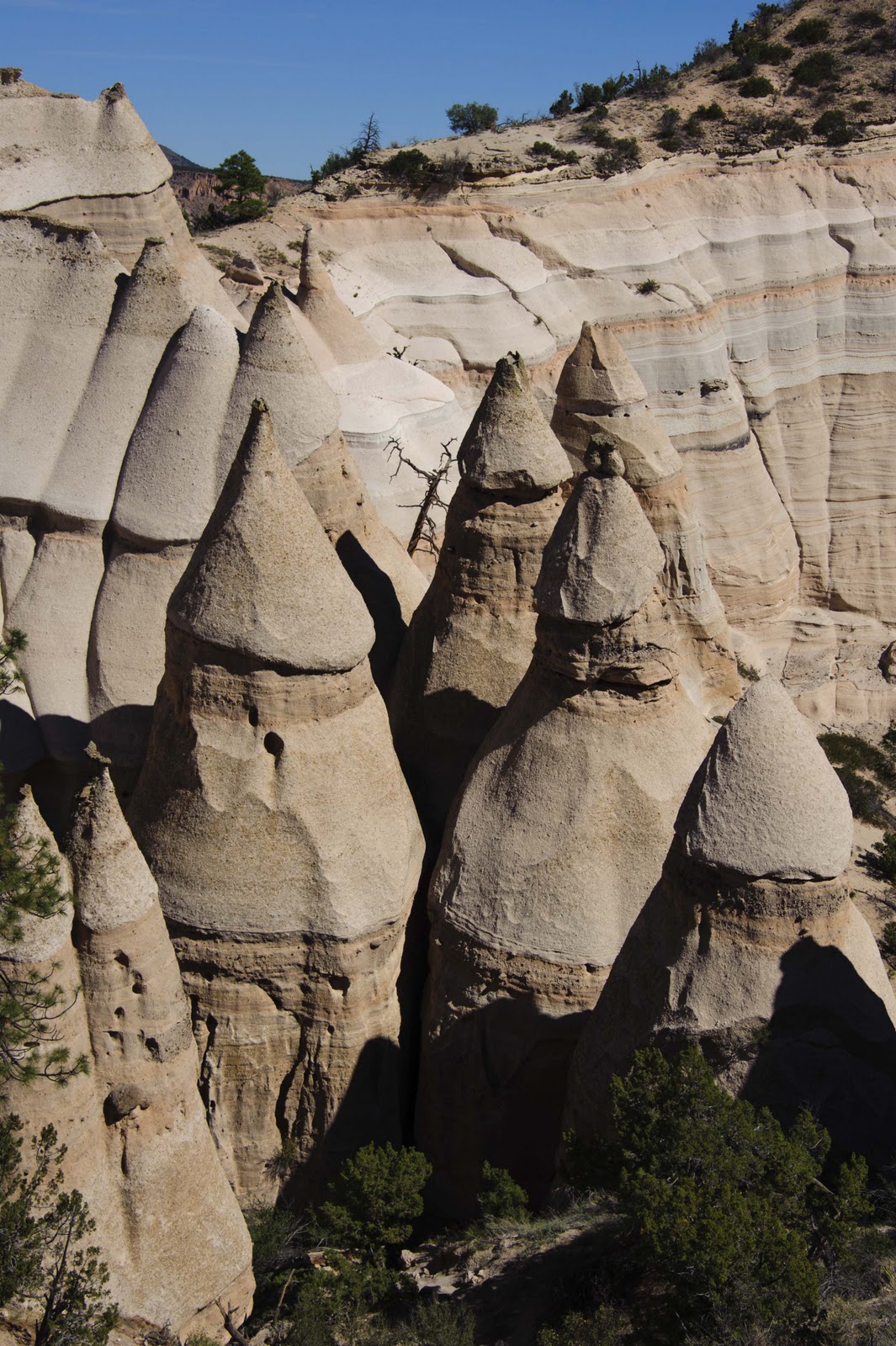
Kasha-Katuwe Tent Rocks National Monument (NM) just outside of Santa Fe, NM provided one of our most favorite hikes – EVER! (This is a MUST DO if you are anywhere in this area!) “Kasha-Katuwe” means “white cliffs” in the language of the Pueblo de Cochiti. The cone-shaped tent rock formations are the products of volcanic eruptions that occurred 6-7 million years ago. There are boulder caps that are precariously perched on many of the tapering hoodoos. There are bands of grey interspersed with beige and pink colored rock. A two mile out and back trail through the Slot Canyon to the top of the mesa provides breathtaking sights around every corner – and some of the corners are pretty small –

Heading out into the Tent Rocks Nat’l Monument
Tight squeezes in Slot Canyon …. glad I was traveling light.
The tent rocks towering over Elizabeth.

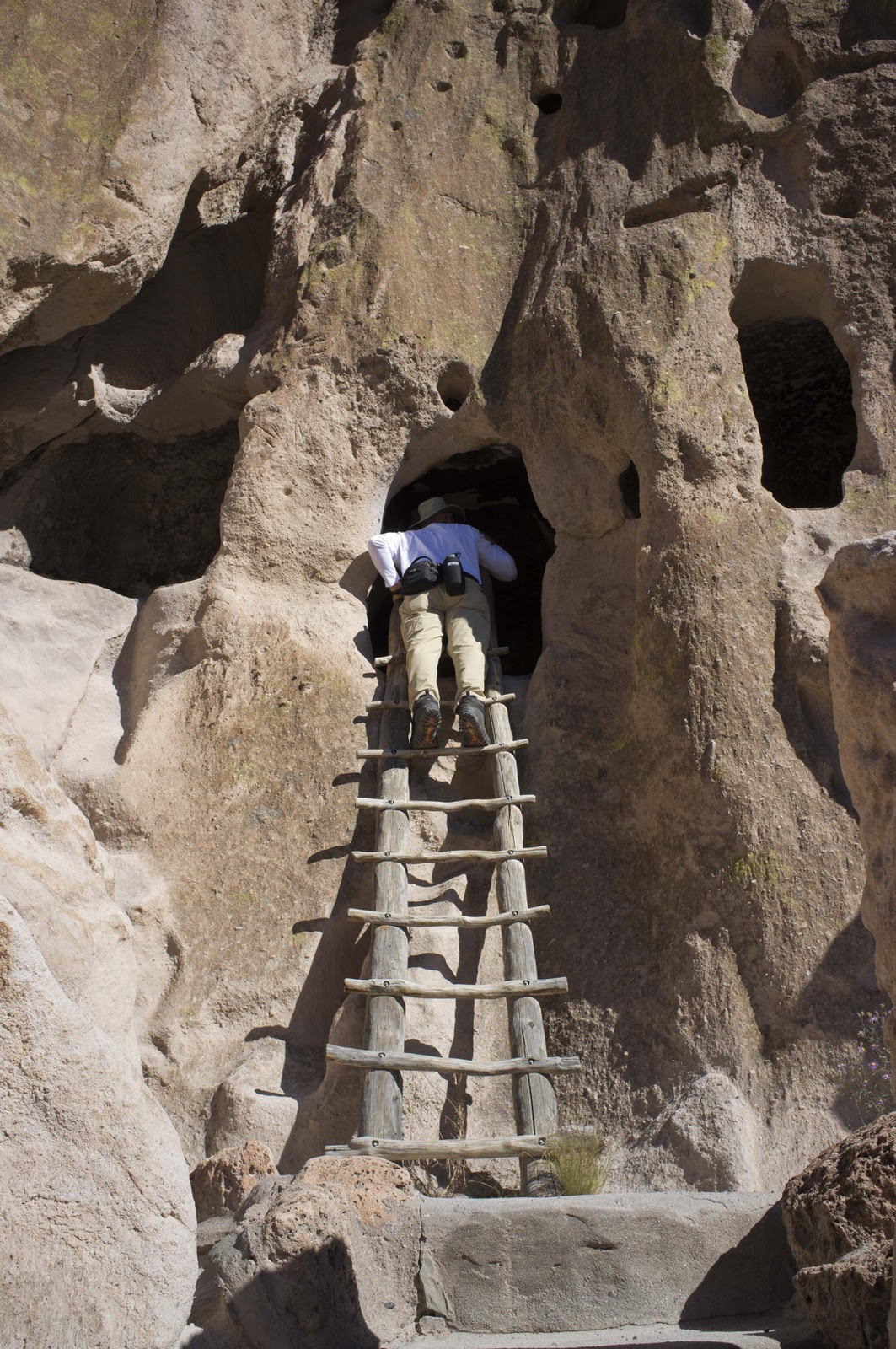
While Kasha-Katuwe was a geological site, our next stop – Bandelier NM – was back to the ancient Pueblo and cliff dwellings. The Ancestral Pueblo people here had cultural links with the people of Mesa Verde and Chaco Canyon. (Since details of these cultures and related time periods have been covered in prior postings, I won’t bore you with all the details yet again!) It is just very interesting to us to see remnants of these societies in so many different locations – and see such similar sights. The Kiva, the same construction and room layout and dimensions and, of course, the cliff dwellings. It was a lot of fun to again be able to have such access to the cliff dwellings – we love the ladders;-)


A bird’s eye view of the Bandelier Pueblo Ruins.

Checking out the loft accommodations in the cave dwellings.
How would you like to come home to this every night.
Trick or treat anyone?
Hmmmmm, think I can fit through here?
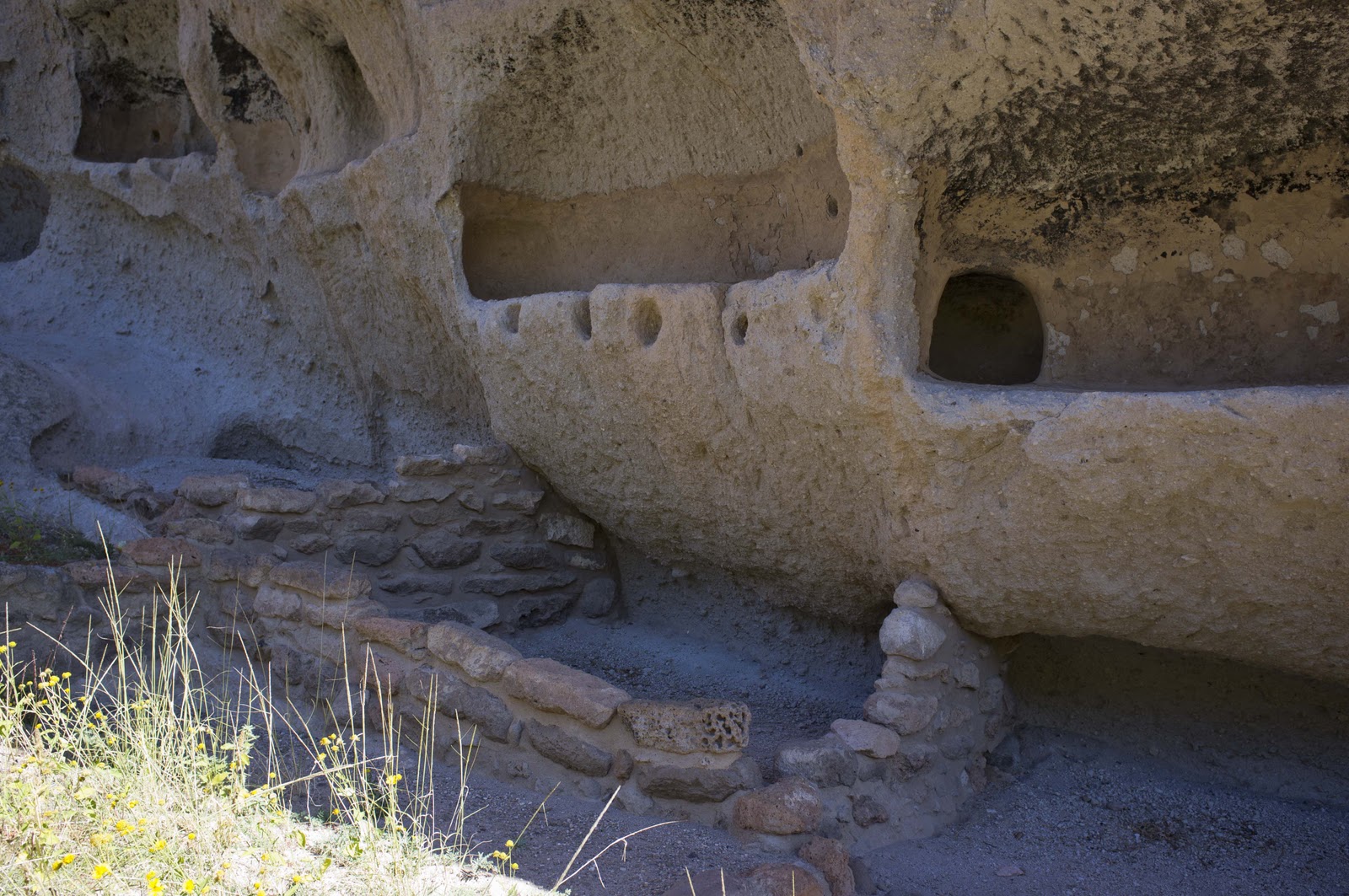
Notice the smoke residue on the ceiling.
The smaller holes in the center are where the roof support logs were inserted.
Note the pictograph in the center. It is covered with a clear protective pane to try and preserve it.
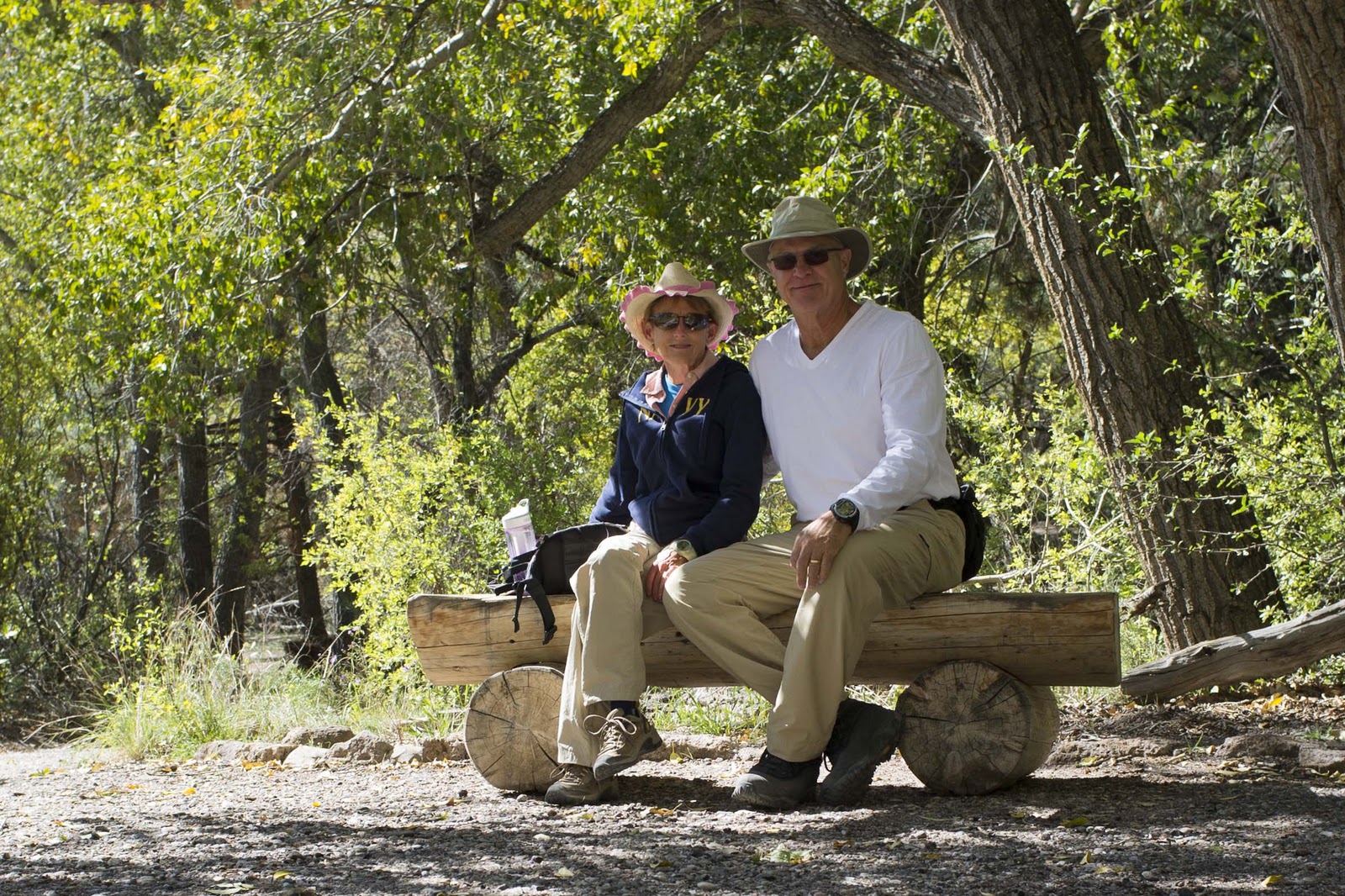
Our lunch spot at Bandelier.
We stopped here to fill our propane tank.
Didn’t realize we could pick up our sheep at the same time.

Talk about culture shock – we went from Bandelier NM to Los Alamos!! That is right – the laboratory established in 1943 as part of the Manhattan Project, the nations’s top-secret program to develop the atomic bomb. There we eavesdropped on discussions of neutrons and electrons at the local Starbucks (NO joke!!) and visited the Bradbury Science Museum. This museum was quite interesting and shouldn’t be missed if in the area, as this is an important part of our history and the continued research affects everyone of us today. However, I must confess that I understood where the movies were shown and where the restrooms were and not much else. The brain went on overload after about 5 minutes!!

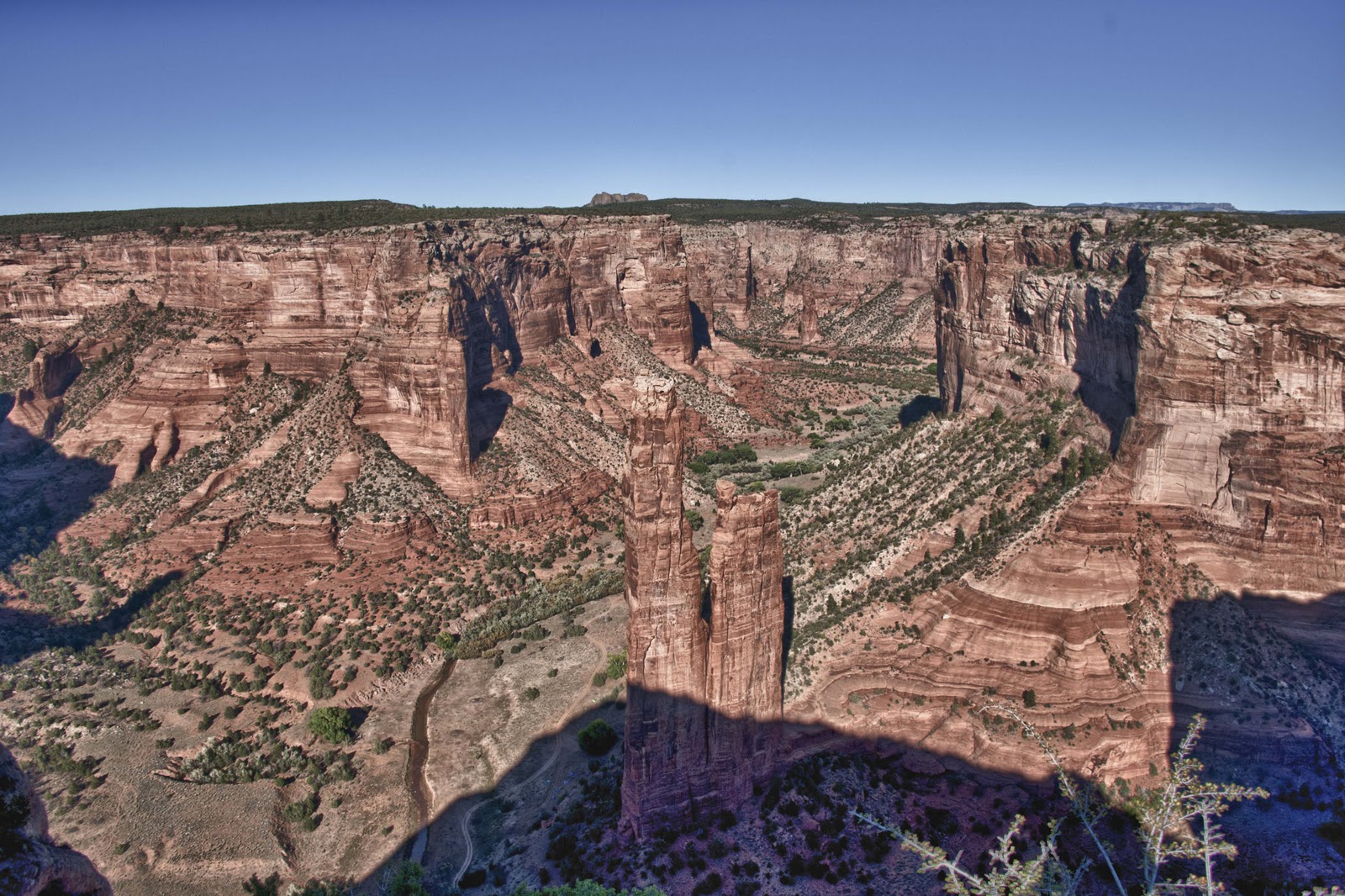
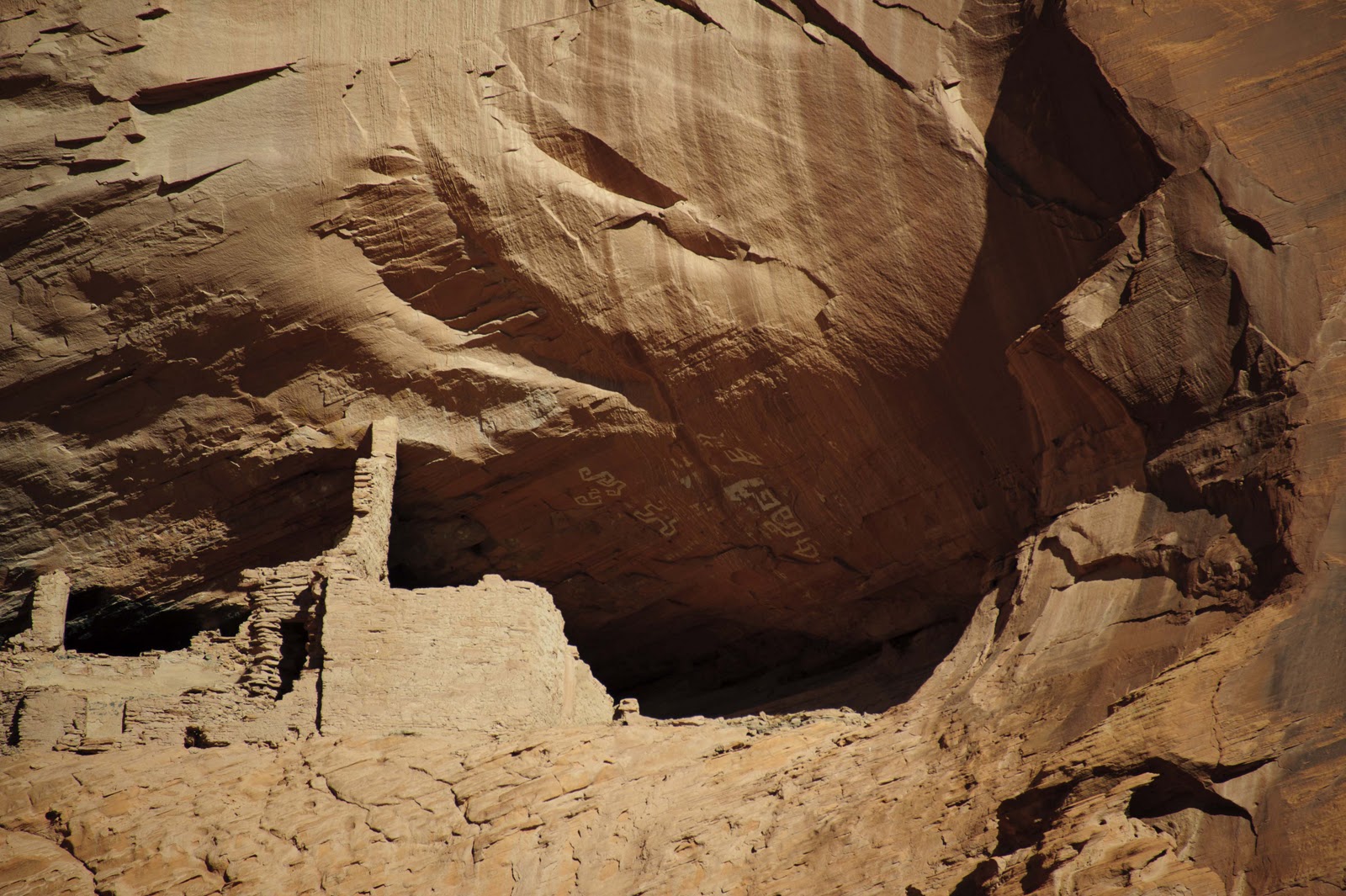
Moving west into Arizona, we spent a fascinating morning on a private jeep tour with a local Navajo tour guide of the Canyon de Chelly NM. Archeological evidence shows that people lived in these canyons for nearly 5,000 years. In later years, the same Basketmakers from Mesa Verde and other surrounding areas came here (200 BC – 750 AD). Followed by the Ancestral Puebloan people (750 – 1300) – predecessors of today’s Pueblo and Hopi Indians. Finally, the Navajo entered the Canyon around 1700. The Spanish and the Americans fought with them – ending in 1864 with Kit Carson’s brutal campaign to round up all the Navajo’s and march them over 300 miles to internment at Fort Sumner. This was after they destroyed all their homes and animals. In 1868, the Canyon was given back to the Navajo and they were allowed to return to their homeland. Today the descendants of those given the property in the Canyon still live there on their ancestors land. Our guide is one of those descendants.

The Canyon walls rise from 30 feet where we entered the Canyon to over 800 feet. There are many cave dwellings on the ledges of canyon walls, pictographs and stunning beauty.


A great view of Canyon de Chelly.
The Spider Rock spires are in the middle of this shot.
We saw more petroglyphs..
Cliff dwellings..
The white figures are several hundred years older than the rust colored antelope.

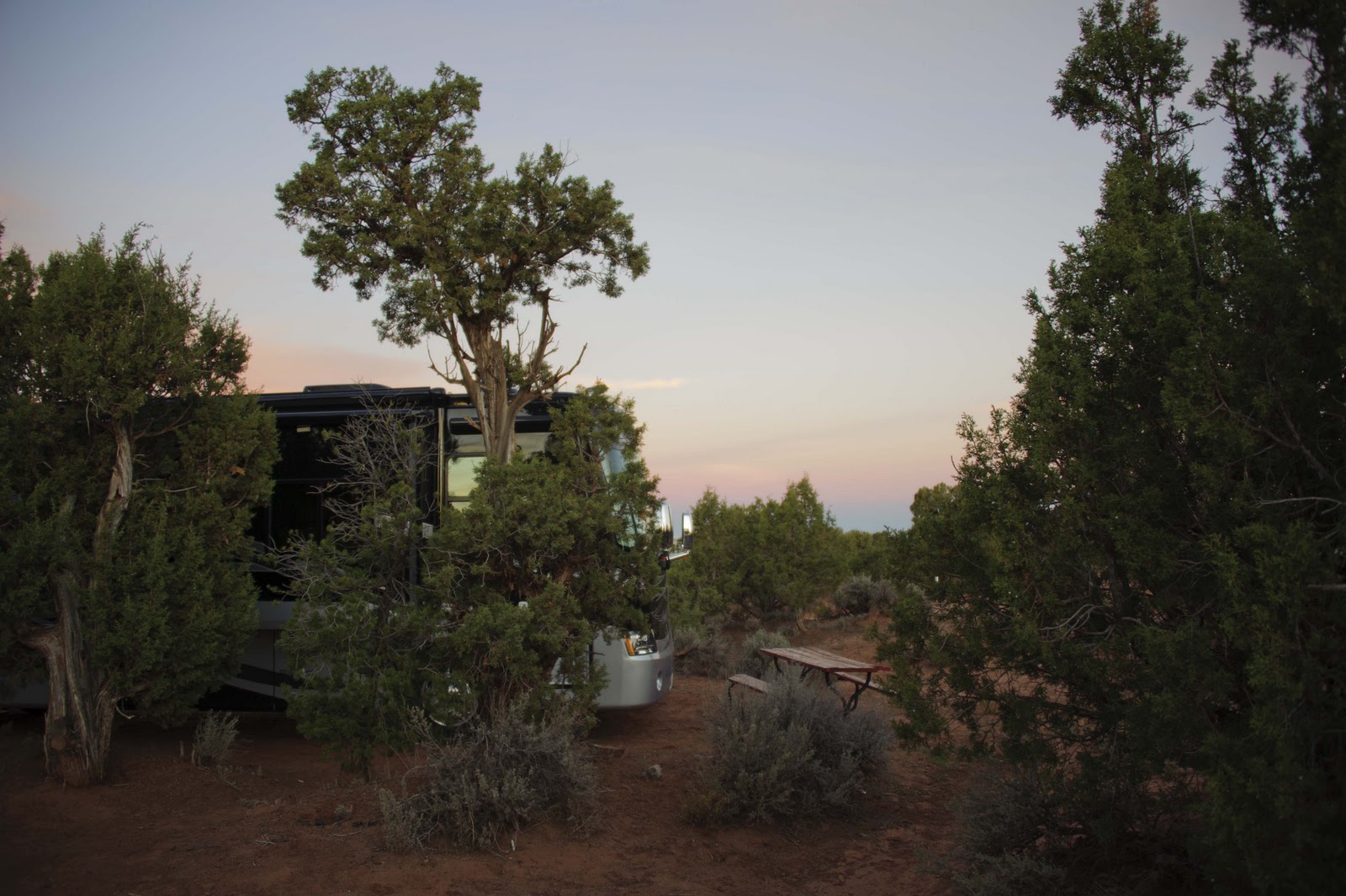
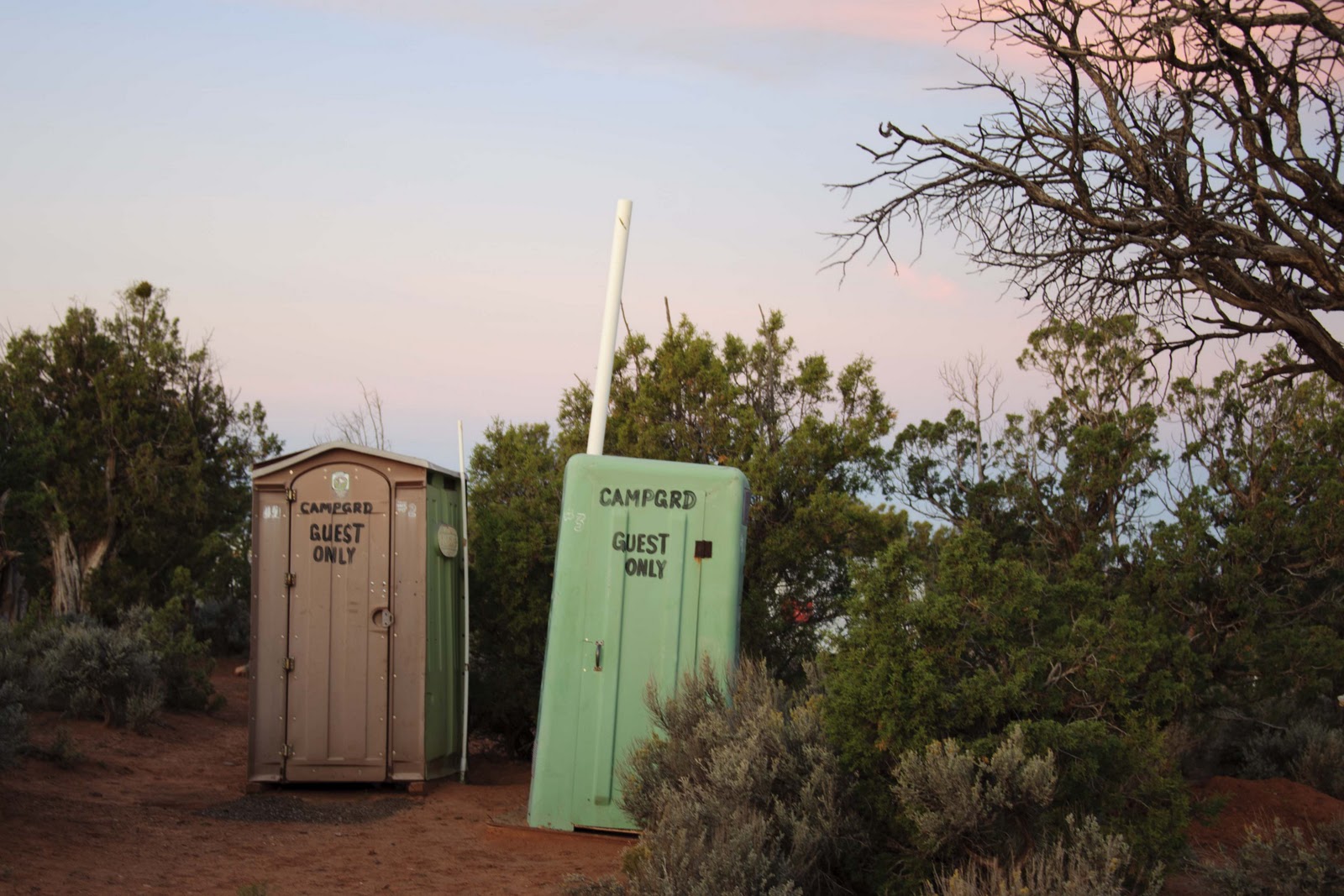
Did I tell you about the campground Magic enjoyed at Canyon de Chelly?? It was a very spiritual place high up on the mesa above Spider Rock. We managed to get Magic ‘wedged’ into a beautiful spot. It was a ‘dry camp’ situation, so we had to conserve!

Dry camping tonight…. a tight fit for Magic, but beautiful.
Glad we travel with our own loo.

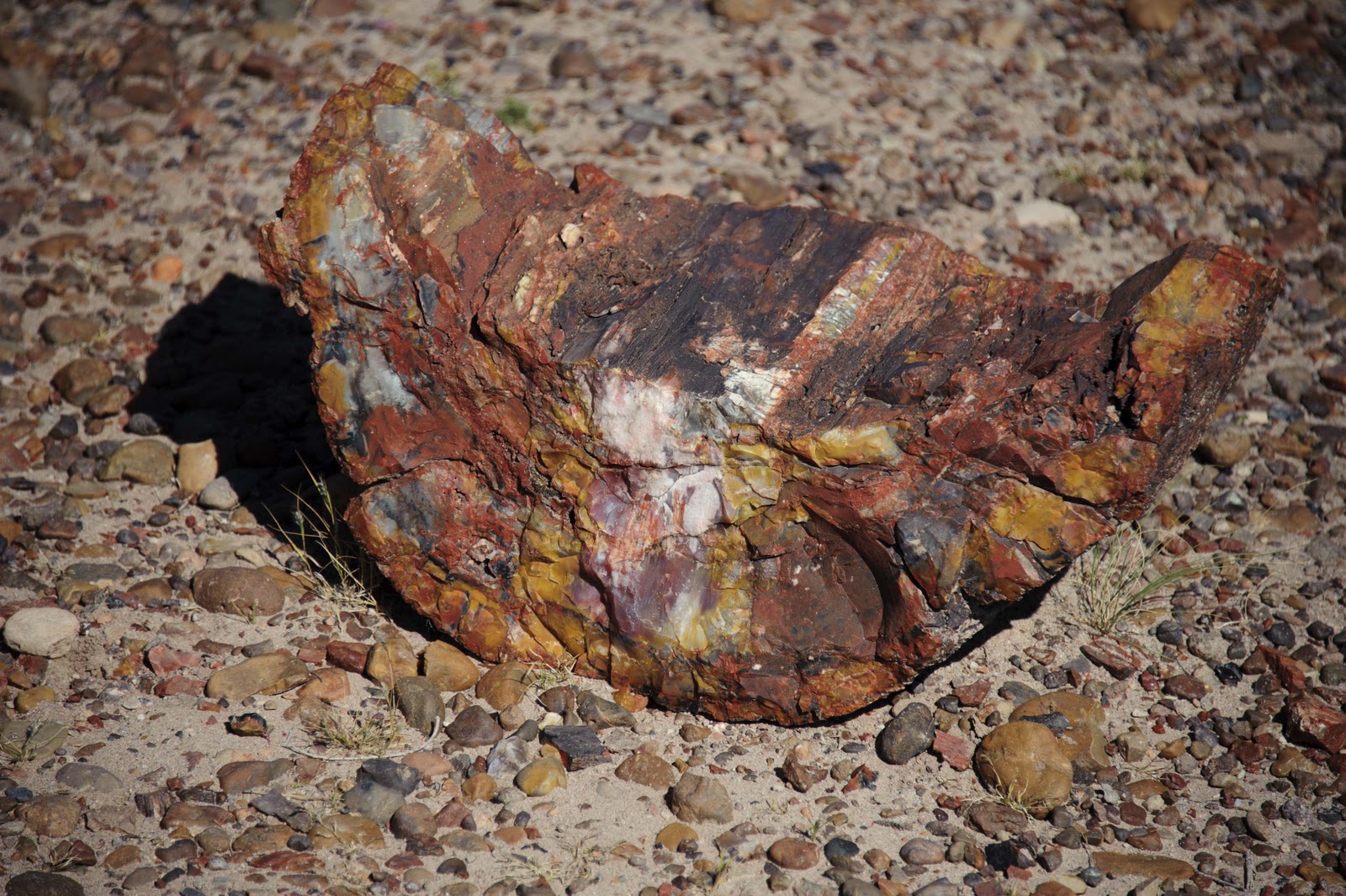
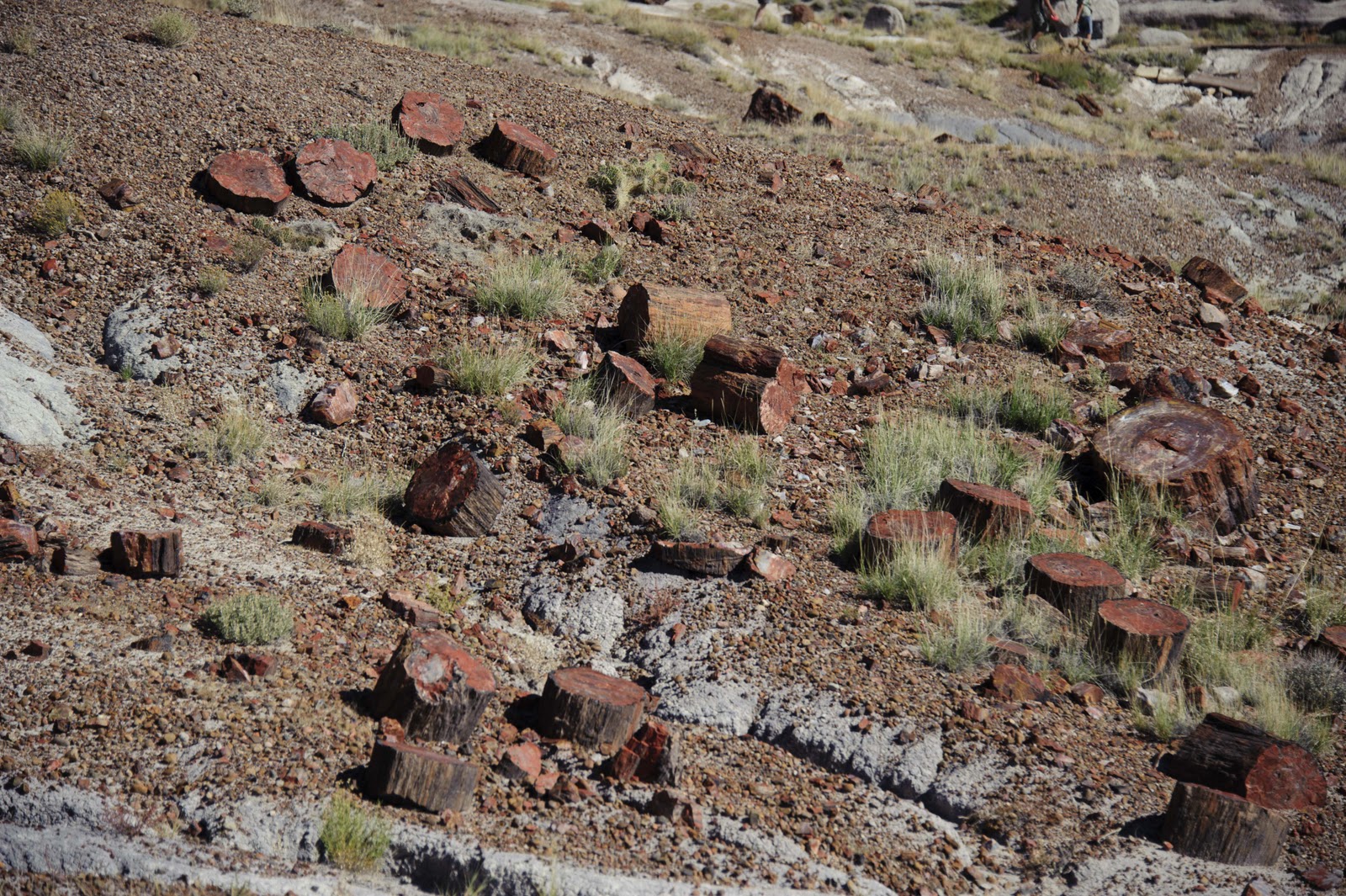
Last, but not least (well maybe – this was not our favorite), was the Petrified Forest and Painted Desert. This was again more of a ‘geological’ experience than a ‘people’ experience – no ladders to climb;-( Perhaps the most interesting factoid learned is that the petrified wood is not really wood! Two hundred million years ago conifer trees did grow here along the banks of the many streams that existed on a vast floodplain. The trees fell and swollen streams washed them into adjacent floodplains. A mix of silt, mud, and volcanic ash buried the logs and cut off oxygen slowing the logs decay. Silica-laden groundwater seeped through the logs and replaced the original wood tissues with silica deposits which eventually crystallized into quartz. The quartz was encased in the ‘cast’ of the tree and preserved as ‘petrified wood’. The various colors come from the minerals in the silica-saturated waters. Iron, carbon, manganese, cobalt and chromium produced patterns and blends of yellow, red, black, blue, brown, white and pink! This ‘wood’ is VERY heavy and VERY hard (7 on a 10 point scale).


Petrified logs.
The color spectrum in some of the petrified pieces were amazing.

Lots of petrified ‘wood’.

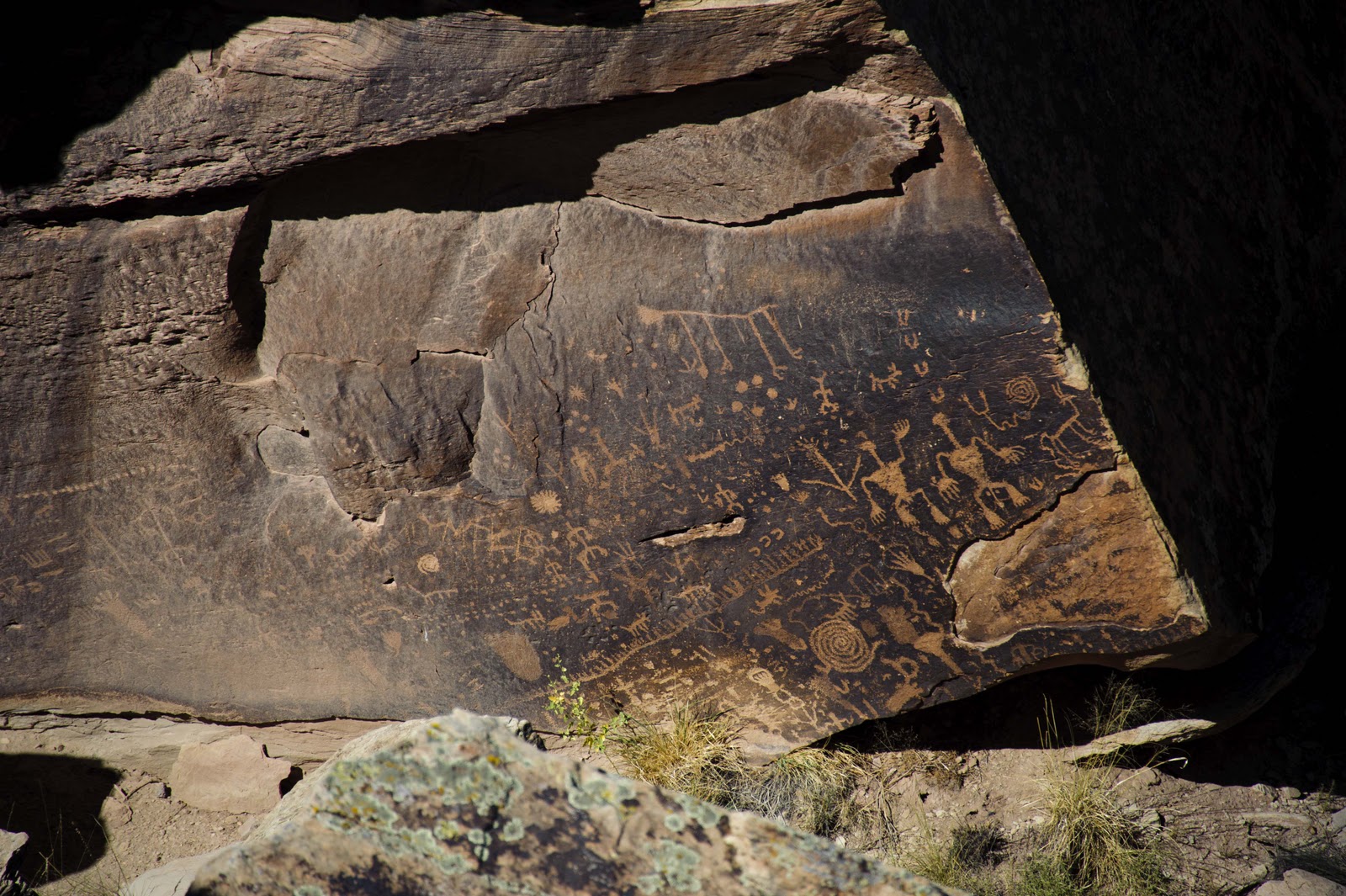
Petroglyphs on the Newspaper Rock in the Petrified Forest.

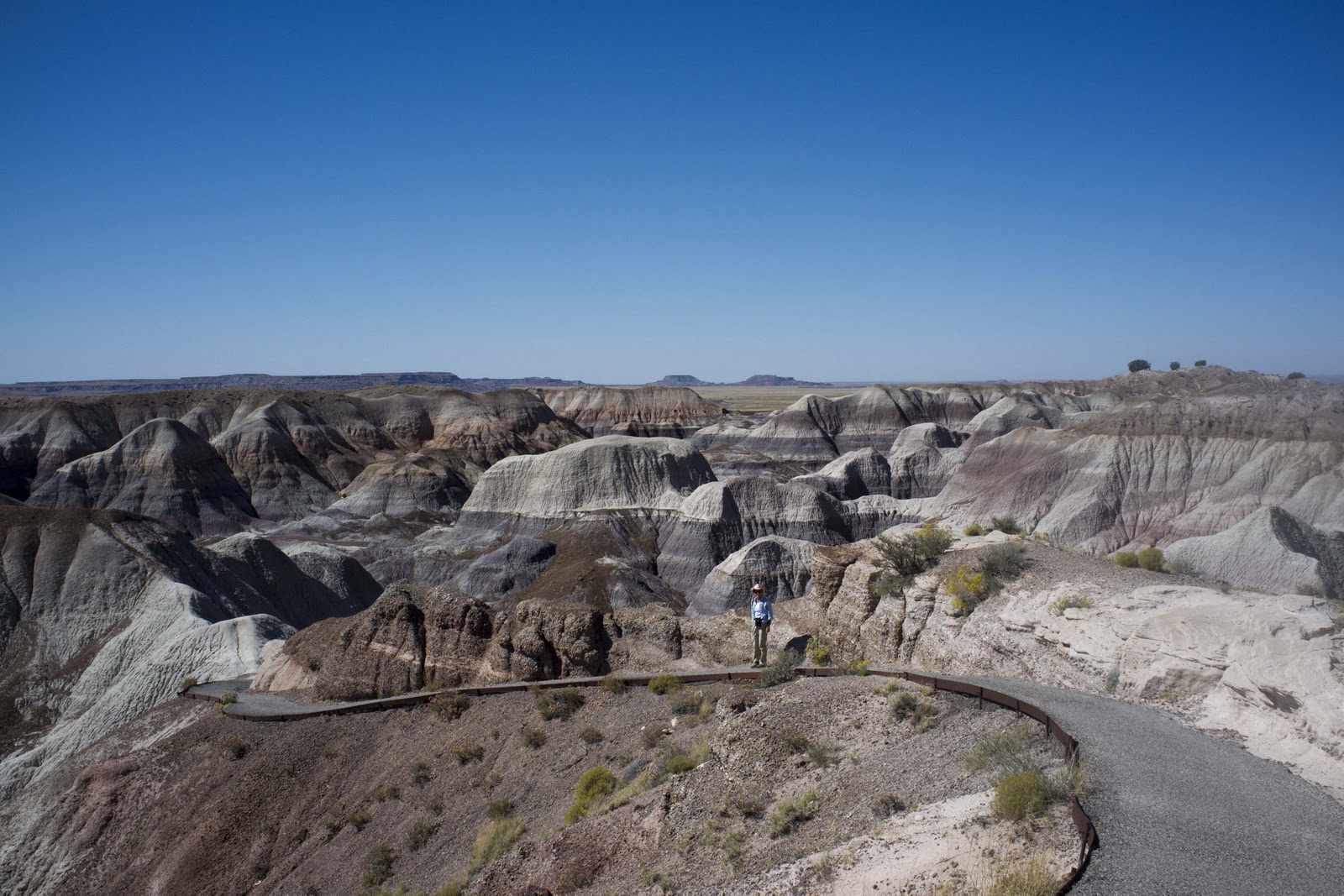
Descending into the Blue Mesa.
Doesn’t it look like someone used a ruler to make the lines?

While there are still many sites to see along the ‘Trail of the Ancients’, we have put a pretty good dent in them on this trip – and enjoyed every minute. The family now awaits – so, we are off in the direction of Lemoore early tomorrow. Pictures of our granddaughter and more golf outings will be forthcoming.

Please stay tuned – E & G

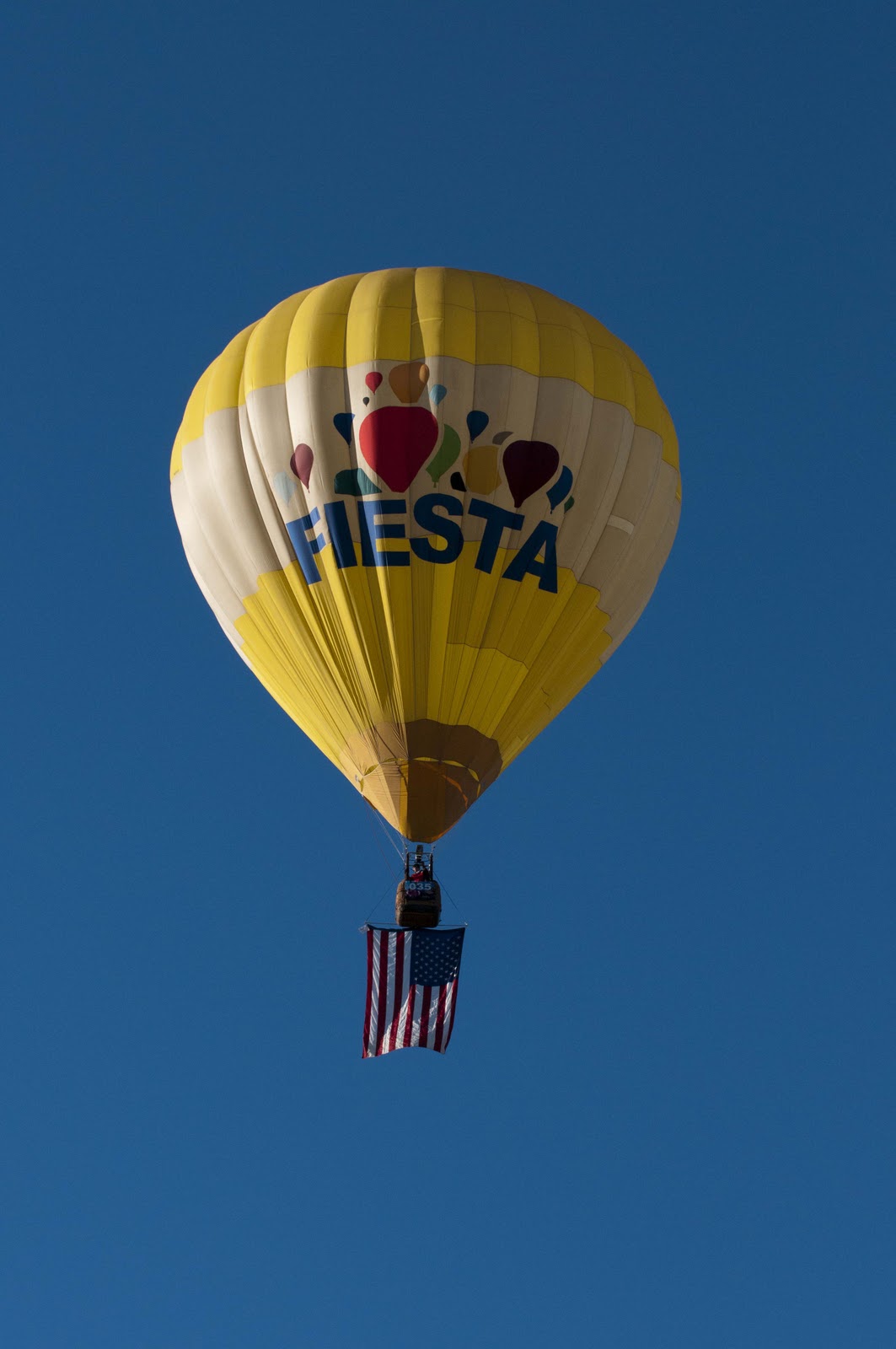
!!!Balloon Fiesta!!!

Have you missed us?? Did you think we fell off a mesa??
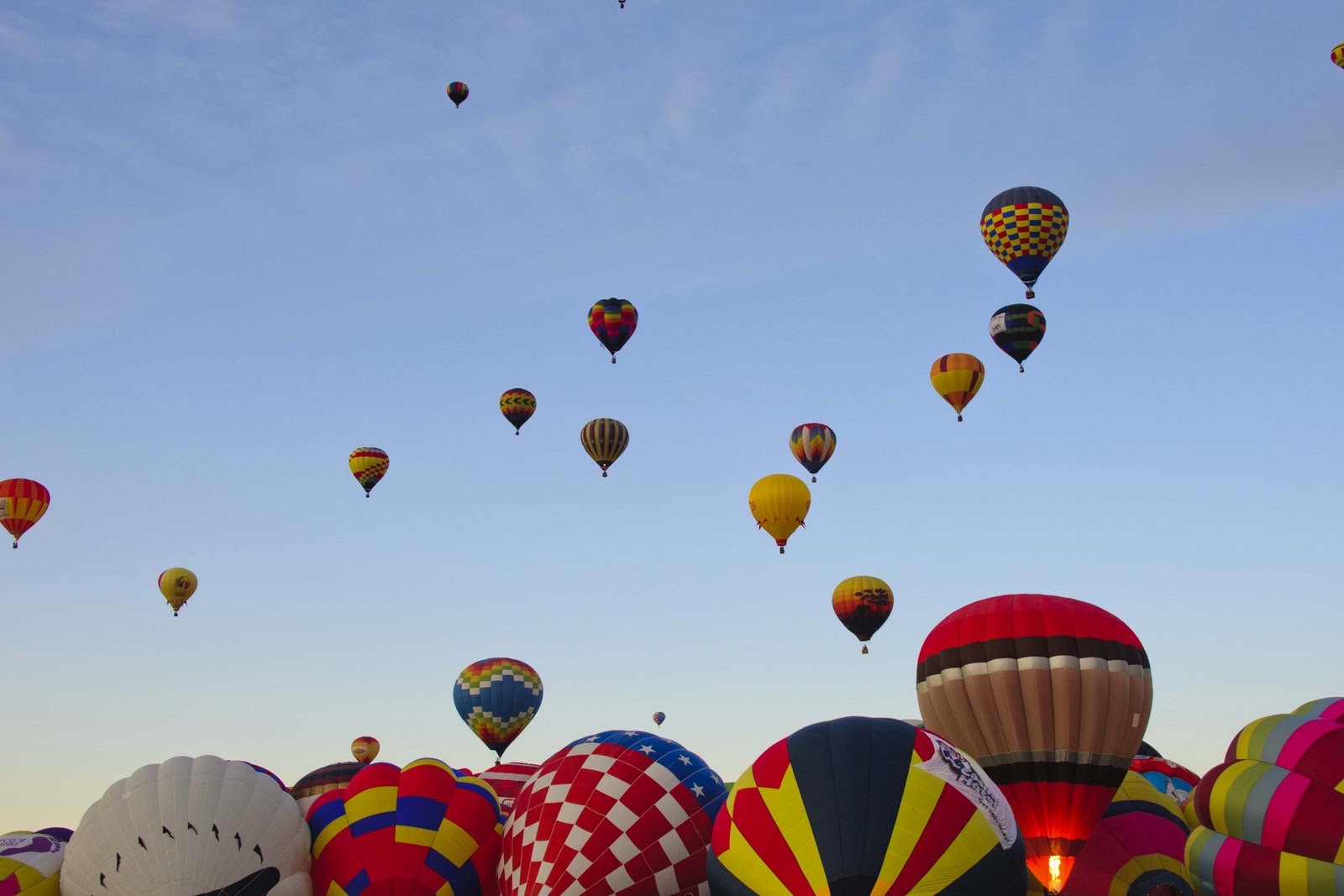
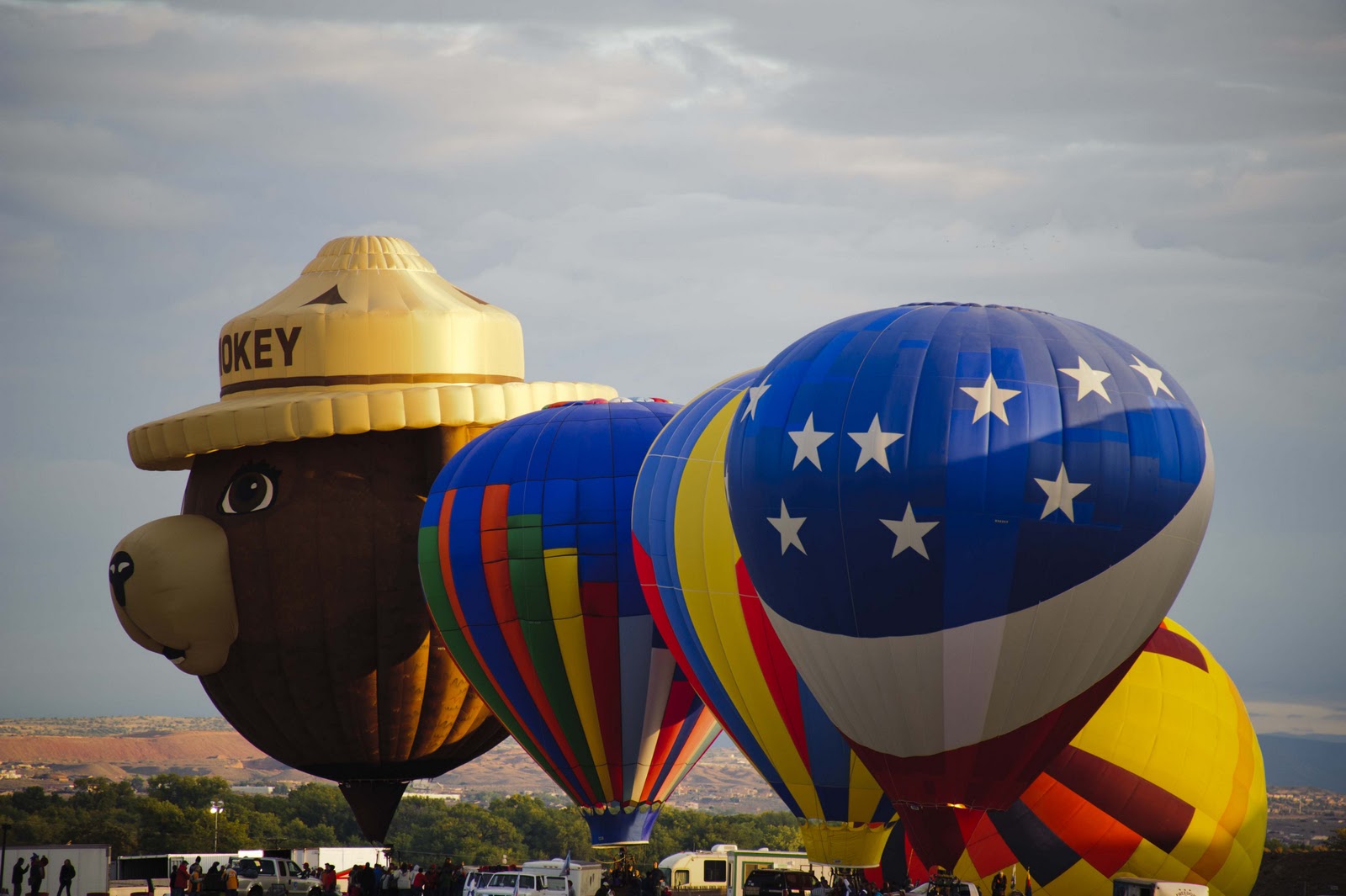
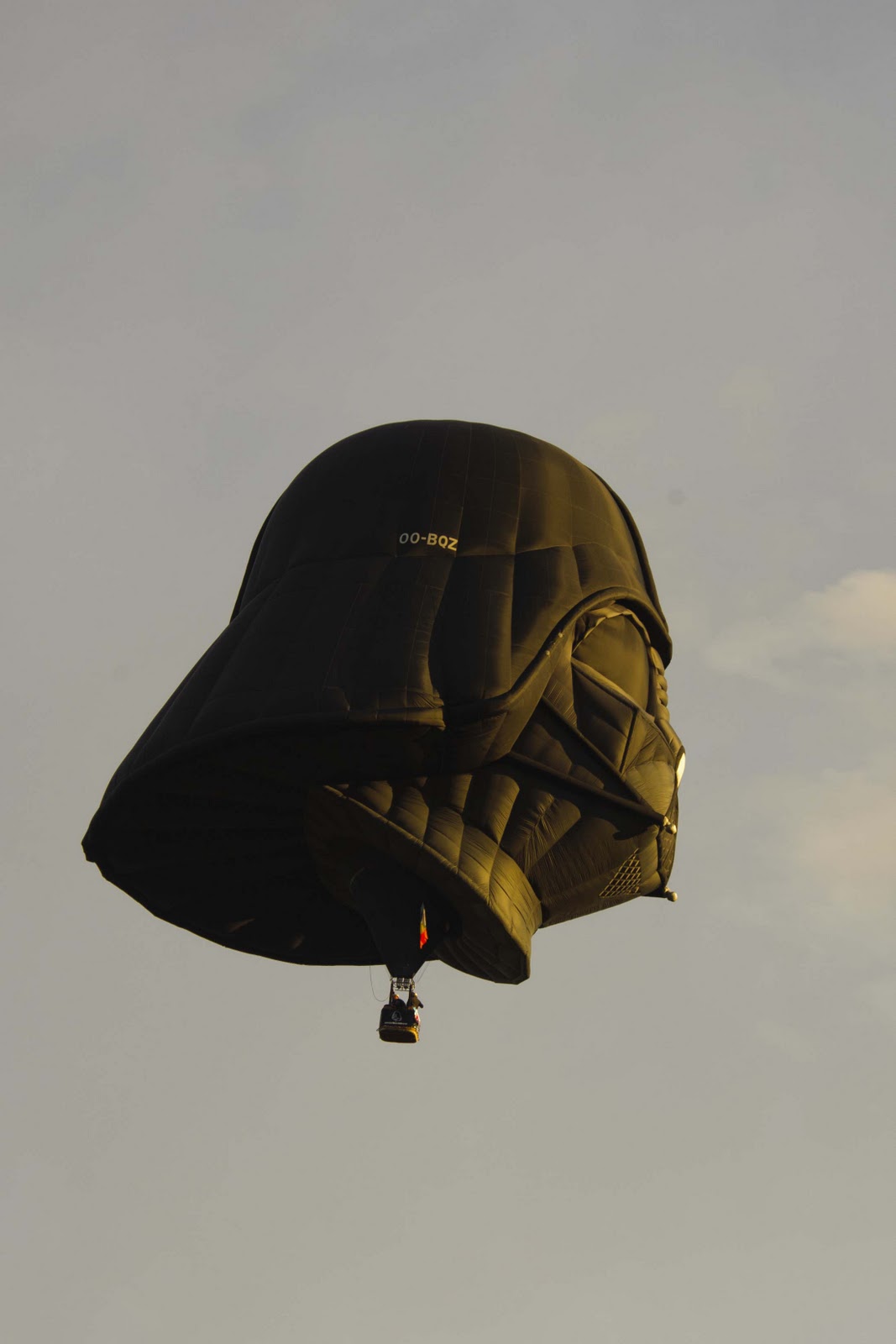
NO – It has just taken this long to sort through the 1,000+ pictures Gary took at the BALLOON FIESTA;-) Needless to say we had a blast! Of course, it really helps to know someone flying balloons – especially the wonderful ‘Special Shapes’.
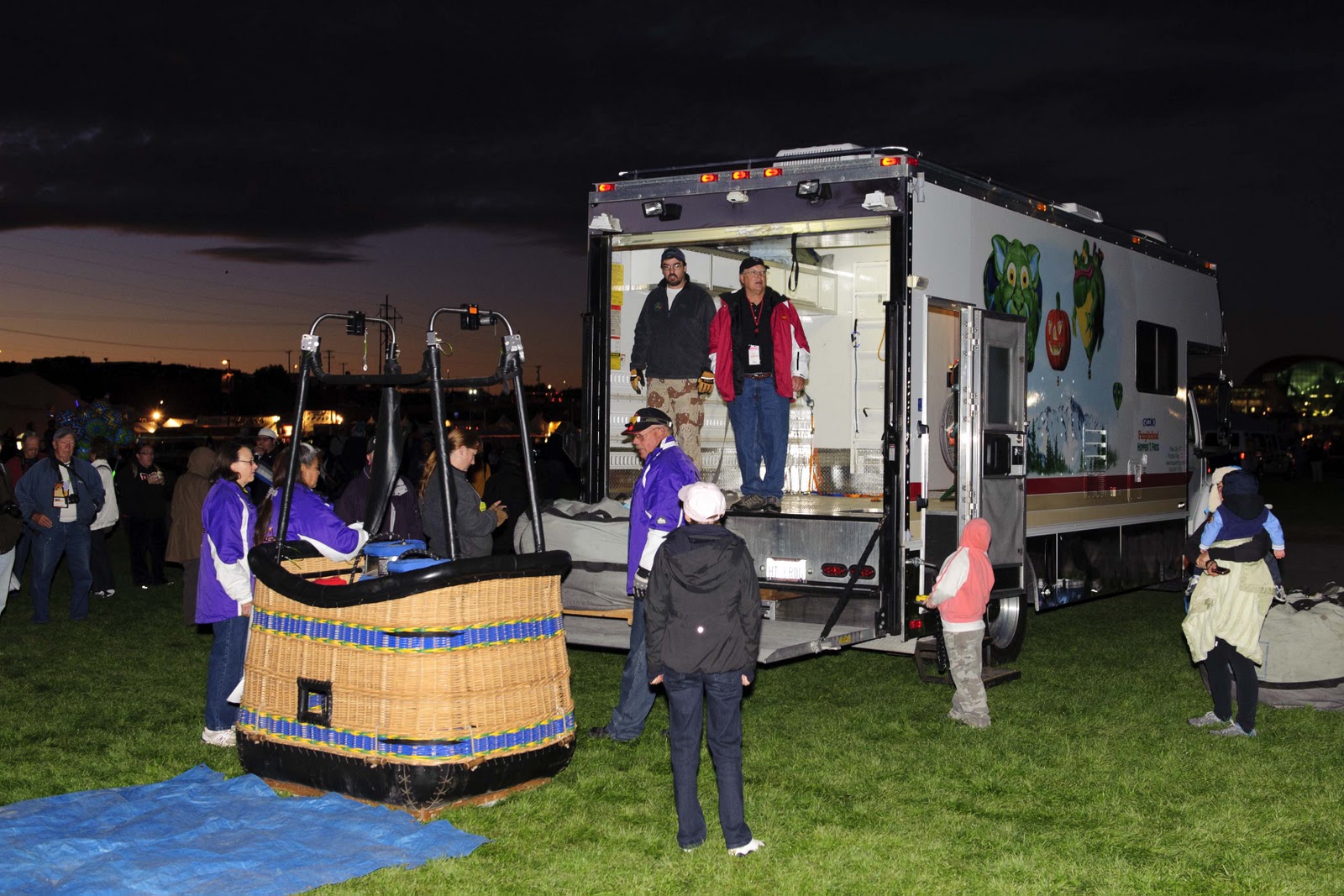
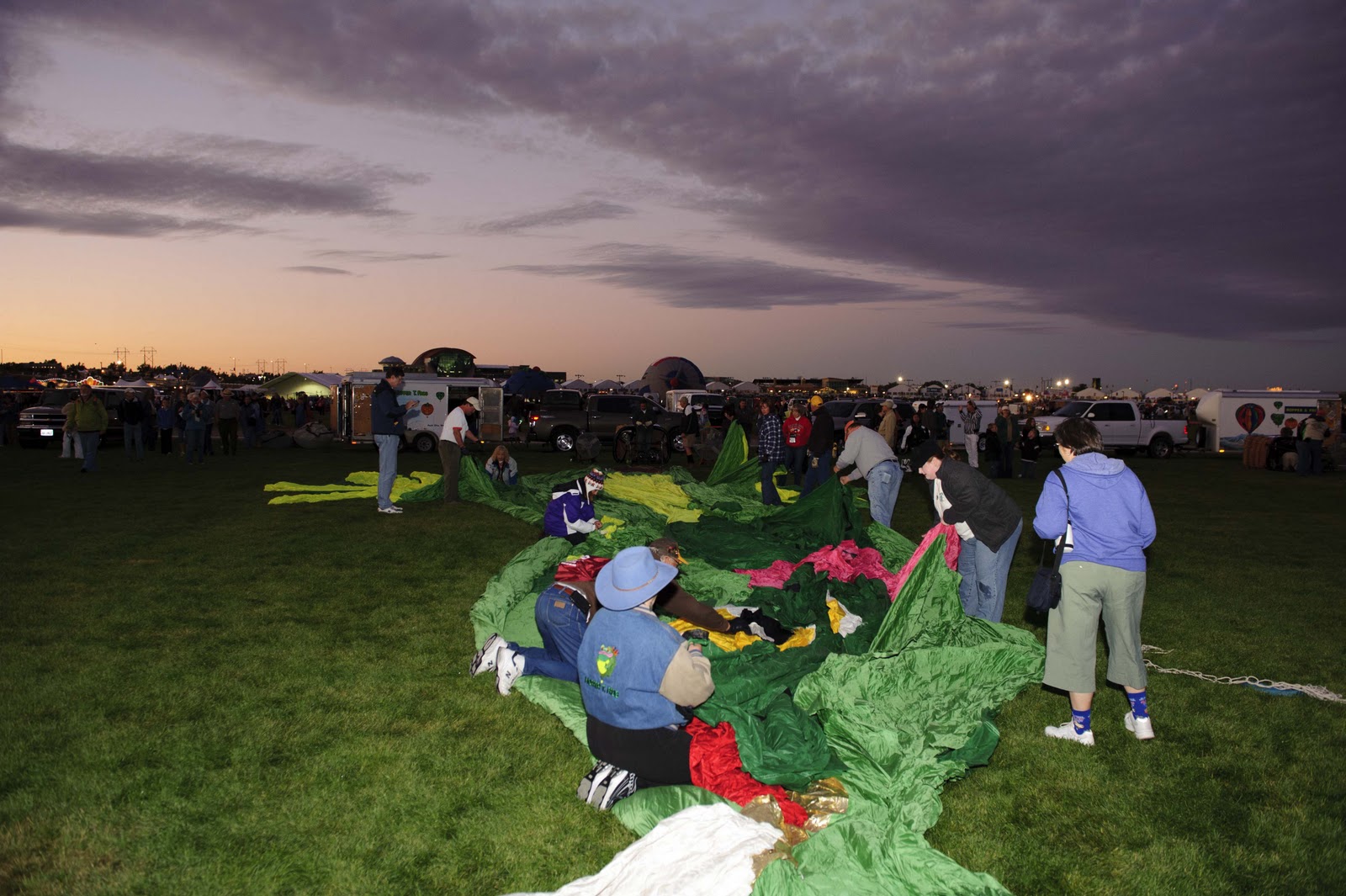
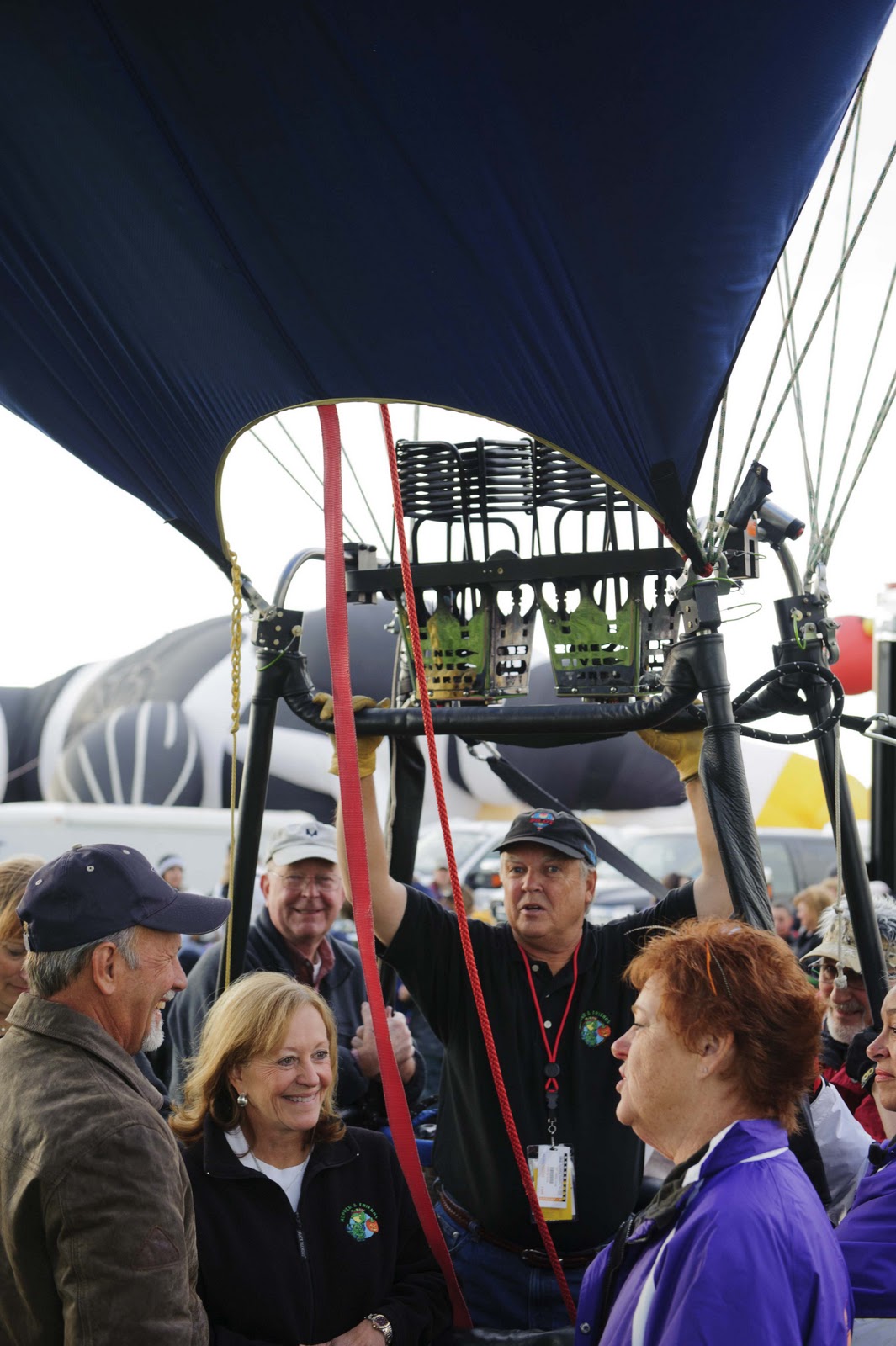
Although the weather did not entirely cooperate with the Fiesta – it did let our friends, Mark & Dianne, inflate their Special Shapes – Gizzmo, Hopper T Frog and Pumpkinhead – so we could see them (along with thousands of other spectators). We even got to help with the process – which starts VERY early in the morning!!

Mark & Dianne’s crew assemble to begin the inflation of Gizzmo, Hopper T Frog & Pumpkinhead.
Getting Gizzmo ready.

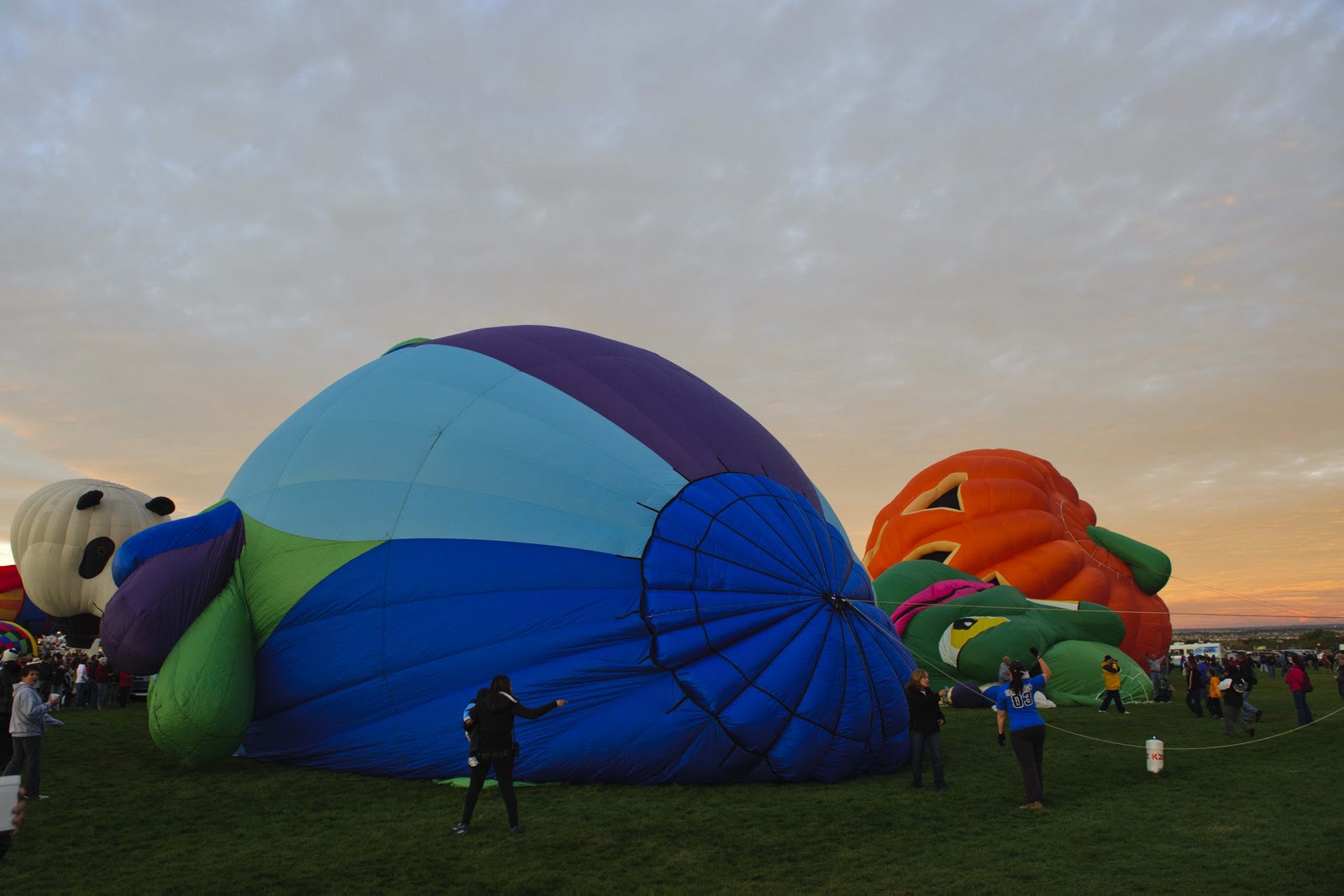
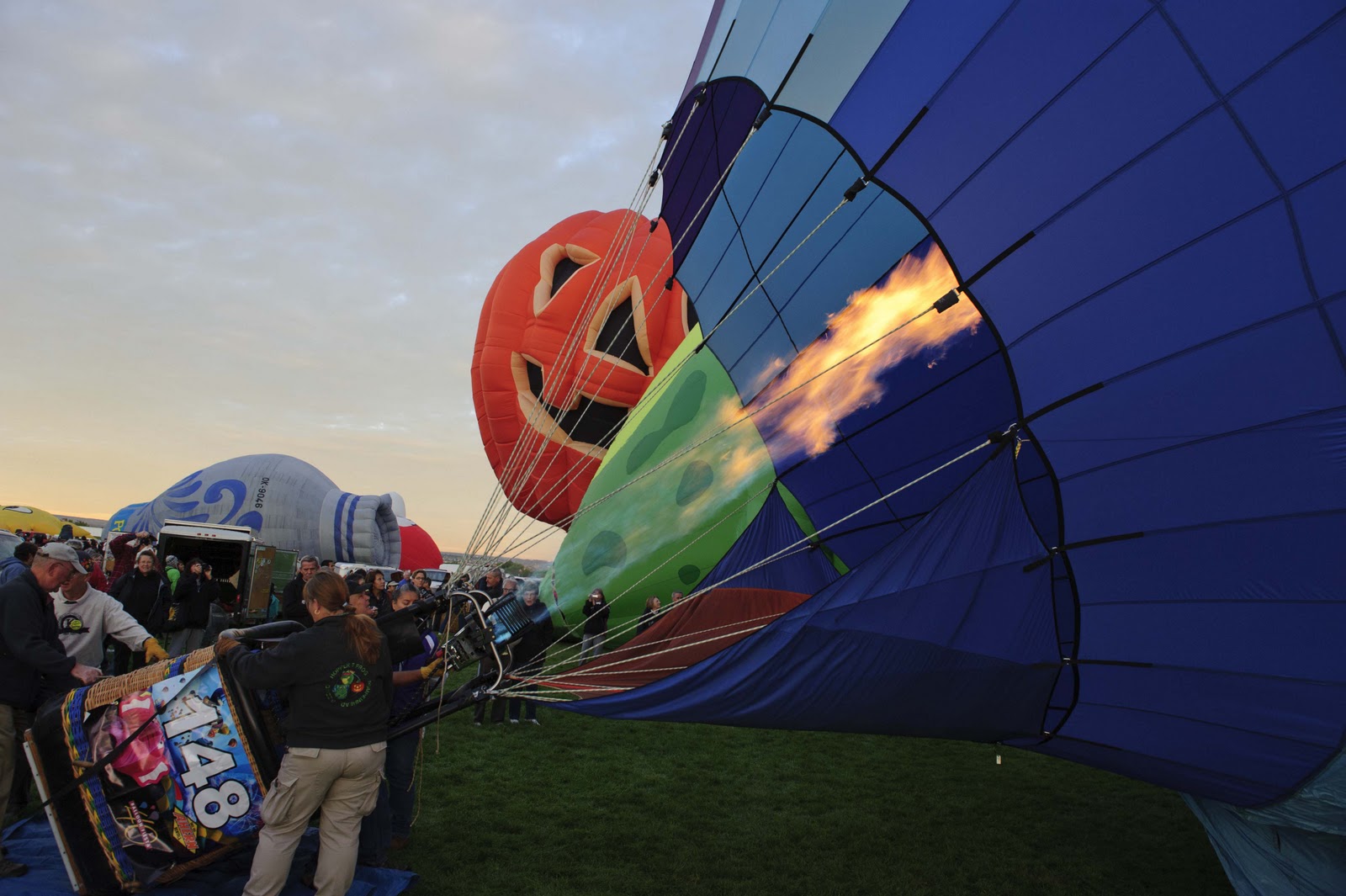
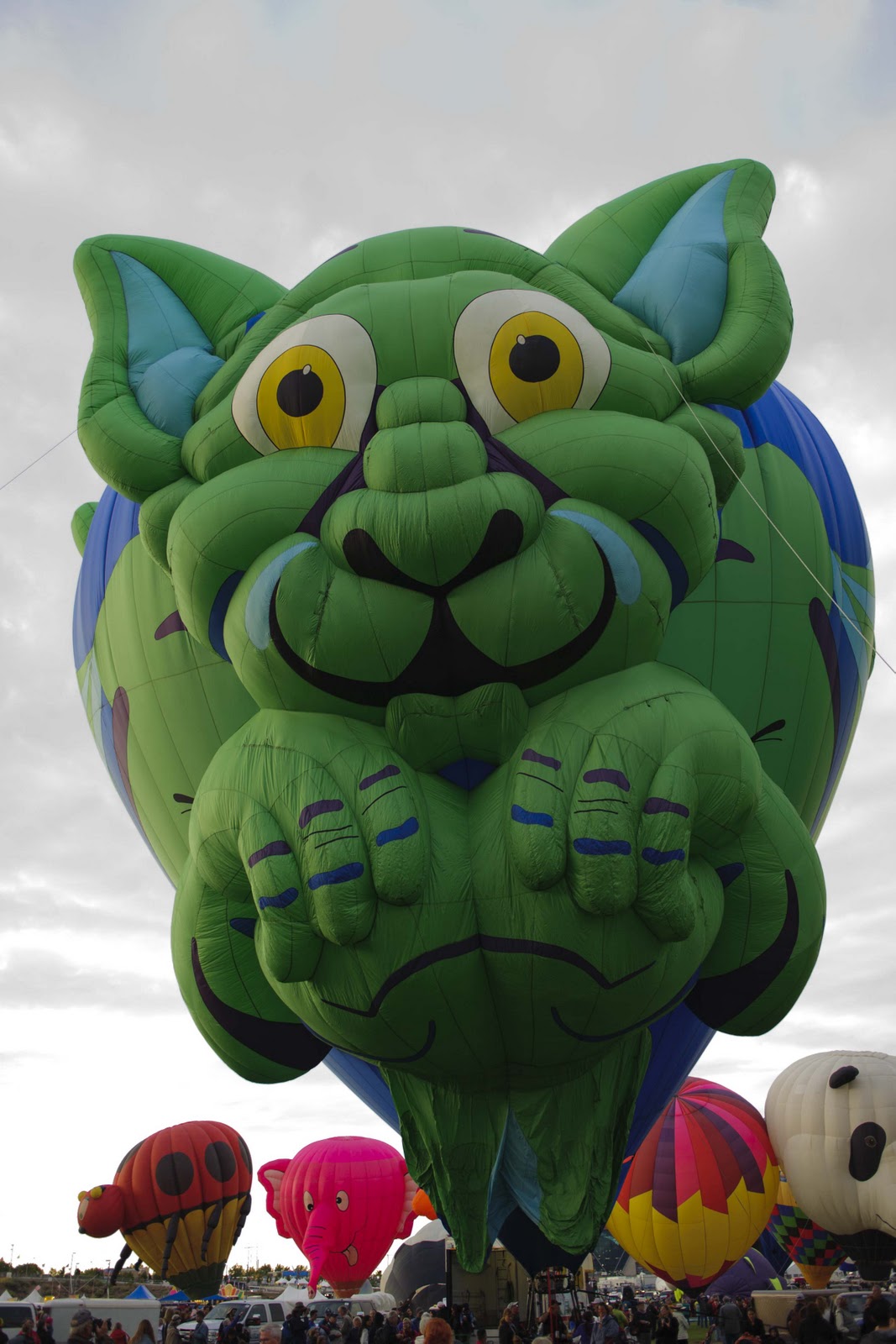
Getting inflated! Pumpkinhead in back, Hopper T Frog in the middle and Gizzmo in front.

Gizzmo is ready to go.
The awesome trio – Pumpkinhead, Hopper T Frog and Gizzmo.
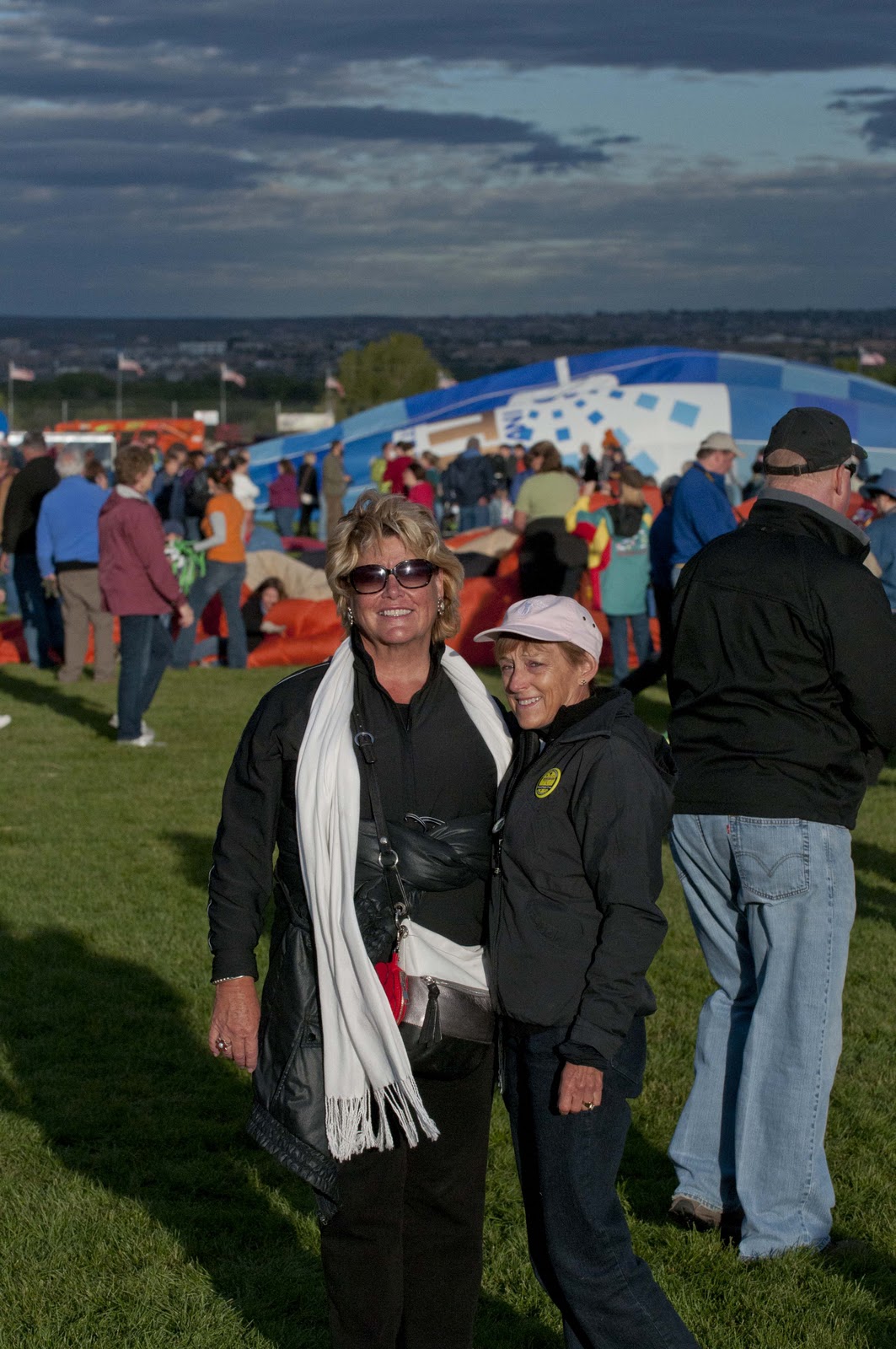
Dianne & Mark enjoying the morning revelry.

The Shapes Days are really special – so, even my friend Kacy drove in from Santa Fe to visit and see them –

Our friend Kacy paid us a visit.

After two and a half days of cancelled events due to wind, pouring rain and even snow –

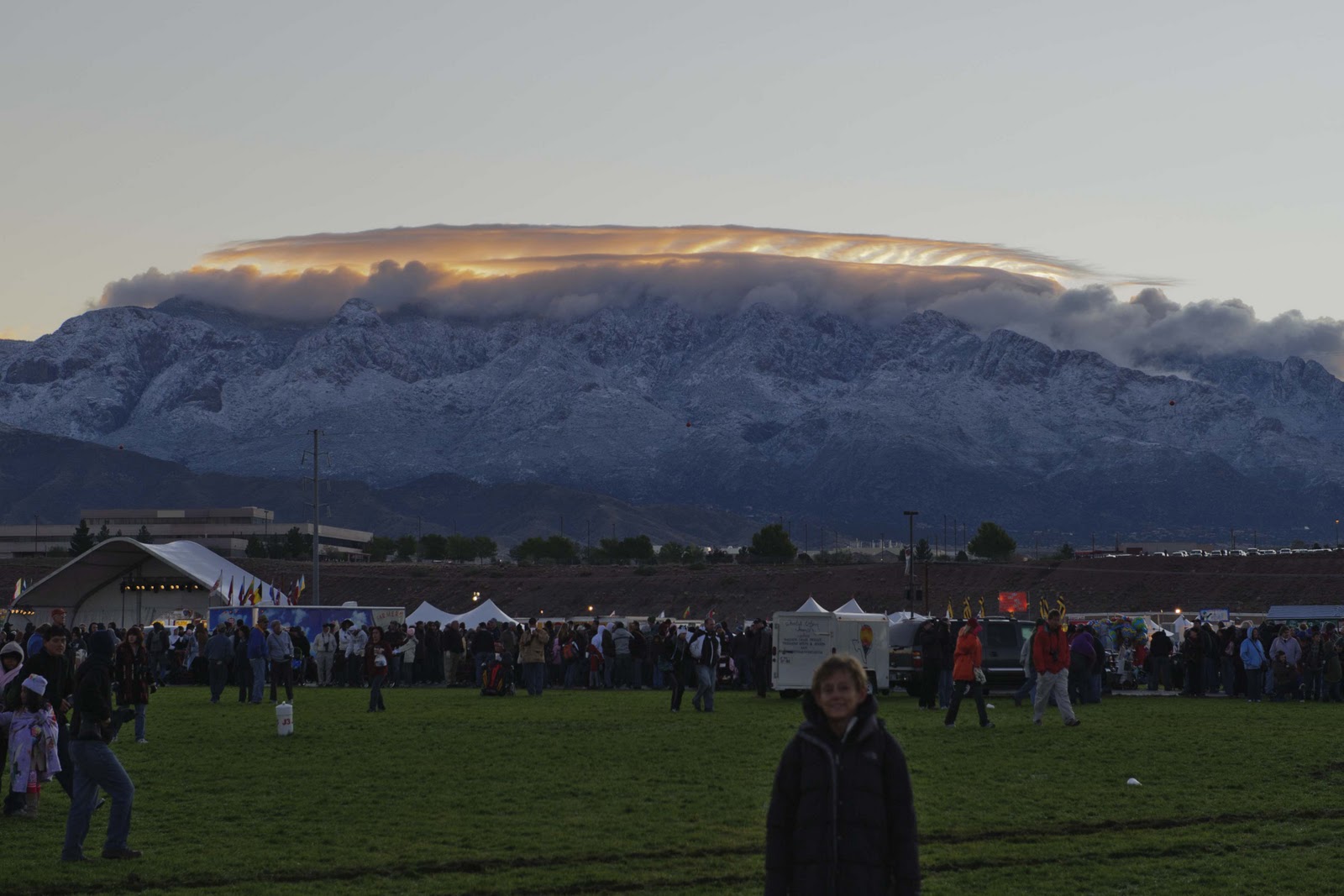
Fresh snow on the mountains above the launch field. Good thing Elizabeth brought her parka.

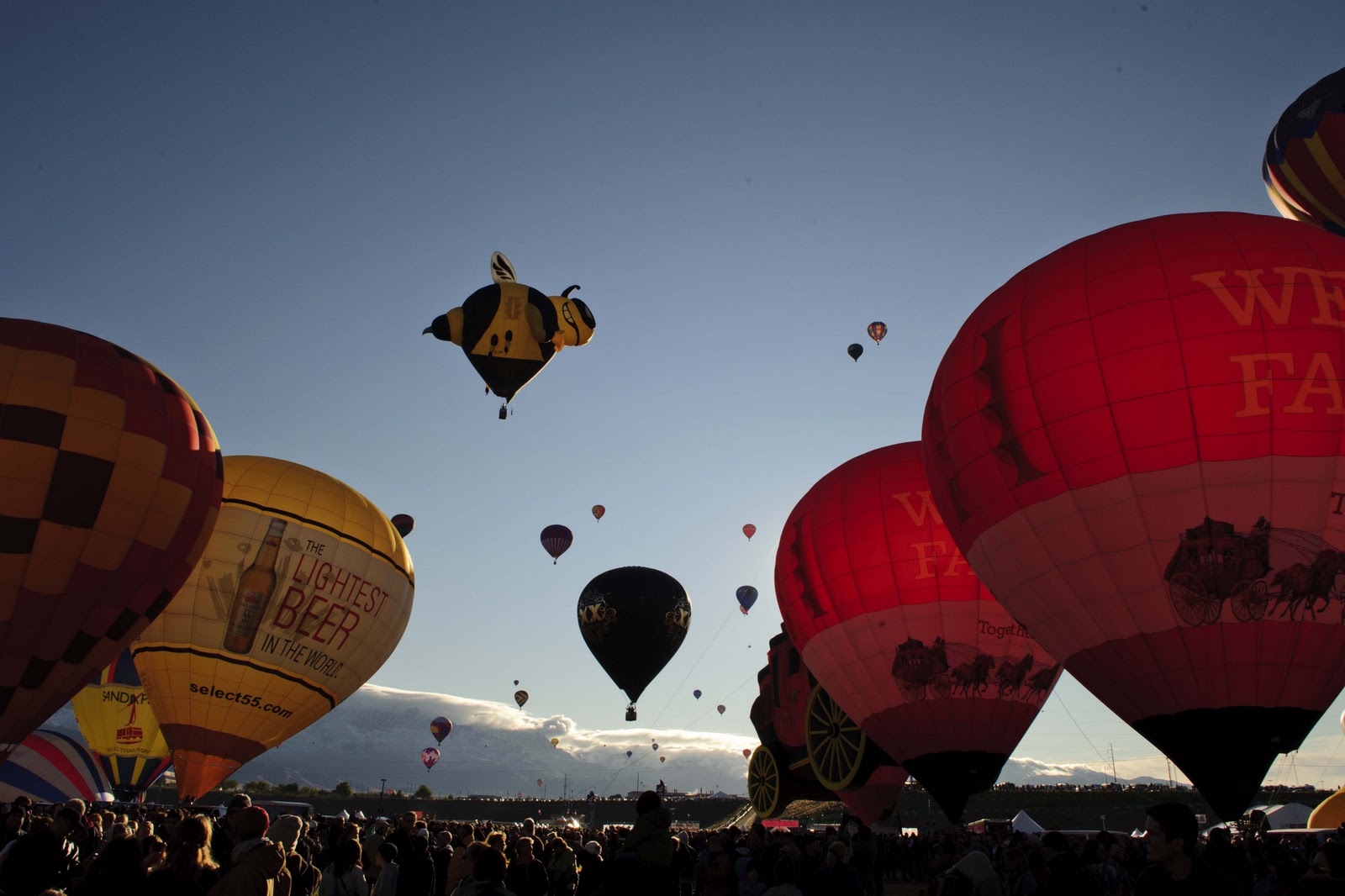
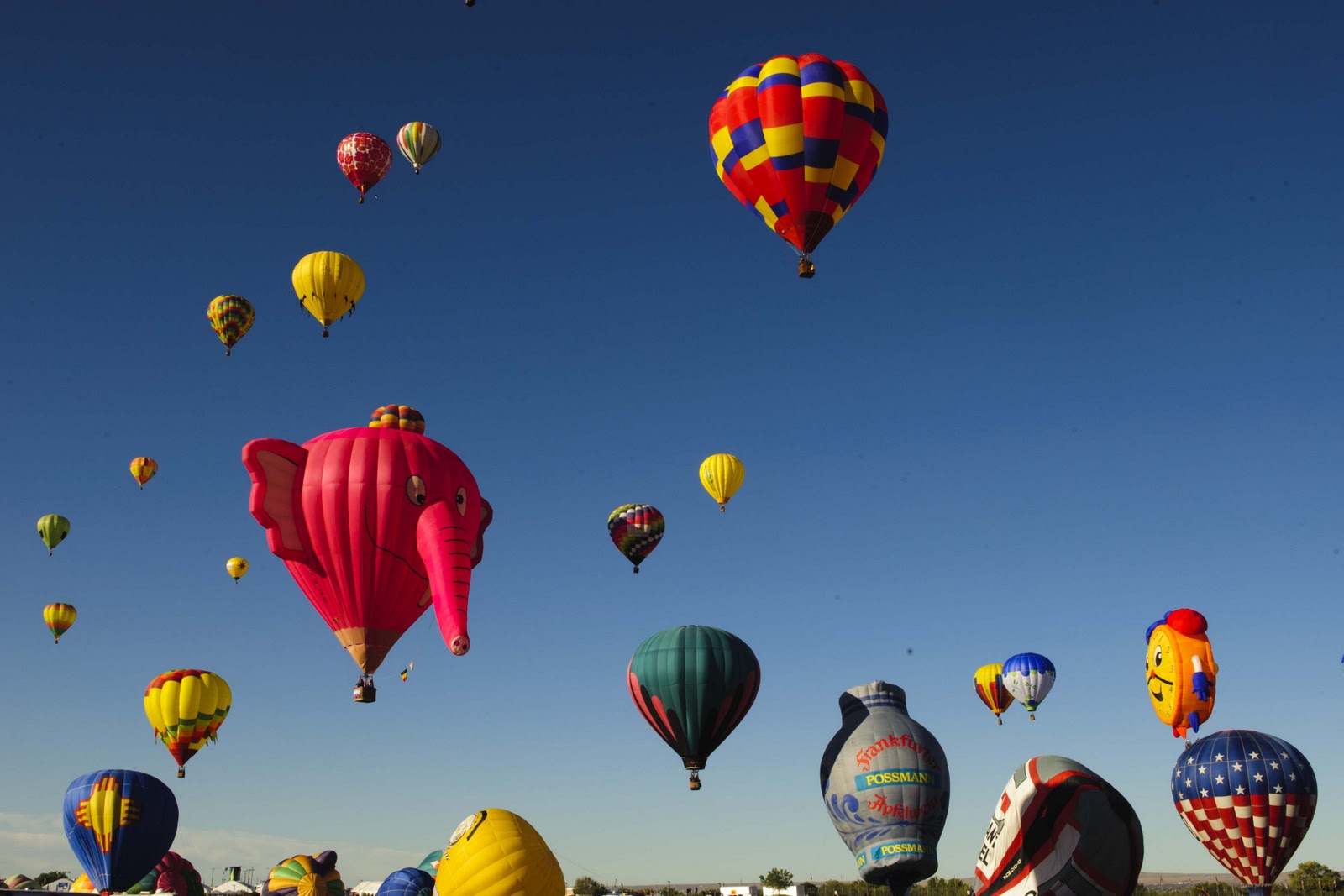
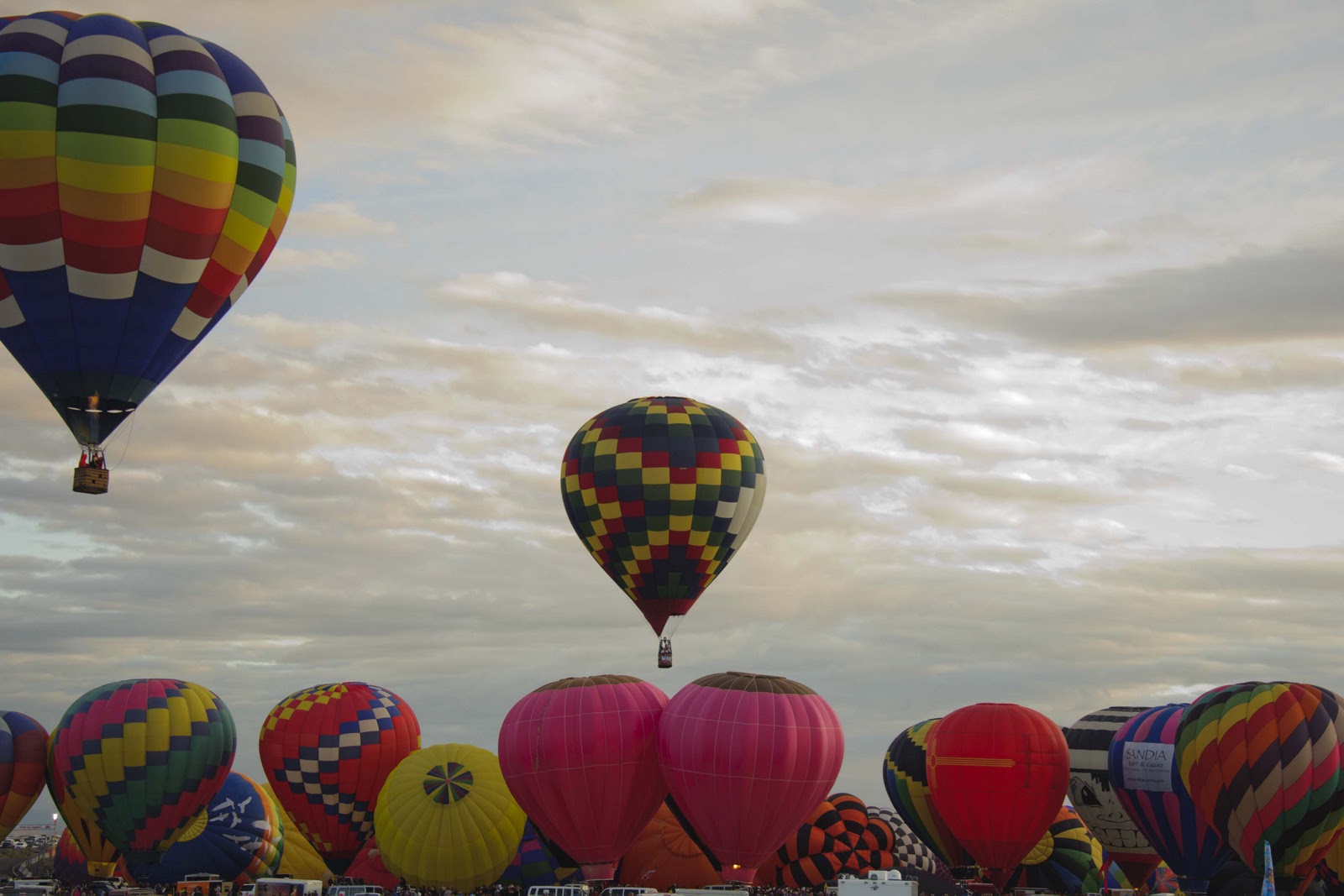
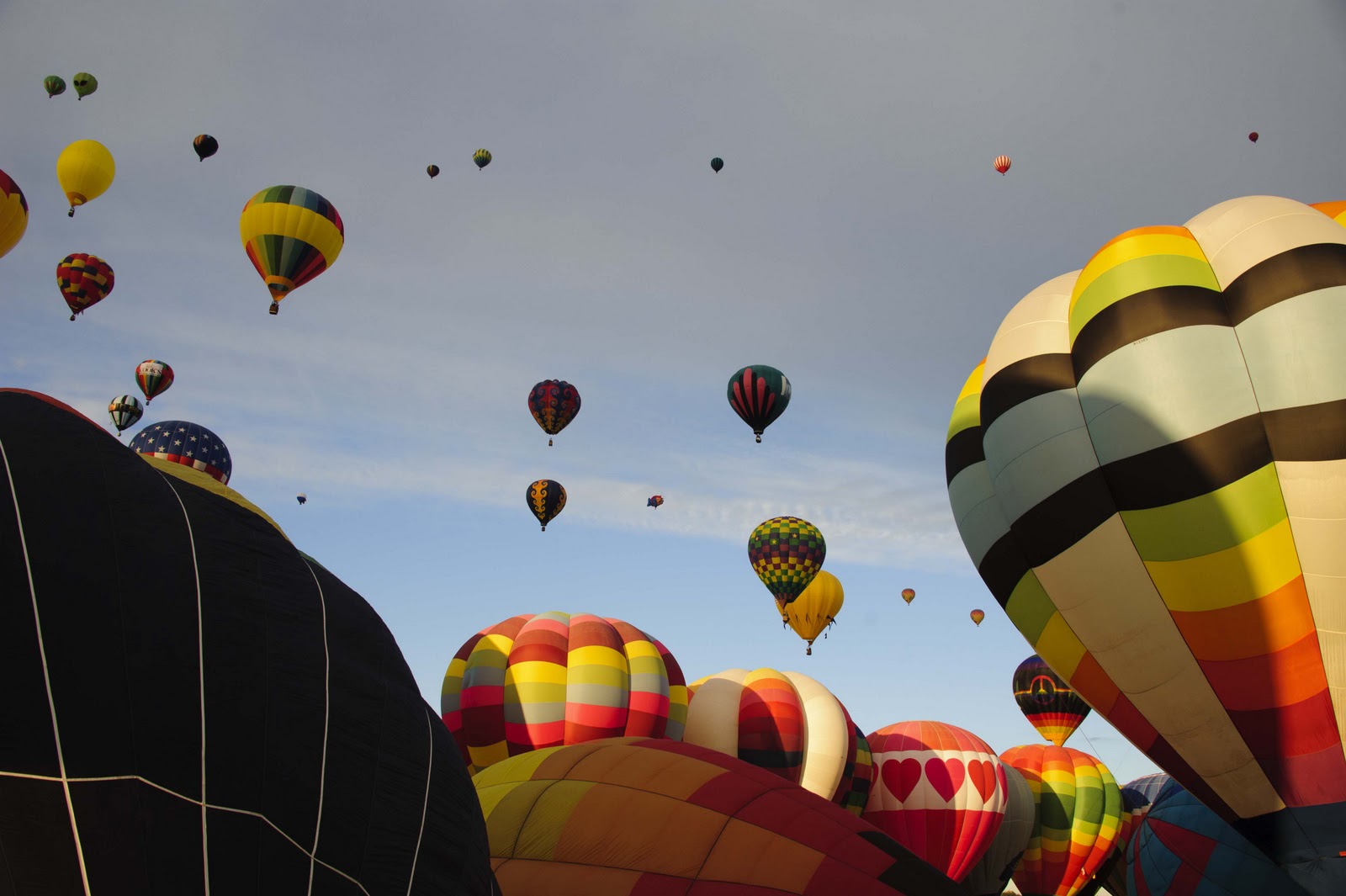
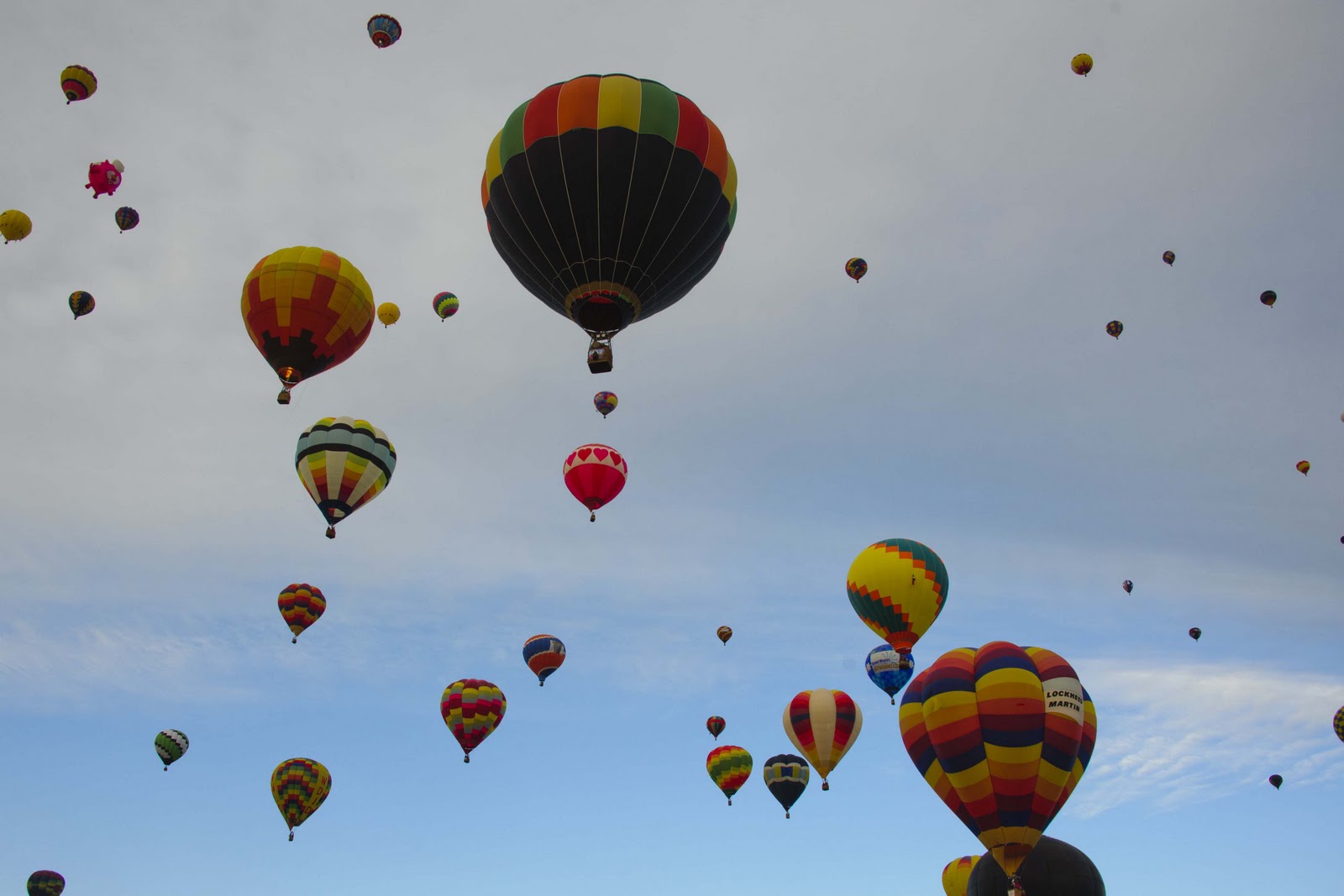
we finally got to see a ‘Mass Ascension’! What a sight to see;-) Again, the Shapes are really Special –

This is how Old Glory was presented during the Star Spangled Banner
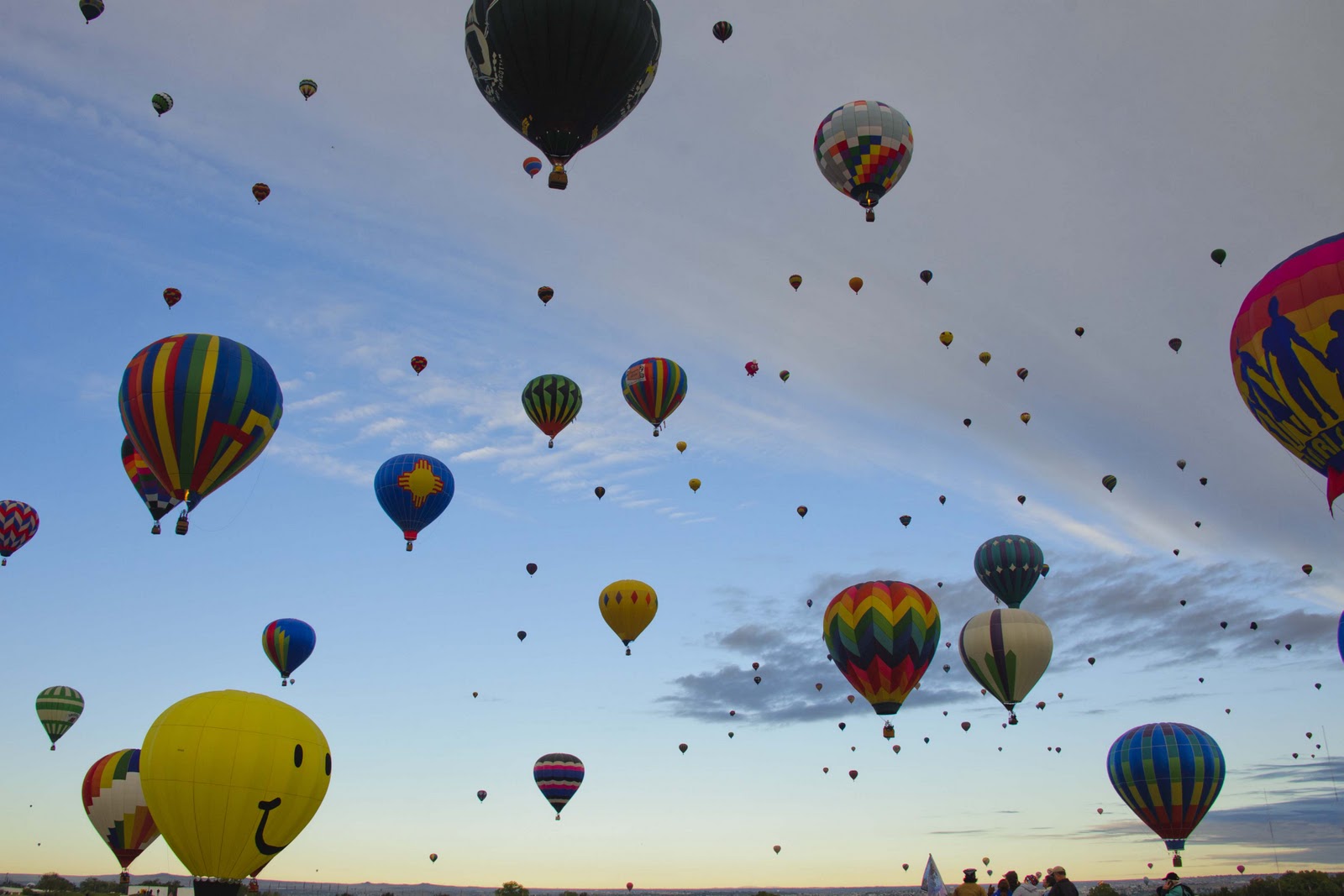
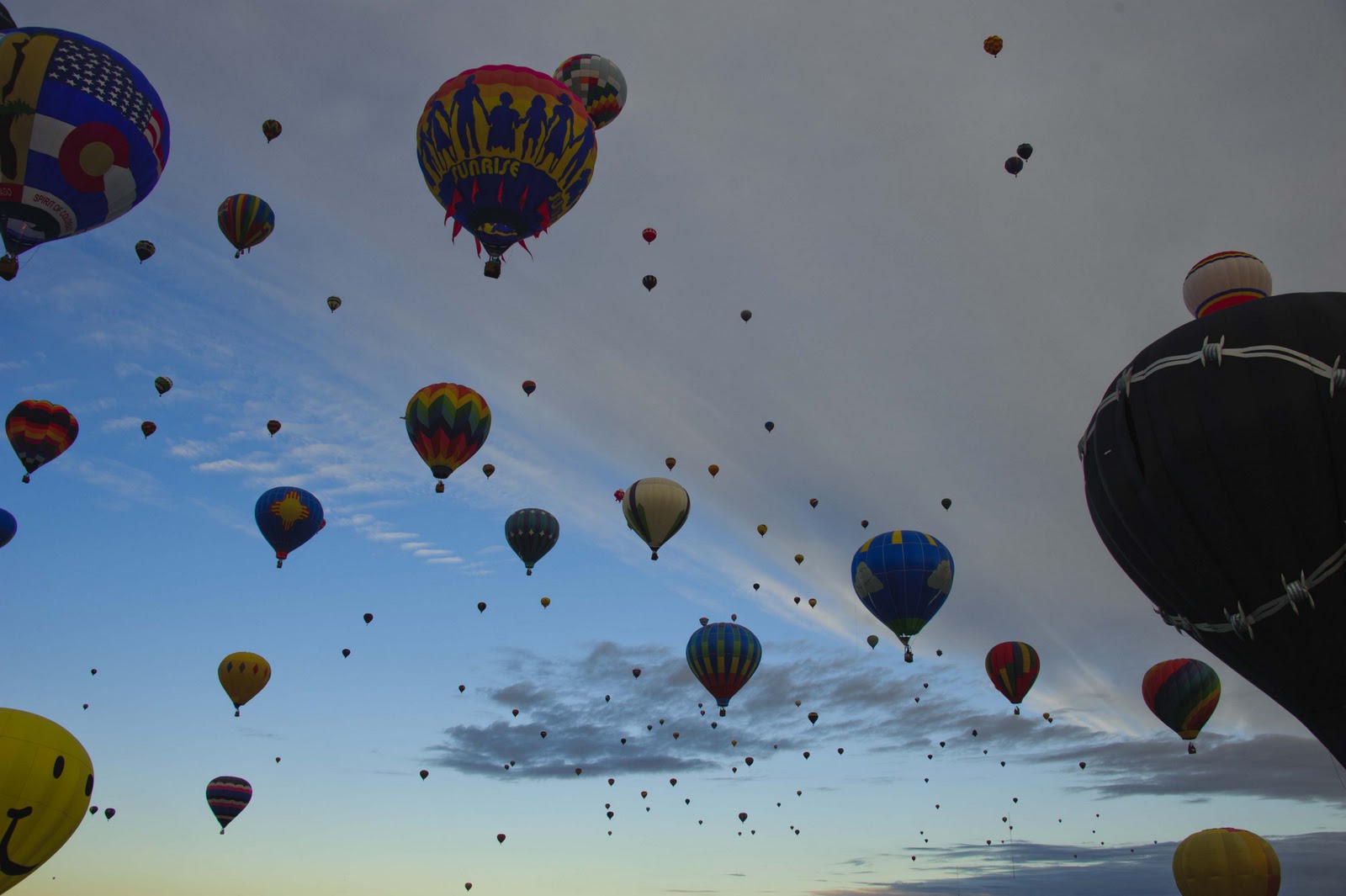
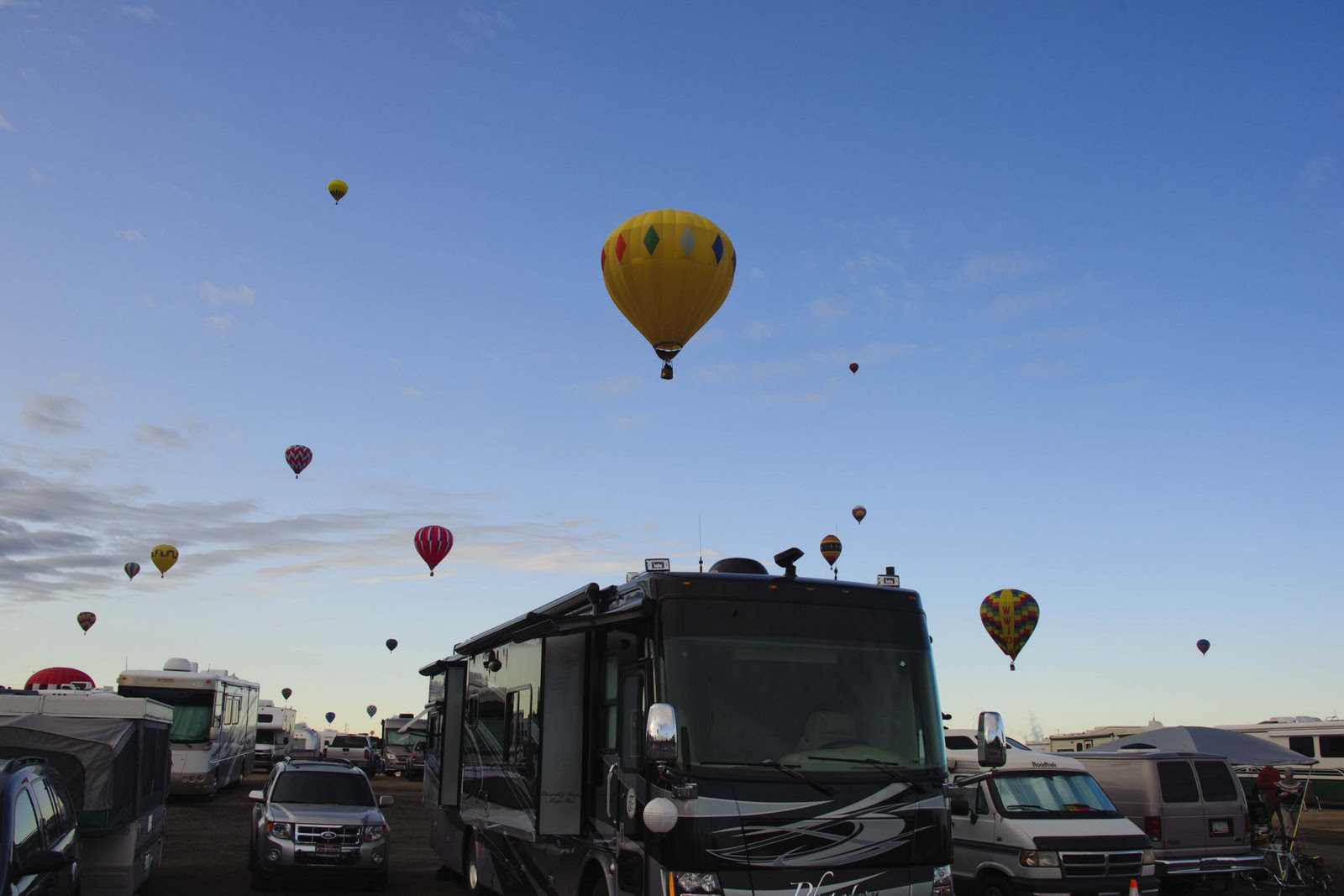
The variety and number of balloons were amazing.
Preparing for lift off??

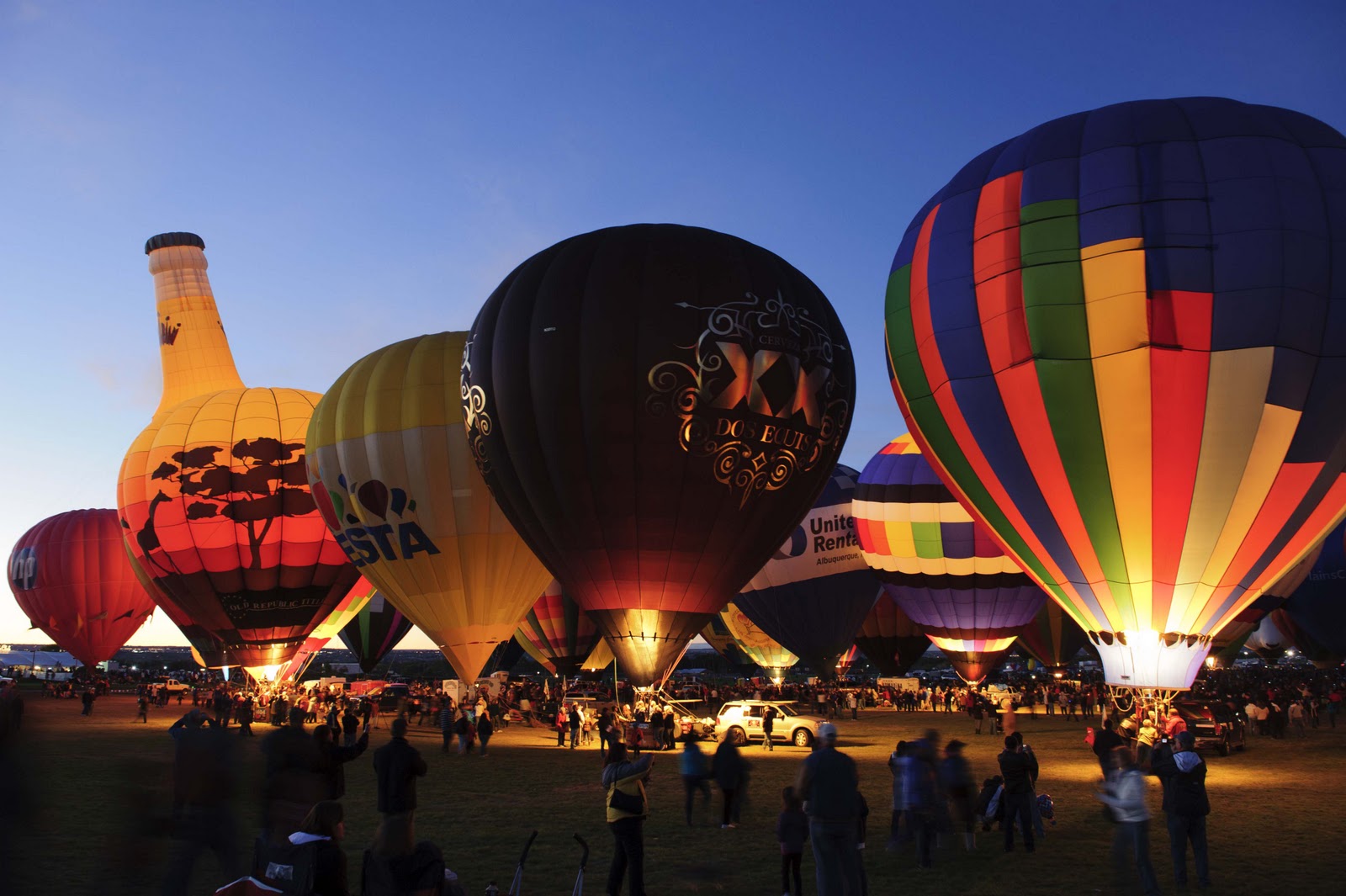
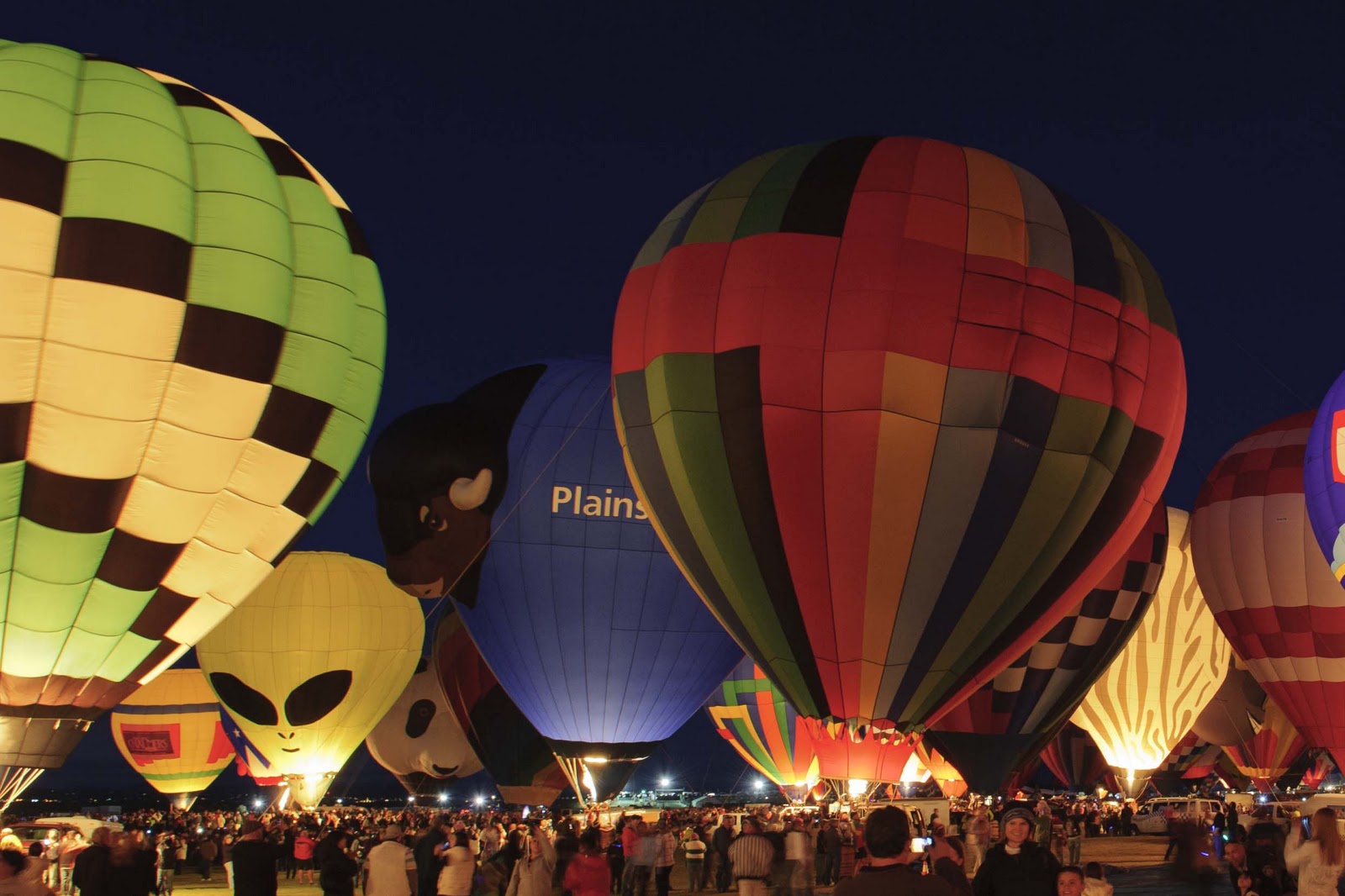
The weather finally cooperated to let the evening ‘Glow’ take place. This is awesome to see all the balloons inflated on the field and ‘glowing’.

The evening Glowdeo was a wonderful display, though quite a challenge to photograph.

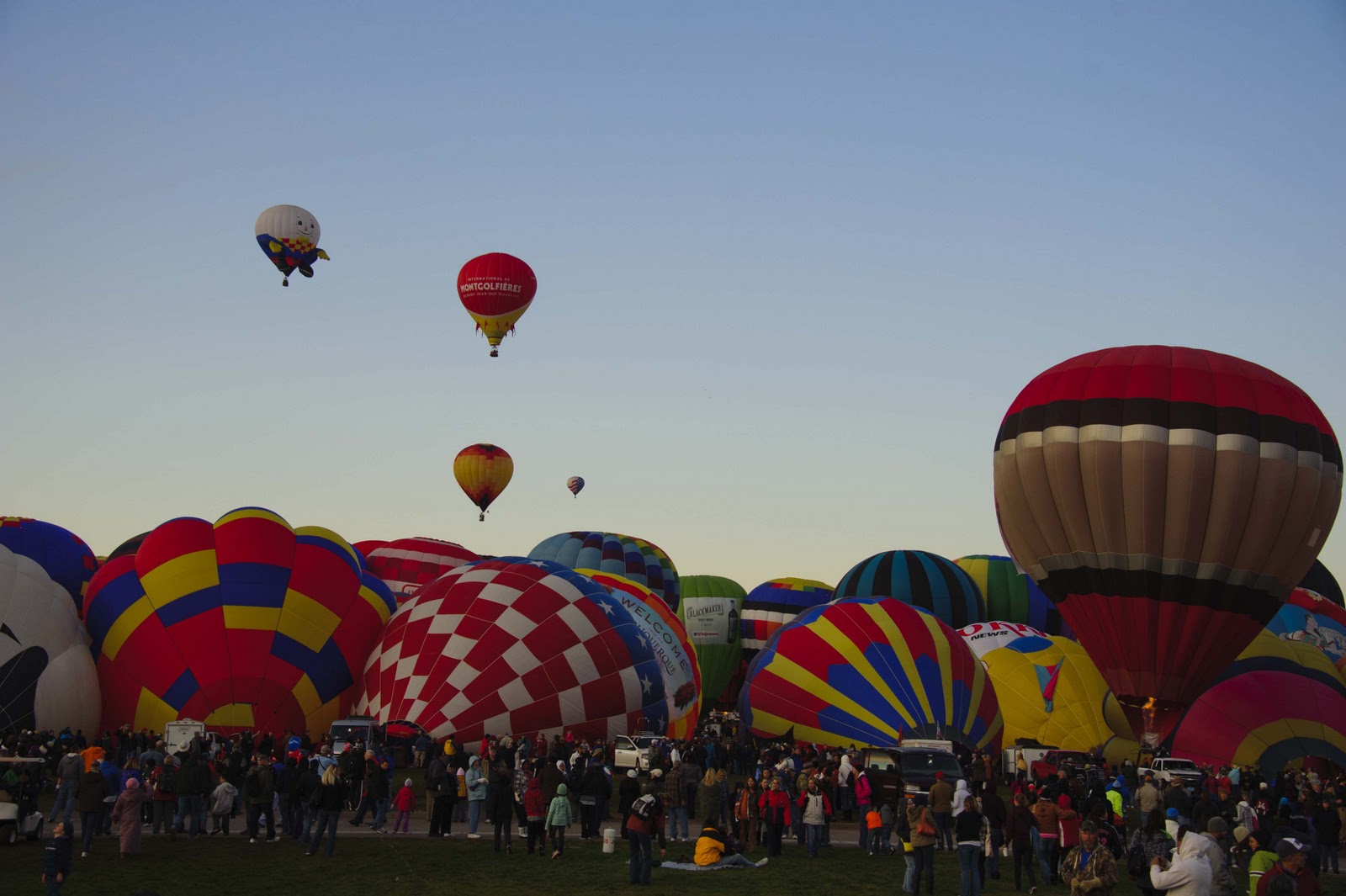
The Sunday morning ‘Farewell Mass Ascension’ is unbelievable! Hundreds of balloons inflating on the field getting ready to fly and hundreds in the air – and thousands of people to watch. You have to be here – but, Gary did a pretty good job of capturing the sights –

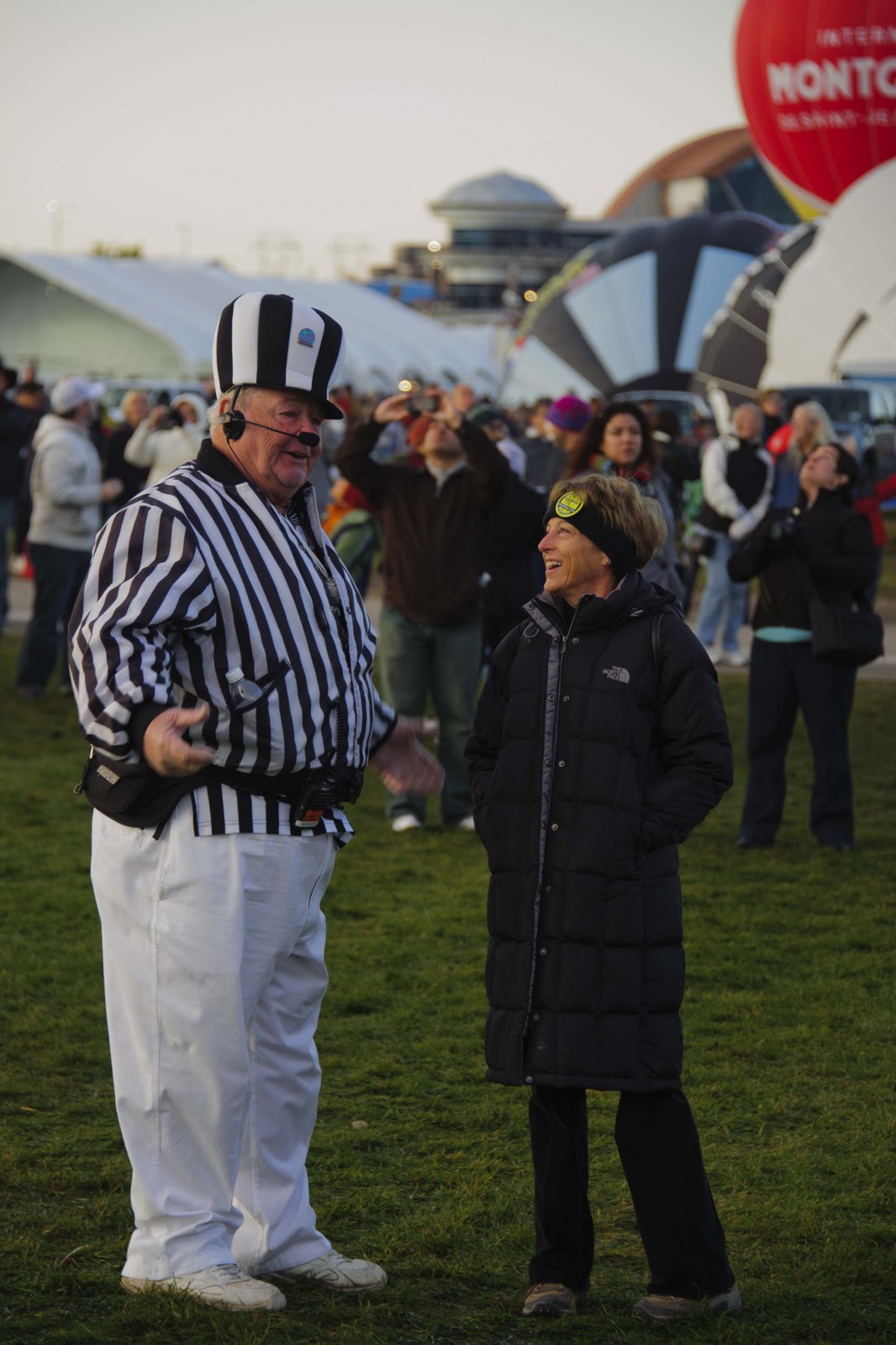
Elizabeth chatting up one of the launch officials.
Kinda looks like W.C Fields doesn’t he?

Couldn’t get enough of the mass ascension.

Any doubt which ones are the Race for the Cure entries?

No joke.
As you wish.

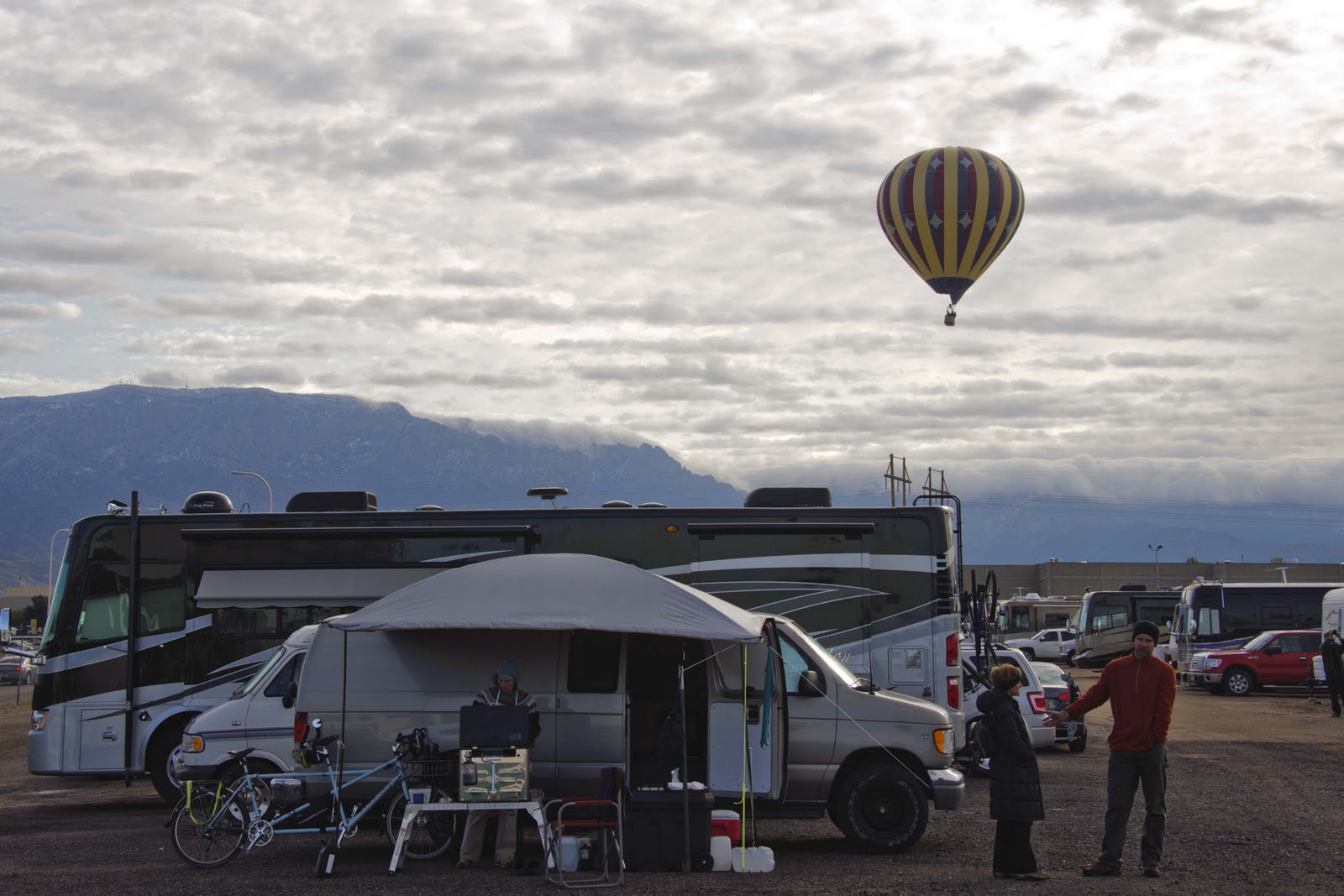
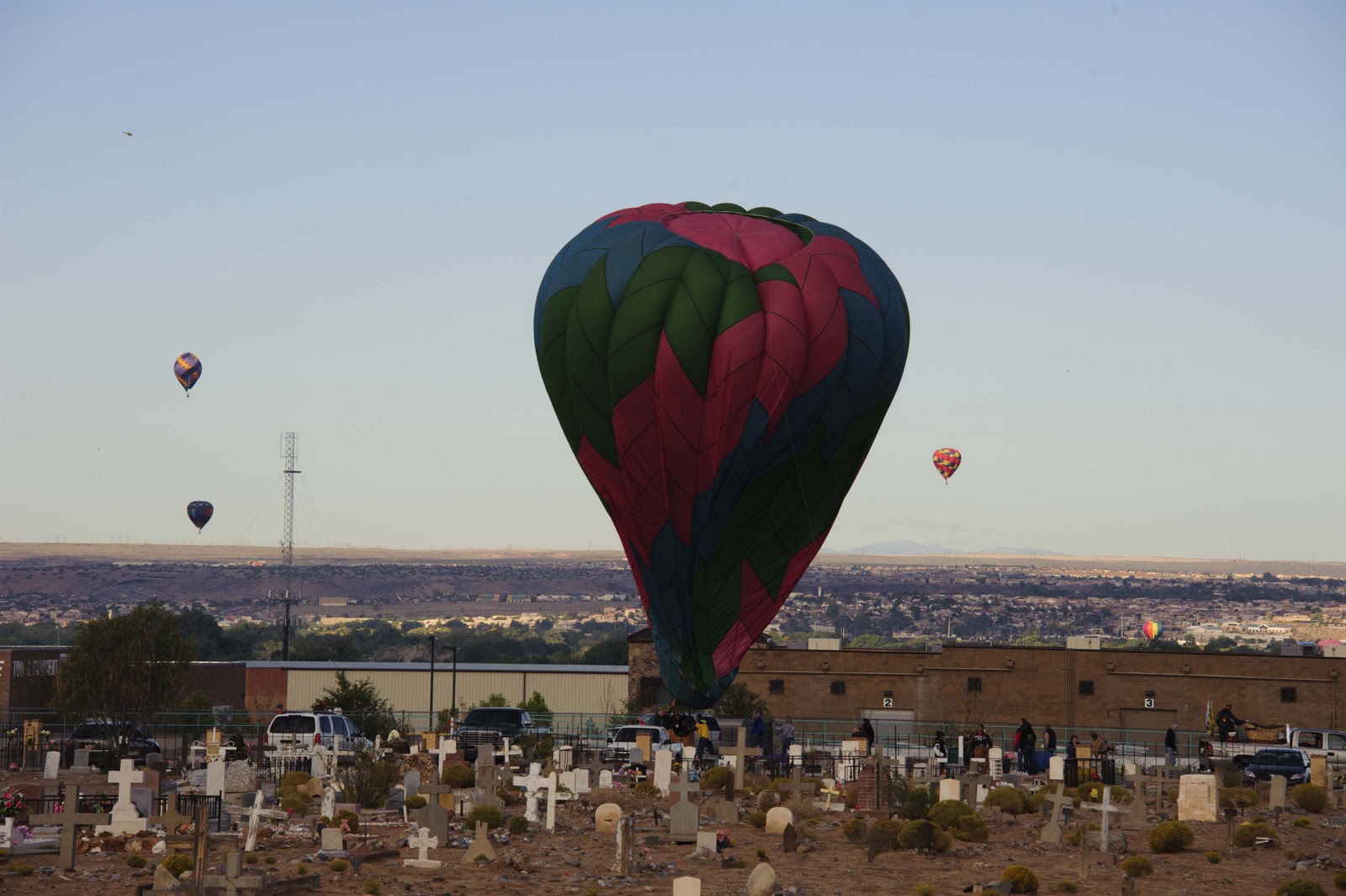
When we got back to Magic, balloons were landing all around us.

I guess, in a pinch, a pilot must take whatever landing spot presents itself.

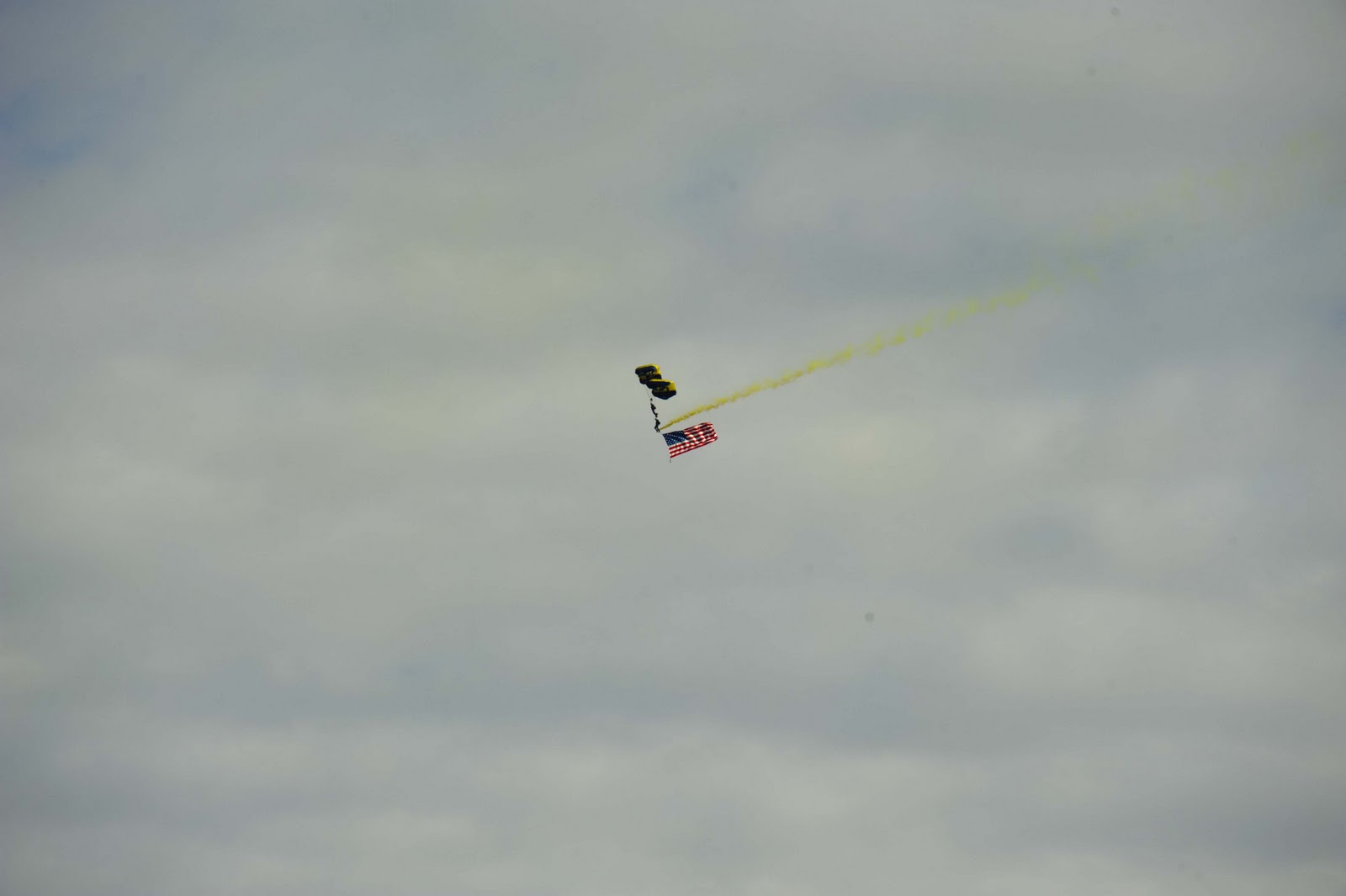
From a balloon to the launch field, this Navy Seal is presenting the Colors.

After all this excitement and long days (up at 4 to take in the morning events and not back until after 9 with the ‘Glow’ and fireworks!!), we were ready for some relaxation time with friends Kathryn & Robert in Santa Fe. They were kind enough to show us some unexpected, non-tourist sights, including the Millicent Rogers Museum in Taos. If you are ever in Santa Fe – this is a must see as it is most unusual.
Millicent Rogers (1902-1953) grew up in New York within privilege and wealth and she was often referred to in the press as the “Standard Oil Heiress,” since it was her grandfather, H.H. Rogers who was the co-founder with John D. Rockefeller of the Standard Oil Trust. Rogers came to Taos in 1947 with a heart broken by Clark Gable, and physically weakened by rheumatic fever as a child. She moved here, completely taken by the landscape and the Native American art in its many forms – and became an avid collector.
At the Millicent Rogers Museum, one enjoys many outstanding historical collections of Native American art and jewelry, contemporary paintings, weavings, and pottery, including the Maria Martinez family collection. Also showcased at MRM are hispanic textiles, metalwork and sculpture, as well as a wide range of contemporary Anglo-European Southwestern Art. Don’t miss it!
Oh yes, there were a couple of wonderful dinners, lunches and even a round of golf squeezed in with Kathryn and Robert during the couple of days in Santa Fe.

Incognito golfers. A great day spent with Robert and Kathryn.
Deflated and back on earth – E & G

Back on the Trail of the Ancients – Chaco Canyon

A quick 80 mile drive back on the Trail of the Ancients and we were ready to tackle another Ancestral Puebloan site – Chaco Culture National Historical Park (NHP). One has to REALLY want to visit this NHP, as it is at least a two hour drive from anywhere! But, the effort is well worth it.

The Chaco Canyon was the center of a thriving culture a thousand years ago. The monumental scale of its architecture (We saw the architecture up in Colorado at the Lowry Pueblo and at Mesa Verde.), the complexity of its community life and its far-reaching commerce (traces of cocoa from South America were found in pottery remnants on the site) created a cultural vision unlike any other seen before or since.

The cultural flowering of the Chacoan people began in the mid-800’s and lasted more than 300 years! This can be seen clearly in the grand scale of the architecture. Using masonry techniques unique for their time, they constructed massive stone buildings (Great Houses) of multiple stories containing hundreds of rooms and many stories high.

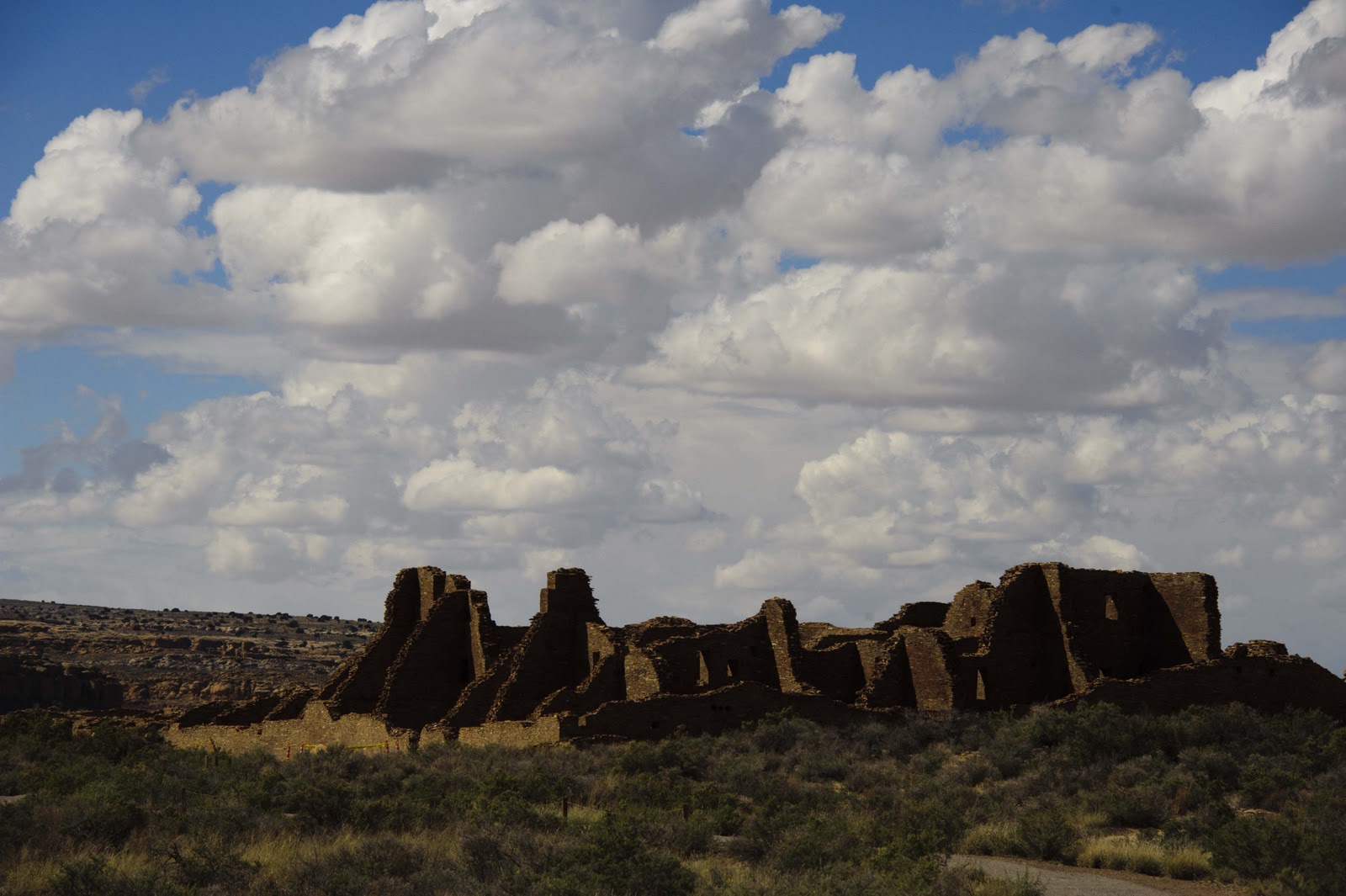
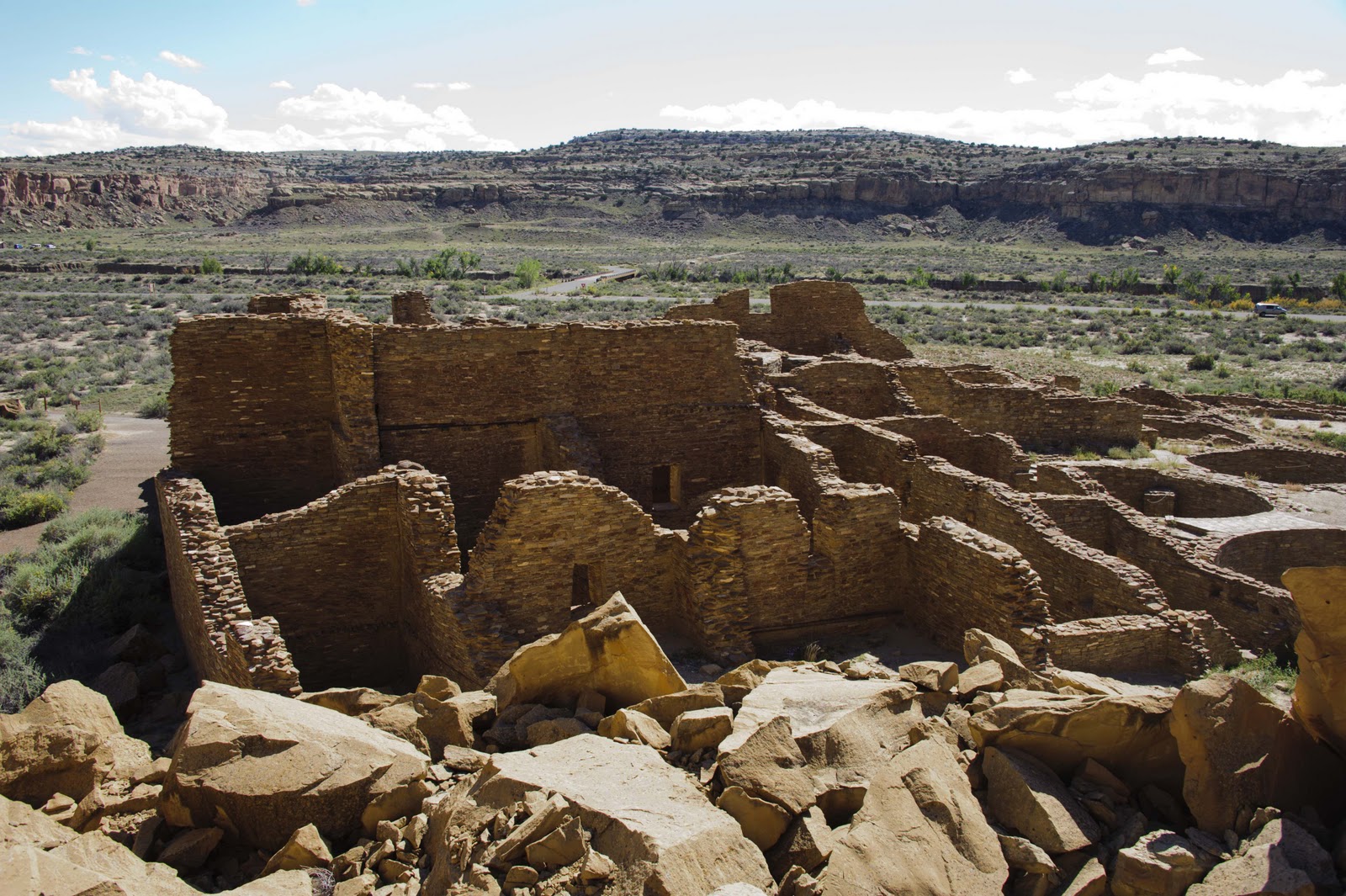
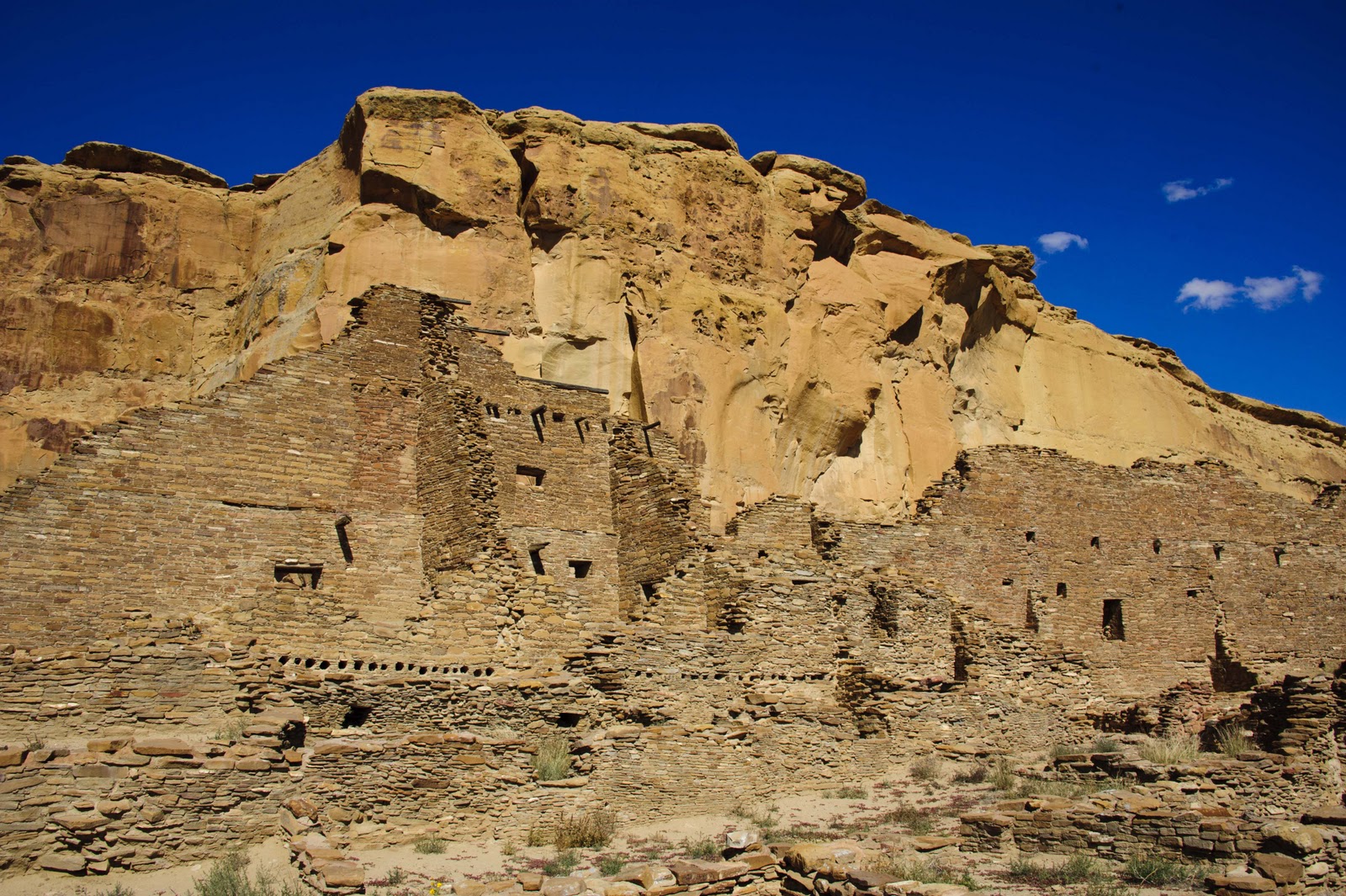
The largest of the Great Houses in Chaco Canyon is Pueblo Bonito, center of the Chacoan world. Planned and built in stages, Pueblo Bonito was occupied from the mid-800s to the 1200s. The structure towered four stories high and contained more than 600 rooms and 40 kivas! The access to this ancient site was extensive and made the adventure a real wonder.

Approaching Pueblo Bonita
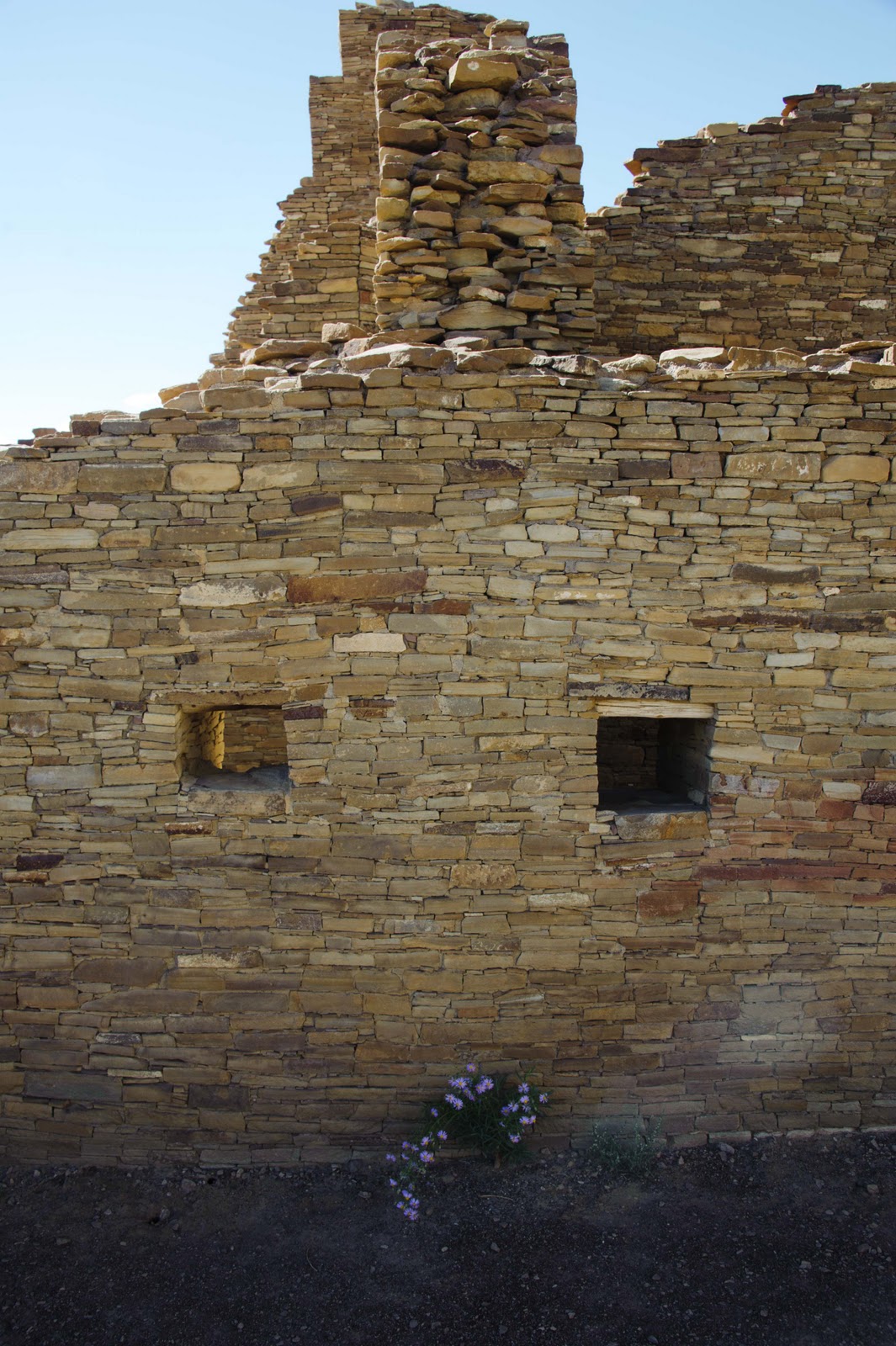
Old wall, new wildflowers.
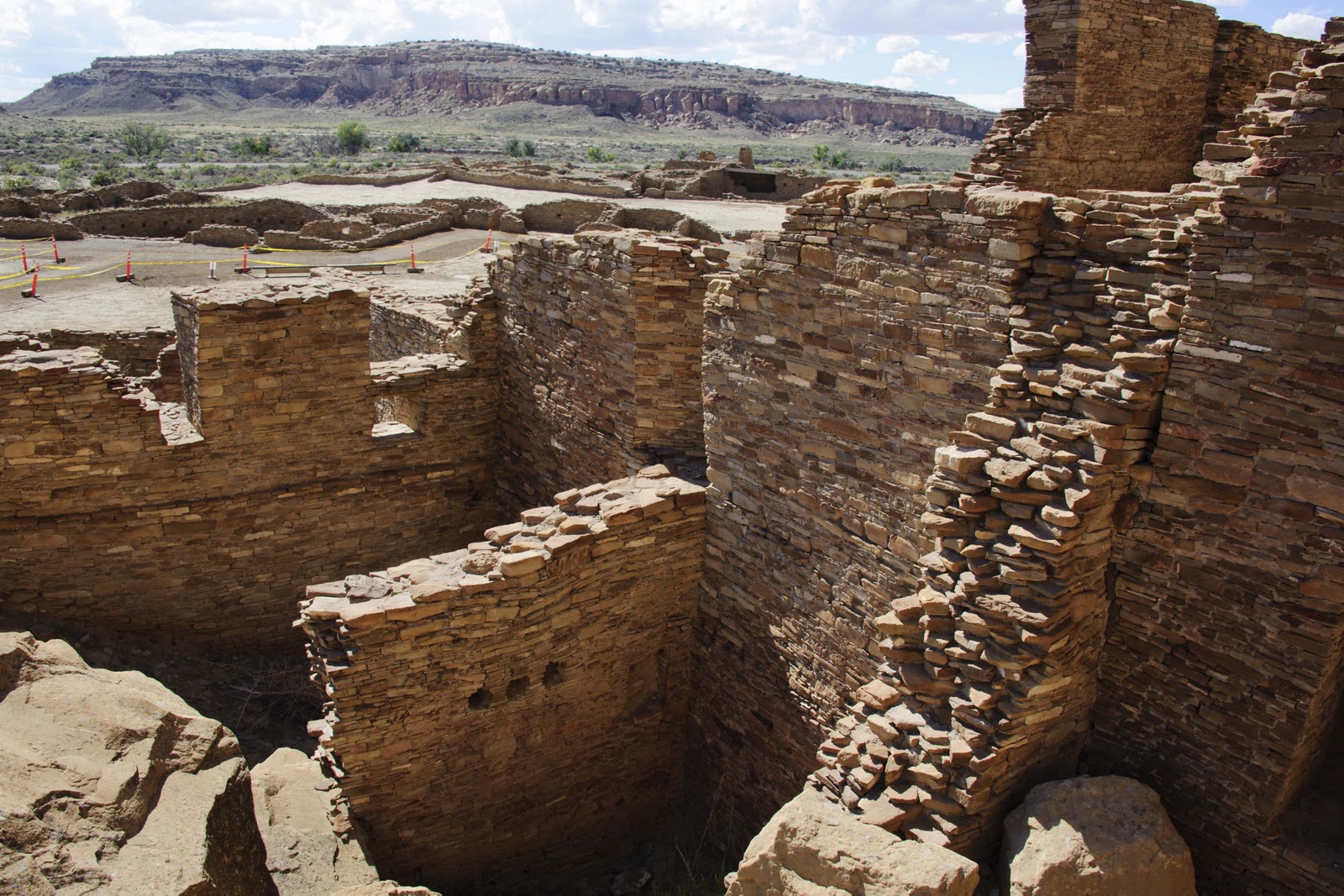
The recent rock slide in the foreground wiped out about 30 rooms in the complex.

Pueblo Bonita covers more than 3 acres. You can see the plaza behind these walls.
Amazing how these large structures blend into the surrounding landscape.
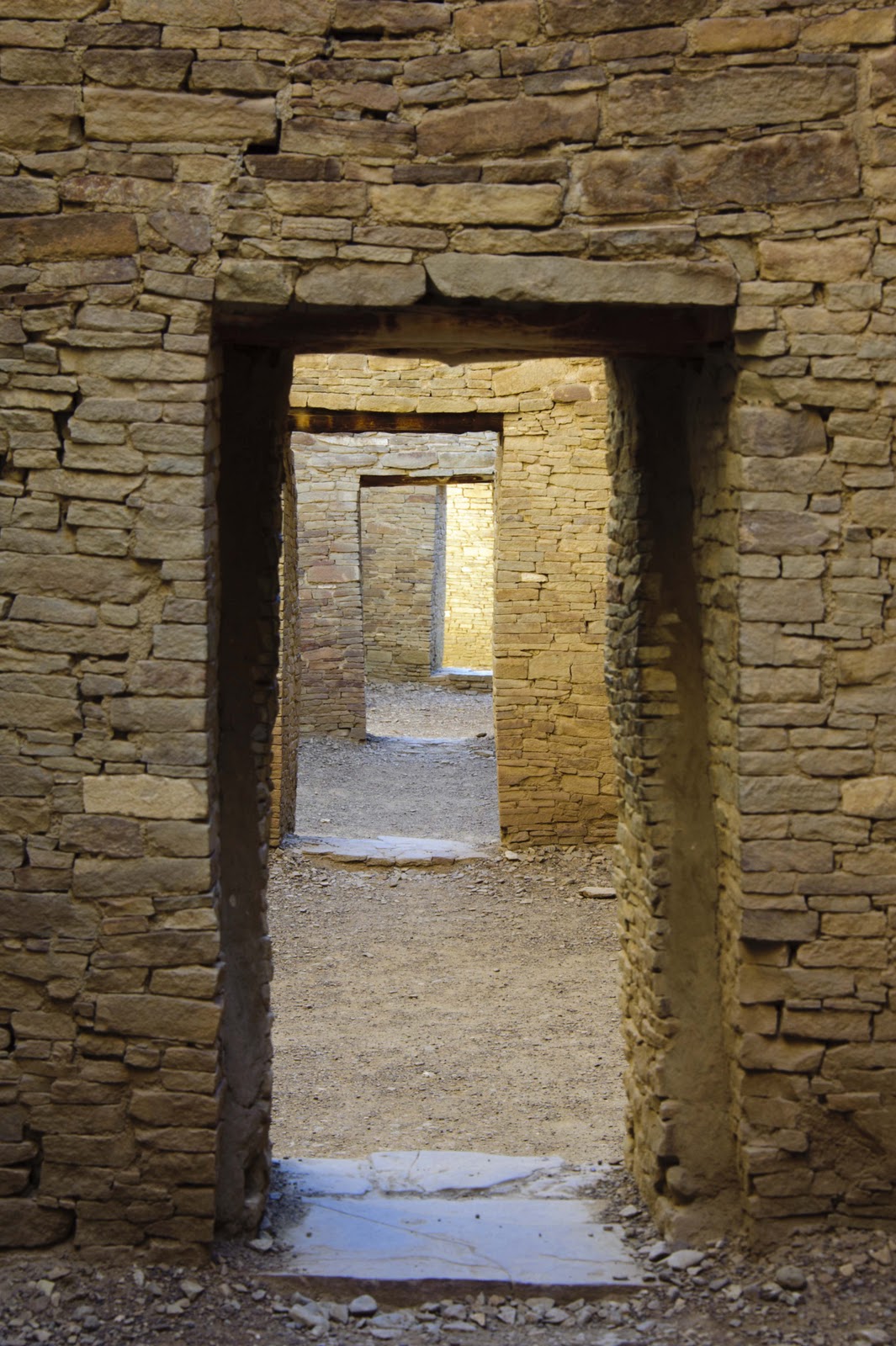
Gary had to duck a lot to get through the doors.

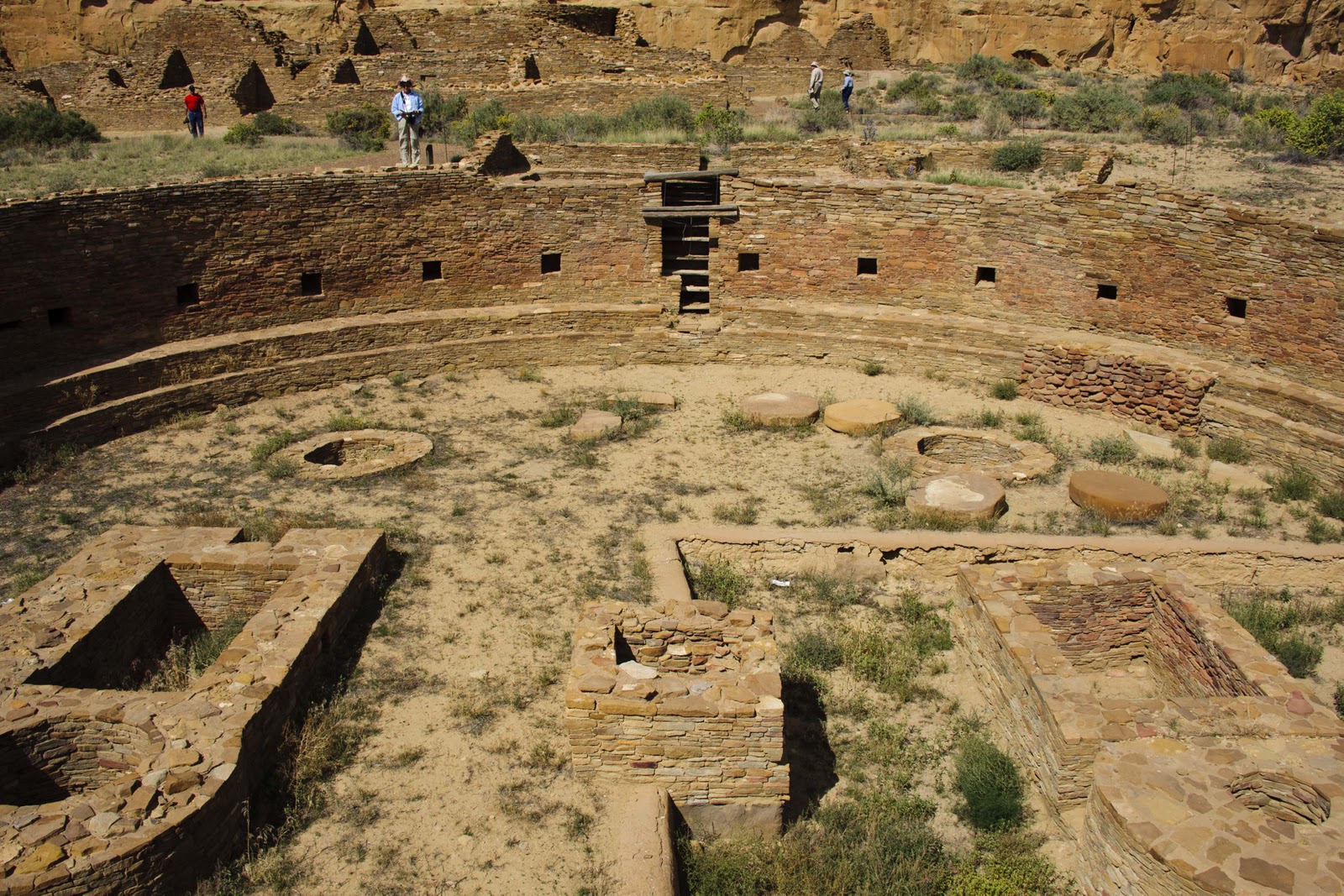
Chetro Ketl is another Great House adjacent to Pueblo Bonito. It was begun about 1020 and contains an estimated 500 rooms and 16 kivas. The Great Kiva included at Chetro Ketl is a wonderful example of the Kiva.

The Great Kiva at Chetro Ketl.

There are several additional Great Houses and sites within the Chaco Culture NHP – all sites to see and experience.


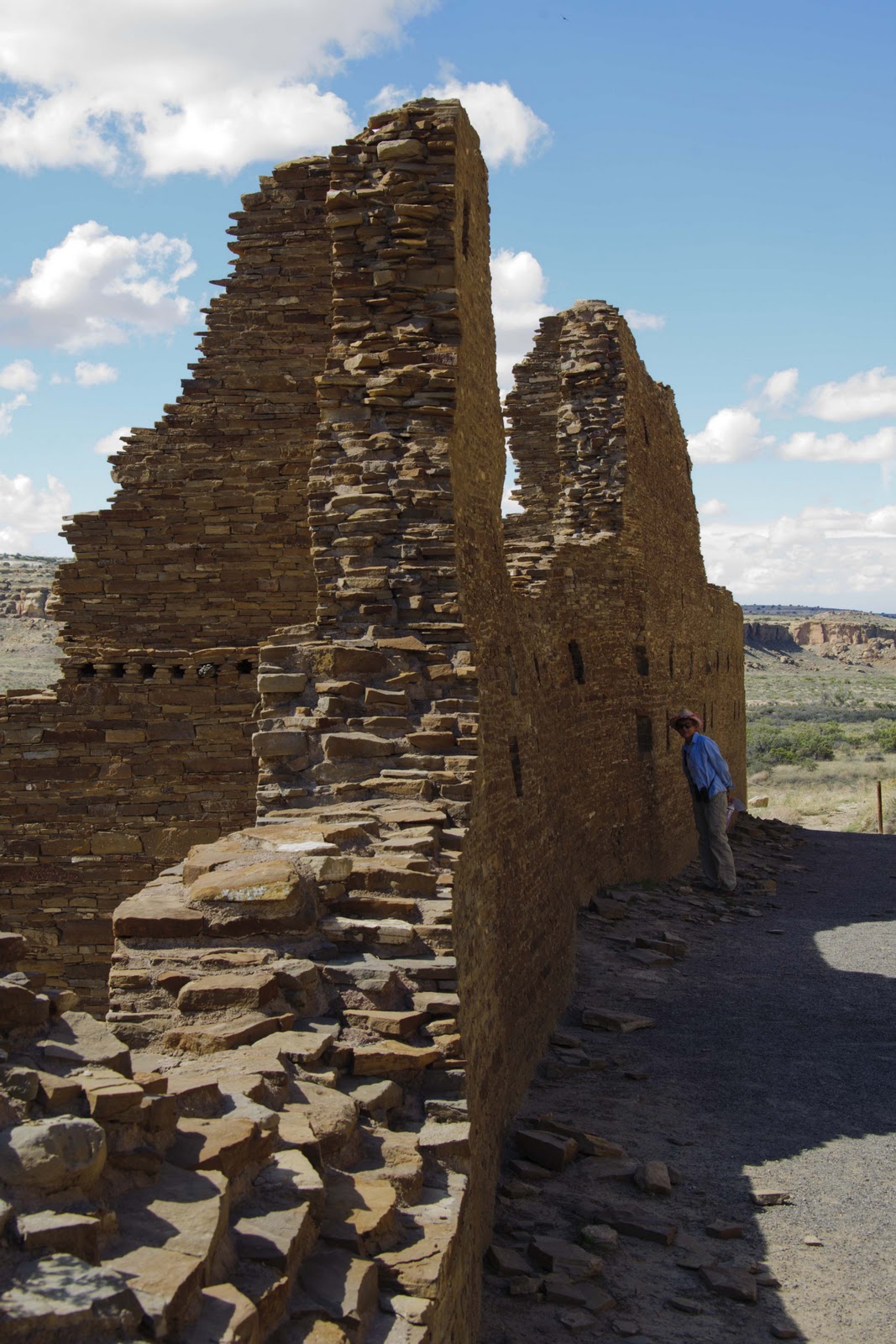
Portions of the three story walls at Hungo Pavi still remain.
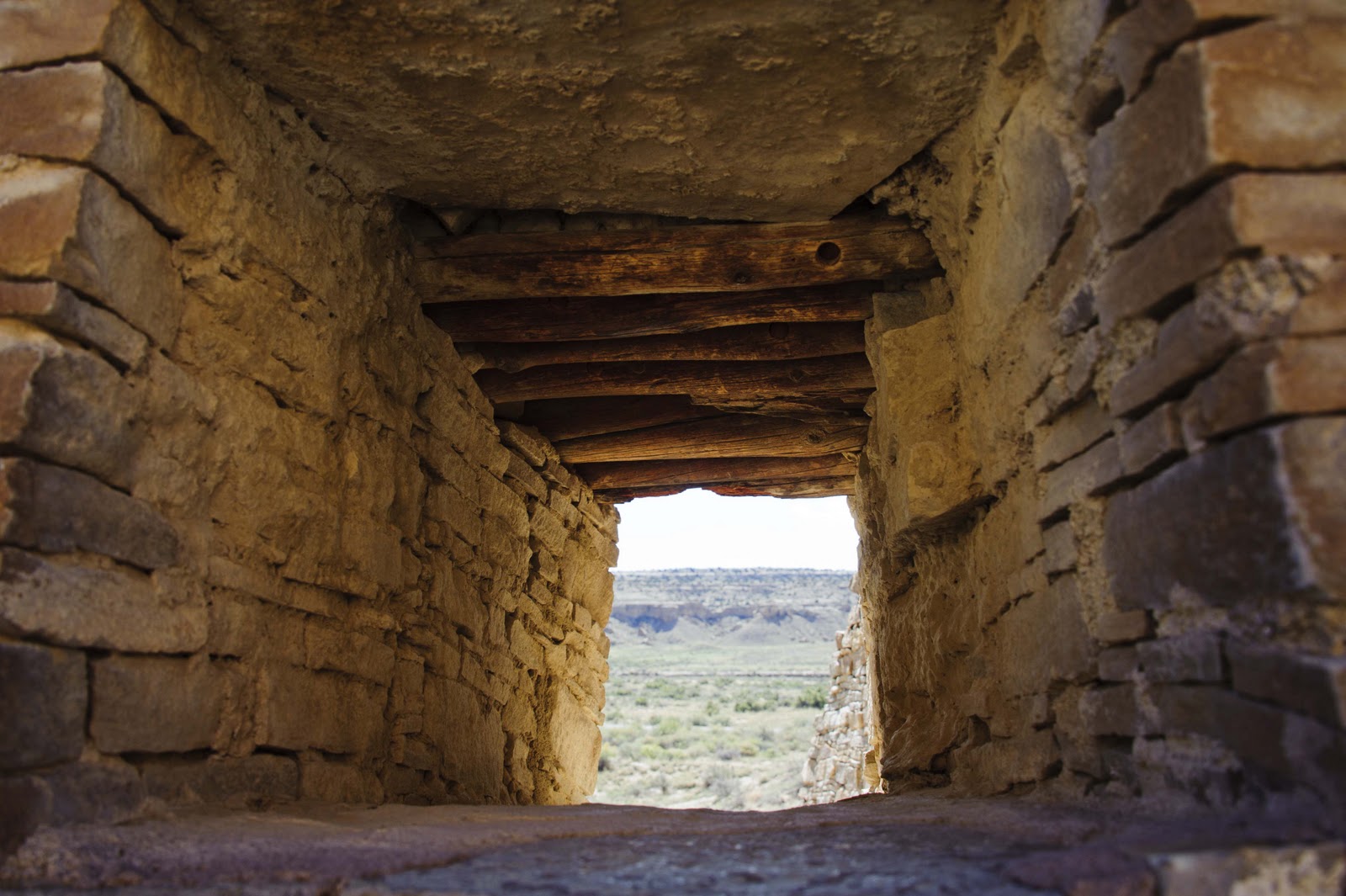
This opening is only about 2 x 2 feet – shows the building architecture.

But, after about 4.5 hours we were again maxed out on our attention span. AND, we had a good hour to get out of the park and back to Magic.

Perhaps you remember the statement at the beginning of this posting that the NHP is two hours from anything! I mean ANYTHING! We found some ‘RV sites’ (a questionable description) behind a ‘trading post’ about an hour from the park entrance in the middle of nowhere – and this was the closest thing without driving back north 2 hours or on to Albuquerque. We were prepared for what we got – and the space did the trick for the evening. We had an electric hook-up to prepare dinner and there were NO trees so the satellite worked just fine for Monday Night Football – thank goodness for satellite!!

The best view we could find from our parking spot.

Here is the actual view of our surroundings.

Tomorrow – The Balloon Festival!! We are sooooo excited!!

Ready to Fly – Elizabeth & Gary from the Middle of Nowhere

We’ll Be Comin’ Round the Mountain

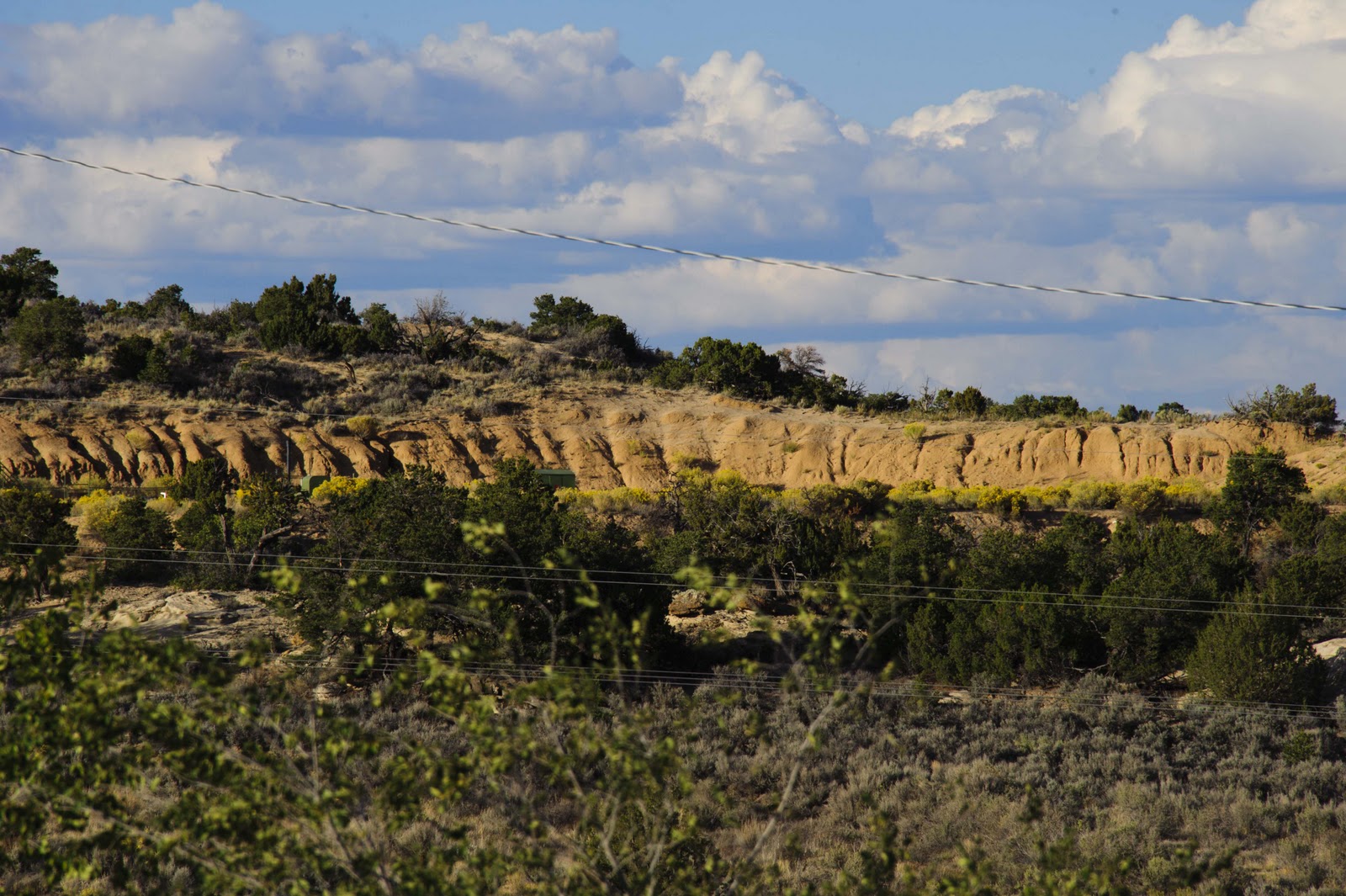
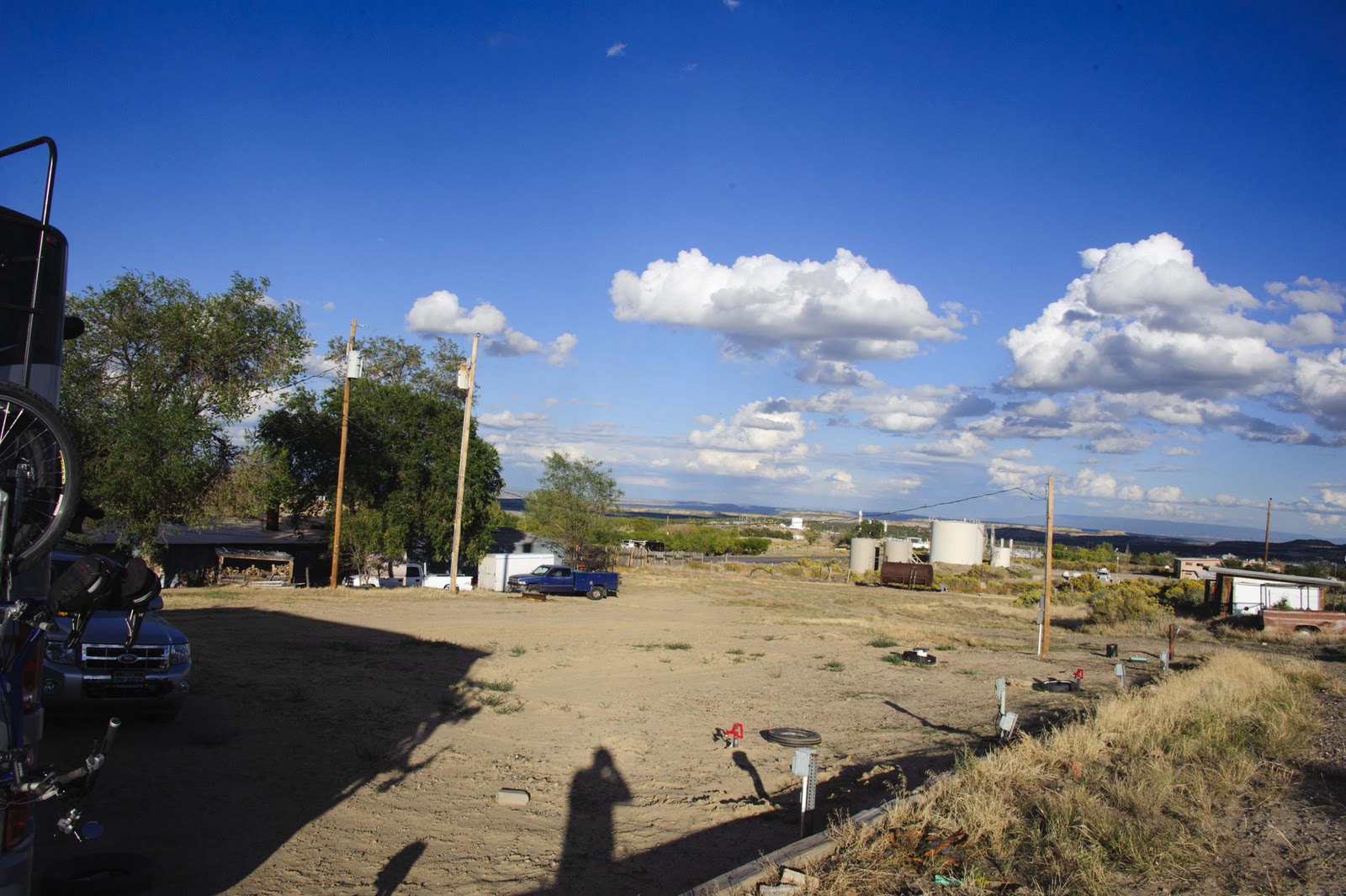
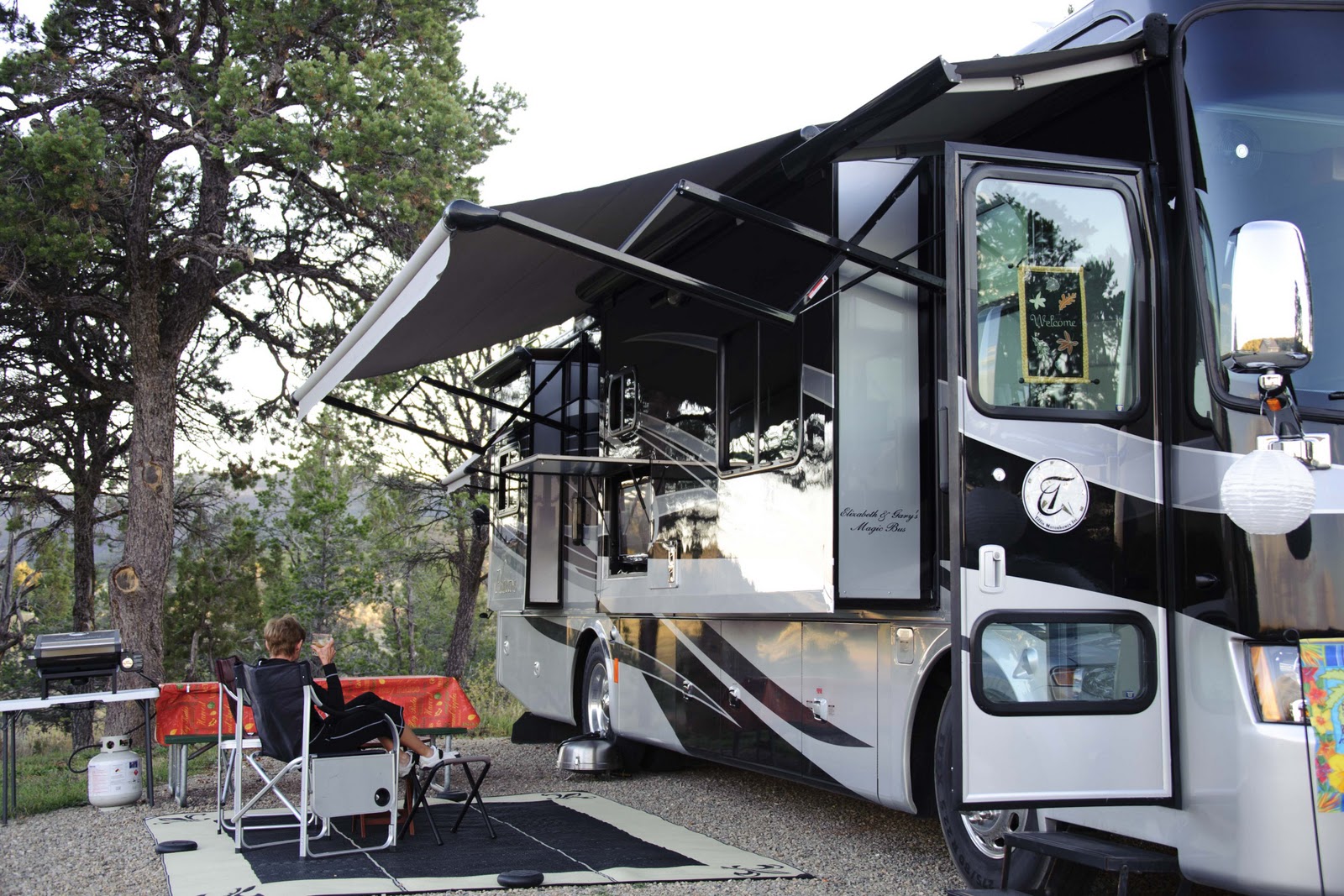
The month of September was ushered out in Durango, Colorado – visually similar to our own Park City – and the leaves are changing daily. The United Campground (great place to park!) just north of town is our ‘home’ for the weekend – and we have quite enjoyed a little down time after the hectic schedule of the first 10 days.

Our camp spot.

After our delightful drive of 36 miles on Thursday, September 29th, we did our usual ‘investigate the town’ routine. And, guess what is here this week-end?!? The Cowboy Poetry Gathering! Since we will be missing the one in Park City, we will enjoy this one;-) And, of course, there is the Durango & Silverton Narrow Gauge Railroad. This is where we shall start.
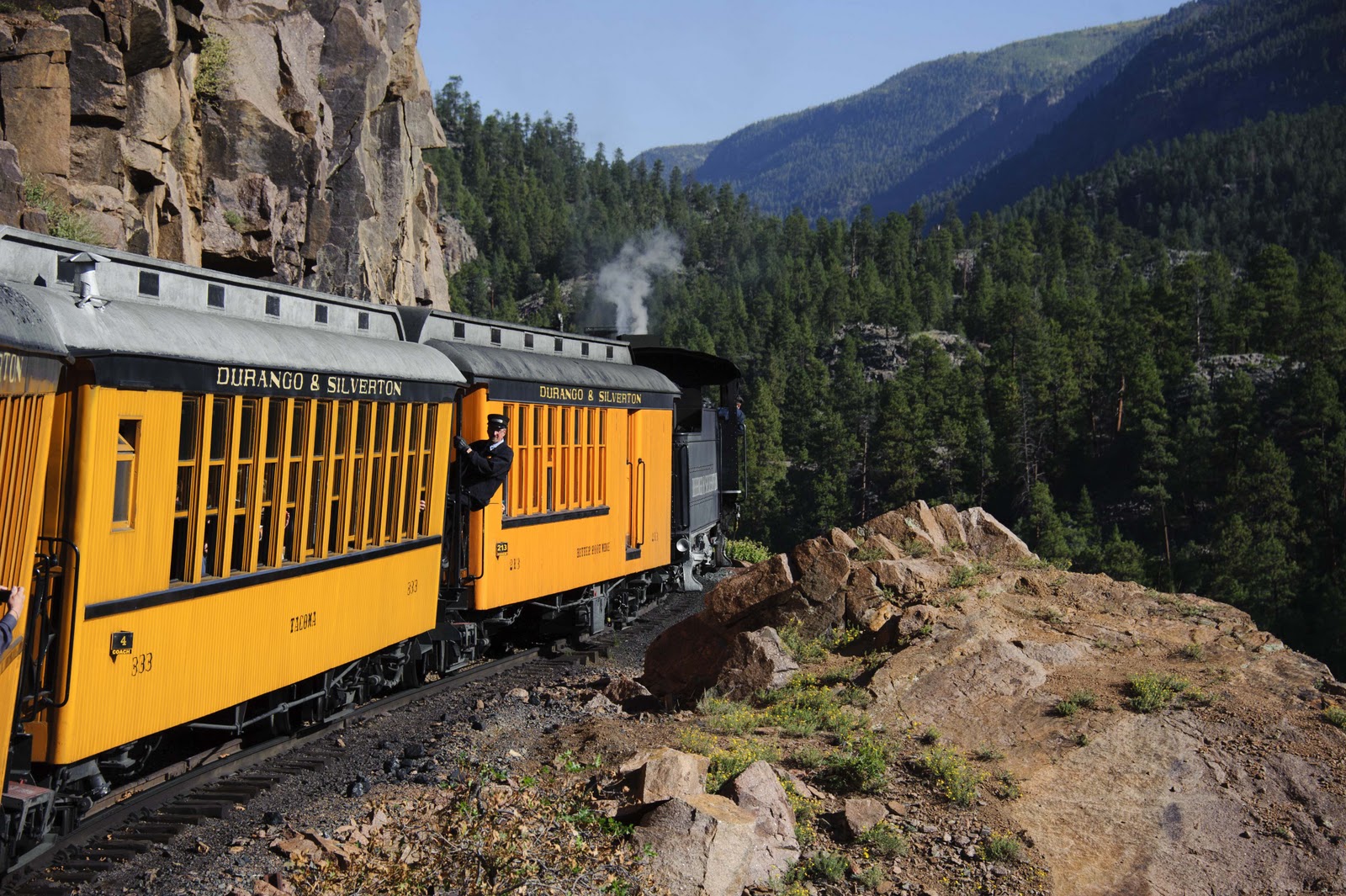
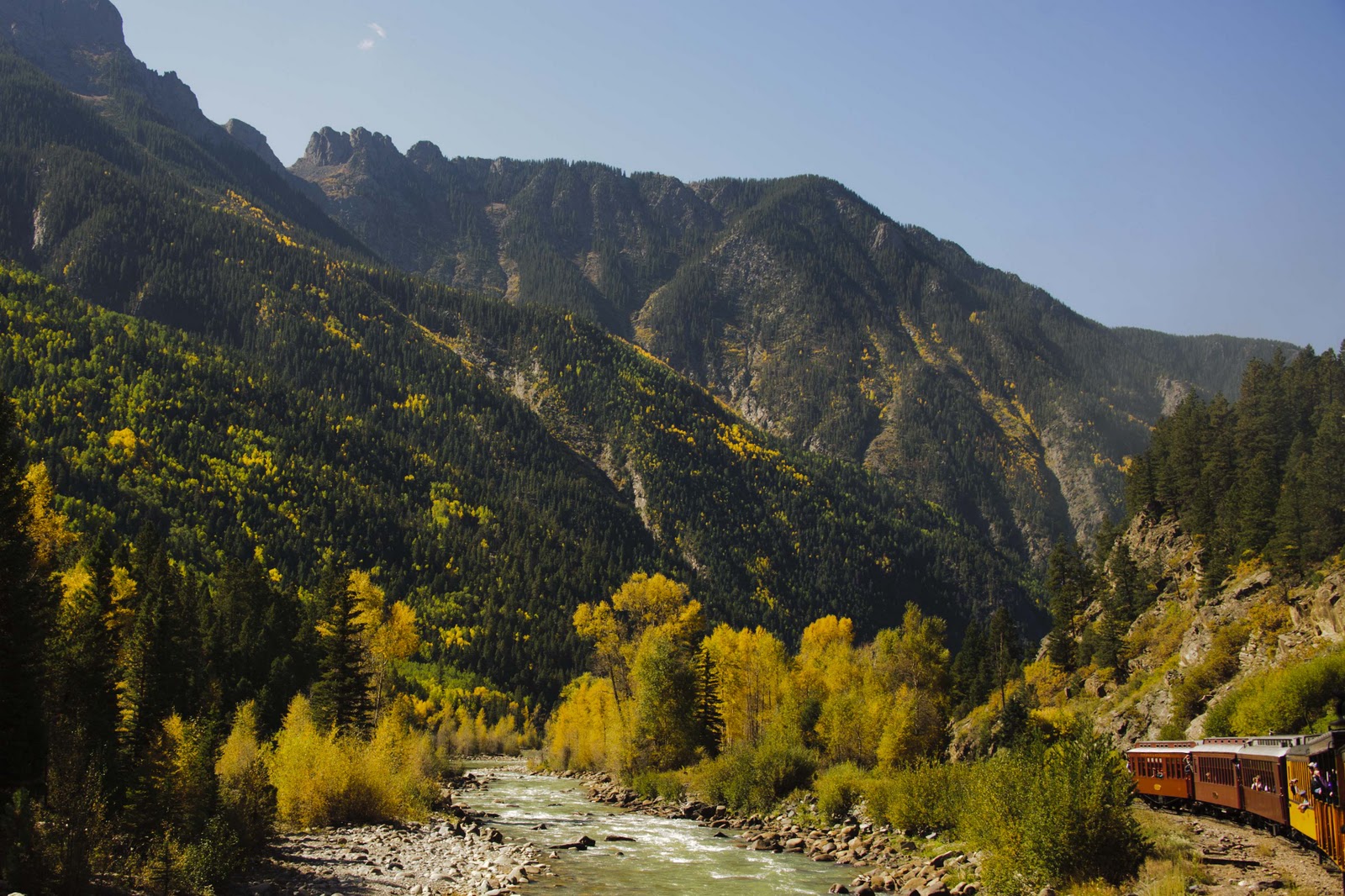
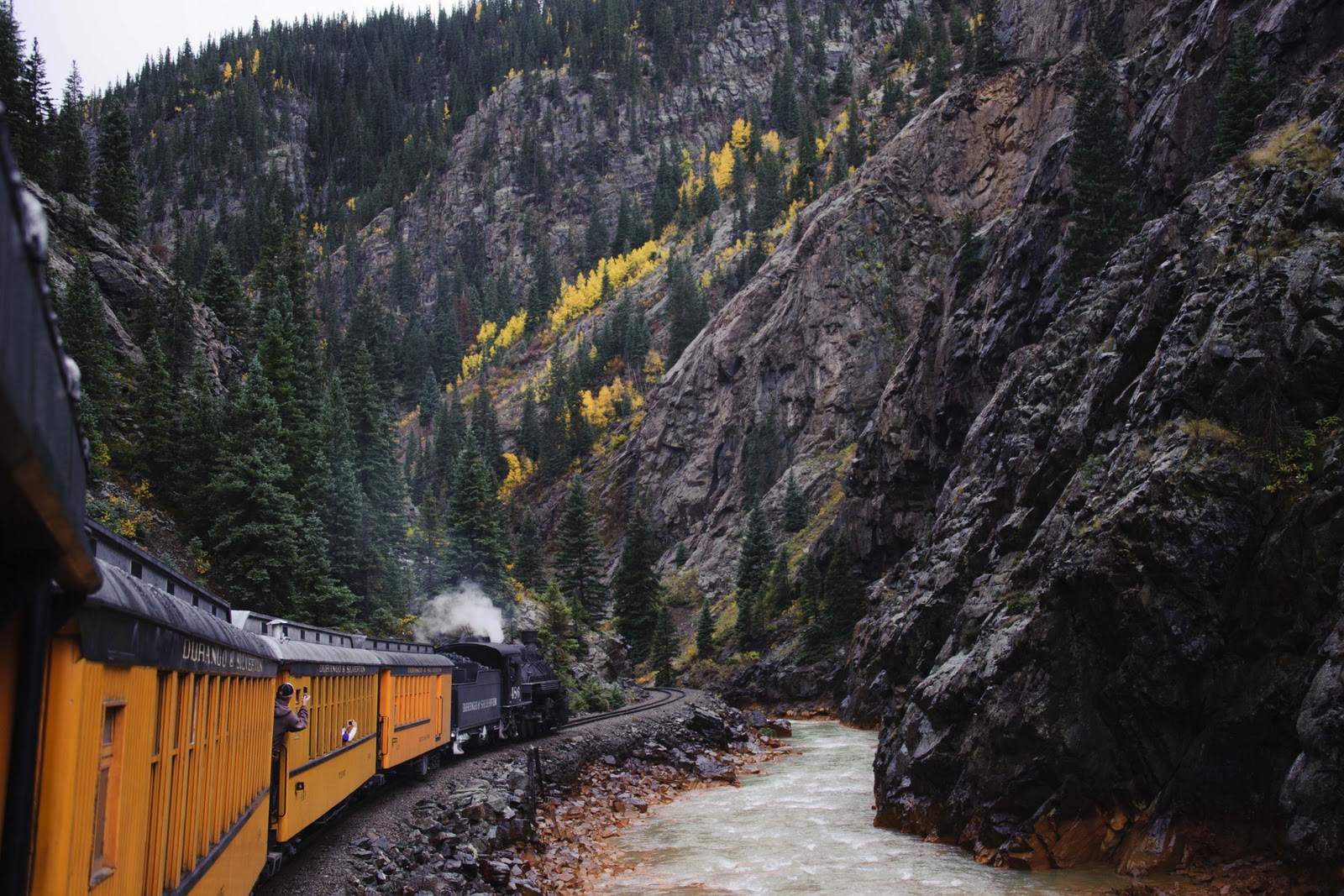
By the early 1950’s, Denver &Rio Grande Western rail freight traffic in Southwest Colorado was reduced to a trickle as shippers started using the new highways. Line after line was scrapped. But, for some reason the PUC denied the request to abandon the Silverton Branch. Thank goodness. After a couple of sales (in 1981 to Bradshaw, a citrus grower, and again in 1997 to the Harpers) and a lot of work on upgrading the rails and equipment by the committed buyers – the Denver & Silverton Narrow Gauge Railroad (D&SNGRR) emerged as a world famous tourist line. Elizabeth rode these rails about 40-something years ago and wanted to relive the experience giving Gary the same thrills. Gary’s camera trigger finger was in constant action!! And, the sights and tree colors were fantastic –

The Durango & Silverton Narrow Gauge Train builds up steam before our departure.
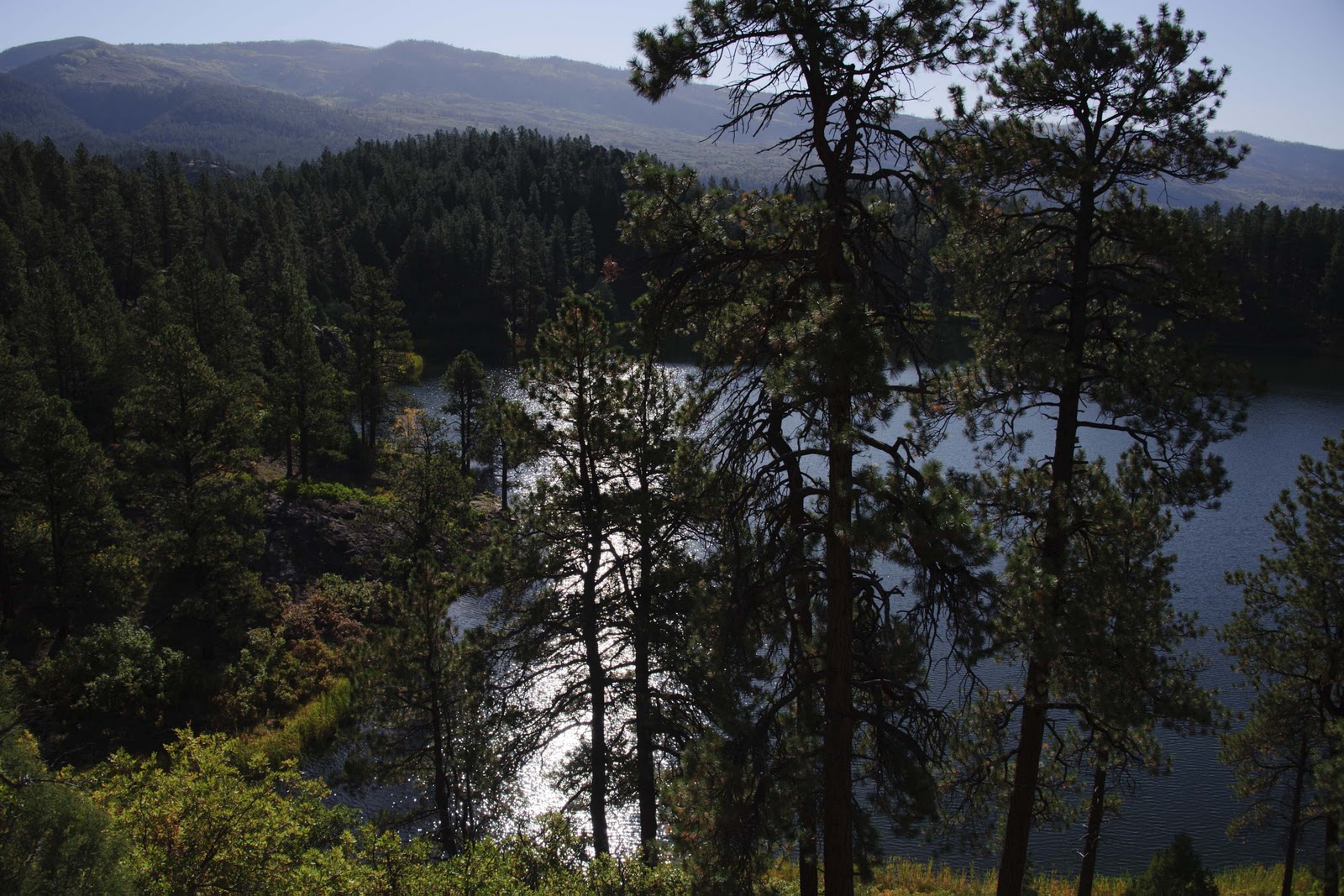
Lots of beautiful sights along the way.

We’ll be comin’ round the mountain when she comes……

…..toot – toot!
Silverton in the distance.

Downtown Silverton.
Not producing much silver these days.
Heading back to Durango.

October was ushered in with a round of golf (sorry no pictures of this course) and the Cowboy Poetry Gathering. Now this may sound like a yawner. BUT, you couldn’t be any more wrong. If you ever have the chance to attend one of these sessions – you should do it. They are REALLY funny, entertaining and ALL AMERICAN!! Can’t be beat. (Also, I challenge you to sit through a session and not tear up at least once!!)
In between these events we walked Main Ave., found that ever searched for Family Mexican restaurant (Tacos Nayarit – GREAT food!!) and enjoyed the sights and sounds of our campground as we watched football on Saturday and Sunday;-)  Oh – did I mention that our campground is right on the D&SNGRR tracks!! So – we got to wave and enjoy the train four times a day when we weren’t on it;-)


and  they don’t run through the camp at night.

Love to All – A relaxed E & G


The Anasazi or Ancestral Puebloans

What a FUN round of golf! No wonder The Hideout in Monticello is such a highly rated Muni course in Utah – it is fun to play, it is incredibly well maintained and the views are beautiful –
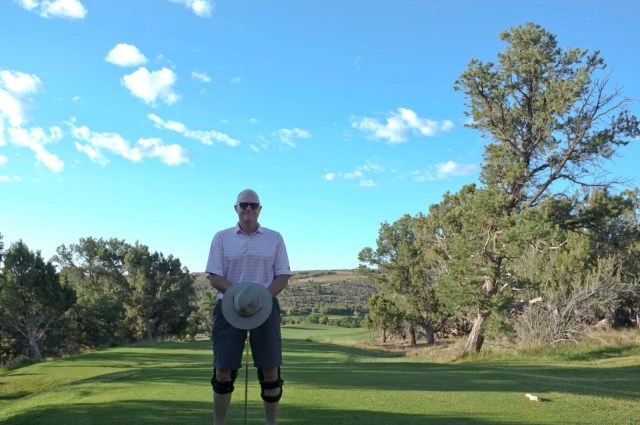
The mechanical man attempts a round of golf with dismal results.

After this wonderful morning, we packed up, said good-bye to our little cat friend and were ready to tackle our LOOOOONG drive of 70 miles to Mesa Verde and our new ‘camping’ spot – which is really peaceful –

A great spot just outside Mesa Verde National Park.
A storm squall rolls into our neighborhood.

For the past several days we have been traveling “The Trail of the Ancients” (apropos, don’t you think???) and will continue along the Trail to Albuquerque.

No, not my trail..the trail of the Ancestral Puebloans.

This Trail encompasses sites in the Four Corners region that ‘exemplify’ the Native People who inhabited the area since about 200 BC and their ‘homes’ and communities. Some of the sites included on this trail which we have already written about include the Edge of the Cedars State Park Museum and Pueblo and Natural Bridges National Monument (NM).
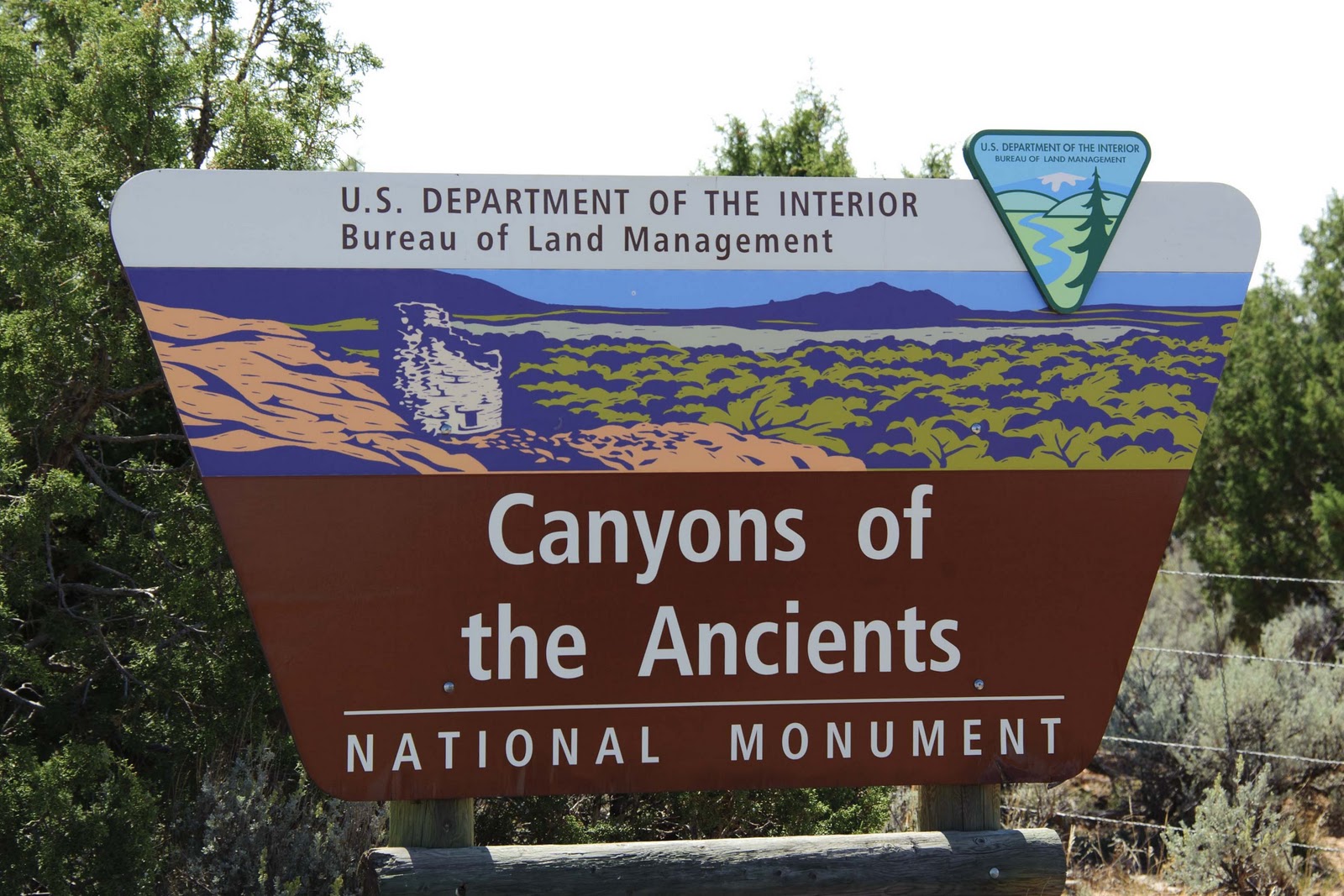
Since arriving at Mesa Verde we have traveled the Trail to see the Anasazi Heritage Center, the Escalante ruins, the Lowry Pueblo NM in Canyons of the Ancients NM, Hovenweep NM and Mesa Verde NP. We are overwhelmed with the sites and history – and could write volumes on what we have seen. It is interesting to have a little of the background on each of these sites – so I will try to give some information BUT keep it short?!?!? Gary’s pictures will also tell the tale.
The Anasazi Heritage Center and the Escalante Ruins – The Anasazi Heritage Center was an outgrowth of the largest archaeological research project ever carried out in the US. This work began after 1968, when the federal government authorized the damming of a river. The required environmental impact study resulted in archaeologists finding more than 1,600 sites! The Escalante ruins, a 20-room pueblo built around 1129 A.D. and occupied, except for two short periods, until the early 1200’s, were excavated and stabilized as part of this study to become part of the Center.

A view of the Escalante Pueblo outside Cortez, CO.

Back to the Anasazi in a minute – but on a lighter note – a fund raising project by the San Juan Mountains Assoc. had artists ‘decorate’ pumas for Public Art for Public Lands. This puma was done in the ‘style’ of the Puebloans of black on white and resided in front of the Center. I loved him and wanted to share –
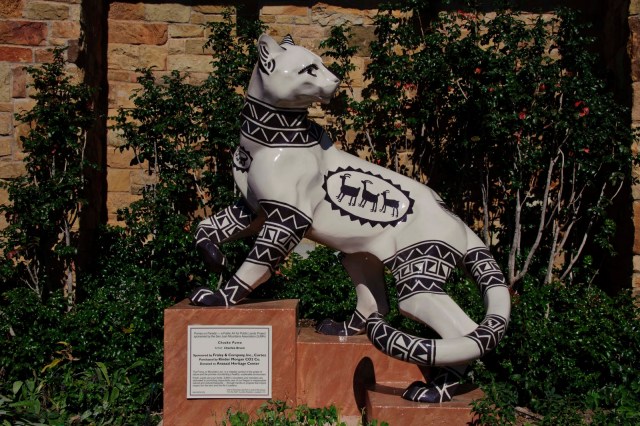

Puma On Parade at the Anasazi Cultural Center.

Now, back to the Anasazi. Although the pueblo above was built in the early 1100’s, the Anasazi (a Navajo term given archaeologists, referring to the former inhabitants of abandoned cliff dwellings and pueblos), or ‘Pueblo ancestors’ (the two terms are now used interchangeably), emerged more than two millennia ago from a seminomadic hunter-gatherer tradition to practice agriculture and live in villages. From about 5,500 B.C. to 500 A.D., small scattered bands or family groups roamed the Southwest hunting small game and collecting edible plants, seeds, nuts and fruit. The acquisition of corn from southern Mexico shifted these people from nomadism to agriculture and was the genesis of the Anasazi culture.

As they progressed from a hunting society to an agricultural one, their architectural skills also changed as they became more tied to the land. They advanced from sheltering themselves in shallow pithouses under rock overhangs to building multistoried masonry pueblos.

Because of the many finely woven baskets found at their pithouse sites, the first Anasazi are referred to as Basketmakers. By 700 A.D. these early farmers were building above-ground attached masonry dwellings, or pueblos. Then the term Basketmaker is dropped in favor of Pueblo. SO –

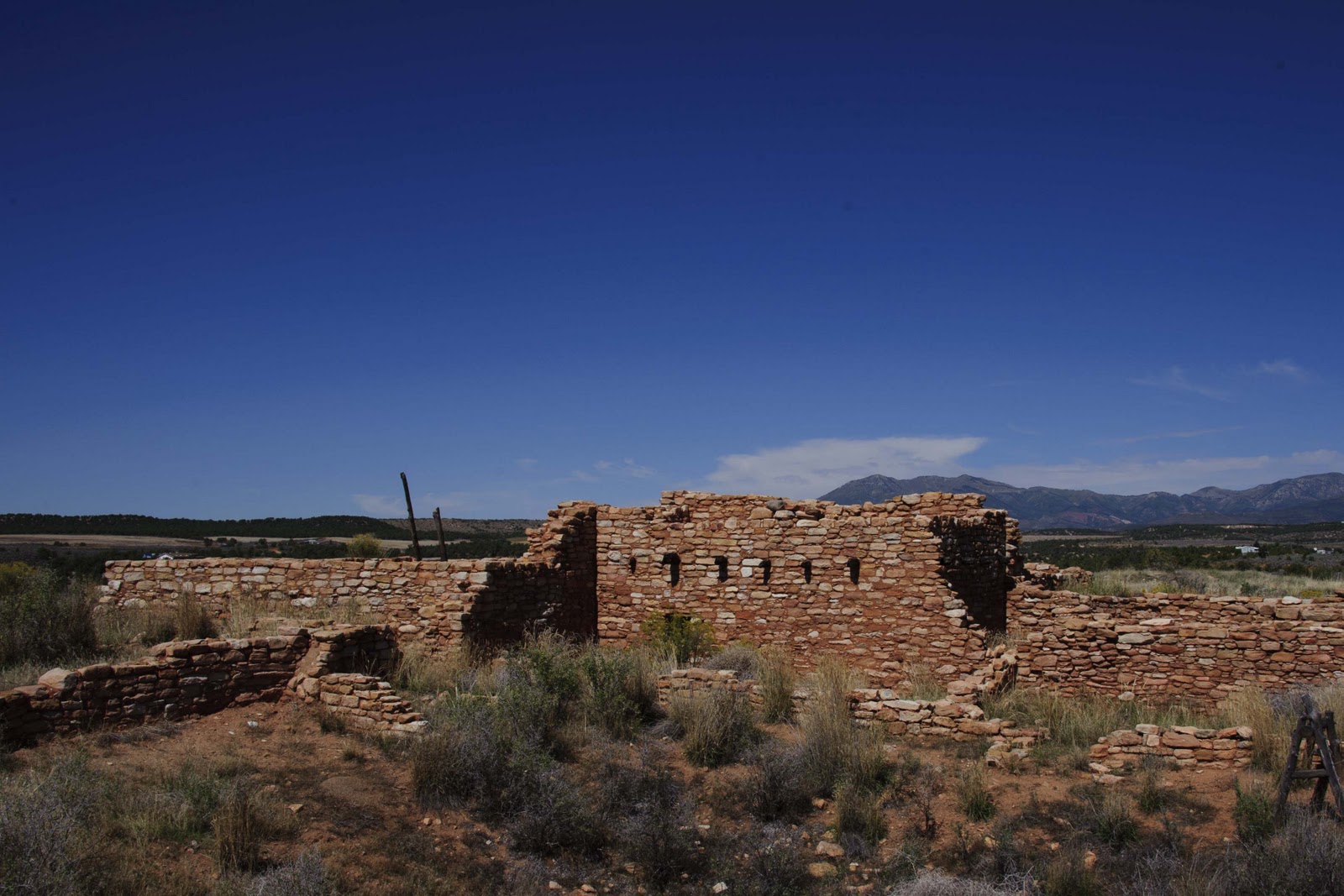
Lowry Pueblo, part of Canyons of the Ancients NM – The Ancestral Puebloan people constructed this Pueblo around 1060 A.D. and inhabited it for about 165 years. Lowry began as a small village with a few rooms and a kiva. By the time the last families left Lowry and migrated to the south, the pueblo had grown to 40 rooms, eight kivas, and a Great Kiva. Access here was wonderful as we were able to walk the perimeter and enter several rooms.

The Lowry Pueblo.

The Kiva was a very important part of the life of the Ancestral Puebloan. It was a central gathering place for the family, storytelling and religious activities. It was always circular, below ground, had a place for a fire in the center and was entered through a hole in the roof via a ladder. (The ruins no longer have the roof in place – on occasion the roof has been replicated.) It appeared that each family would have a Kiva and there might be a larger one for the community. The picture below shows the Great Kiva of the Lowry Pueblo, which probably drew Ancestral Puebloans from several hundred square miles to conduct religious ceremonies. An interpretive sign quoted a Hopi woman who recently visited the site as saying that the two rock designs in the floor of the Kiva were the images of Summer and Winter. If you look at the rocks they do have the character of human figures.
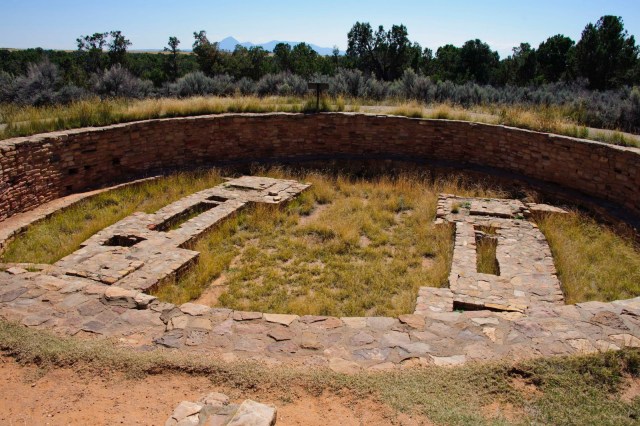

The Great Kiva at the Lowry Pueblo.

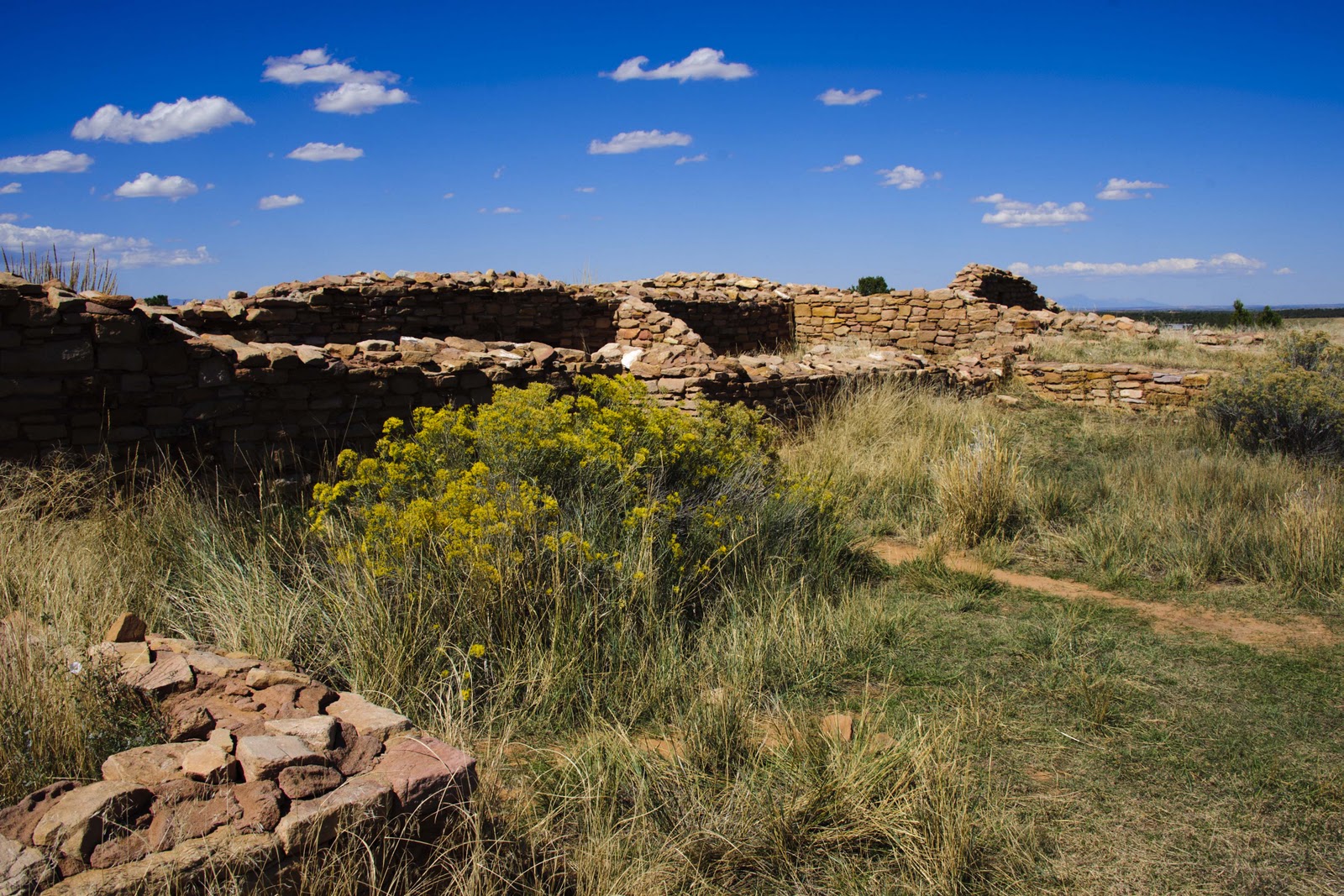
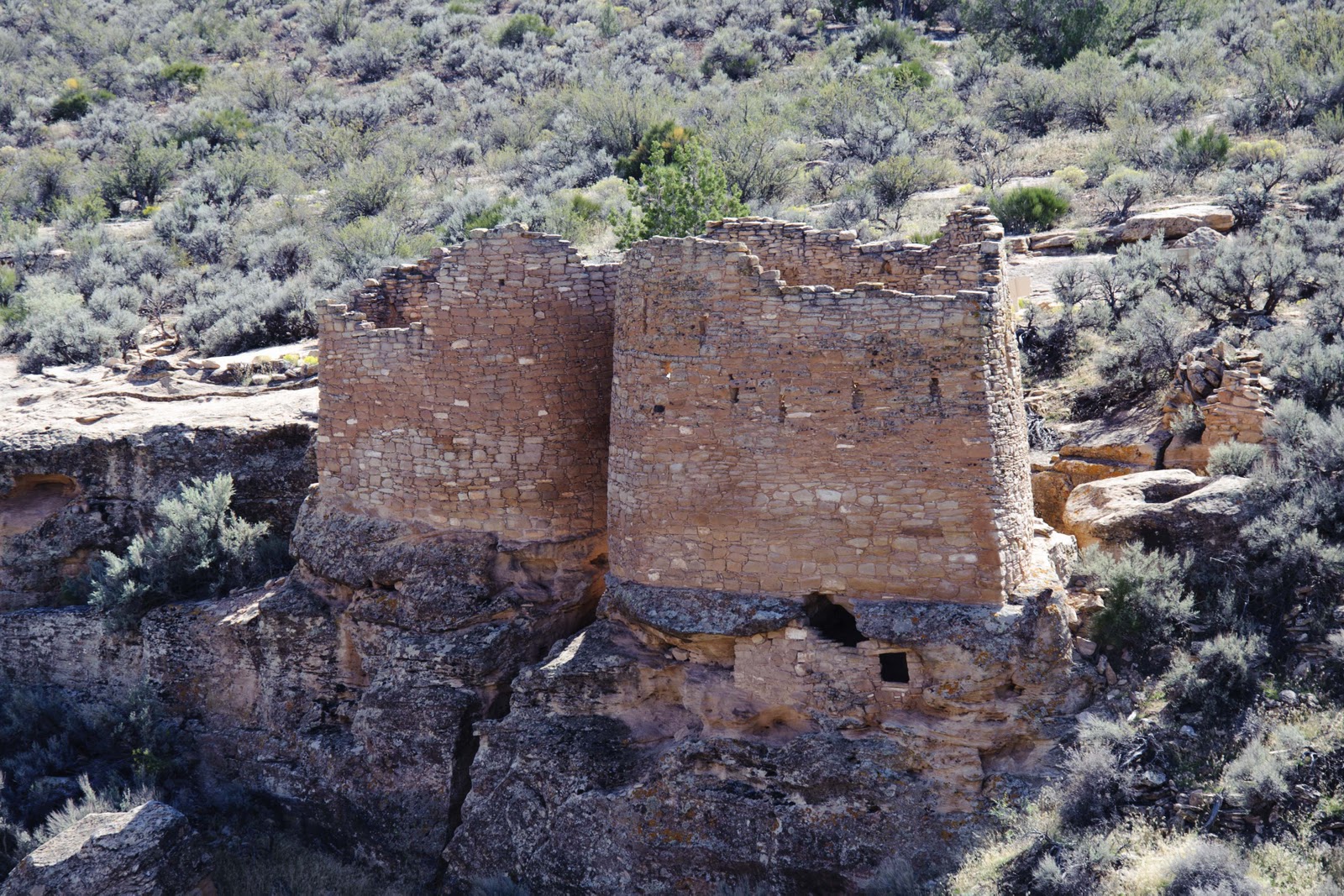
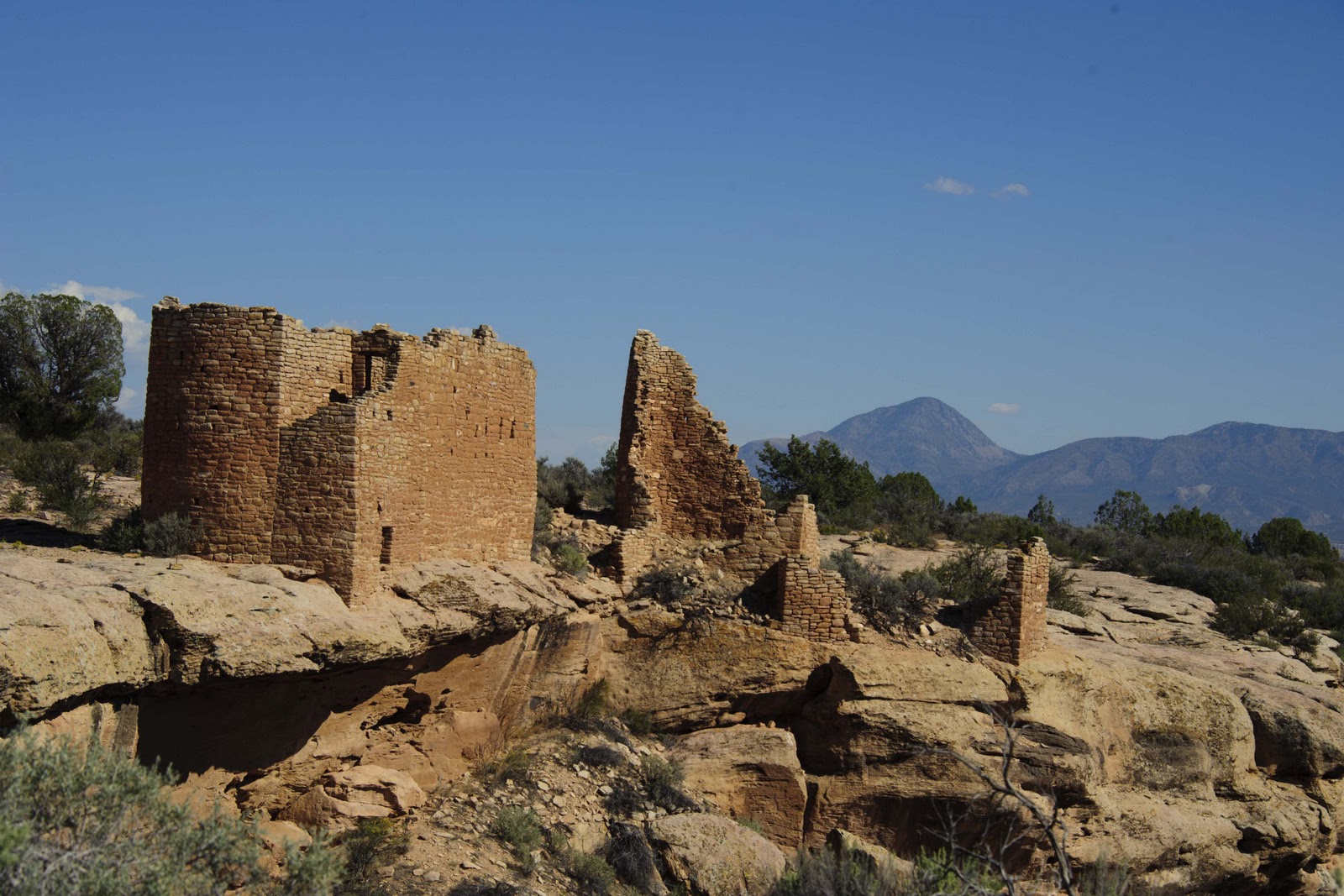
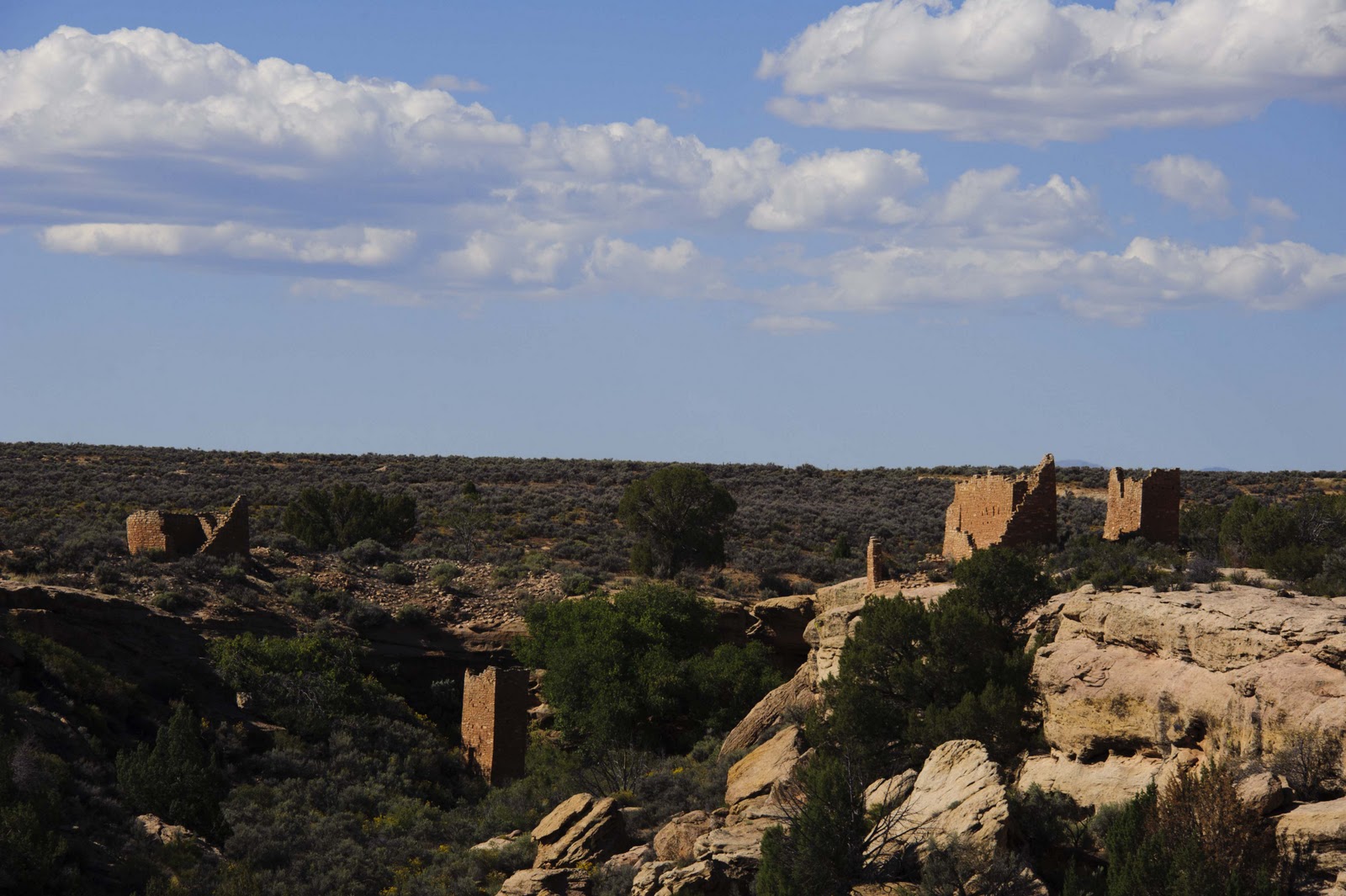
Hovenweep NM – Here at Hovenweep (which means ‘deserted valley’ in the Ute language) most of the buildings still standing were constructed from 1230 to 1275 by the Ancestral Puebloan and are referred to as the Square Tower group. The stunning Square Tower and an intriguing collection of buildings are clustered along the rim of Little Ruin Canyon. Here we were able to walk the entire rim to view the sites.
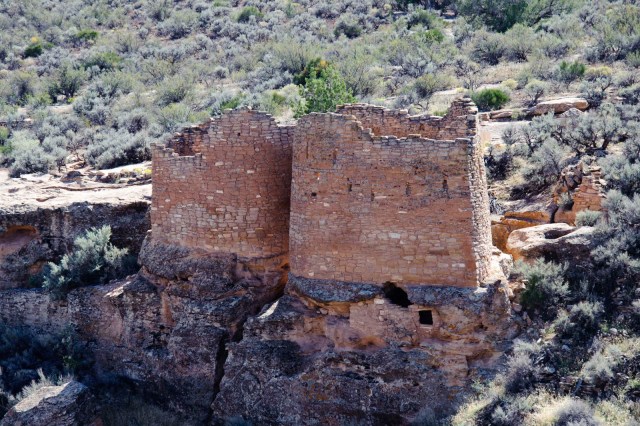

The Twin Towers
Hovenweep Castle
Several of the Hovenweep Towers nestled around the canyon. Square Tower sits down in the canyon.

Mesa Verde – The real jewel in the crown of the Trail (at least so far). Cited as one of the world’s top cultural attractions, Mesa Verde was home to the Ancestral Puebloans for more than 700 years! Complete homes and entire villages have survived with many artifacts amazingly intact, providing a unique and thought provoking glimpse into America’s pre-European past. The cliff houses set in rock alcoves or tucked in cracks in the canyon walls do give a feeling of fantasy – a Disneyland of American archaeology!

Although hunter-gatherers certainly roamed these canyons for thousands of years, Mesa Verde was not permanently settled until around 600 A.D. At this time, numerous pithouse villages were home to extended families. By 750 A.D. they had begun building surface rooms of upright posts woven through with slender branches to form walls that were coated with mud. While cool in the summer, these structures provided inadequate protection from the sharp winds and deep snows of Colorado winters. So – small contiguous masonry rooms eventually took their place as living quarters. Mesa Verdeans lived in pueblos on top of the mesas until around 1200 A.D. when many people moved into the canyons to live in the cliff dwellings. By the mid-1200’s, these cliff dwellings housed about half the population of the Mesa. By 1300 these pueblos were vacant! The reason for the exodus is a mystery – but believed to be because after such a long habitation the natural resources were depleted AND a prolonged drought reeked havoc with the agricultural society (global warming in the 1300’s!!). One has the opportunity to see the full range of this historical period – from pithouses of 600 A.D. to cliff pueblos of 1300’s – here at Mesa Verde. Some – up close and personal!

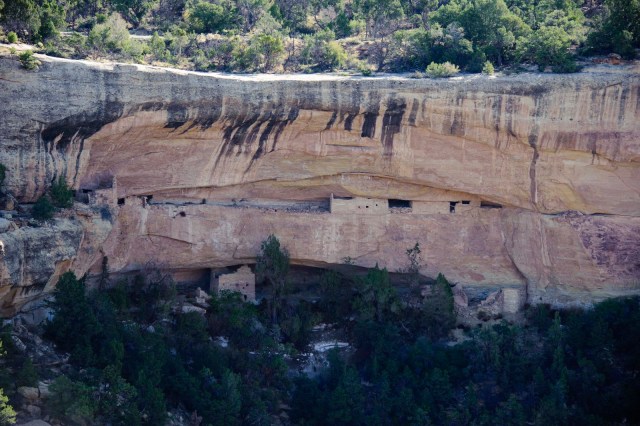
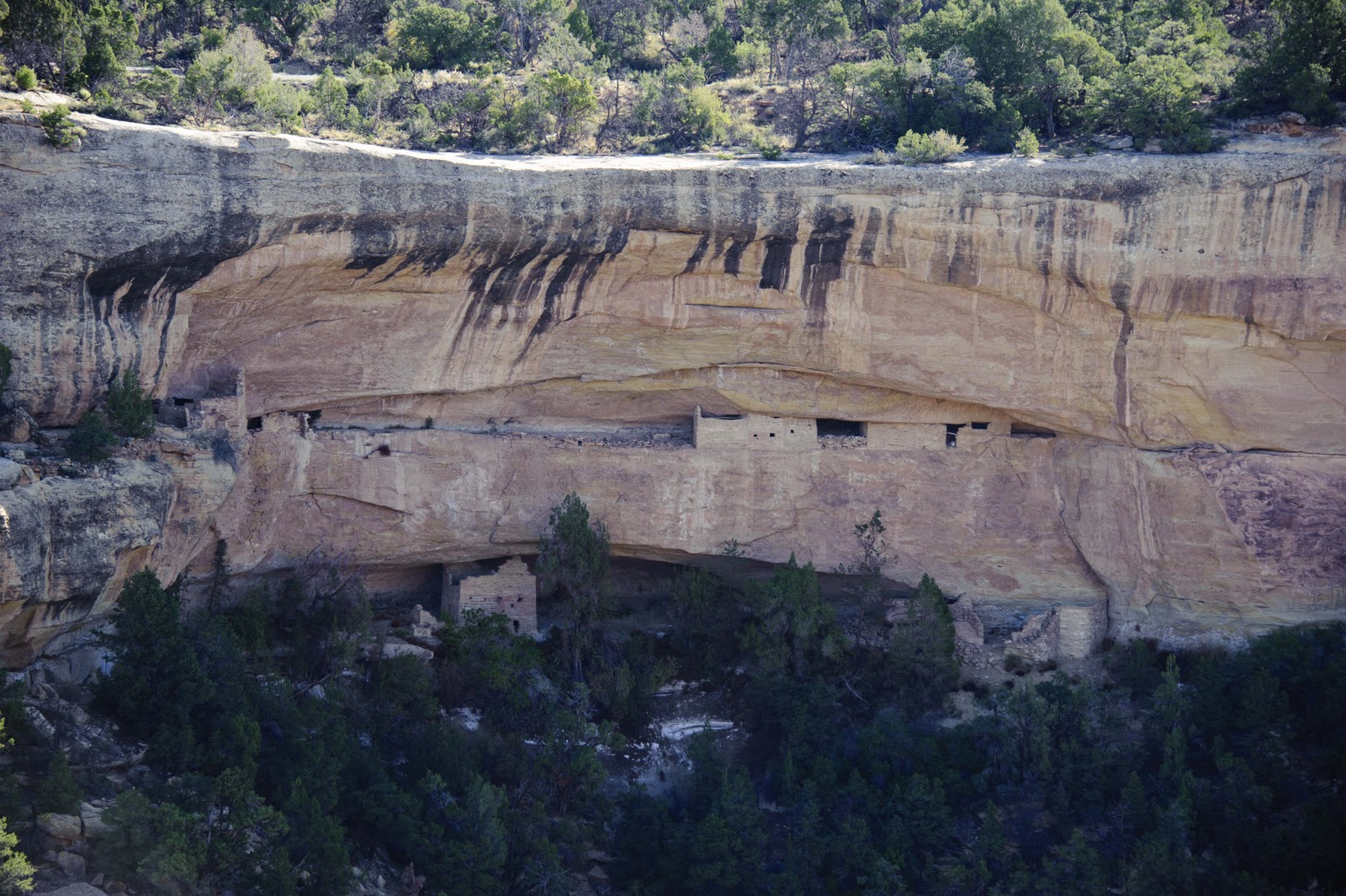
Dwellings built in the alcoves along Mesa Top.

Sunset House.
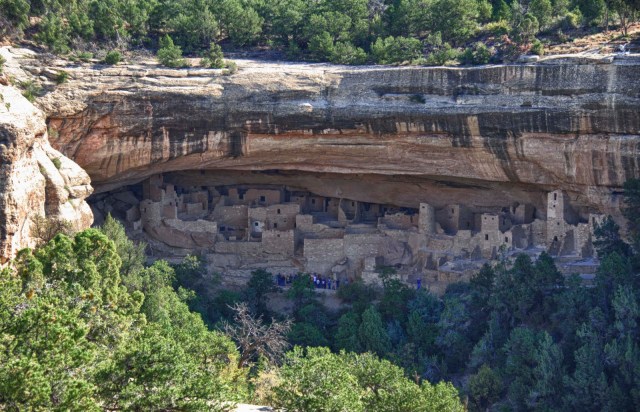
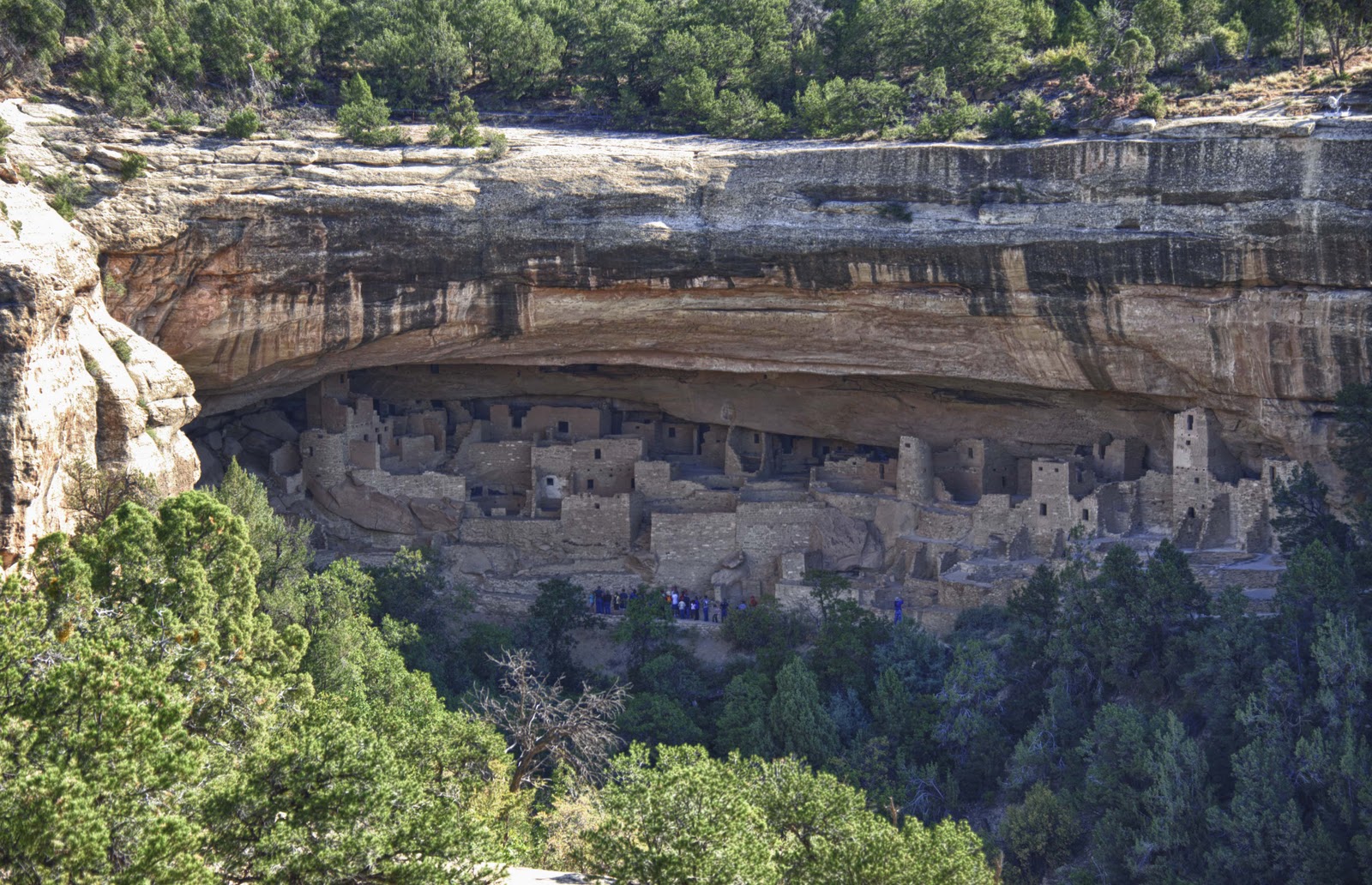
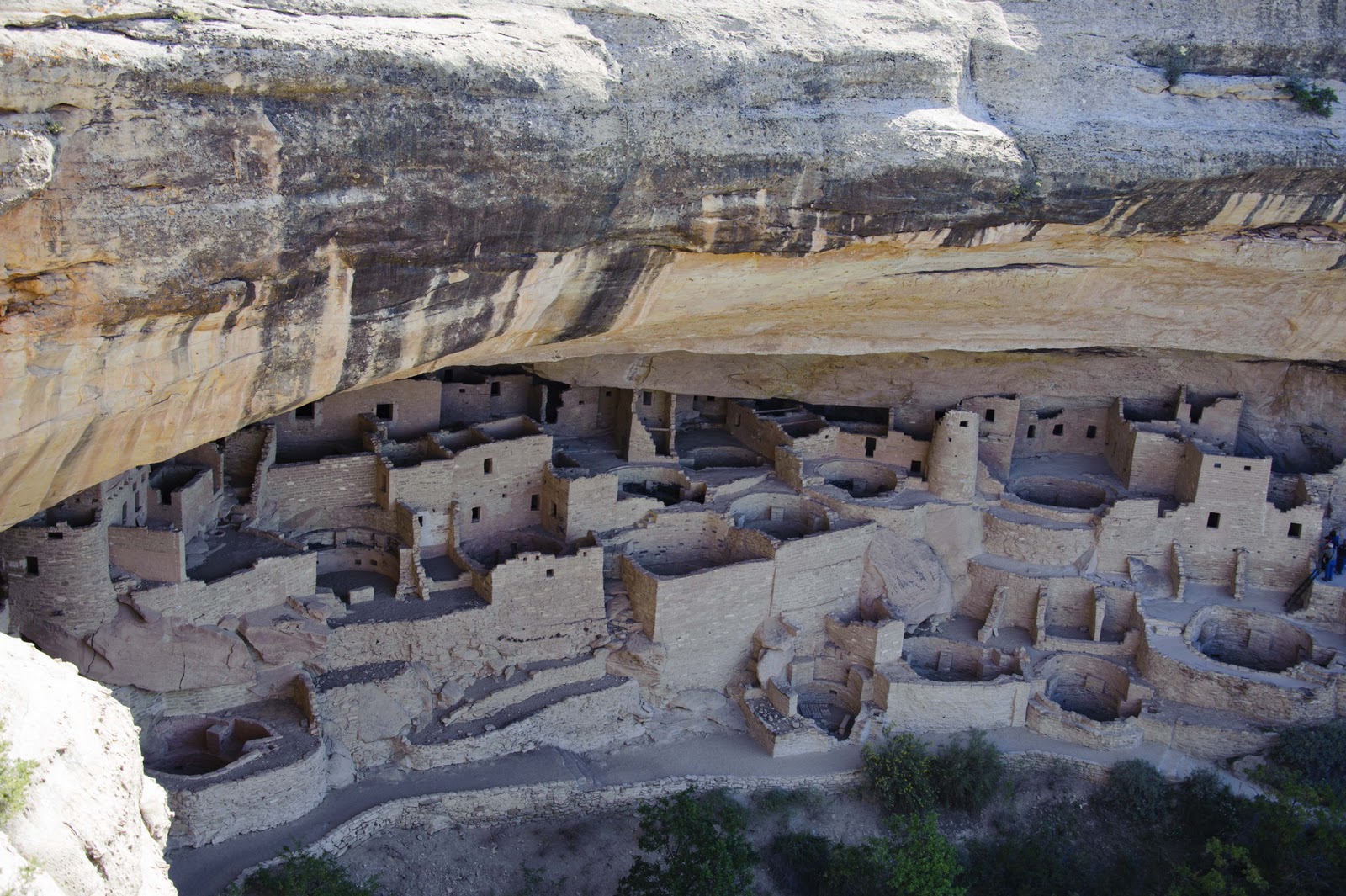
A distant view of Cliff Palace-the largest cliff dwelling in the Southwest!
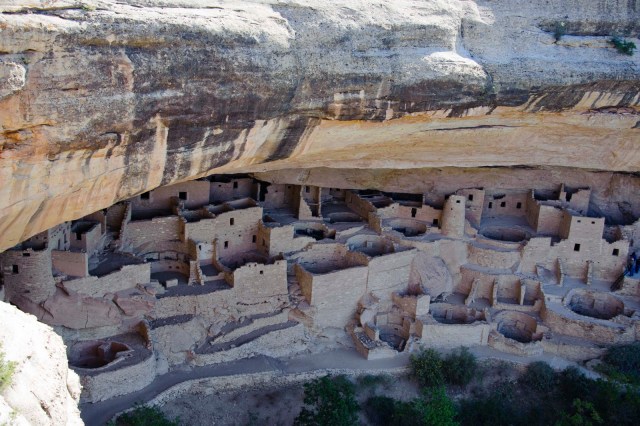
Getting closer.
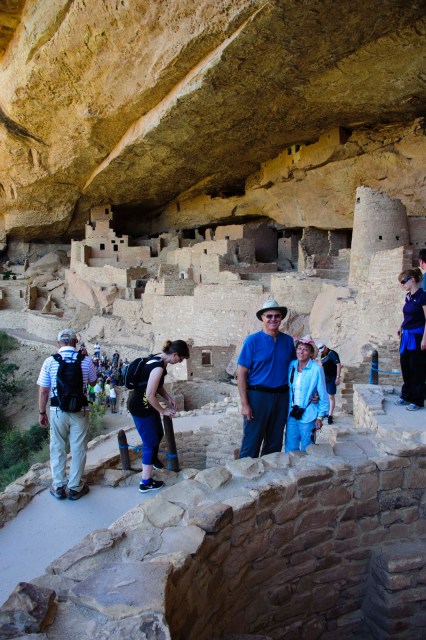
Almost there.

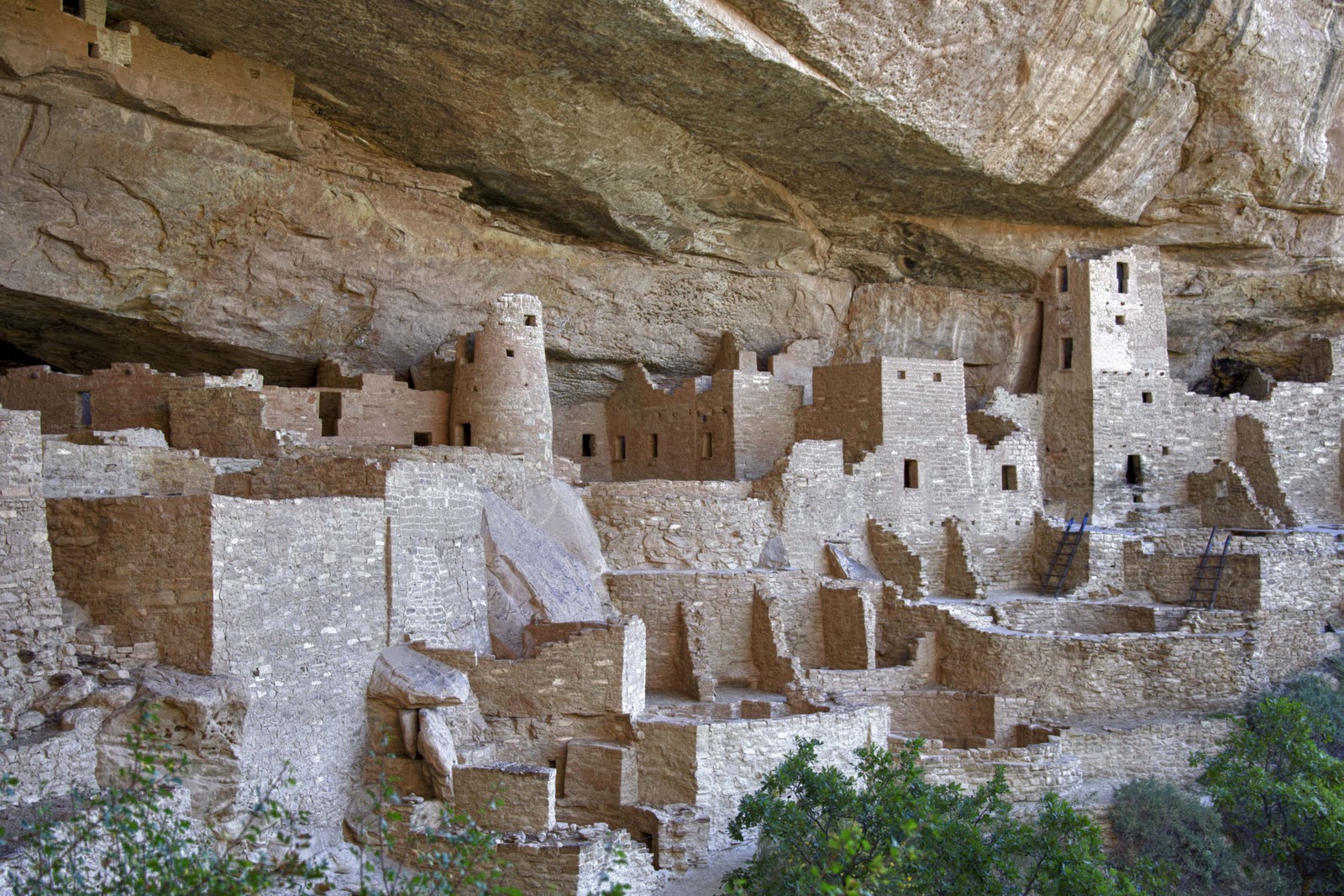
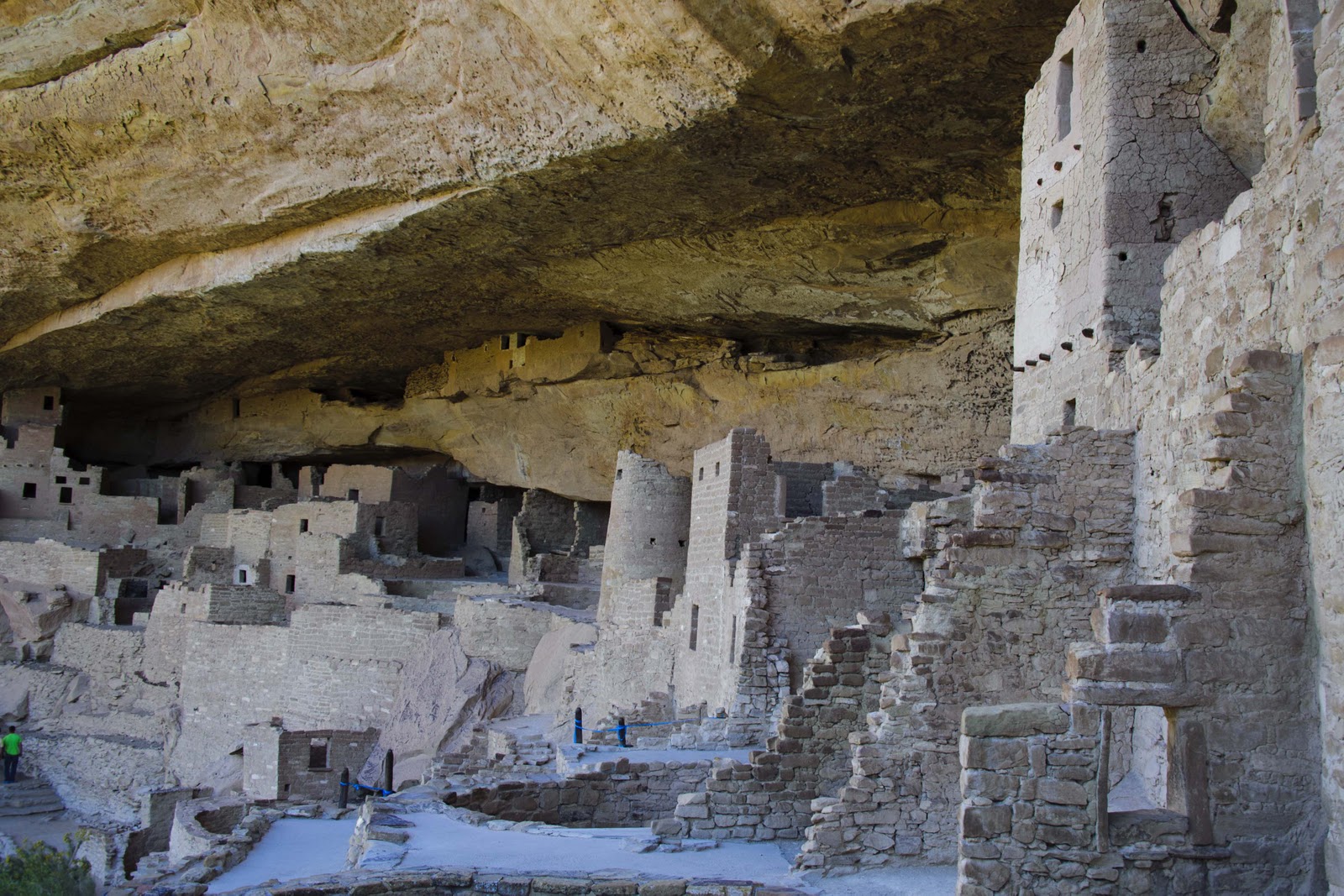
More than 100 Puebloans occupied Cliff Palace.

Amazing to see this from such a close proximity.

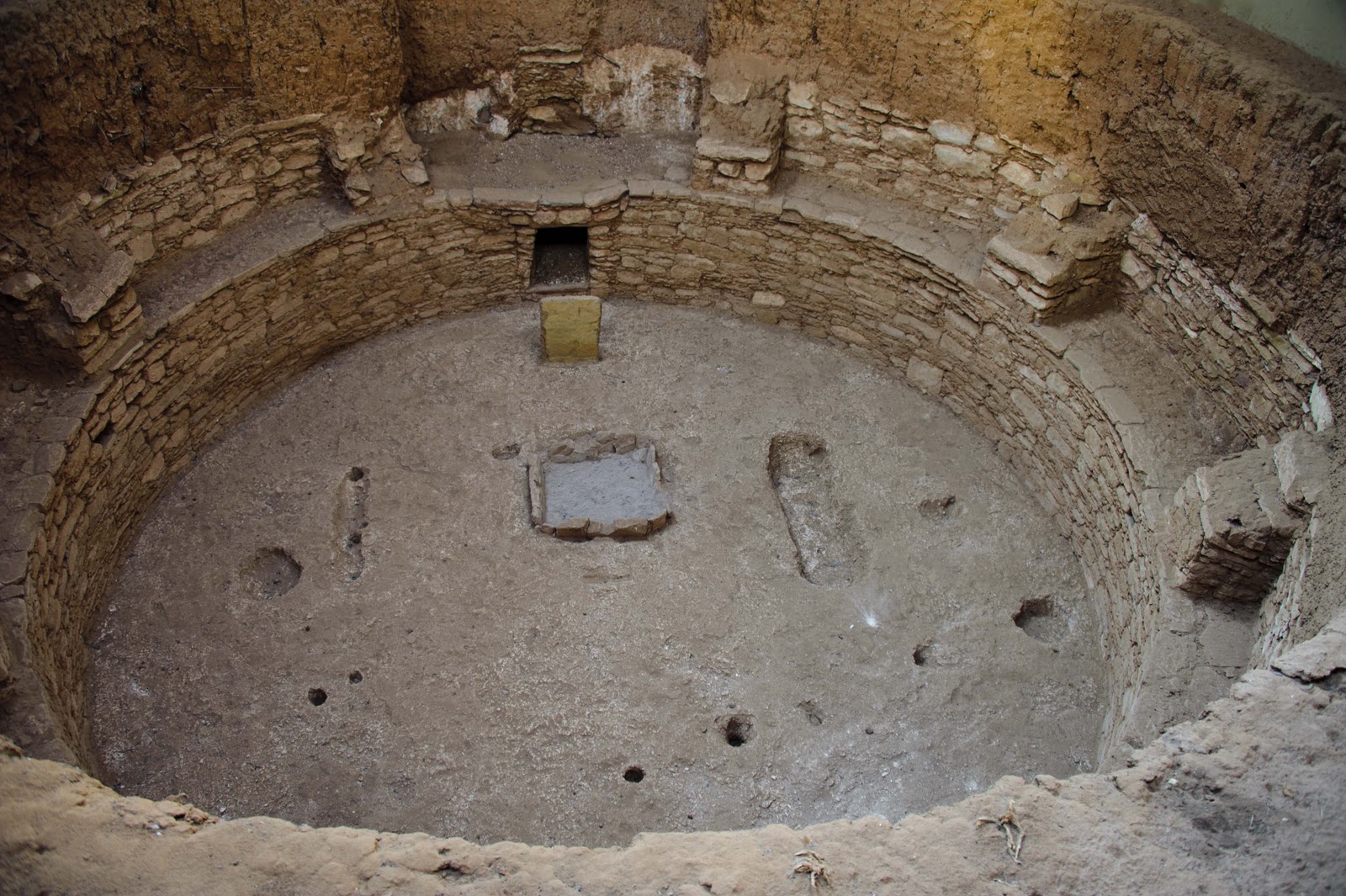
As you can see, by the 1300’s the Kiva has advanced to a much more ‘finished’ ceremonial room. Now an air ‘intake’ is included to bring fresh air into the Kiva. However, to prevent the rush of air from blowing the fire out or blowing the ash around the floor of the Kiva, a rock panel is placed in front of the intake entrance. The fire pit is still in the middle of the room. In this picture, the ‘sipapu’ is also easily seen. This is the little round hole in the floor directly below the fire pit. Remember the bridge of the same name at Natural Bridges?? This is the ‘entrance’ by which the ancestors spirits are able to come and go. One can also see the benches and pilasters that held up the roofs. These Kivas were still covered with a roof, which had the entrance ‘hole’ using a ladder. However, these roofs have not endured the test of time;-(
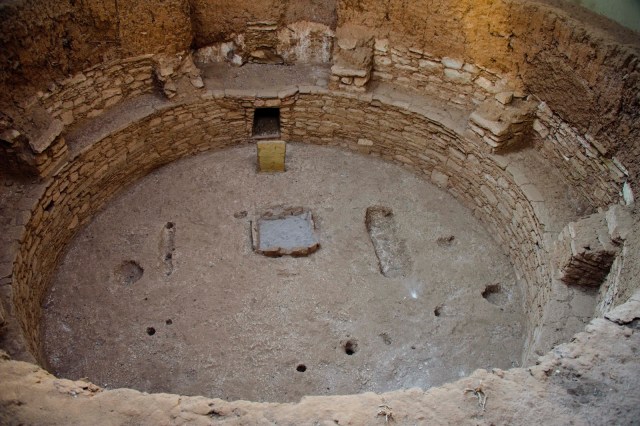

Note the air intake hole at the rear of this Kiva.
We had to climb several of these ladders to get back out of the canyon from Cliff Palace.


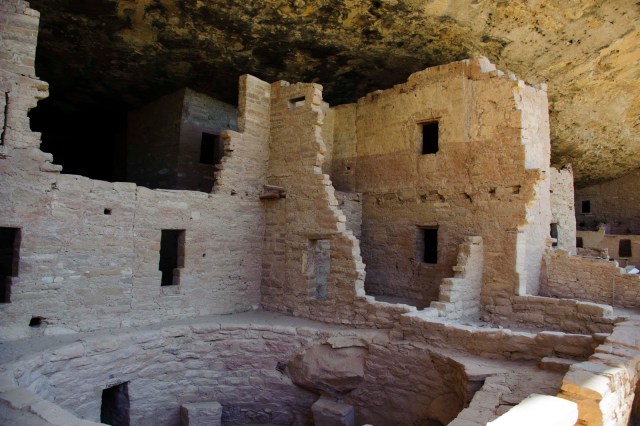
Spruce Tree House, our next destination, is the third largest cliff dwelling among several hundred within park boundaries and was constructed between 1200 and 1276 by the Anasazi. This dwelling contains about 114 rooms and eight kivas and housed about 100 people. Again, one can actually hike to the dwelling and climb amongst the ruins;-)


Now we are headed down to explore the Spruce Tree House.
Three story apartments at the back of this section of Spruce Tree House.
(Notice ladder down into the covered Kiva.)

The ladders lead down to Kivas.

The round structure below ground level is a Kiva without its roof.
Look at the red and white ‘paint’ on the upper back wall.

These last several days have been awe-inspiring. Makes one wonder – why do we talk about history of thousands of years ago only existing in Europe?? As in the Coliseum, Parthenon, etc?? There are wonderful, amazing, overwhelming and ageless sites in our own back yard!! AND – our Federal Government has done the National Park system right. Just hope funding isn’t cut here too;-(

Well – hope the narrative hasn’t been too boring, but maybe a little helpful. AND – hope the pictures have given some feel of what we have been able to experience the last few days. AND – there is more of the Trail to come with a little Balloon Festival in between. But, now we have to pack up for another LOOOONG moving day – 36 miles!!

So – have a great week-end and we will talk to you again soon.


Overwhelmed – E & G from the Trail of the Ancients
Bridges & Needles

Well – this week-end has been spent in and around the cute little town of Monticello in the southeastern part of Utah. The town may be small but it is the entry way to some of the most beautiful scenery in two National Parks/Monuments – Natural Bridges NM and The Needles district of Canyonlands.

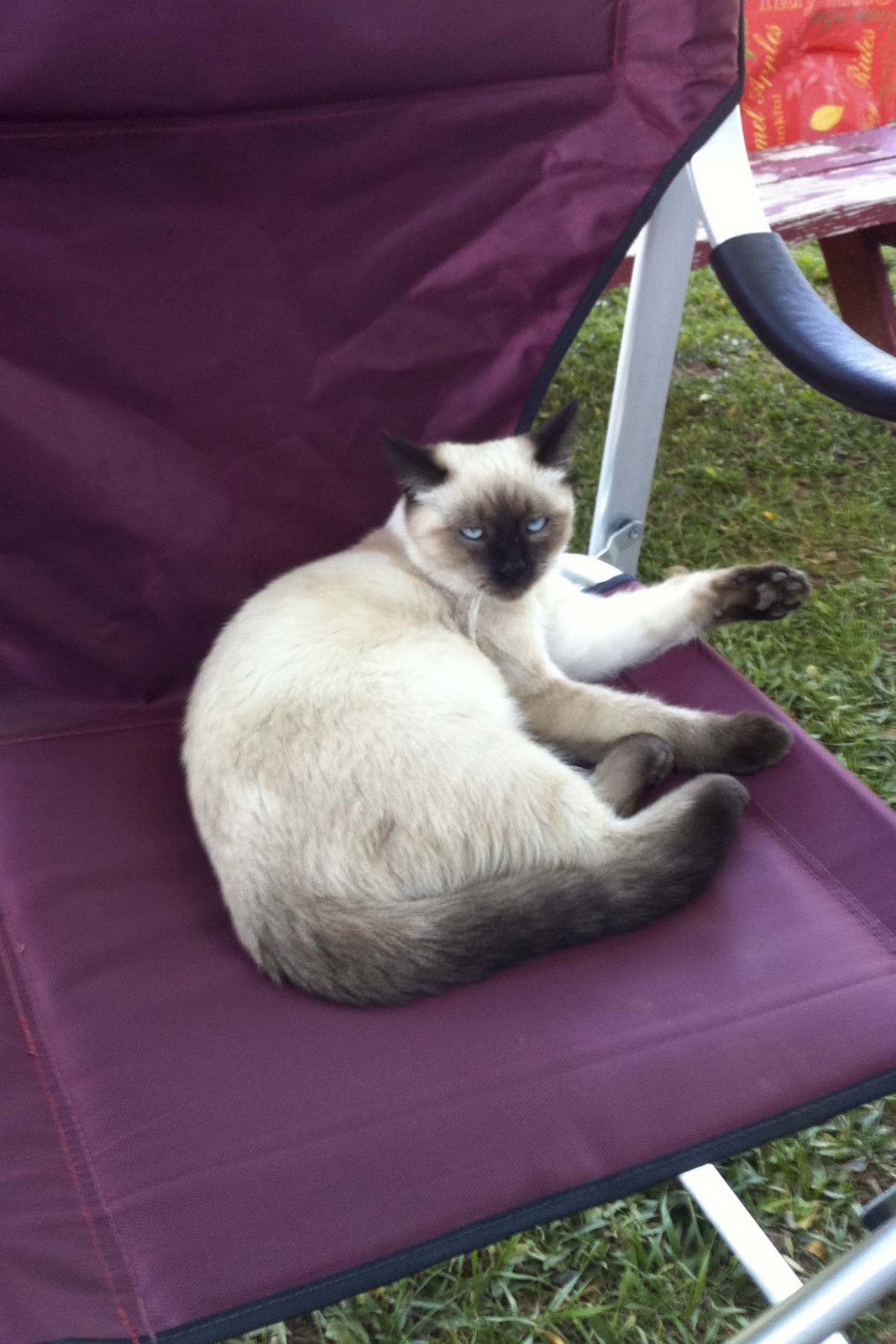
Before we pulled up stakes in Moab Friday morning, we again wore ourselves out with a 14 mile bike ride into more beautiful red-rock country. This made the 56 mile trip to Monticello tolerable, as we needed a little rest time;-)!! After finding a charming little RV park run by locals (Mountain View RV Park with a sweet little cat who liked to get to know the visitors and make itself at home!!) –


RV Park’s cat made himself at home and took over Gary’s chair!

we made our usual trek to the Visitor Center. We came away armed with brochures and returned to Magic to plot out our next two days.

Saturday we enjoyed our morning – watched a little college football, had the treat of cinnamon rolls and then were off on our adventures for the day.

Our first stop was the Edge of Cedars State Park and Museum. This museum is small, but well worth the visit. It is a world class research facility with the archaeological repository (it has an outstanding collection of prehistoric ceramics and other artifacts and a mural reproducing some of the region’s major pictographs) for all of Southeast Utah containing exhibits relating to the Anasazi, Navajo, and Ute Indians.
Just outside the museum is the Edge of the Cedars Pueblo – inhabited by the Anasazi Indians (ancestors of modern Pueblo Indians) between A.D. 850 and 950 and again between 1025 and 1125.

Remains of a Puebloan structure at Edge Of Cedars State Park

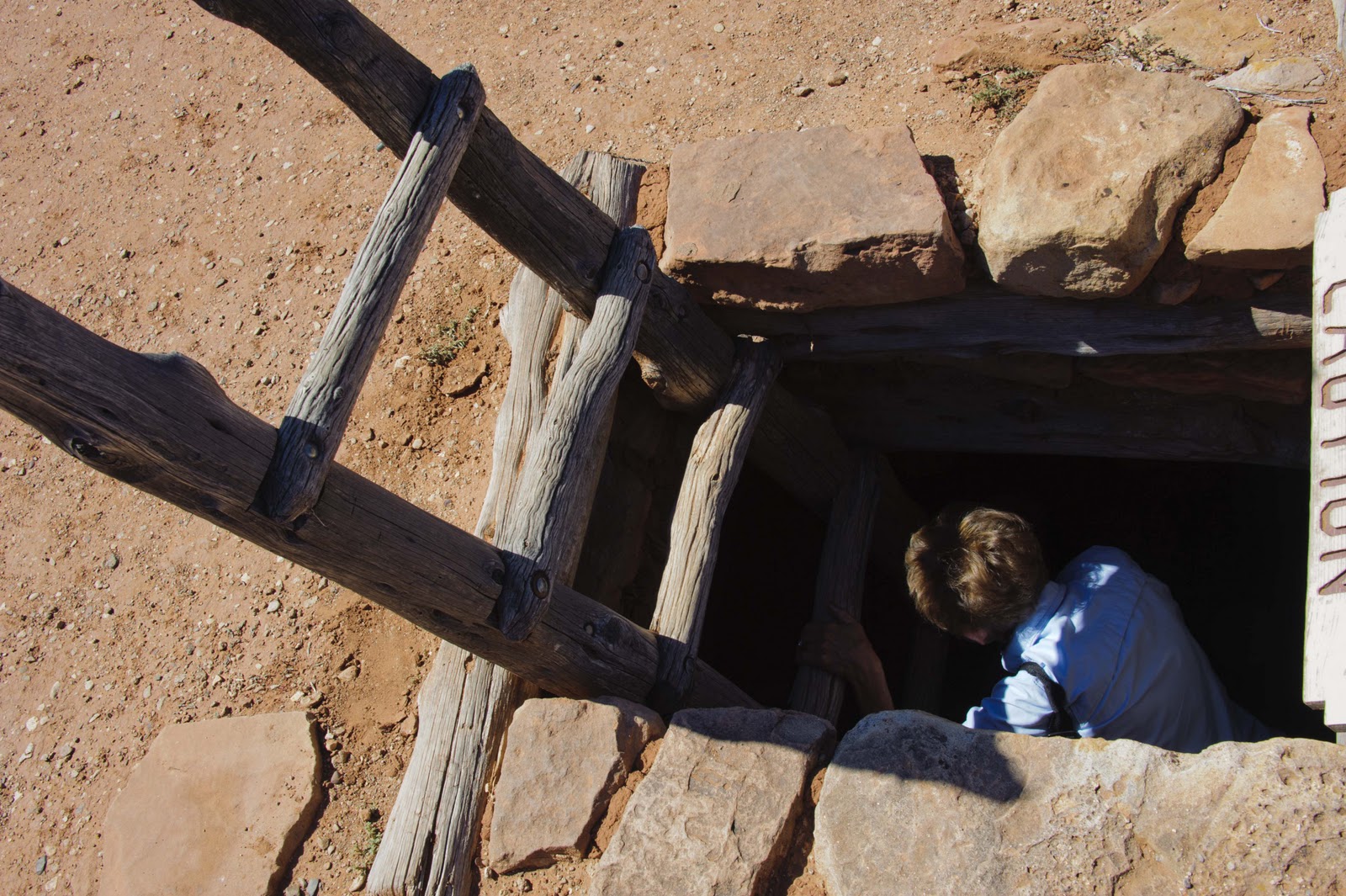
At its peak, their pueblo consisted of six residential complexes, including ten kivas (a circular room used for ceremonies) and one great kiva. One kiva has been excavated and restored and may be entered by means of a ladder descending through the roof –

Elizabeth checking out the Kiva.

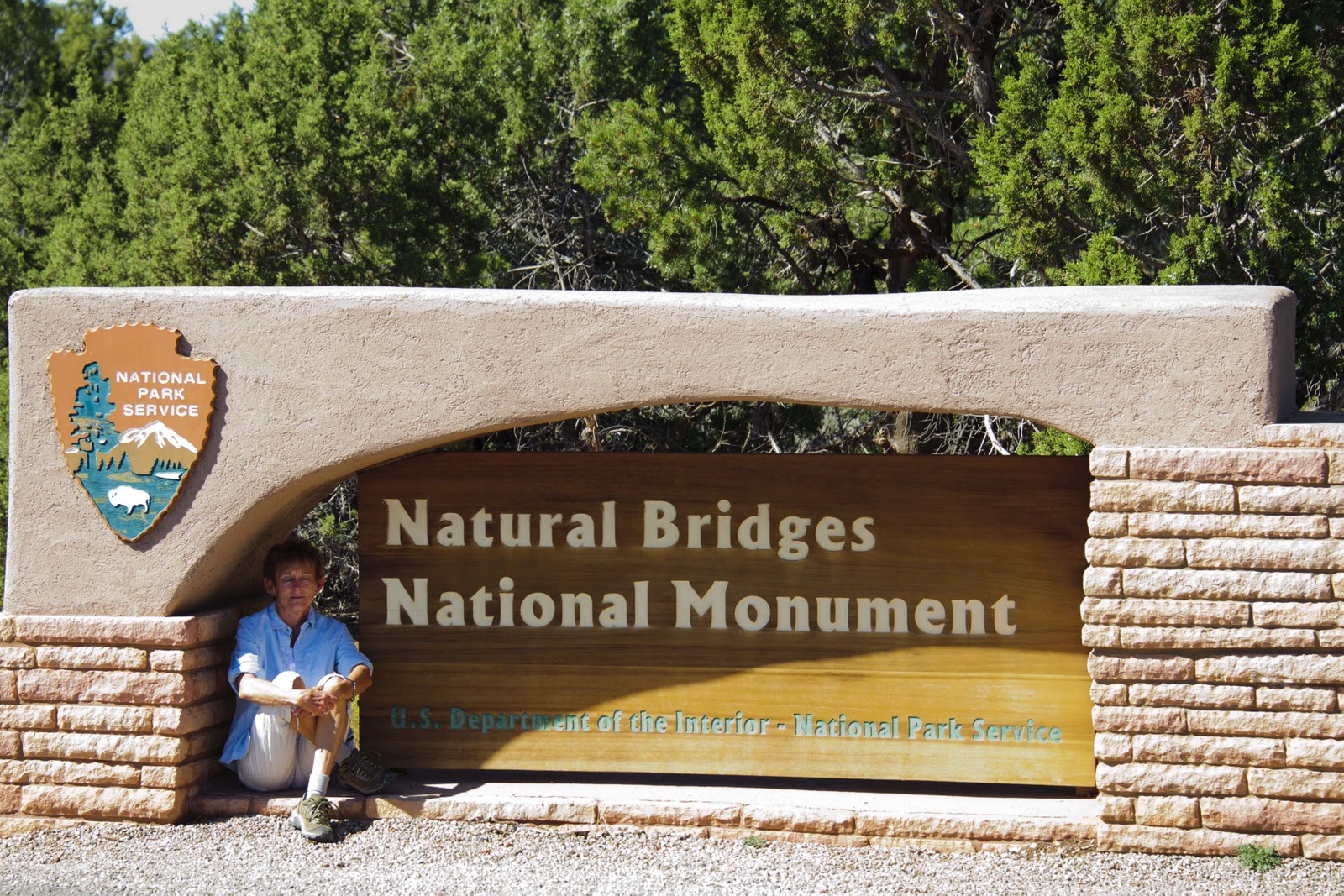
Time to get moving to Natural Bridges National Monument, which sits high on Cedar Mesa at 6,500 feet above sea level.


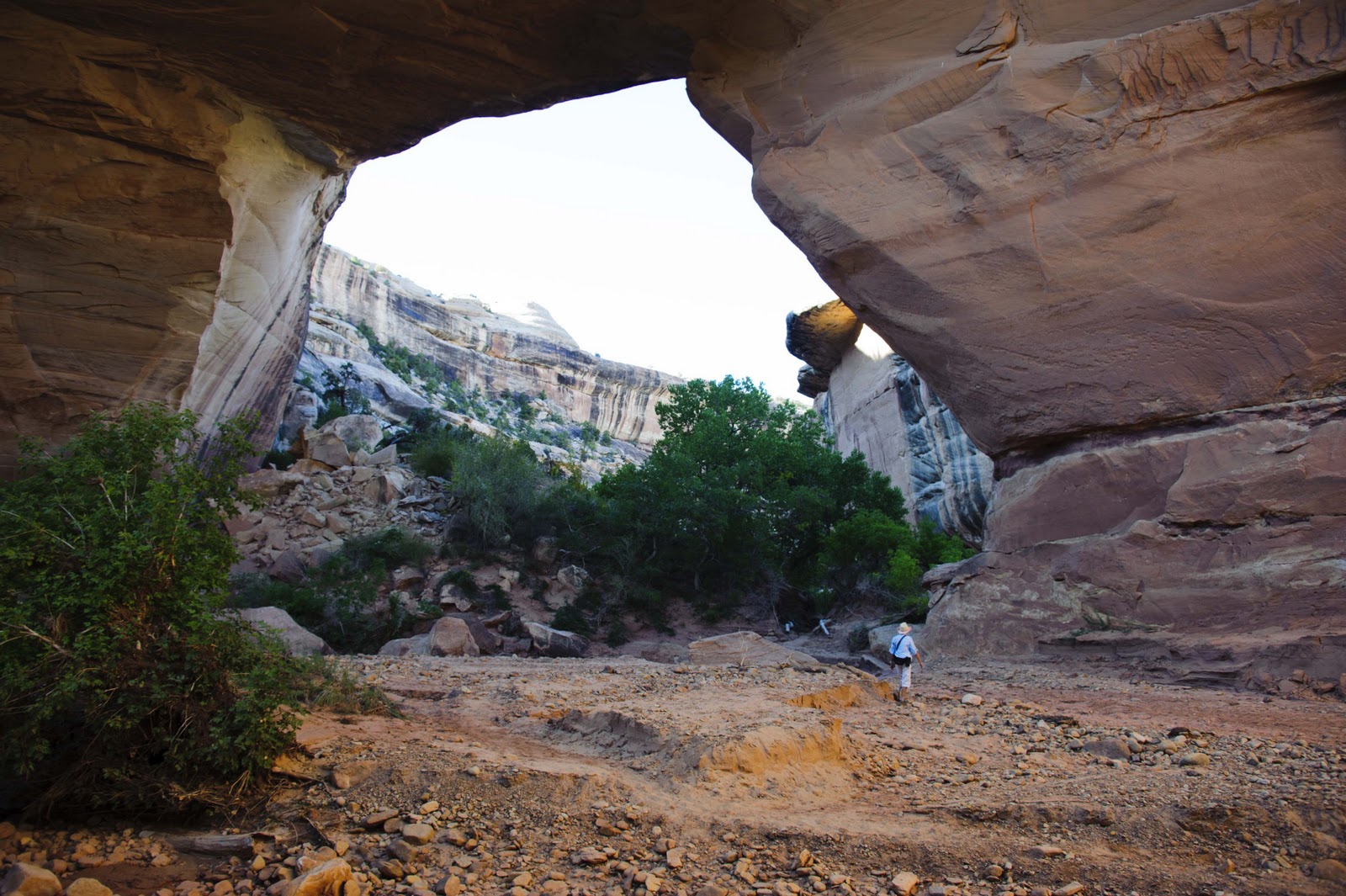
Intermittent streams have cut two deep canyons and three massive bridges in sandstone formed from what was once the shore of an ancient sea. (Bridges are formed by rivers where the Arches such as those in Arches NP are formed by erosion.) Each of the three bridges has its own personality and age.

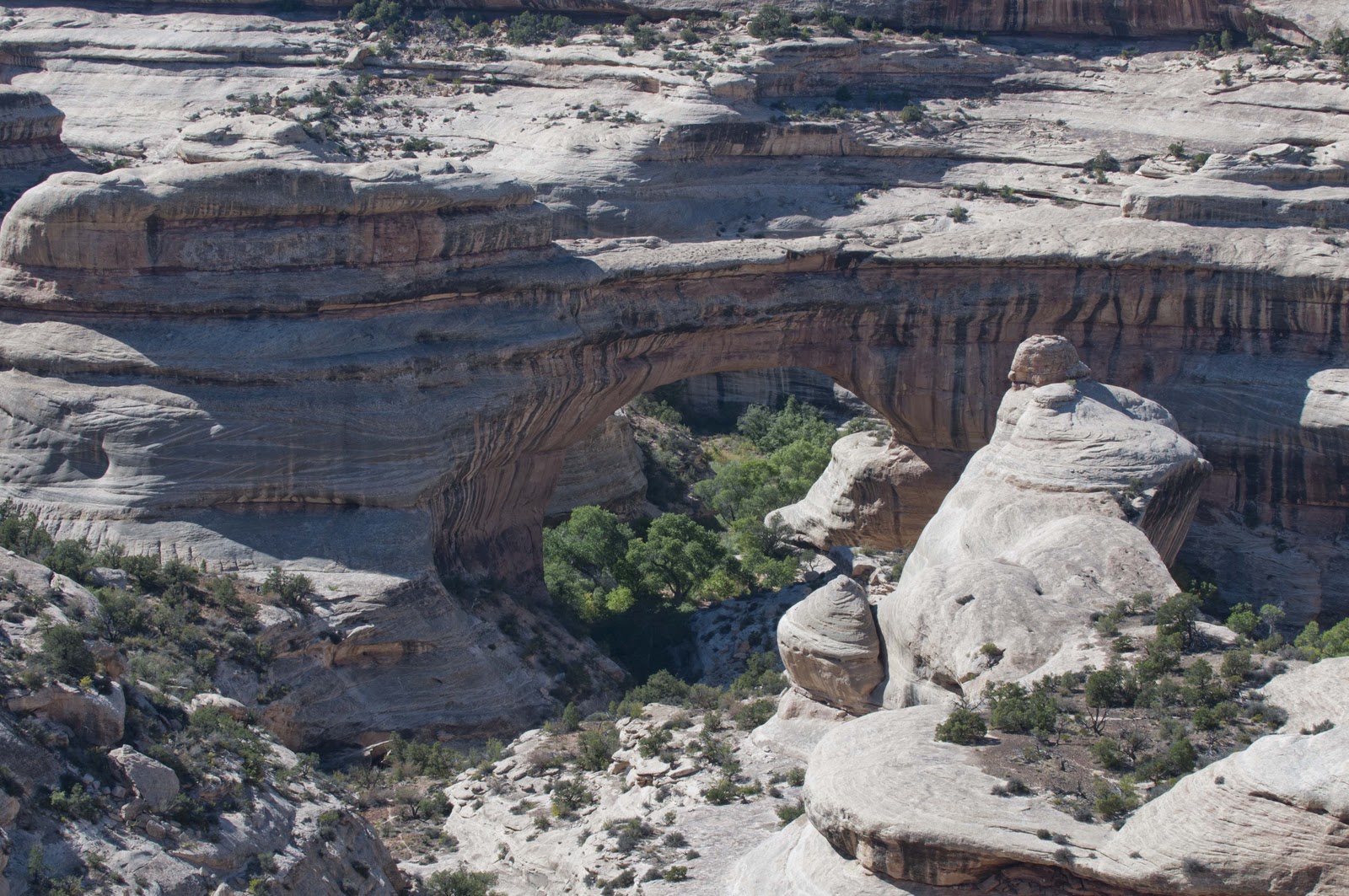
First on the trail is Sipapu Bridge, the second largest natural bridge in the world (only Rainbow Bridge in Glen Canyon is bigger) and the ‘Mature’ bridge of the three.


Here is what Sipapu Bridge looks like from the overlook.
Let’s go down and check it out.

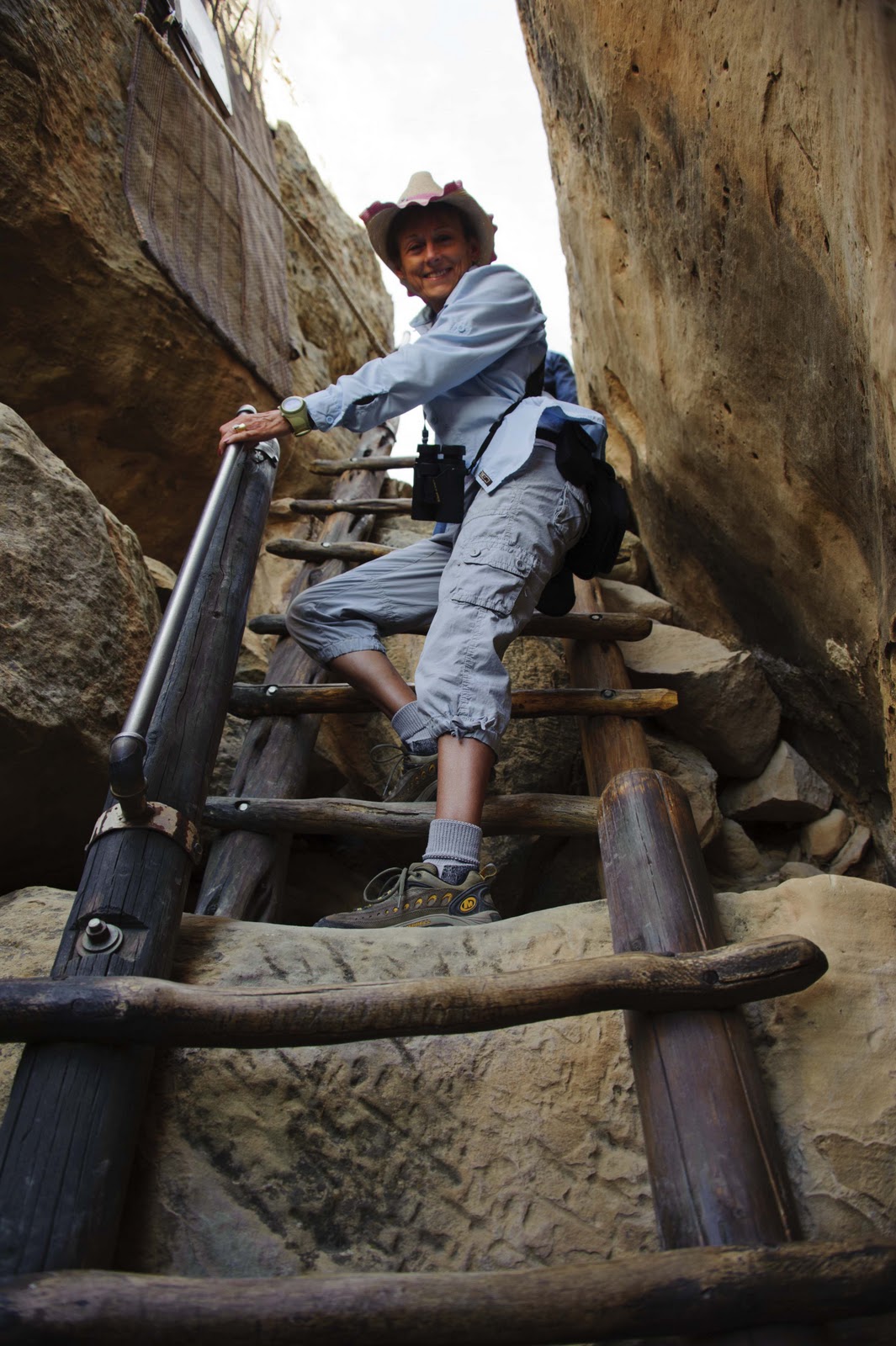
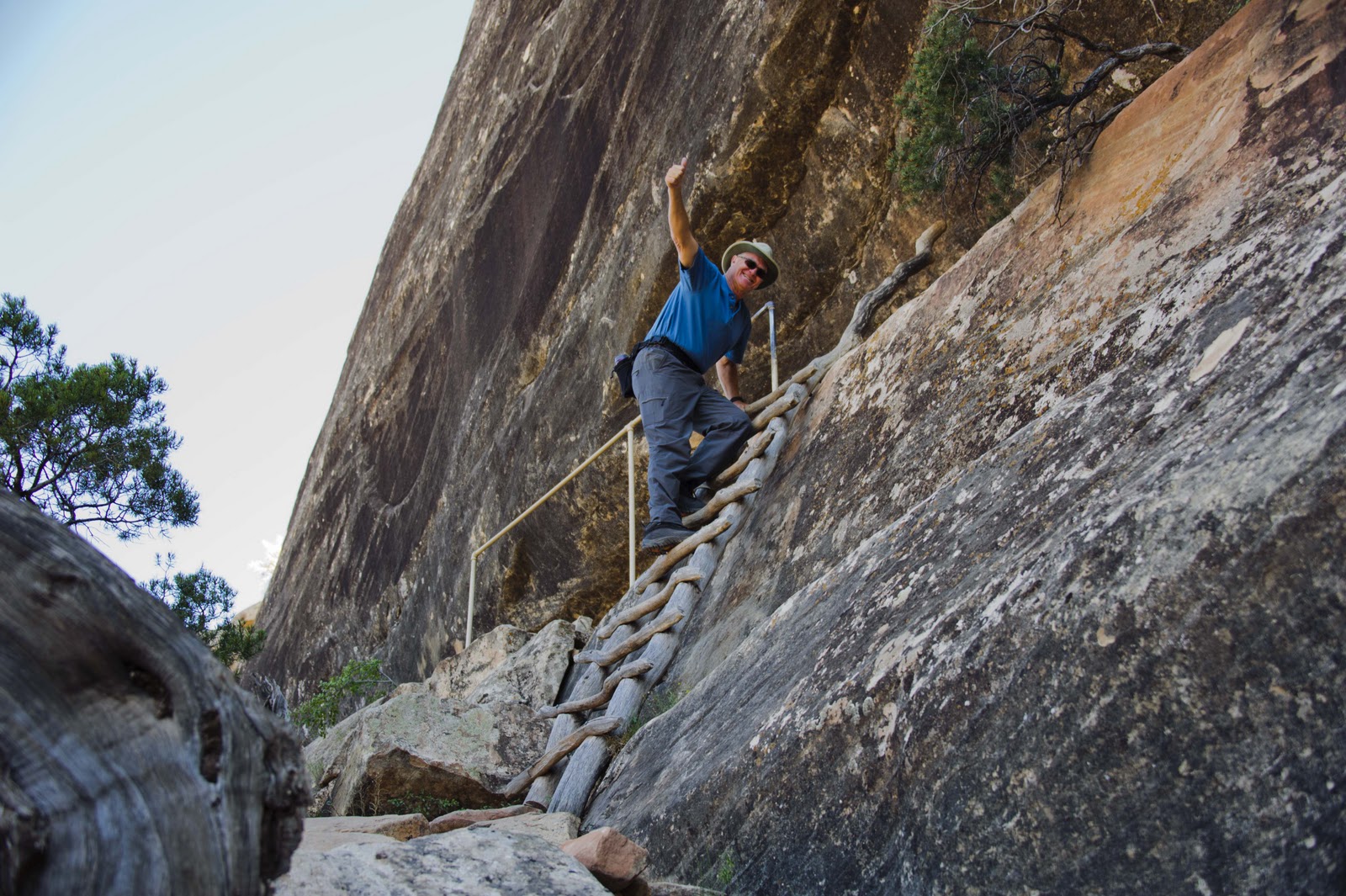
Each of these bridges has had several names over time. When the park was expanded to also protect nearby Puebloan structures, the General Land Office assigned Hopi names. In Hopi mythology, a “sipapu” is a gateway, or place of emergence, through which the Hopi believe their ancestors came into this world. The trail to the canyon bottom below Sipapu is the steepest in the park with staircases and ladders to aid in the descent –


Yikes, maybe we should have stayed up top. I’m not so good with high places.
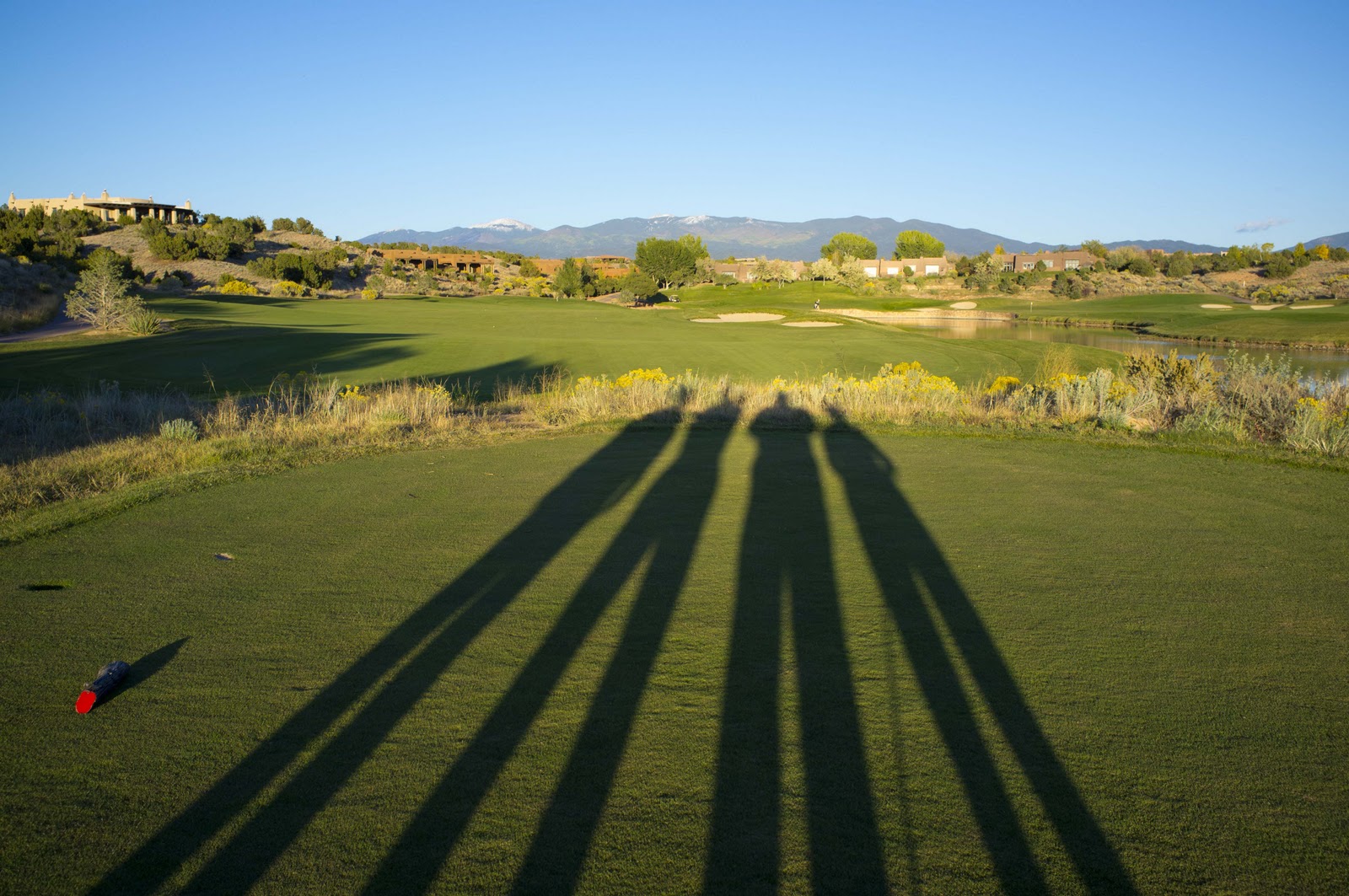
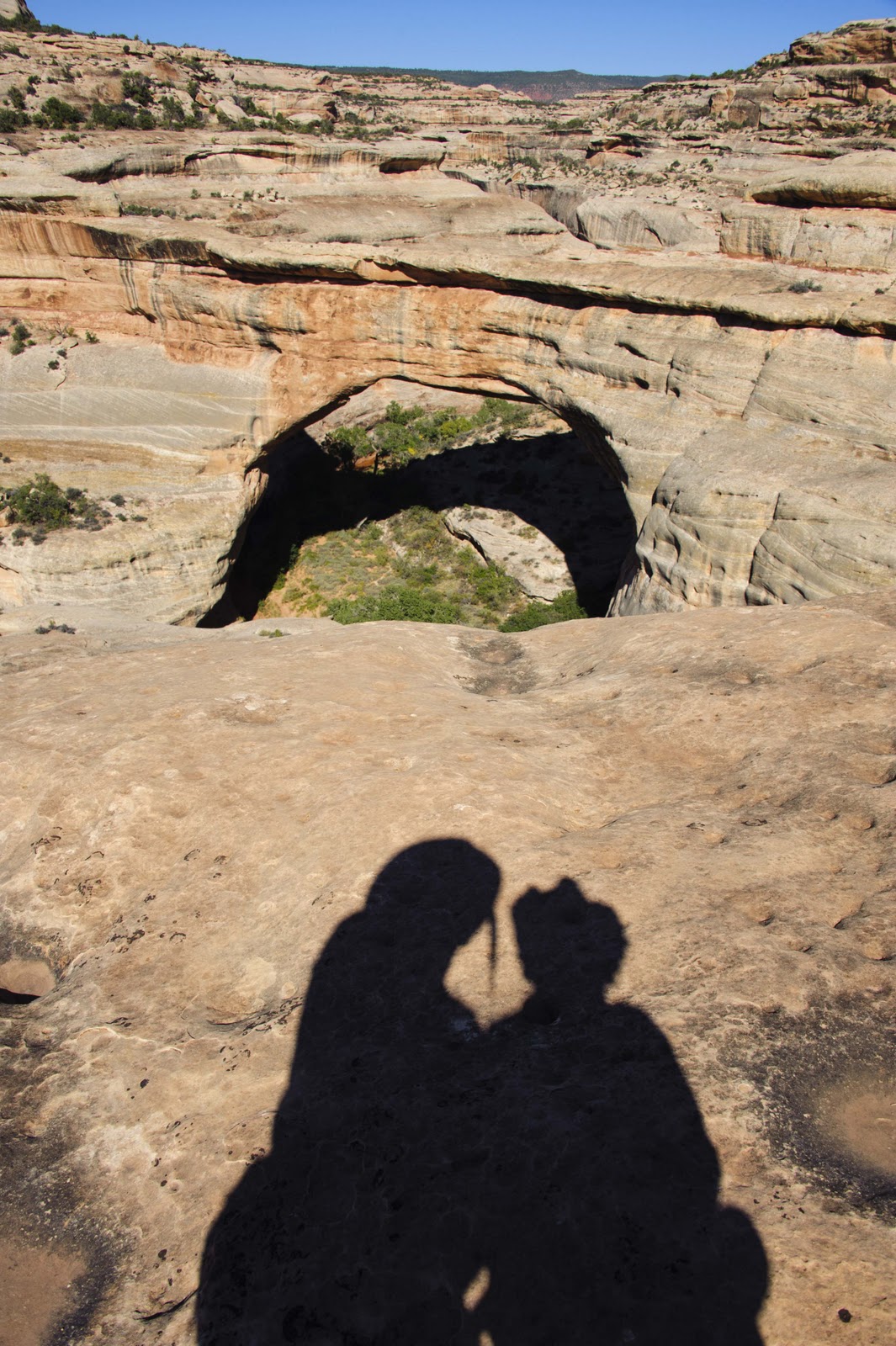
The shadow people are back, checking out Sipapu Bridge.

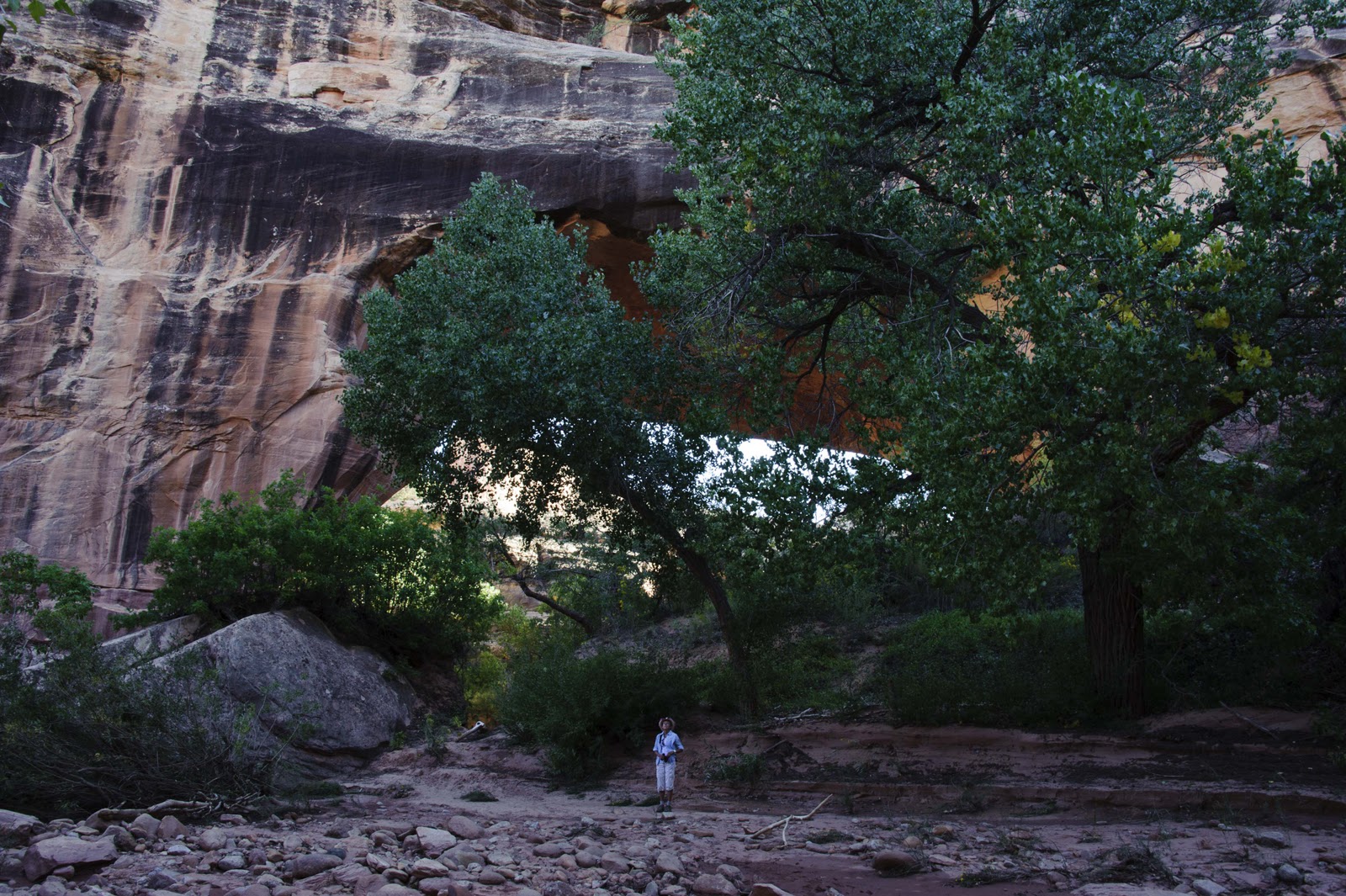
The ‘Young’ Kachina Bridge was next on our agenda. It is considered the youngest of the three because of the thickness of its span. White Canyon floodwaters still work to enlarge its span as do rock falls, such as one in 1992 when approximately 4,000 TONS of rock broke off the bridge!! It is named for the Kachina dancers that play a central role in Hopi religious tradition. (Notice who is in front of this ‘young’ bridge!)


On the left hand side here you can see the 4,000 tons of rock that fell 19 years ago..

A view from the backside of Sipapu Bridge.

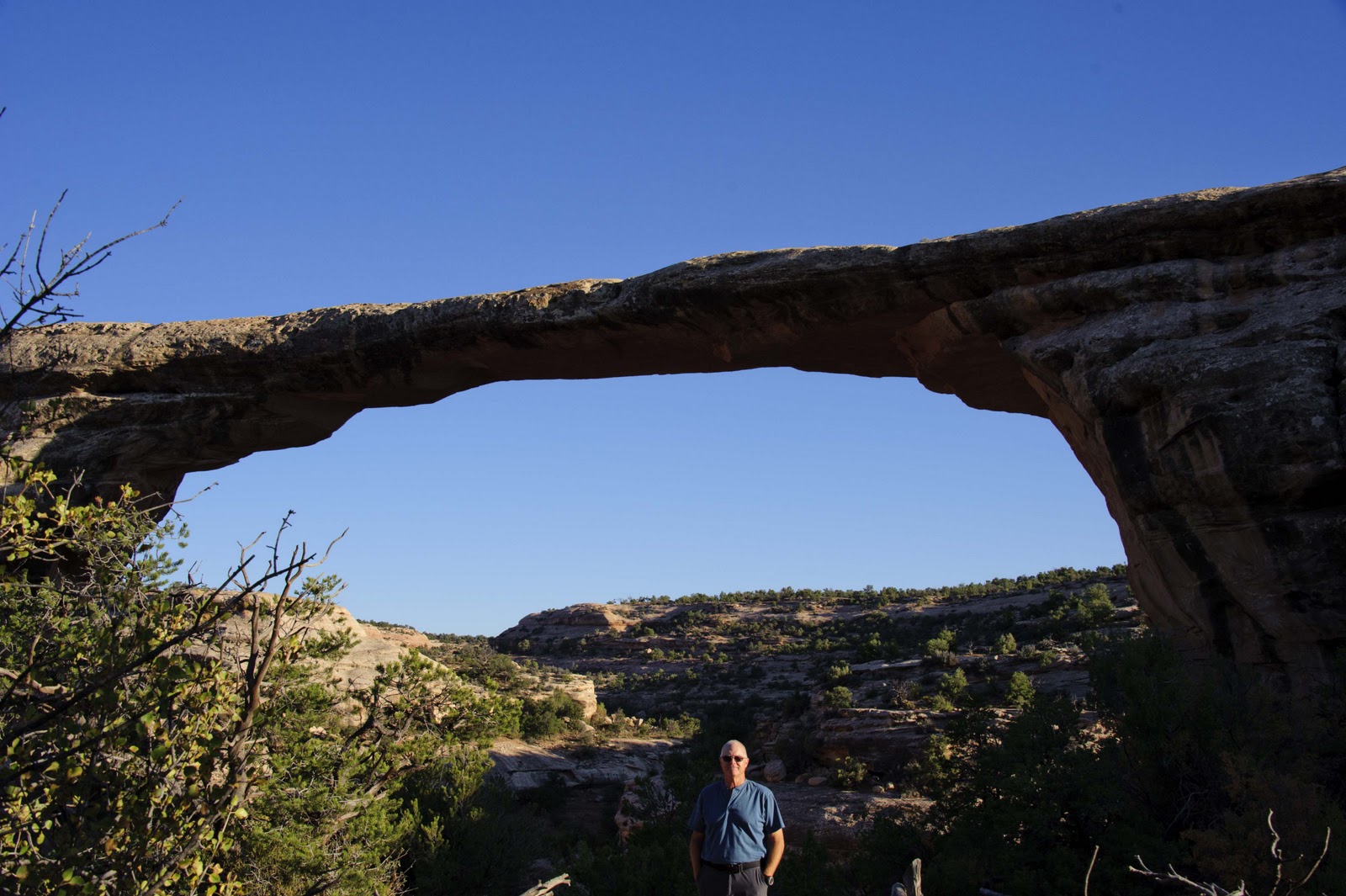
Last, but by no means least, is the Ancient – Owachomo Bridge. The streams that made this bridge no longer erode it, but frost action and seeping moisture do. The bridge may now have a fatal crack;-( Owachomo means “rock mound” in Hopi, and is named after a rock formation on one end of the bridge. (Notice who is in front of this ‘ancient’ bridge!)


A couple of old timers. The Owachoma Bridge and you know who.

Well – the hikes to all of these wonderful sights wore us out yet again. BUT – when the sun came up on Sunday, we were ready for more! So – off to The Needles district of Canyonlands. We, of course, took one of those scenic roads – Harts Draw Road – to get there. Along the way we enjoyed deer, lots of wild turkeys and the changing leaves of the Gambel Oak.

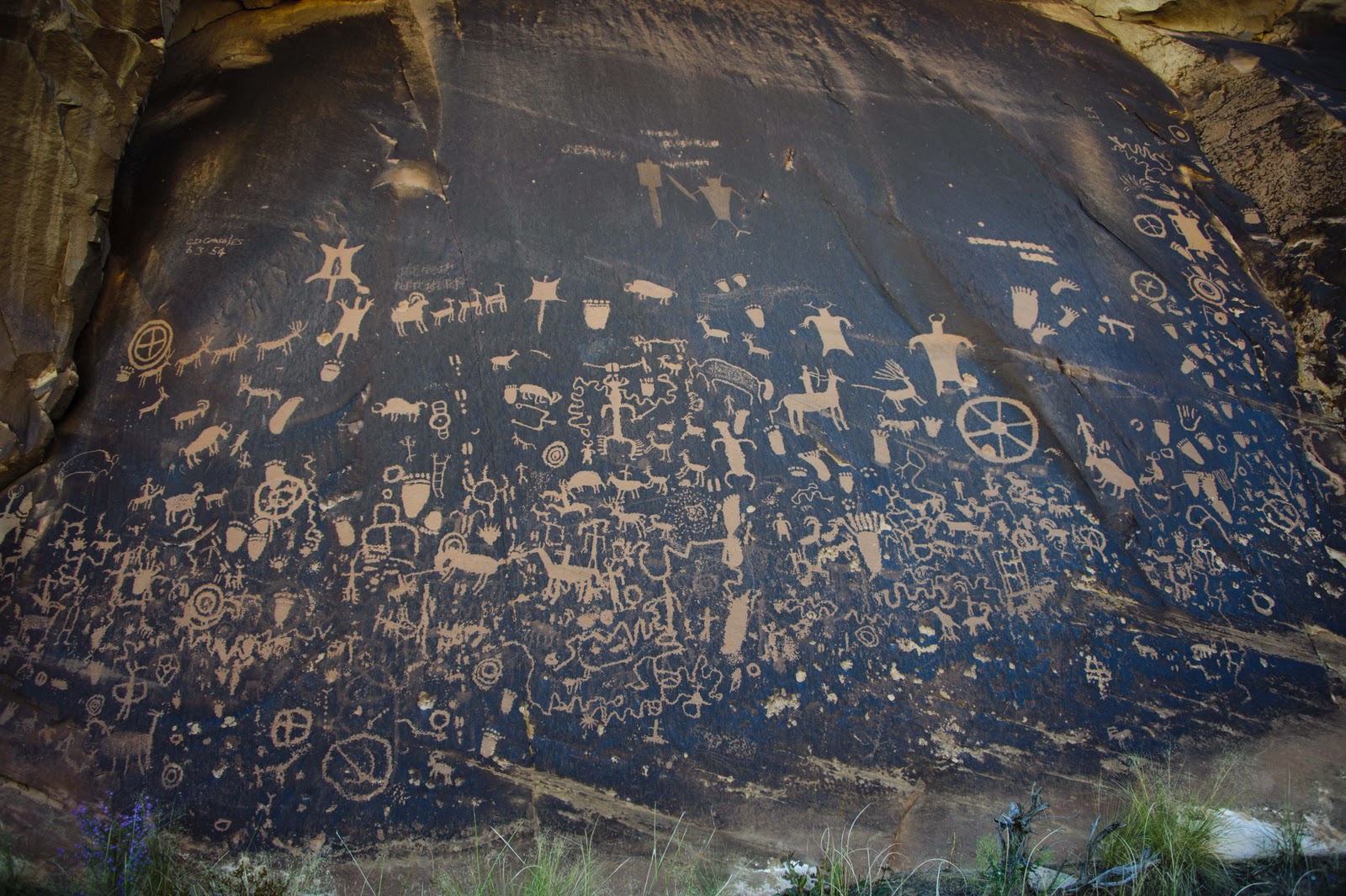
On the way into the Park, one has to stop at Newspaper Rock – perhaps a newspaper from over 2,000 years ago! This rock art panel is jam-packed with petroglyphs on the darkly patinated slab of sandstone from several Native American cultures – Archaic, Basketmaker, Fremont, Anasazi, Ute, and Navajo.


Newspaper Rock petroglyphs.

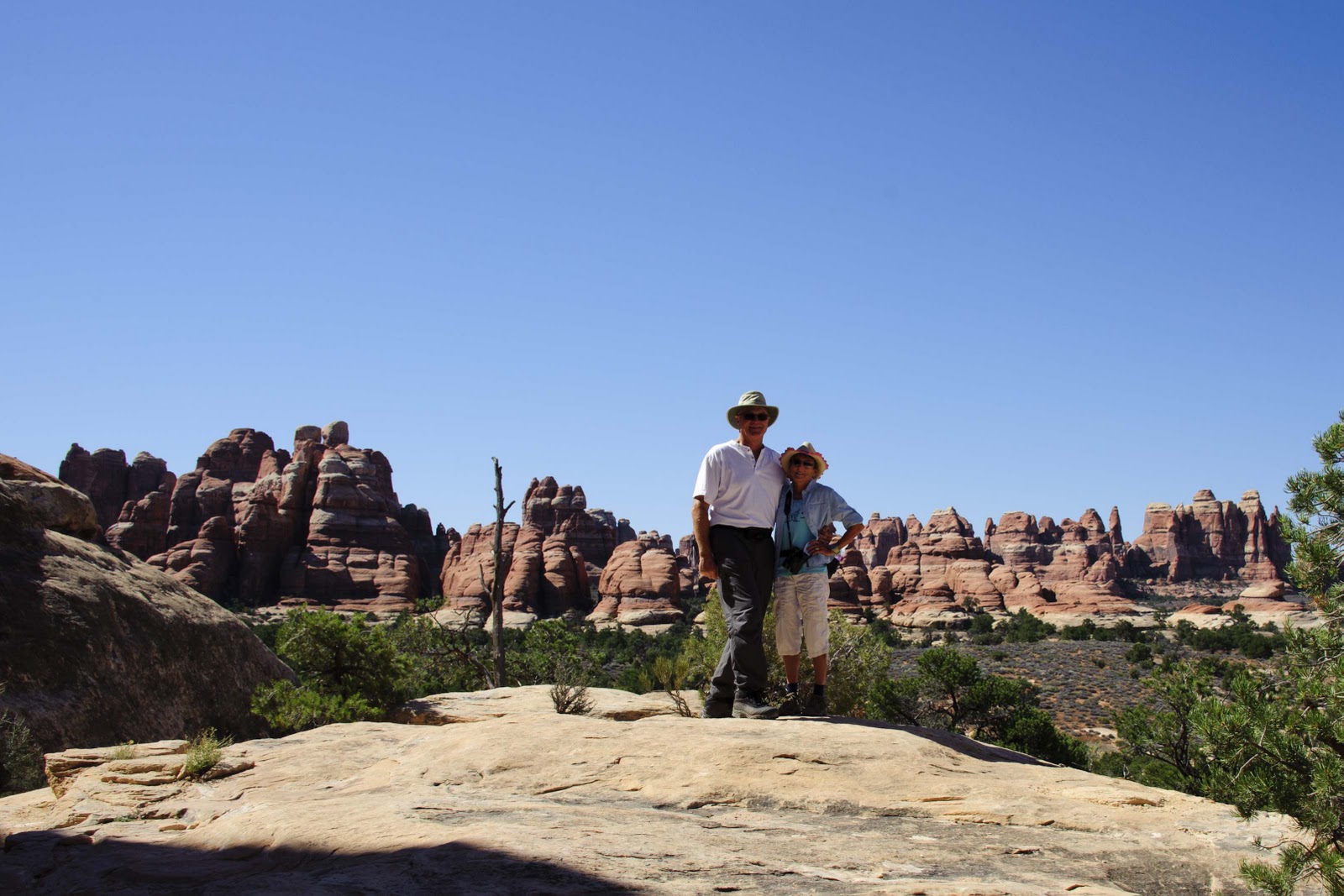
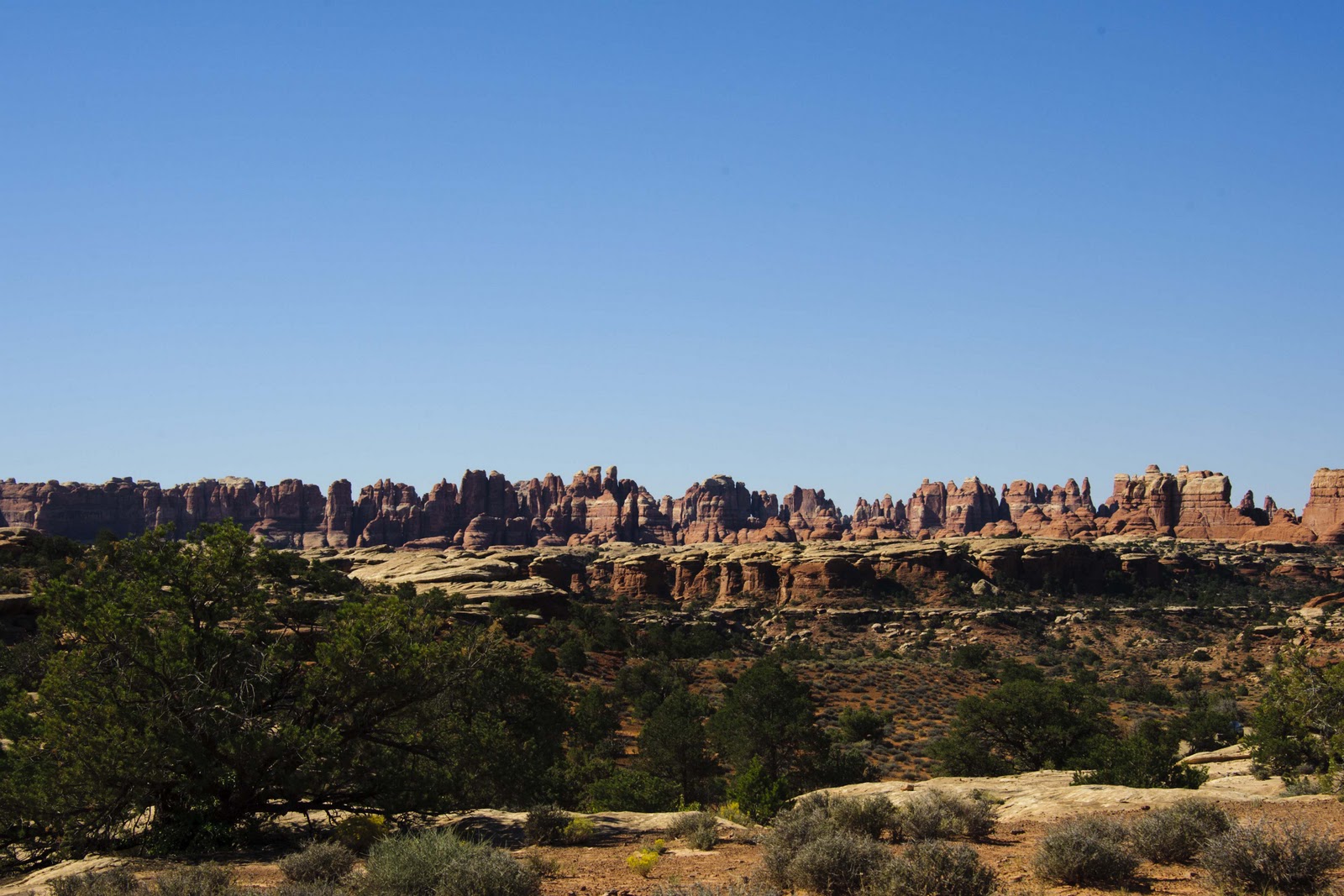
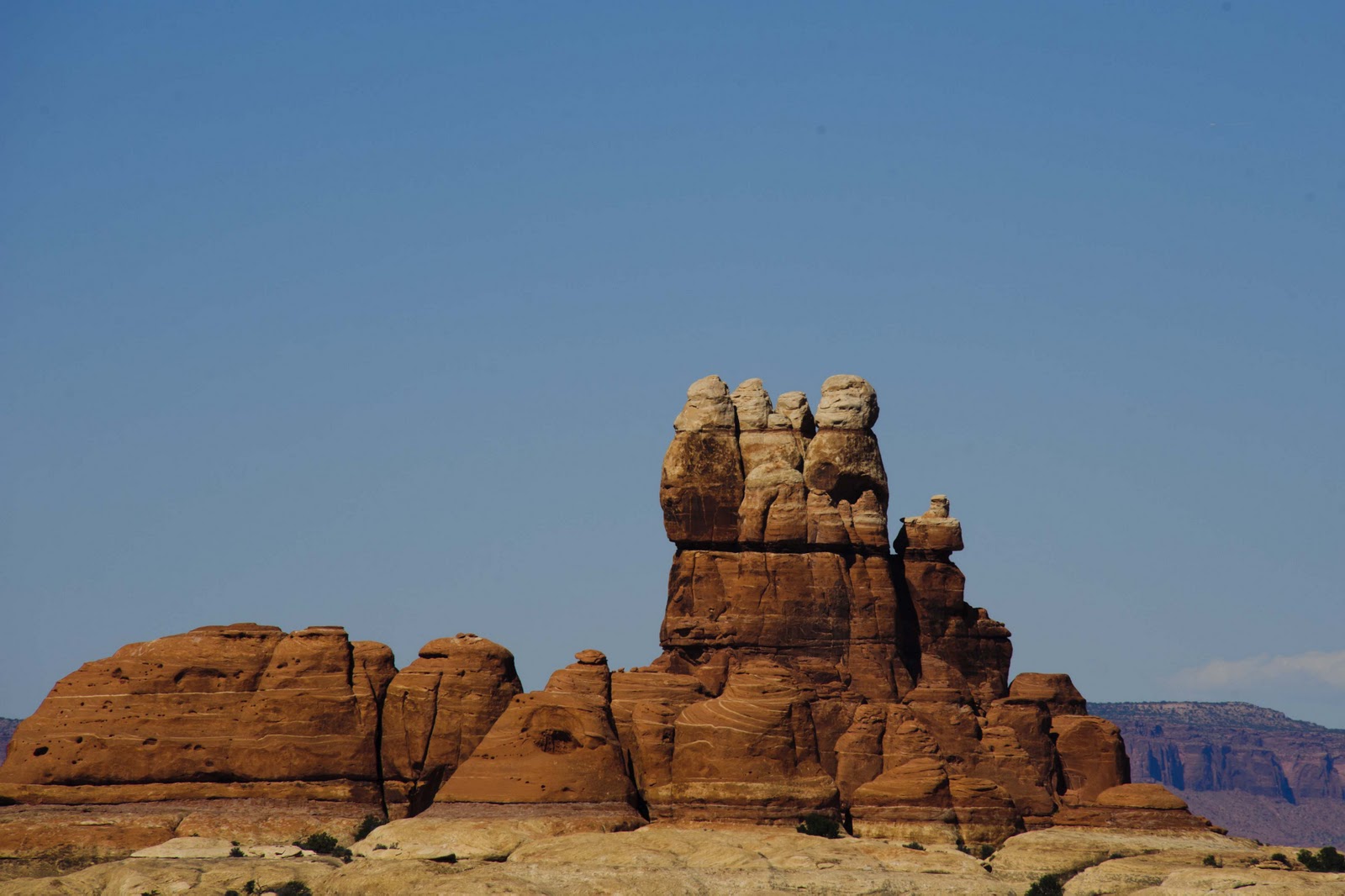
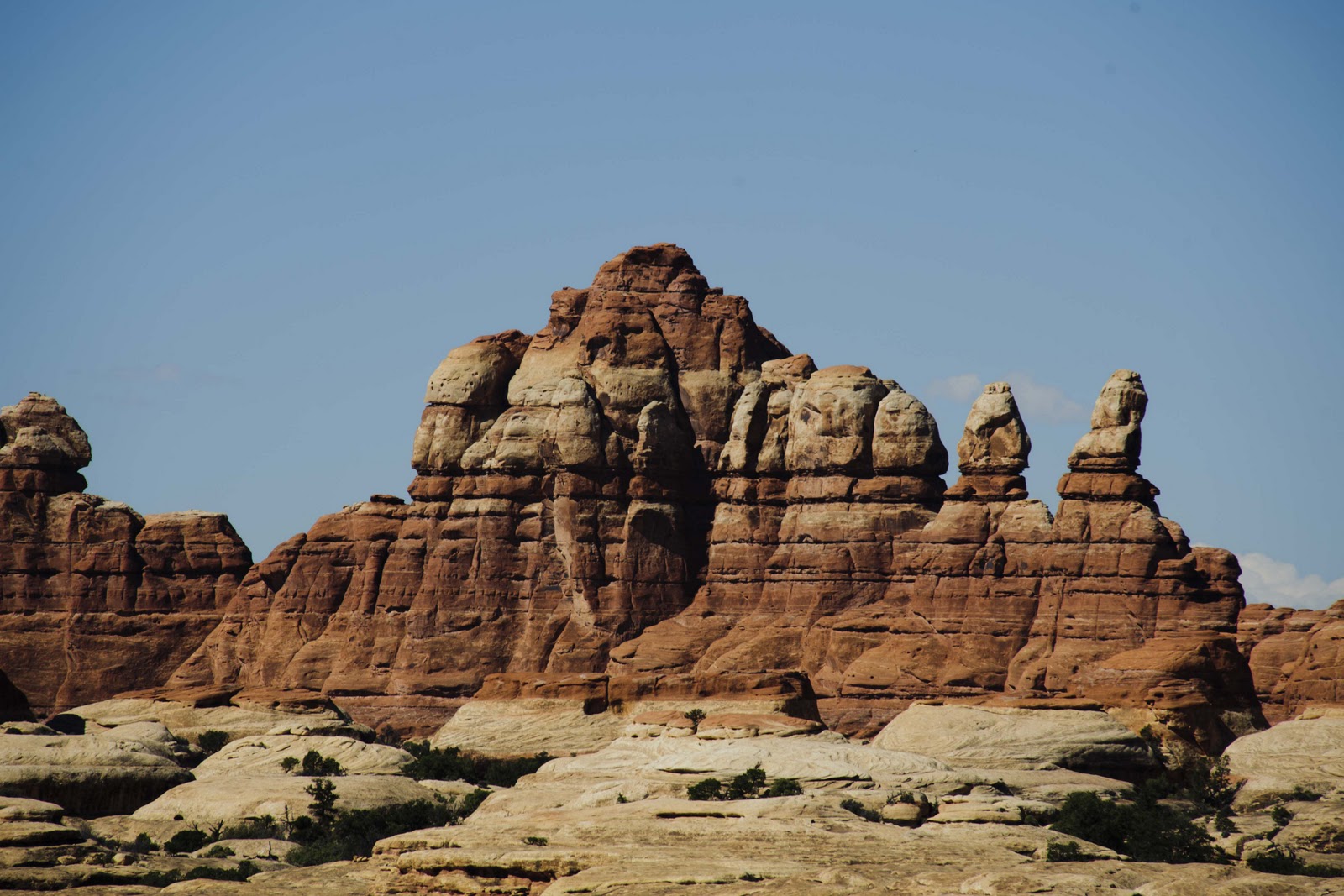
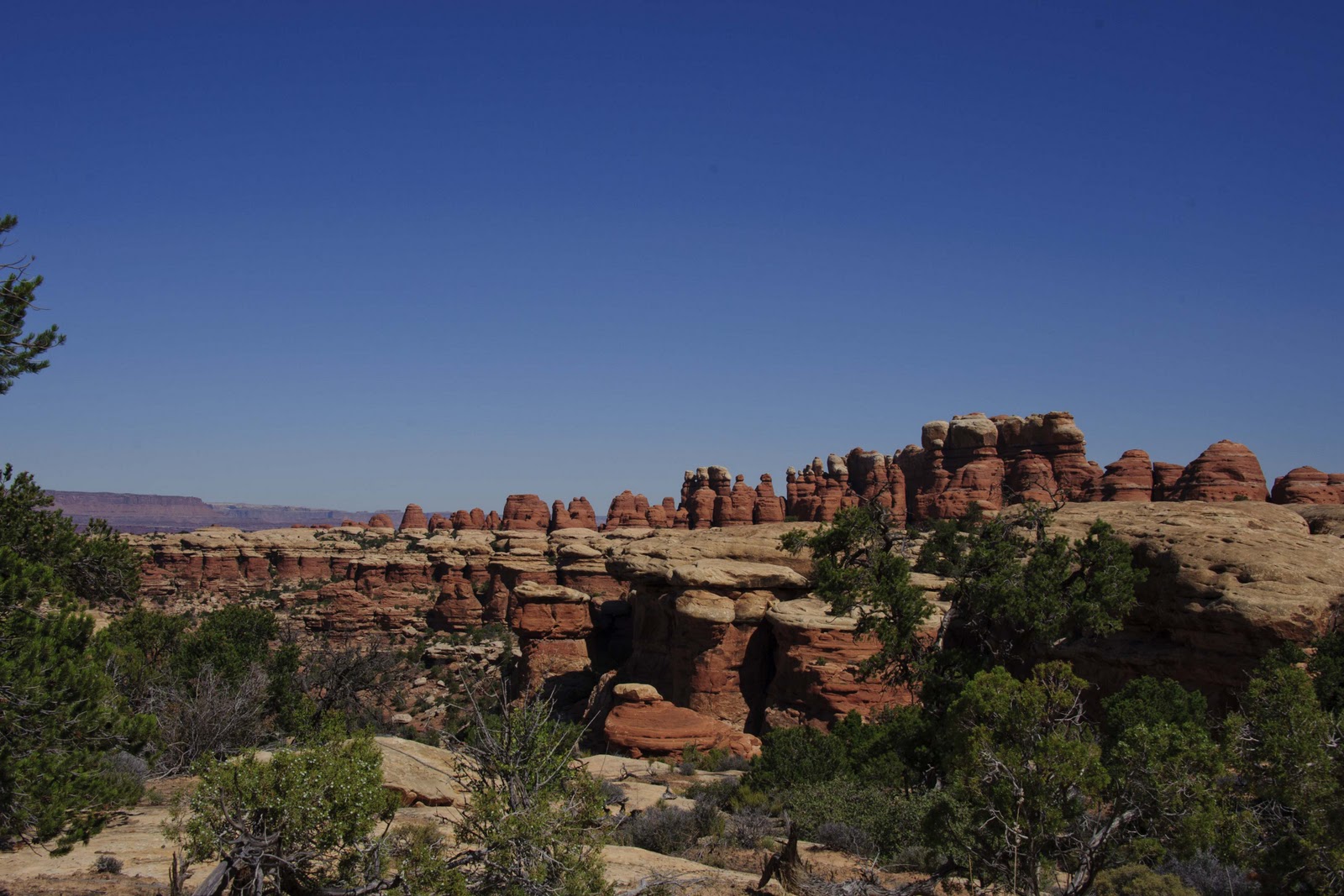
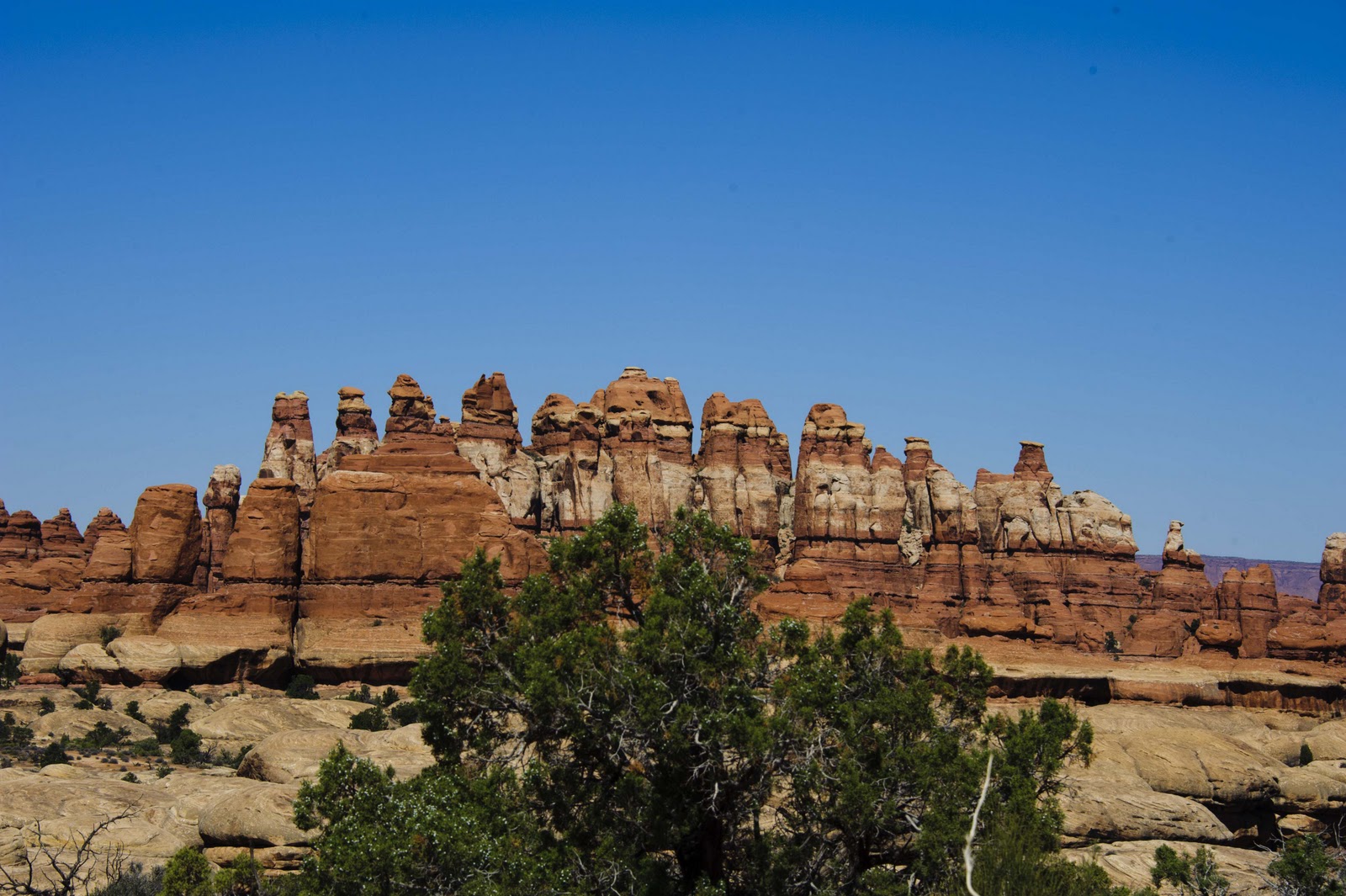
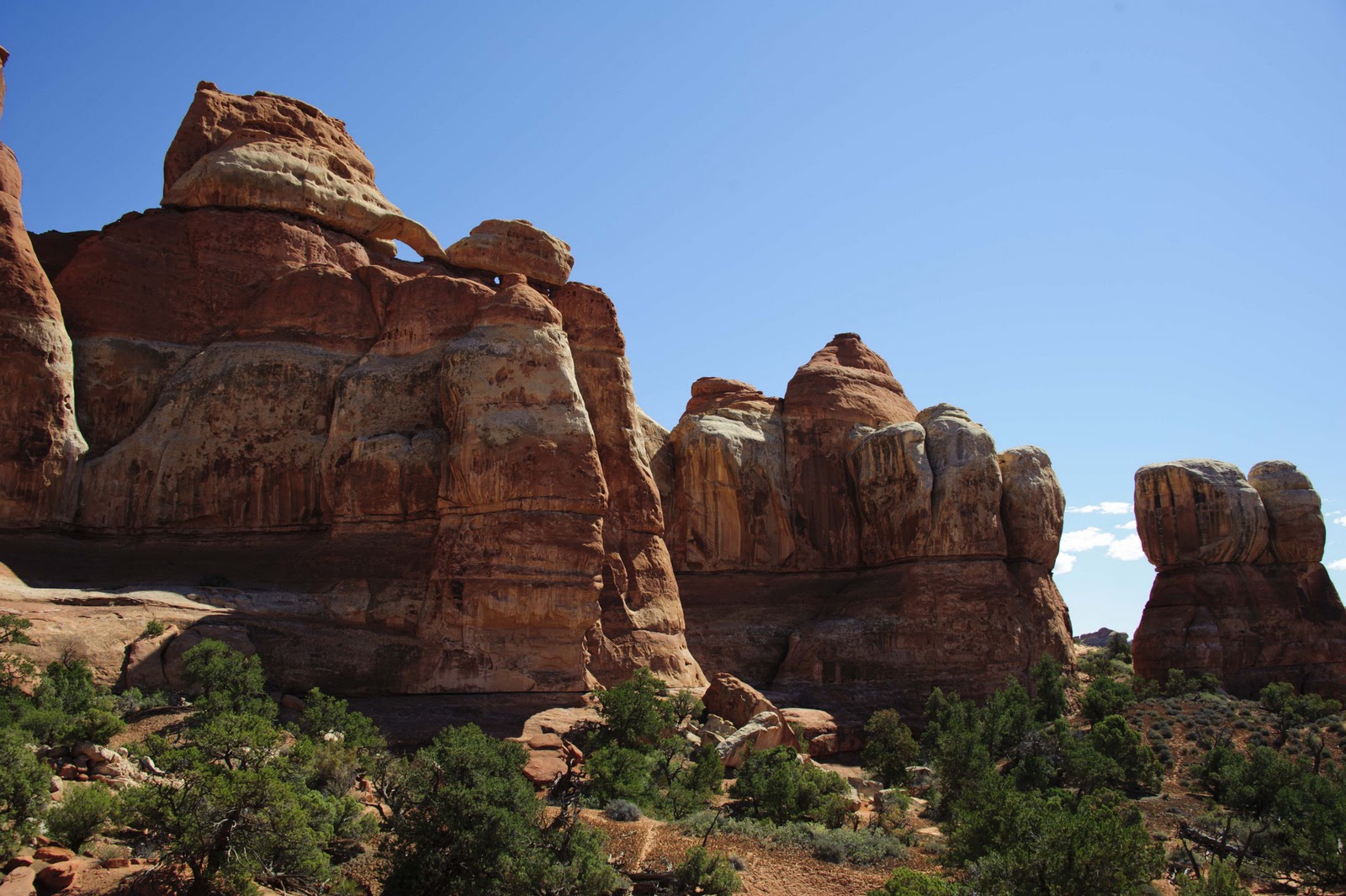
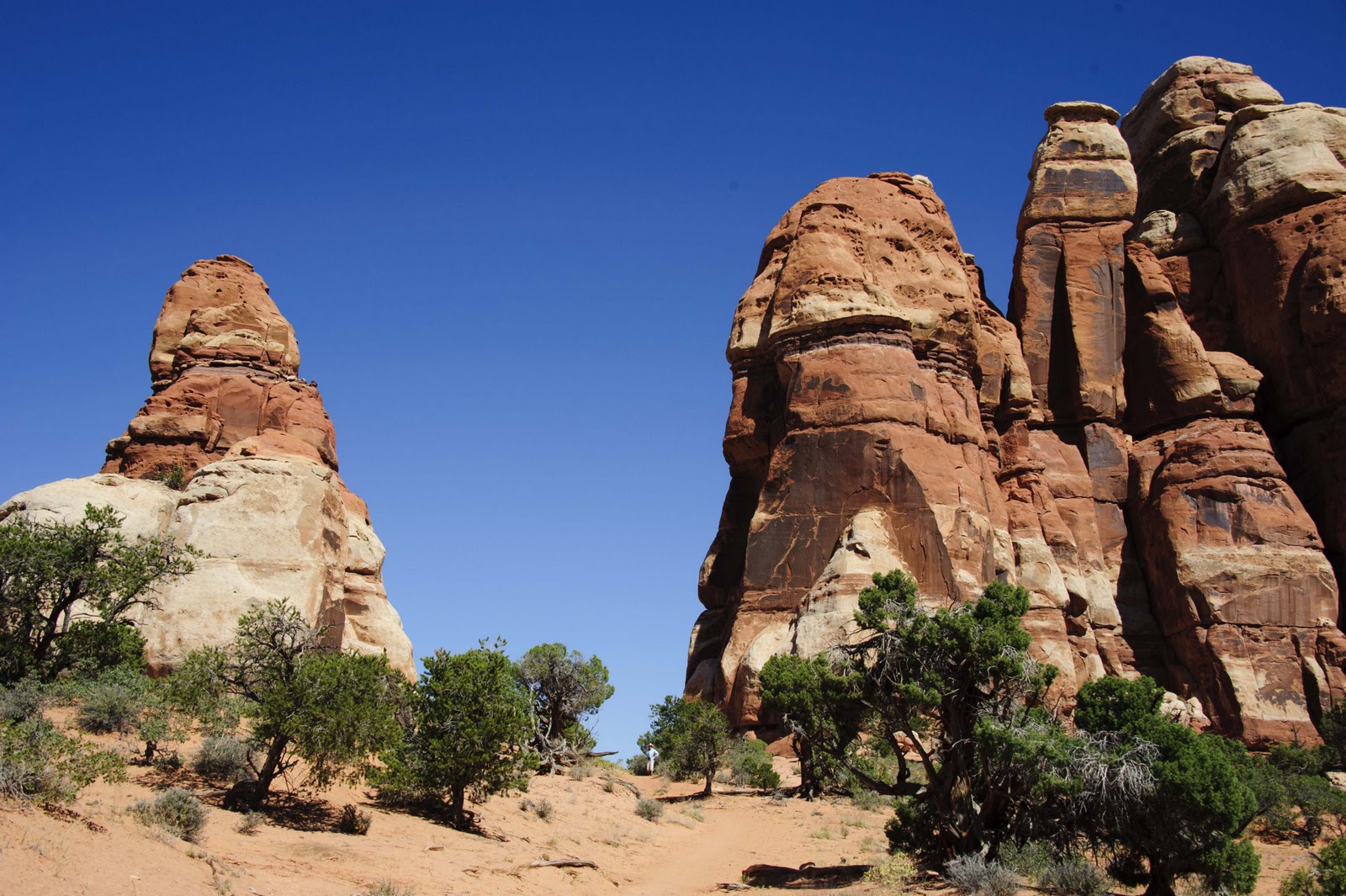
And, finally, The Needles district of Canyonlands, named for the colorful spires of Cedar Mesa Sandstone that dominate the area. The area covers a lattice of canyons, flat-bottomed valleys called grabens, arches, and spectacular sandstone walls notched by rocky spires and columns. A 6 mile round-trip hike to Chesler Park took us along ridges into the canyons where we walked among the ‘needles’ –


Heading out on a 6 mile hike over, under, around and through the Needles area of Canyonlands National Park.

Beautiful sights.
This grouping reminded Elizabeth of Russian stacking dolls.
The only arch we spotted on this hike.

This was the turnaround point on our hike.

Tomorrow is a golf day at the local muni course – the Hideout – rated the top muni course in the state!! Then we are on the move again.
So – more from Mesa Verde in a few days – E&G