Oslo, Norway

What a difference a day makes. The next port was Oslo – which we LOVED!! One of Europe’s most amenable capitals, it holds two fabulous sights everyone must see. One an outdoor ‘museum’ of sculptures from the early 1900’s and the other a documentation of the Arctic and Antarctic explorations in the late 1800’s to the early 1900’s.

Vigeland Park contains a lifetime of work by Norway’s greatest sculptor, Gustav Vigeland. During his youth, Vigeland frequented the studio of August Rodin and admired his naked, restless, intertwined statues. He advanced in his sculptures to capture sturdy humans with the universal themes of the cycle of life – birth, childhood, romance, struggle, child-rearing, growing old and death. In 1921 he made a deal with the city of Oslo – in return for a great studio and state support, he’d spend his creative life beautifying Oslo with this sculpture garden. From 1924 until his death in 1943 he worked on-site designing 192 bronze and granite statue groupings – 600 figures in all. Today this park is loved and respected by all. The park is open to all – free – and there are no police patrolling, no fences and no graffiti!! How amazing is all of that?!?! This is a wonderful sight and no one visiting Oslo should miss it.
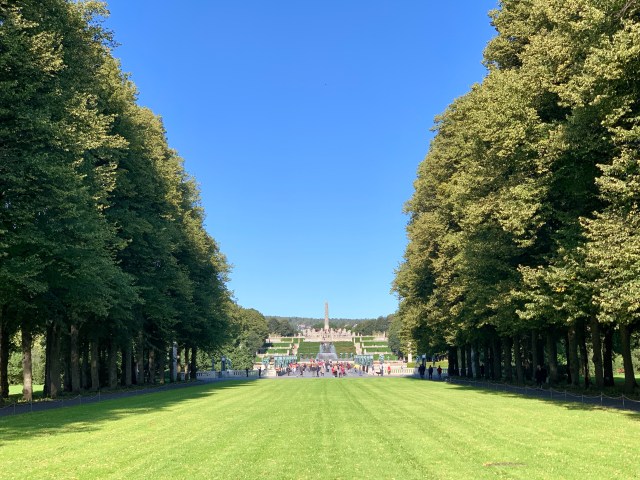
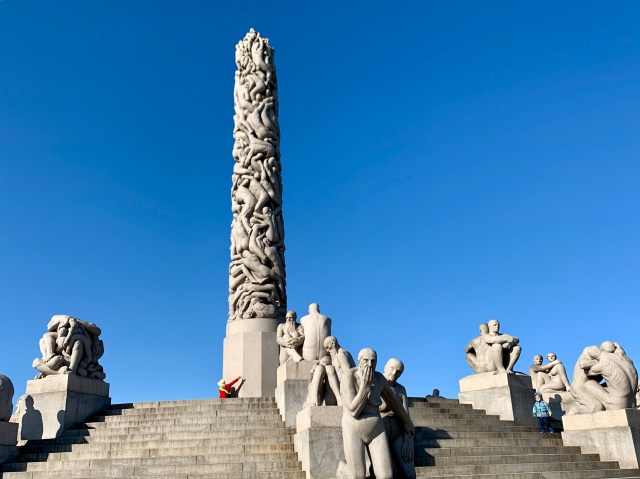
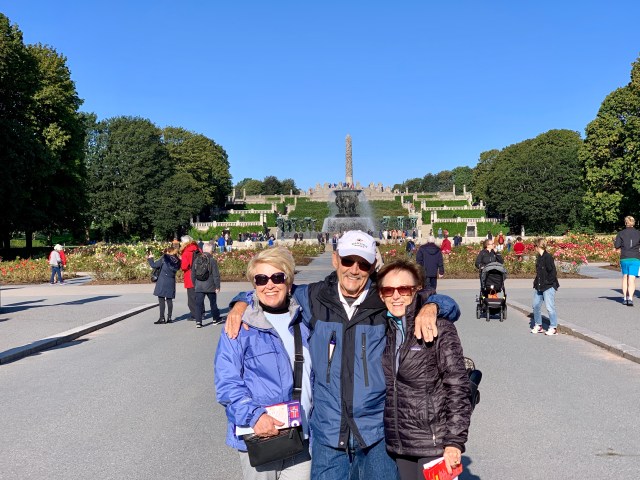
A view of the entire park leading through the sculptures to the 50 foot tall monolith of 121 figures.

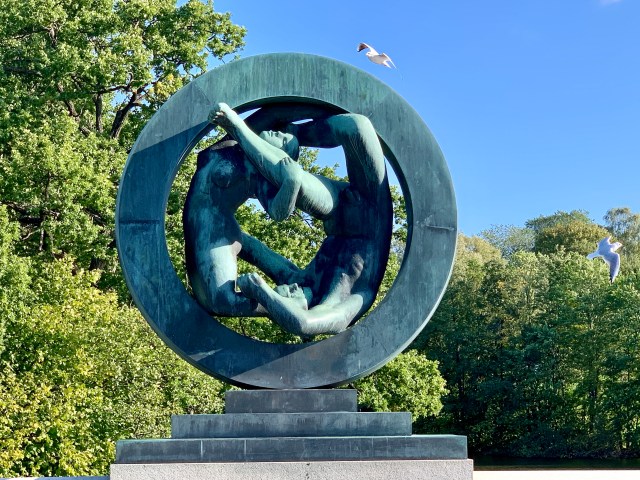
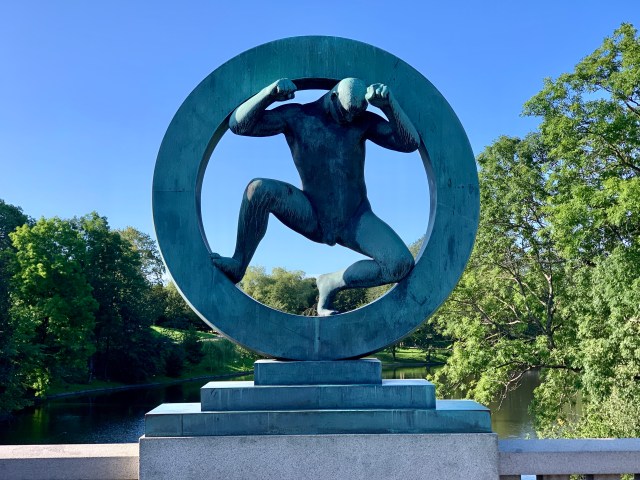
A 300 foot long bridge contains 58 bronze statues that are a general study of the human body – many dealing with relationships between people. One circular statue in particular is of a man and a woman going round and round. What else is new – right? Perhaps it signifies the eternal attraction, or the on and off again with man and woman?? Directly opposite another circle feels like a prison – man against the world attempting to break free – –
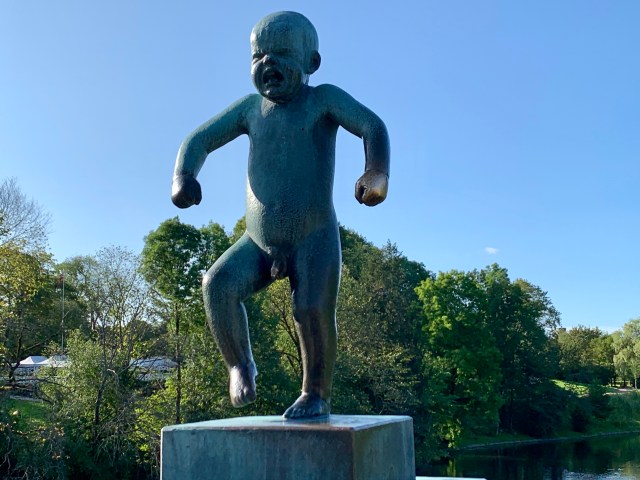
Then there is the wonderful symbol of the park – the Sinnataggen, the hot-headed little boy. It is said that Vigeland gave a boy chocolate and then took it away to get this reaction. Who wouldn’t react like this if chocolate was taken away????
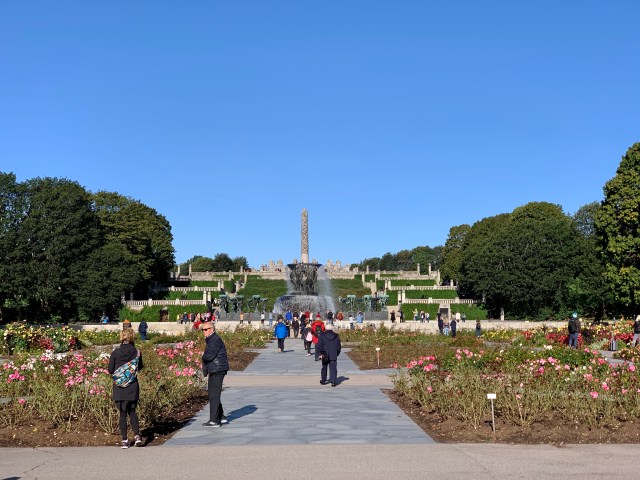
A beautiful rose garden creates a break between sculpture groups.

The Fountain – Six giants hold a fountain, symbolically toiling with the burden of life, as water – the source of life – cascades steadily around them. Twenty tree-of-life groups surround the fountain showing the seasons of life – childhood, young love, adulthood and winter – with the monolith looming over.
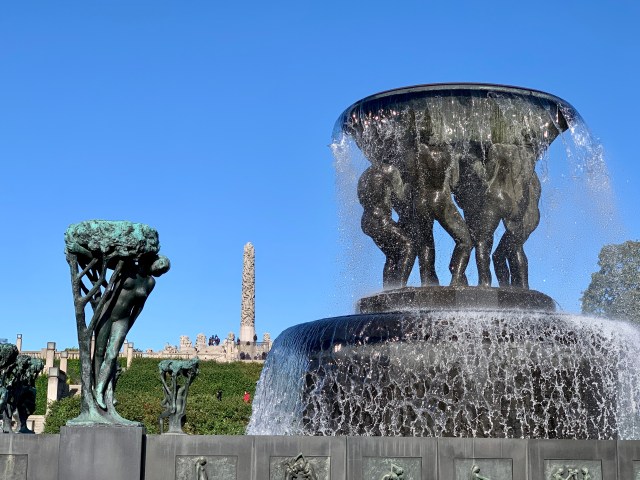
Finally one reaches the centerpiece of the park. The monolith, teeming with life, includes 121 figures carved out of a single block of stone. Three stone carvers worked daily for 14 years, cutting Vigeland’s full-size plaster model into the final 50 foot tall piece. It is surrounded by 36 groups of granite statues – again from birth/youth to old age.
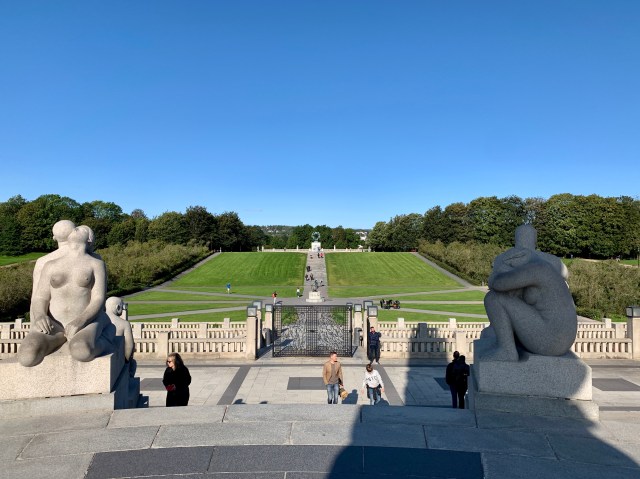
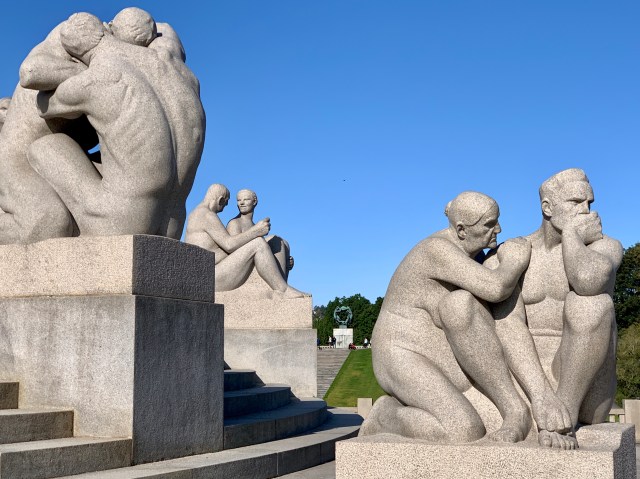
Enjoyed this Park immensely!

Stuck between to ‘beauties’ was the interesting Viking Ship Museum. Not often one gets to see two majestic oak Viking ships dating from the 9th and 10th centuries. The first was the Oseberg dating from 834 AD. Less substantial and more ornate in carving, this ship was most likely designed for sailing on calm inland waters during festivals as a royal pleasure craft. The second ship – the Gokstad – however, was a practical working boat capable of sailing the high seas. Dating from 950AD, it is likely explorers such as Eric the Red hopscotched from Norway to Iceland to Greenland to Newfoundland in such a vessel.
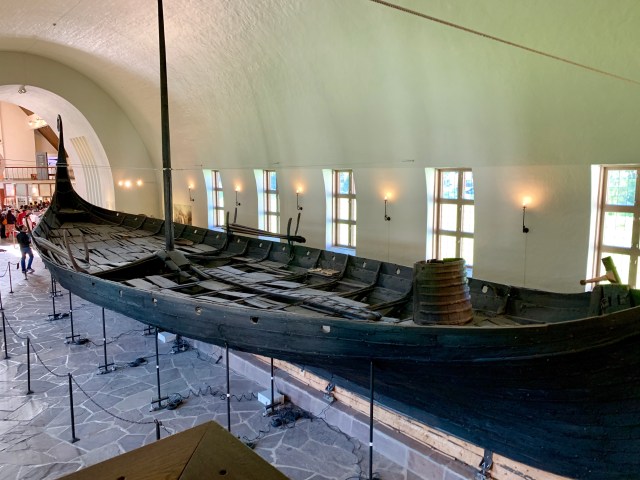
The ornate Oseberg
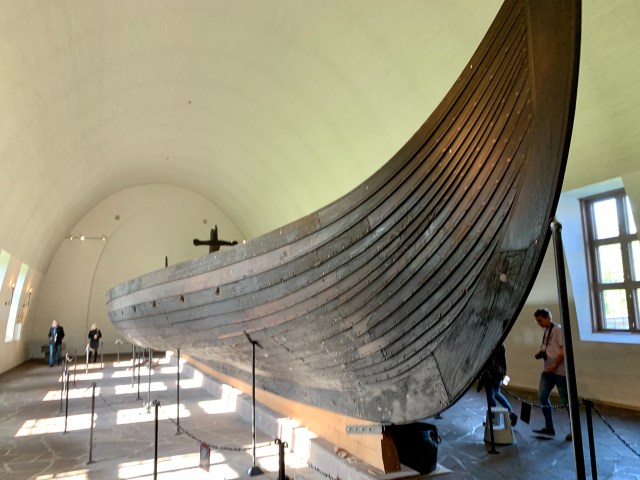
The practical, working ship – Gokstad.

The Fram Museum brought us forward in time to more modern day Vikings and was the second must see in Oslo. The Museum houses two ships – the Gjoa that was the first through the Northwest Passage (1903-1906) and the Fram that explored both the North Pole and later the South Pole.
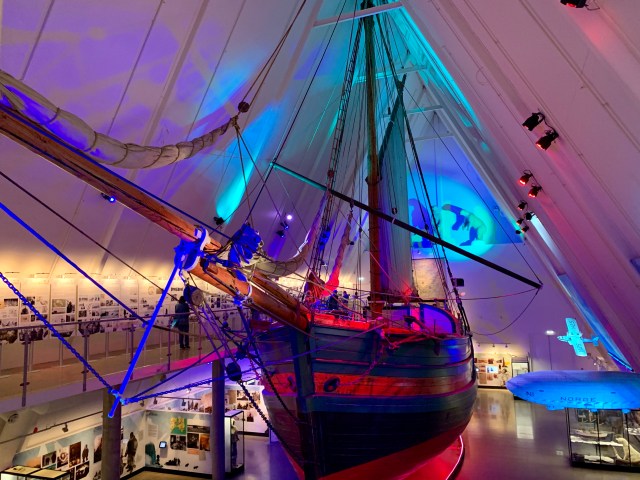
The Gjoa.
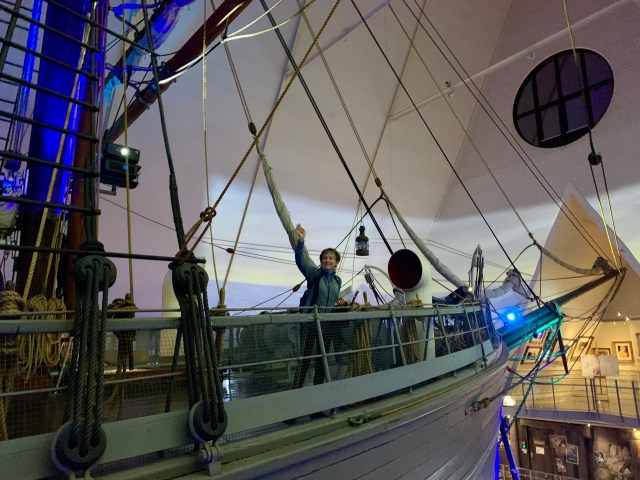
Aboard the Fram.
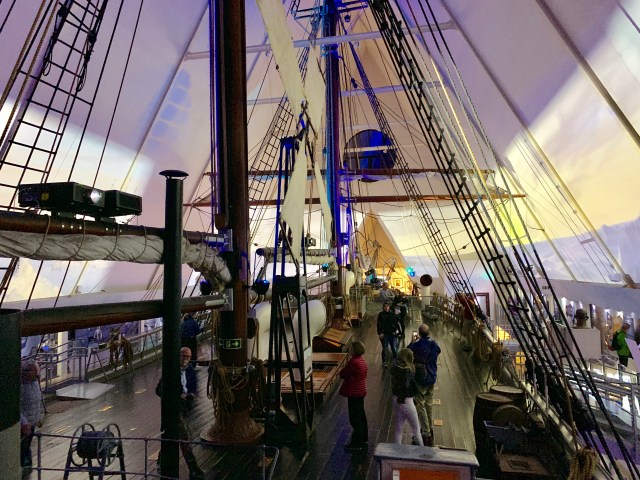
Yes – an actual windmill on board to provide power.
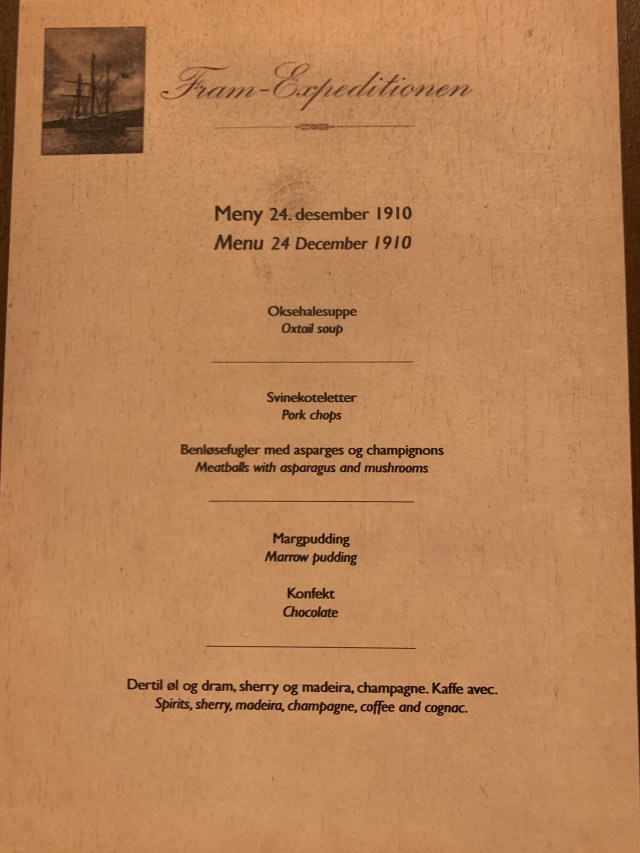
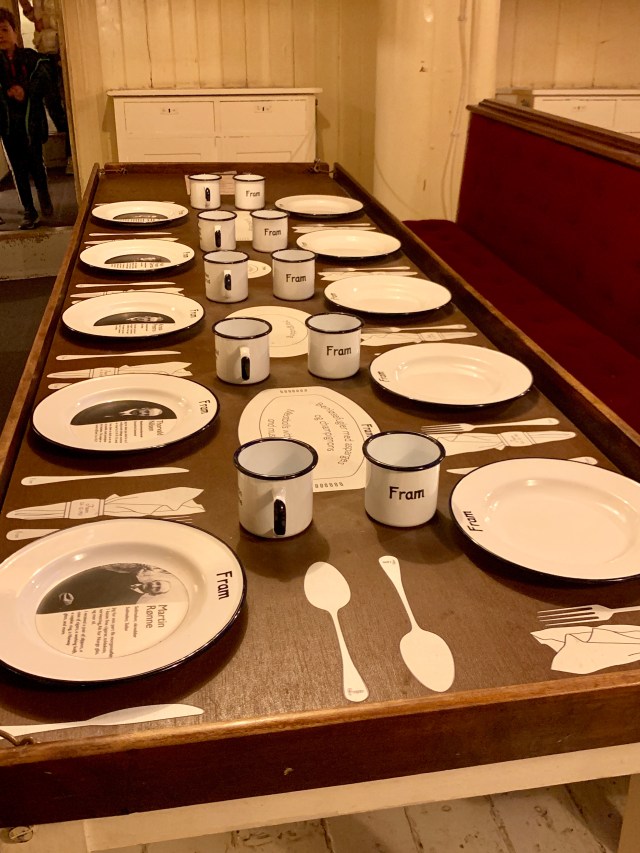
Christmas Eve dinner aboard the Fram.
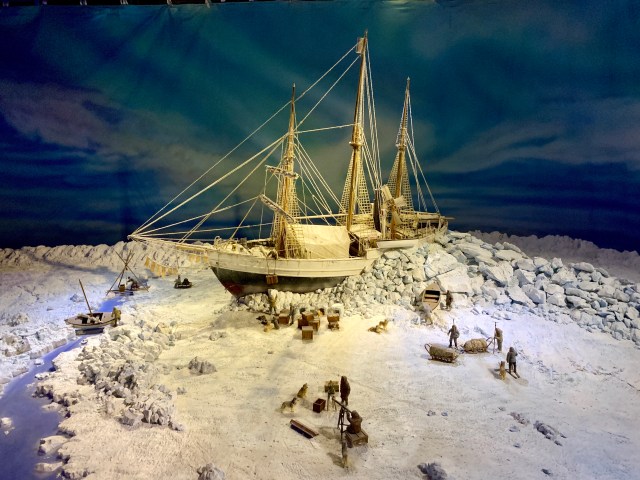
A model depicting the Fram breaking through the ice on its journey.

Interesting, but in a totally different way, was the Kon-Tiki Museum. Thor Heyerdahl and his crew used two different ‘boats’ to prove that such vehicles could have crossed the Pacific and the Atlantic to settle areas. He first created the Kon-Tiki in 1947 out of balsa wood, using only premodern tools and techniques, and set sail from Peru. They survived 101 days and 4,300 miles later arrived in Polynesia. He then took on the Atlantic in 1970 on a vessel made of reeds. This journey was 3.000 miles from Morocco to Barbados. As said – interesting and what movies are made of;-)
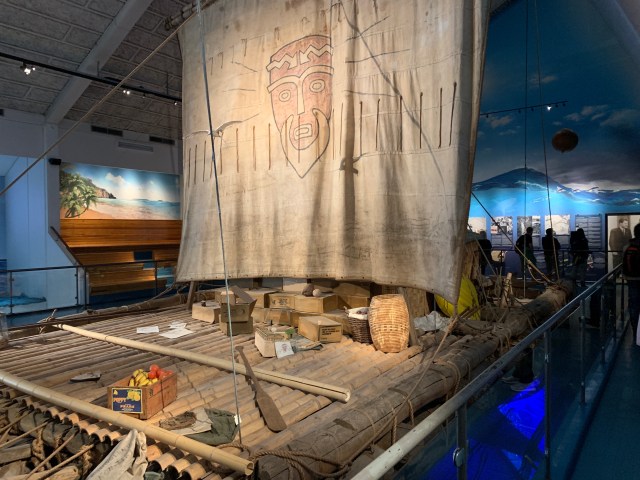
The Kon-Tiki
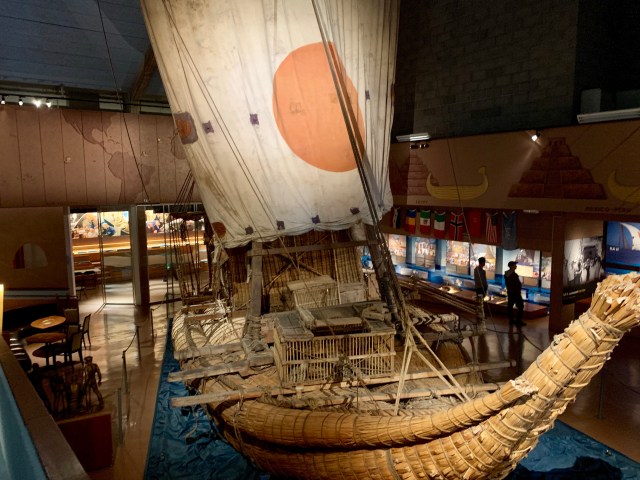
The Ra II (Ra I sank partway into its journey!)

Oslo was a winner!! Just a few more fun sights before returning to the ship.
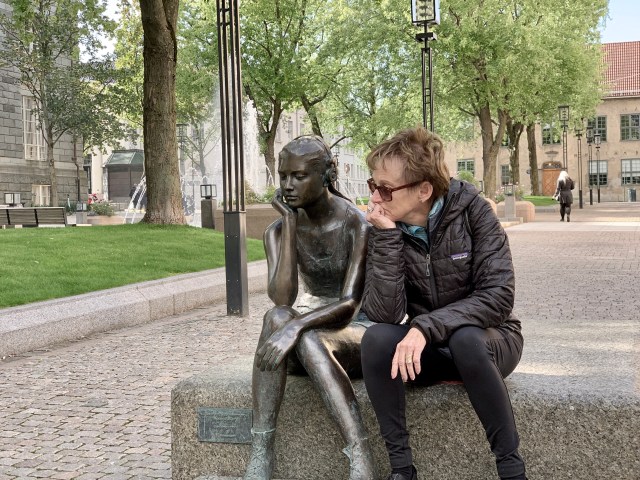
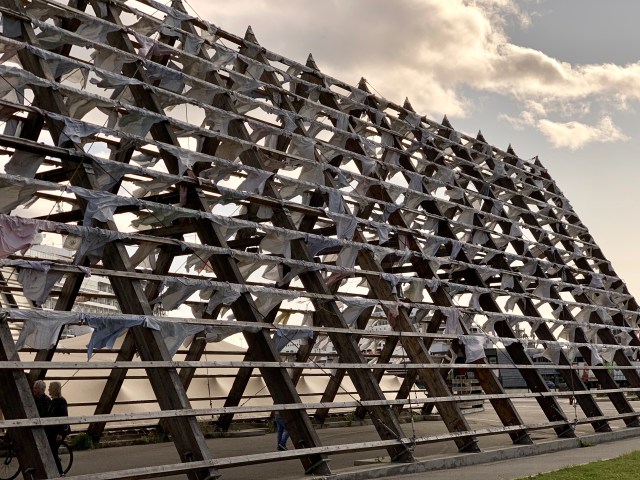
A unique Oslo clothesline;-)

A beautiful day for a beautiful city. Oslo was fabulous – just not enough time.

E & G enjoying every bit of our cruise;-)

Gothenburg, Sweden

Only two ports left and perhaps a bit of fatigue – but the best sight of Gothenburg was this great fortress on the way in!!

Please don’t fire up those cannons on the left;-)

After a walk up the Avenyn – billed as the loveliest (?) and busiest (definitely) street in Gothenburg – the Gotaplatsen (billed as the square which is the cultural hub of Gothenburg) was in front of us. This square is flanked by the Gothenburg’s Konstmuseum, the concert hall and the municipal theater. Perhaps too many OLD city centers had been on the agenda – but this was a snooze;-(.

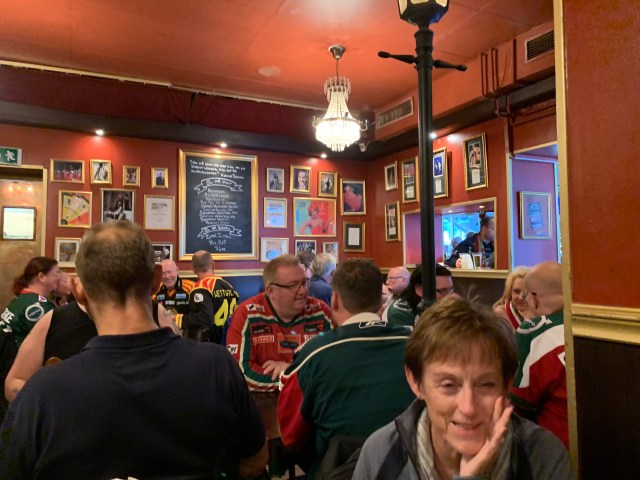
So – we did what is always done when nothing else appeals – looked for a place to lunch. It was noticed that every restaurant and sidewalk cafe up the Avenyn had been filled with ‘sports fans’ with their jerseys on. Finding the Stage Door restaurant just off the Gotaplatsen – the same was true here. LOTS of sports fans. It was learned that this particular Saturday was the opening hockey game of the season. AND, the Gothenburg Indians (???) were playing their arch rivals from Stockholm. Imagine the ferver for hockey – as we WERE in Sweden!! And – the Indians so reminded E of Gramps’ favorite Cleveland Indians (although a different sport). Even as Americans, we joined right in the anticipation and celebration – –

Go Indians!!

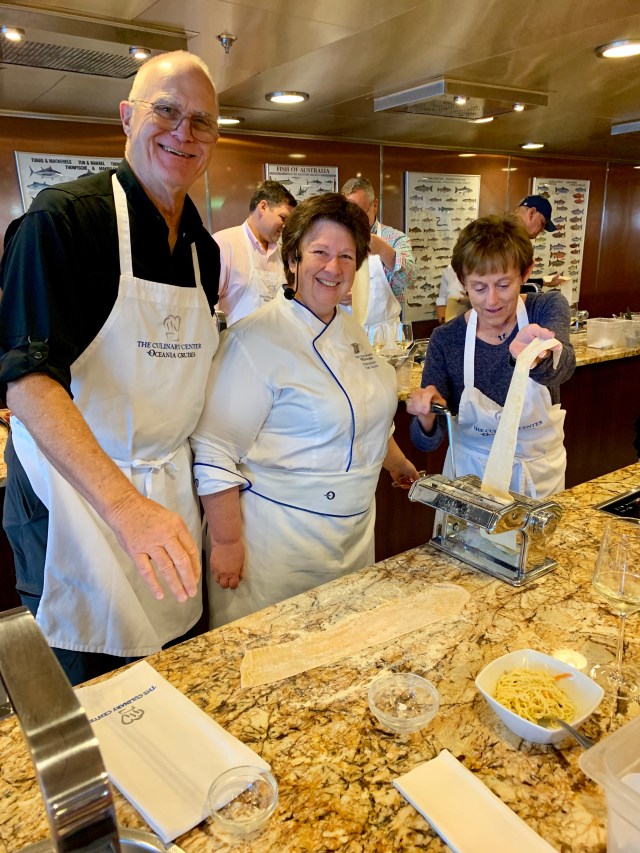
There was ONE afternoon without an excursion, which gave time for a cooking class. It will come as no surprise to most that we opted for an Italian class cooking pasta. After three wonderful dishes, including the making of fresh pasta, we waddled out of the class;-). Just a note – we have these recipes and would love to prepare them for anyone interested!! (Side note – our instructing Chef worked for Julia Child for 16 years as her Executive Assistant.)

This sauce included mushrooms, cream and spicy sausage;-). (AND a little wine!)

Chef was supervising my fettuccine.

Another great couple of days. Only one day in port left.

A VERY full E & G;-)

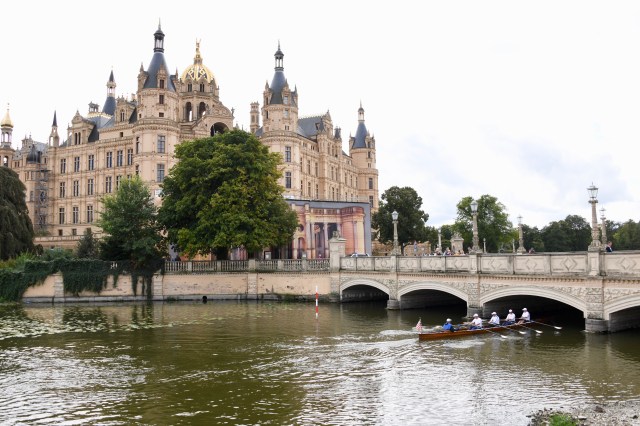
Schwerin, Germany – Schwerin Palace

It was a pretty grey day when the Oceania bus set out for the Schwerin Palace and our excursion of the day (most on the ship set out for a three hour bus/train trip to Berlin).

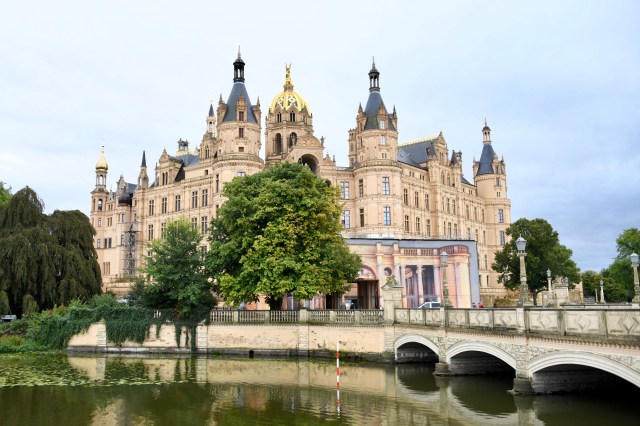
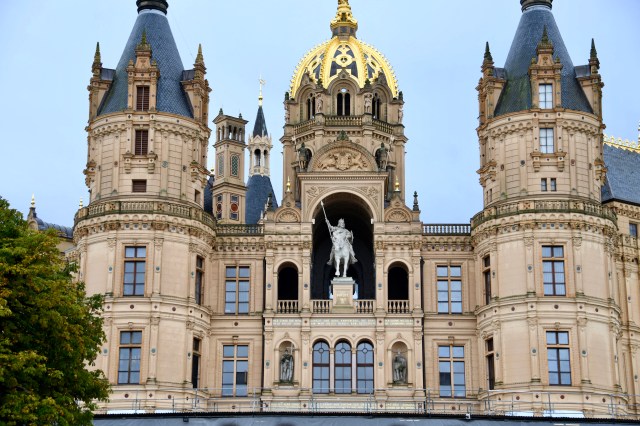
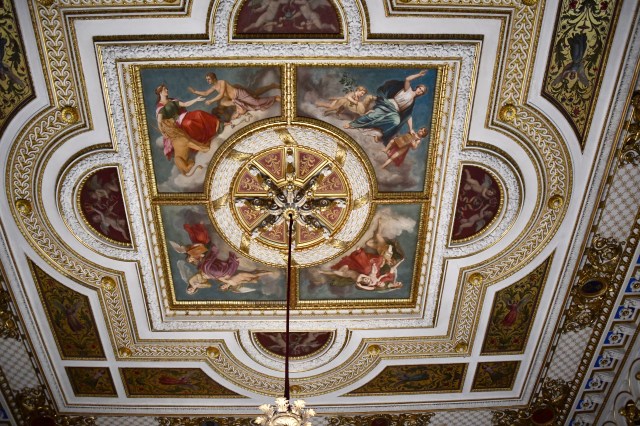
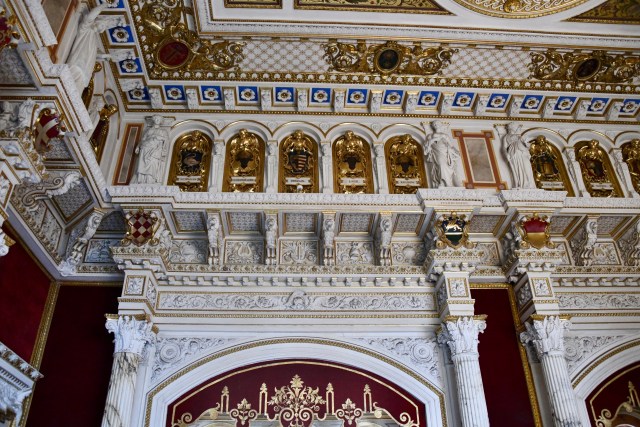
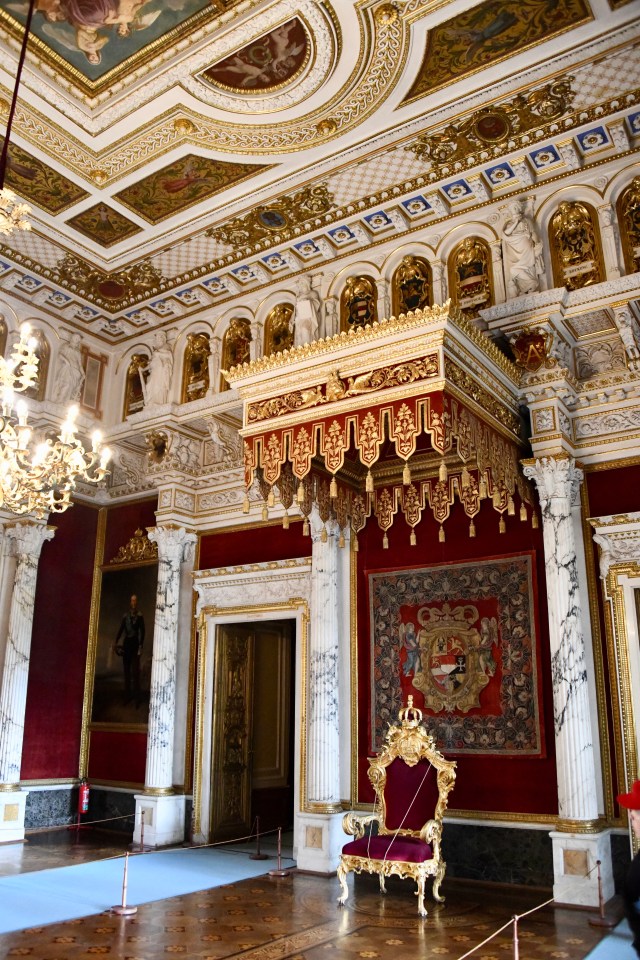
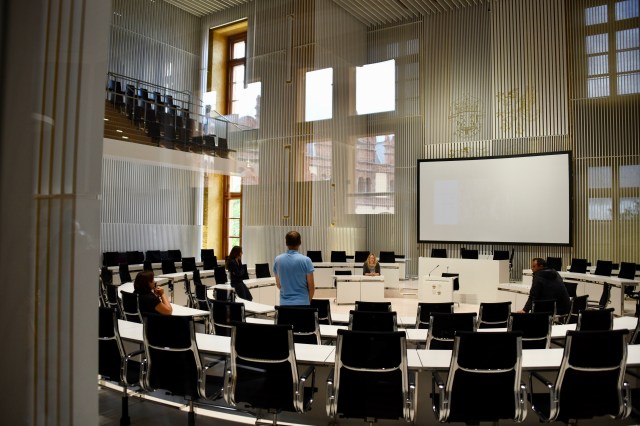
The Palace is situated on an island amid a charming landscape of lakes and parks just on the edge of town. This magnificent residence was built in the mid-19th century as a renovation and extension of the original palace structure which had existed for over 1000 years. Today this beautiful structure houses a museum as well as the state assembly for this state of Germany.

A beautiful sight to drive up to.

The Orangery with its colonnaded courtyard.

Please – come in!

Can you guess this is the more modern section used by the State Assembly?

In the cute little village of Schwerin.

The Geezers rowing group;-)

It was a short – but beautiful – day for us.

E & G on to Gothenburg, Sweden

Gdansk, Poland

A very interesting stop.

One of the Baltic Sea’s seaports since the Middle Ages, Gdansk was originally fortified by the Teutonic Knights. Fast forward to the aftermath of WWI when it became the center of German shipbuilding following Hitler’s rise to power. In fact, the city’s residents were the first to witness the beginning of WWII as the Nazi’s invaded and occupied Gdansk on September 1, 1939 to protect their interests. Caught between the German and Russian powers, the “Long Street” and all its buildings were turned to rubble. While these buildings have all been meticulously reconstructed – the fact remains that all the buildings are new and most are only facades, looking a bit Disneylandish;-(

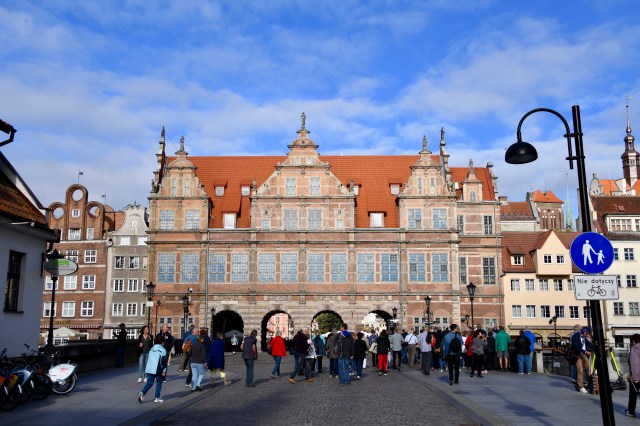
One enters the Old Town via the Green Gate, actually built as a residence for visiting kings and now houses Lech Walesa’s office.

Come on in.

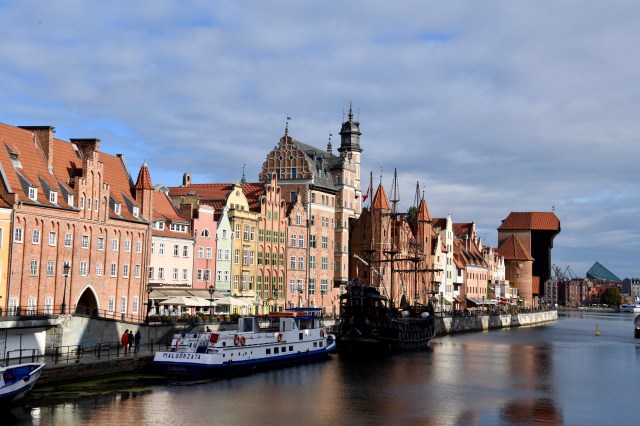
The riverfront embankment of the Motlawa River that flows to the Baltic Sea.

Once inside the Green Gate, The Long Market opens up in front of you with the Main Town Hall tower beckoning. This is also the first glimpse of the reconstructed facades;-(. But look beyond those and one sees lots of shops and restaurants!

The centerpiece of the square just ahead is the statue of Neptune, God of the Sea. A fitting symbol for a city that dominates the maritime life of Poland.

Towering over Neptune is that imposing Town Hall Tower. Not only does it have that wonderful clock telling all when it is time to return to ones ship, it also has this fantastic sun dial – with the proper time!!

Stunning!

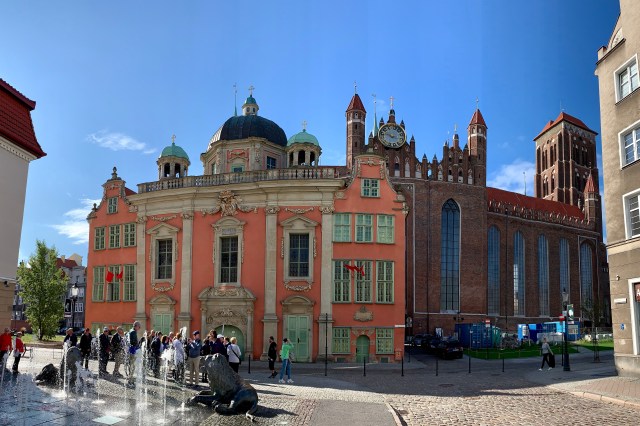
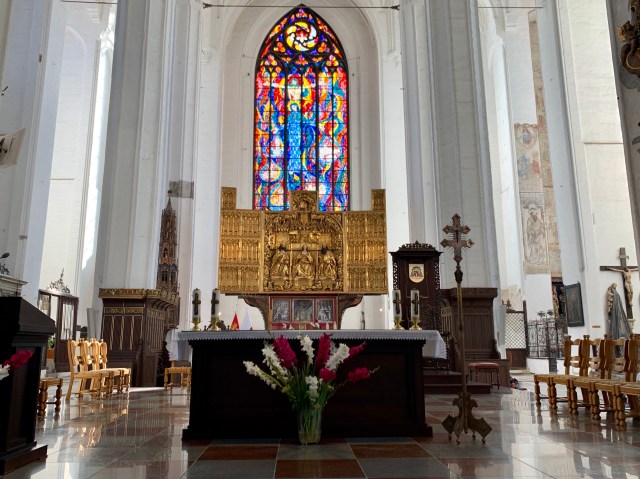
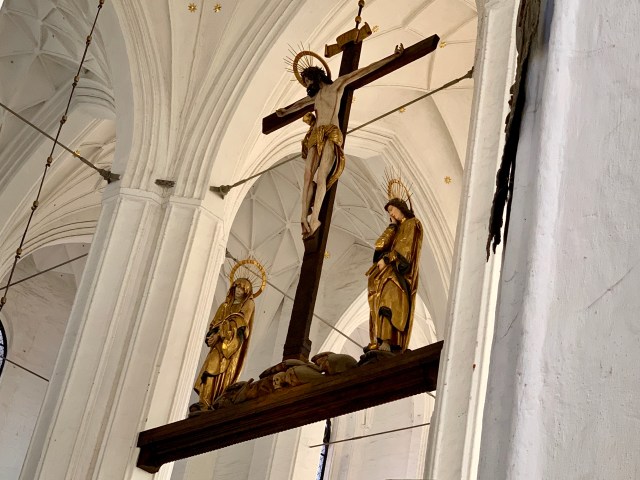
As one wanders the streets of Old Town, St. Mary’s appears. It is one of the largest brick churches in the world – built from 1343 to 1502 as a Catholic Church, became Lutheran and back to Catholic after WWII.

A beautiful High Altar with a ‘replaced’ stained-glass window from 1980.

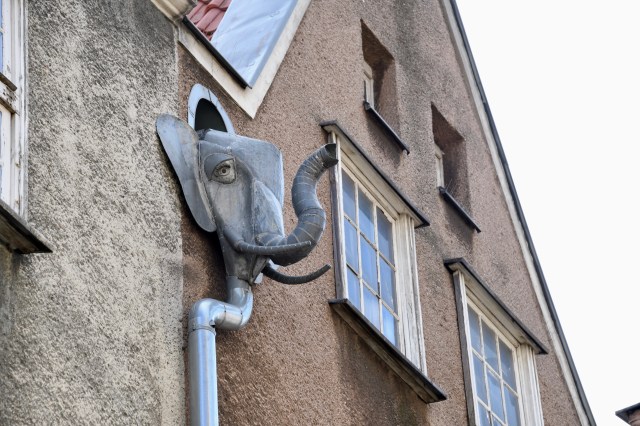
While we went back out into the real world, the ‘important people’ of the day did not want to see mundane items like down drains. So – they were decorated to please – –

Name your animal – they were all up here;-)
Unfortunately, as we left Gdansk there was only time for a quick drive by Solidarity Square to see the memorial and gate in front of the shipyard that perhaps began the fall of communism.

And so ended our very quick visit to Gdansk —

Good night Gdansk.

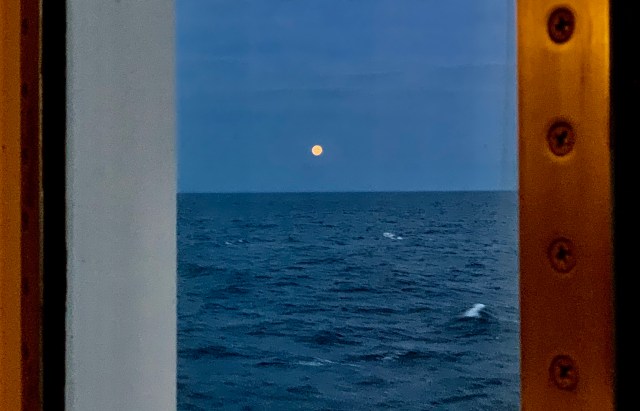
Back at sea and more adventures.

E & G looking forward to another tomorrow;-)
Stockholm, Sweden

Stockholm – What a fabulous day for an interesting and educational visit with fortuitous sightings;-)

Sweden’s capital is one-third water, one-third parks and one-third city spread across 14 islands with 57 bridges and very distinct neighborhoods. It is built on an archipelago of islands making the journey into the city quite beautiful – –

Some islands only the size of the house that sits on it!

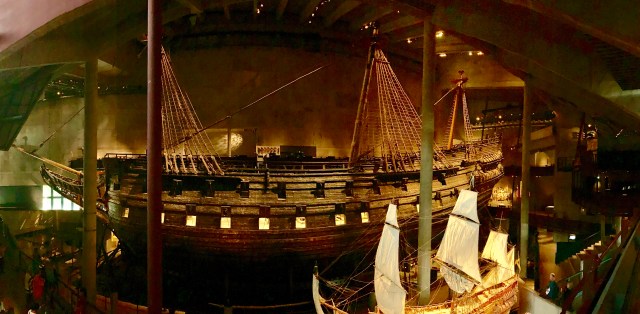
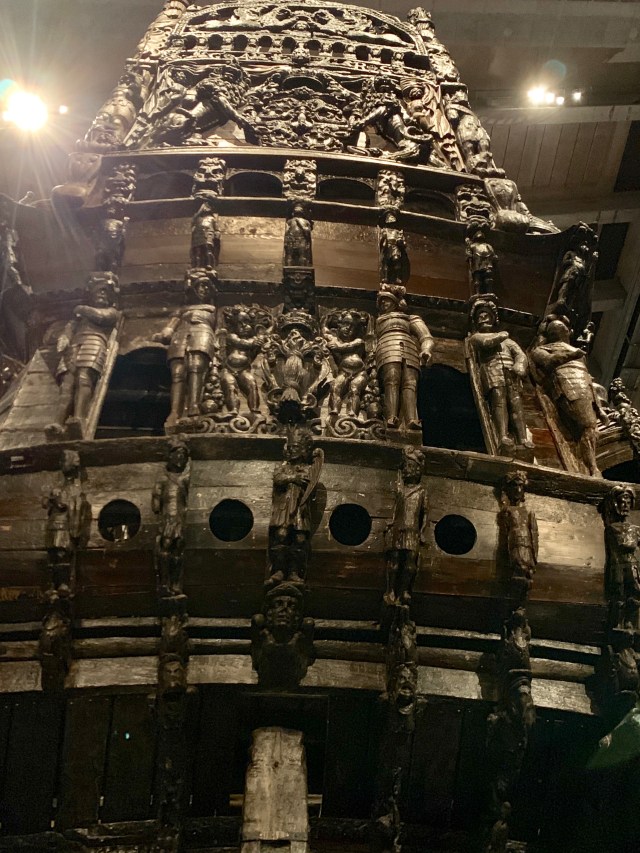
In the 1500’s, Stockholm became a political center when Gustav Vasa established the monarchy. A century later, King Gustavus Adolphus made it an influential European capital. This “Lion of the North” prepared to establish his empire by creating a great navy to dominate the whole of the Baltic Sea. He ordered a great ship – The Vasa – to be built with two fearsome decks of cannons that included 72 guns! It also had 500 carved wooden statues – including a 10 foot lion on the magnificent prow – draping the ship painted in bright colors to symbolize the King’s power. Because the ship was built tall and narrow with lots of weight high on the ship – it only sailed a few 100 feet and then sank on its maiden voyage in 1628;-(. 333 years later it was found on the sea bottom, salvaged in 1961 and is in the process of being totally restored. This is one of the most fascinating exhibits to see – –

The actual salvaged Vasa (98% original) with a model in the foreground as it originally appeared.

The model with original detail and coloration.

Loved this Lion on the prow. Just beautifully carved.

The model with painted sculptures as they would have appeared.

The model of the stern of the Vasa.

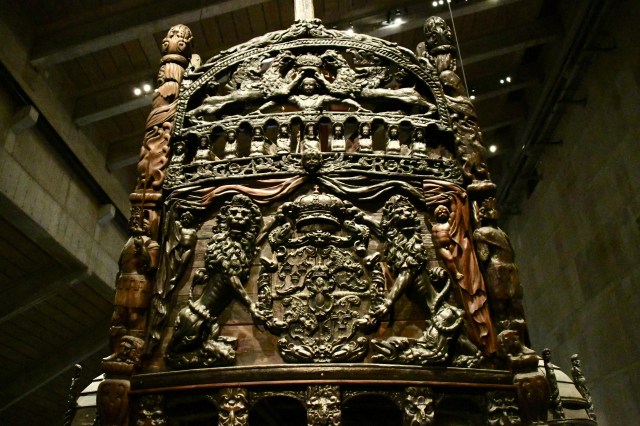
The actual stern of the Vasa which will appear as above after all restoration is complete!

The crest and initials GARS (Gustavus Adolphus Regeant of Sweden) identify the ship as the Vasa.

A model depicting life on the ship.

This is one of the most fascinating exhibits. Not only is the entire ship enclosed in this building created to protect it, the various exhibits describing the salvage process, reconstruction, etc. are educational and intriguing. One could spend much more time here than we had.

In order to see any additional parts of Stockholm, we had to hightail it over to Gamla Stan – or Old Town. This area of the city is a charming maze of alleys and cobblestone streets, as well as one of those fabulous old squares. The Great Square of Stortorget is the hub of Gamla Stan dominated by the Old Stock Exchange, which now houses the Nobel Museum. It is also filled with many restaurants where one can people watch while enjoying Swedish meatballs – as we did;-)

Unfortunately, time passes much too quickly for us. Feeling that there just wasn’t time to do justice to the Nobel Museum, we headed to the bus pick-up. That’s when the fortuitous sighting occurred. There was a great deal of pomp and circumstance around the Royal Palace – the official residence of Sweden’s King and Queen. (The 18th century Italian Baroque edifice contains 608 rooms and took 60+ years to complete.). Turns out the King, Queen and Crown Princess were to be escorted in their carriages by the Royal Guard from the Royal Palace to the Parliament Building to open Parliament! How lucky were we?!?!?

The Royal Palace behind.

The King of Sweden with the Queen.

The Crown Princess.

The Royal Palace.

The Parliament Building.

There was not enough time in Stockholm – which means another trip will have to be had. But, what time we had there was unbelievable;-)!!!

An awestruck E & G

Tallinn, Estonia

One can step back in time as you explore the winding cobblestone streets, medieval towers and old city walls of Tallinn – a UNESCO World Heritage site.

The Tower of St. Olaf’s Church (on the right) dominates the skyline. Hard to believe – but in the late 1500’s this was the tallest building in the world!! The 19th century Russian Orthodox Alexander Nevski Cathedral, with its onion domes, is another skyline highlight.

A wonderful view of Lower Town Old Town Tallinn

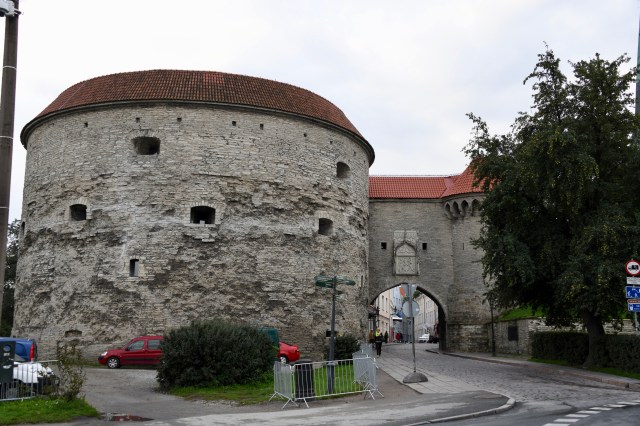
The entry to Old Town is guarded by Fat Margaret Tower just as it was in Medieval times. Besides being a defensive outpost, the tower was made big just to impress anyone coming to town from the harbor. The relief above the gate dates from the 16th century.

Come on in!

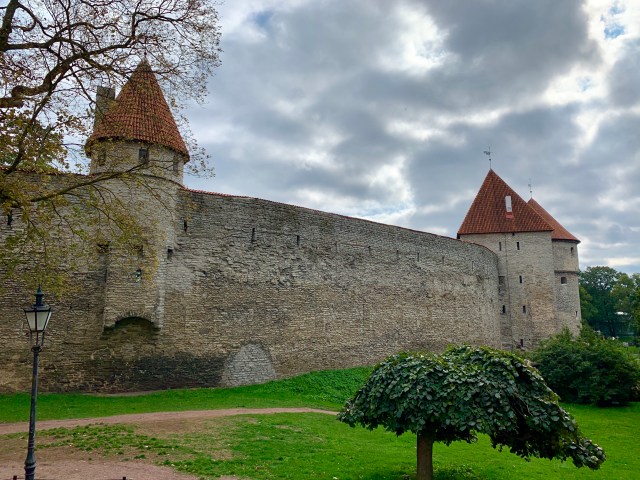
Impressive walls protecting the city! Some of the original 46 towers.

This Old Town is full of beautifully carved, fanciful facades, many dating from the 1400-1500’s – –

Built in 1440, this was used as a German merchants’ club.

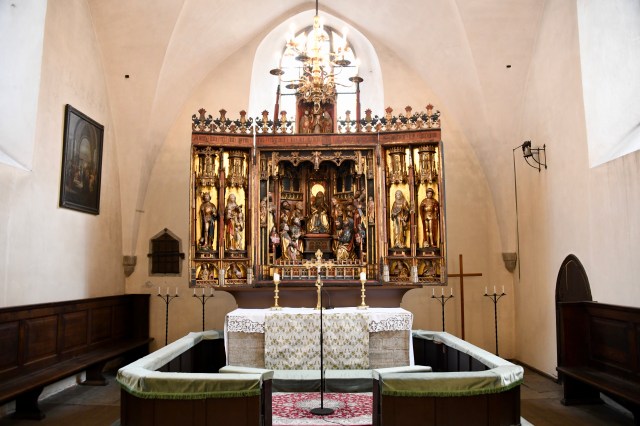
Church of the Holy Ghost is a wonderful little medieval church sporting an outdoor clock from 1633. The interior is quite simple – especially when compared to what we saw in St. Petersburg!!

Such a simple ‘pulpit’ without all the gold.

The Town Hall Square was fabulous! It, of course, served as a marketplace through the centuries and is the focal point of the Old Town. Once, it held criminals chained to pillories for public humiliation or knights showing off in chivalrous tournaments. Today the square is full of cafes and provided a wonderful spot for us to have lunch and watch the world go by;-)

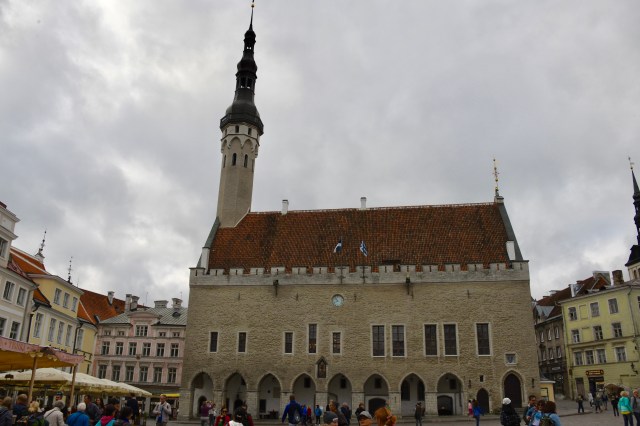
The Town Hall opened in 1404 so the city’s burgomasters would have a suitable place to meet. It dominates the square.

Town Hall.

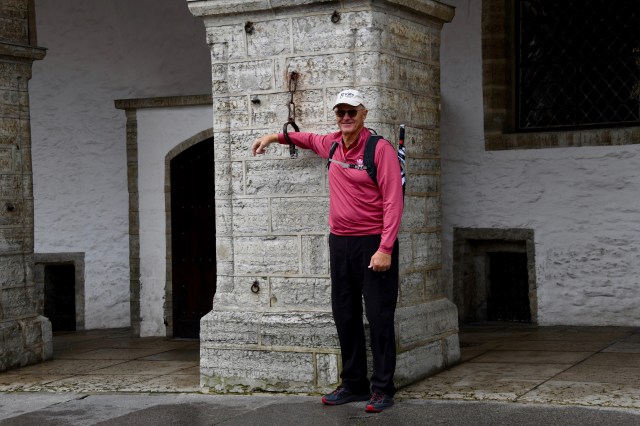
Uh Oh – A well known ‘criminal’ chained for public humiliation!!!

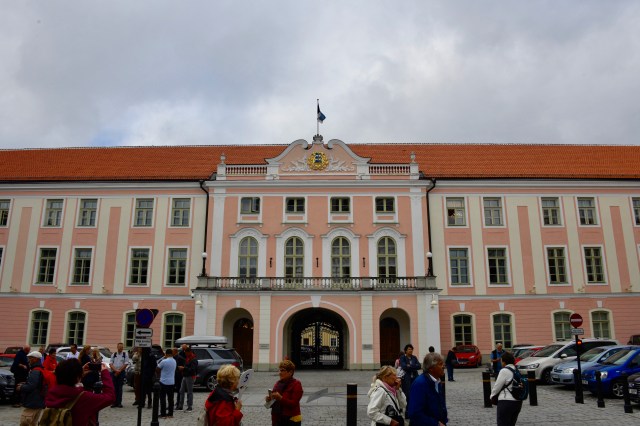
The Upper Town is dominated by Toompea Castle and the Russian Orthodox Cathedral. The pink Toompea Castle is an 18th century Russian addition to the medieval Castle. Today, it is the Estonian Parliament building. The Russian Orthodox Cathedral – which faces Parliament across the square – was built in 1900.

Estonian Parliament

Alexander Nevsky Cathedral

Another wonderful church in the Upper Town is St. Mary’s Church – known as the Dome Church. It is an example of simple Northern European Gothic built in the 13th century during Danish rule. One can climb the 140 steps up the tower for fabulous views of the Upper and Lower Towns.

Yes – we climbed all 140 TINY steps to the top of the Tower!!

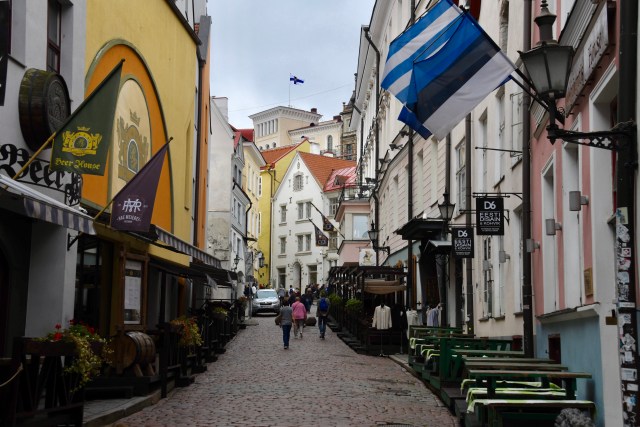
The sights and sounds of this little, old Medieval town were wonderful – –

Tallinn was a bright spot in our itinerary. Loved the day here.

E & G smiling;-)

St. Petersburg, Russia – The Hermitage

What awaited the next morning was – LINES!! It was Sunday morning, more ships were in port and everyone was going to the Hermitage;-(.

REALLY!!!!

But – all was worth the wait. The Hermitage Museum complex contains a staggering three million pieces of artwork housed in a series of imperial buildings on Palace Square. The most prominent is the eggshell blue Winter Palace built in 1754-1762 by Peter the Great’s daughter, Elizabeth. This was the czar’s official city residence, built by Italian architects in the Elizabethan Baroque style, named for the czarina who popularized it. The entire palace is designed to impress, astonish and humble visitors with the power of the Romanov dynasty. And it did!

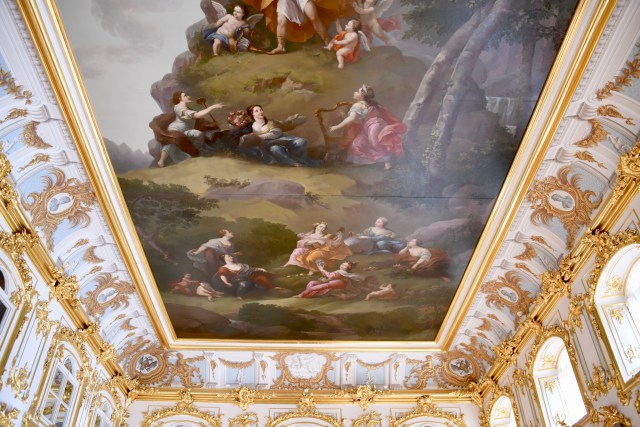
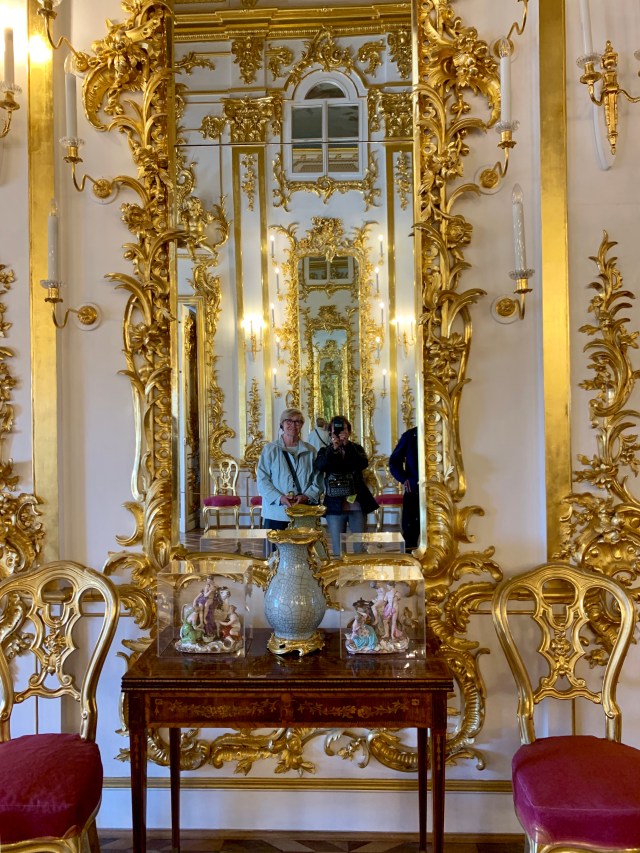
Extravagant gilded decorations cover the walls, alabaster statues watch over visitors and the Greek gods relax in the clouds above. The double-headed Romanov eagle is a common symbol everywhere – indicating the ability to look ahead and behind to protect.

Peter the Great Room (Small Throne).

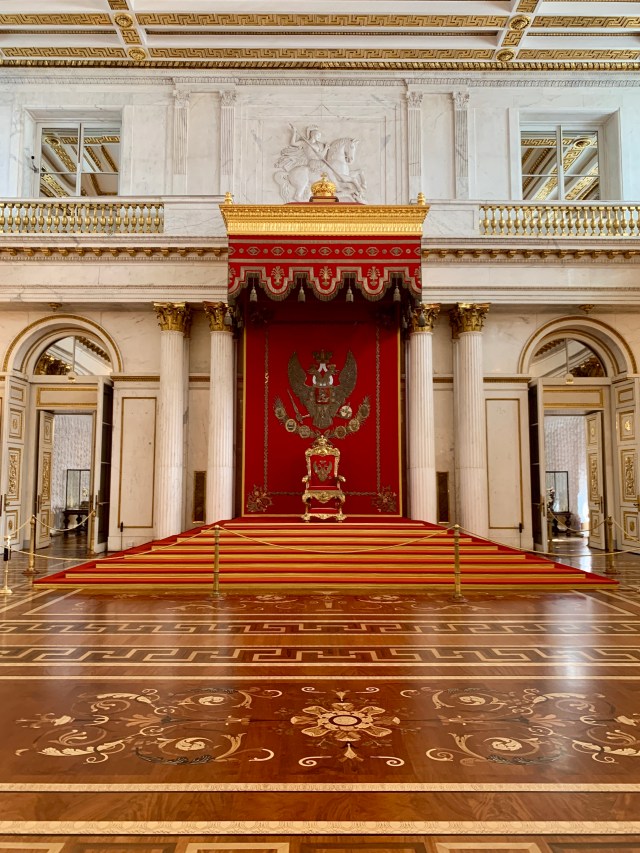
There are actually two throne rooms in the Palace. The ‘Small Throne’ room (above) is to pay homage to Peter the Great and the walls are emblazoned with the double-headed Romanov eagle. The St. George Room – or Large Throne Room – was created in the 1840’s as the setting for official ceremonies and receptions. The magnificent parquet floor is made from 16 types of wood and the design is a mirror image of the gilded ceiling.

The War Gallery of 1812 displays more than 300 portraits of the generals who helped to expel Napoleon from Russia in 1812.

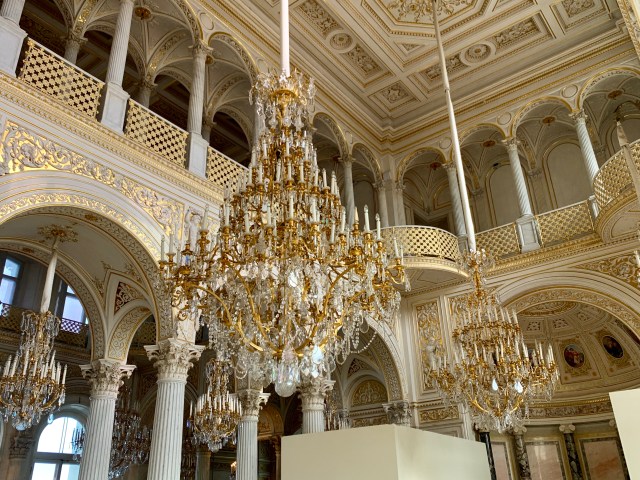
In 1762, Catherine the Great commissioned the Small Hermitage be built, as there was not enough room in the Winter Palace to display all the art she had collected. The Pavilion Hall was a connector, decorated in the French Renaissance style with MUCH gold – –

One more dance in another Grand Hall;-)

When the Small Hermitage would no longer hold the artwork collected, the Old and New Hermitages were constructed. Once through the rooms of the Winter Palace, one begins to see the magnificent art collections. With over 3 million pieces, we didn’t put a dent in what was to be seen.

An early Leonardo da Vinci – Benoit’s Madonna (1475-78)

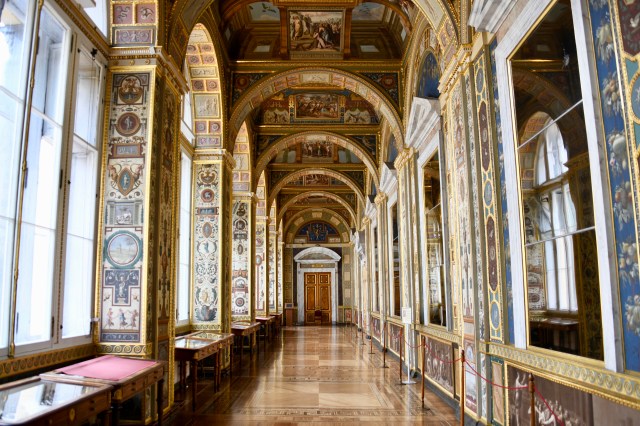
Raphael Loggia and Majolica Room – A long narrow hallway (200 feet long, 13 feet wide) decorated with colorful paintings is a replica of one of the painter Raphael’s – the Vatican Loggia in Rome – which Catherine the Great had replicated in the 1780’s.

Urn is made with lapis lazuli.

Just loved these columns.

And so, a very brief visit to the Hermitage ended as did our stay in St. Petersburg. For all the comments received prior to our visit – we did not find the city a bleak gray with unfriendly, unhappy people. There was a very European-ish city with tremendous sights to see (and we did not see anywhere close to all we would have liked to). The new Gas company headquarters just across from the piers did amuse us;-). And – we found the new football (soccer) stadium built for the 2018 FIFA championships an advertisement for St. Petersburg. That is not to say there weren’t crumbling apartment buildings all around – as there were. But, so are there projects in NY blocks from Fifth and Park Avenues.

A new edifice for the Gas company headquarters.

The stadium built for FIFA 2018.

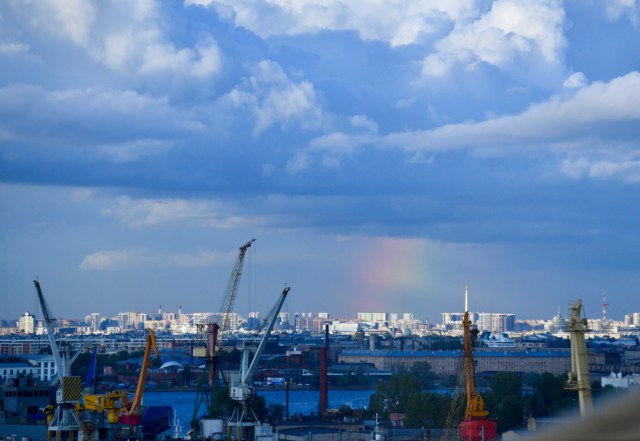
The storm clouds parted and we were on our way to Tallinn, Estonia – –

A rainbow has been over our shoulder. Another opportunity to check one off of the Bucket List – happily. St. Petersburg was a sight to see.

Moving on – E & G

St. Petersburg, Russia – Peterhof

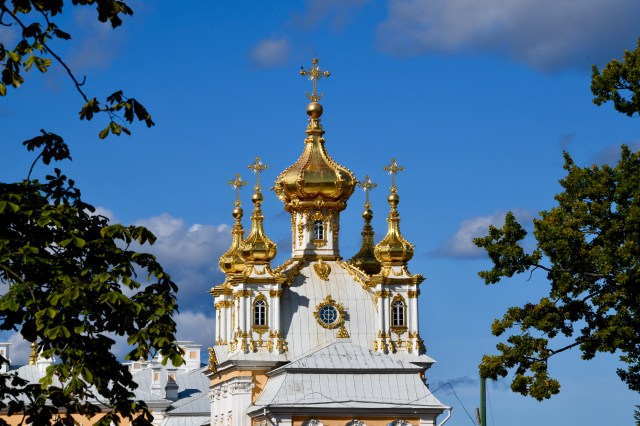
So – Peter the Great began the city of St. Petersburg at the Fortress of Peter and Paul and extended into the ‘suburbs’ with Catherine Palace and a little palace at Peterhof referred to as Russia’s Versailles. Continuing to be impressed with the French, Peter built this magnificent 18th century palace set amongst beautiful fountains and parklands in the style of Versailles.

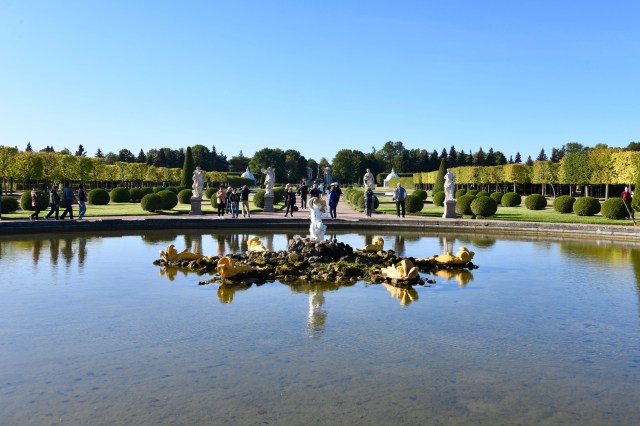
Peterhof sits along the Gulf of Finland west of the city atop a hill that tapers down to the water. The drive up to the palace is impressive – but nothing like the view out the back looking over the 150 fountains contained on the grounds. The pictures speak for themselves – –

Welcome!

This is only the front!!

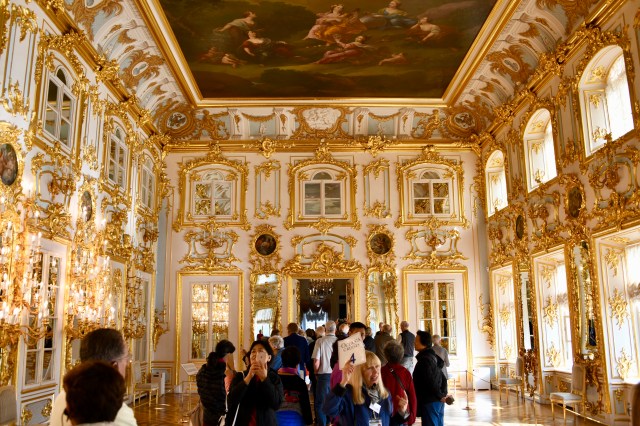
Once again, there is more gold and artwork than you can imagine exists —

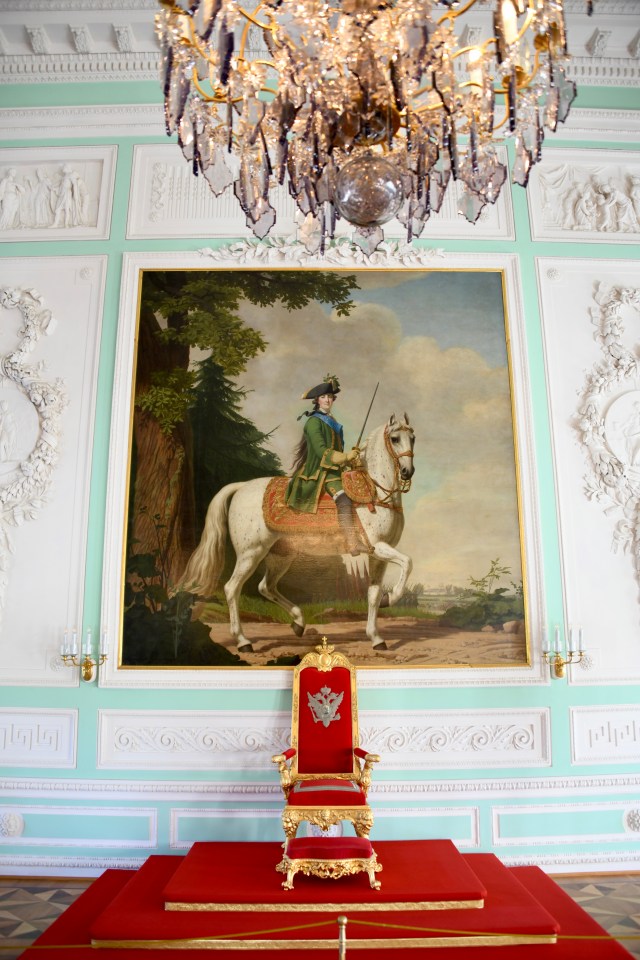
The portrait is actually Catherine the Great as she often lead her army.

It appears there are hundreds of rooms.

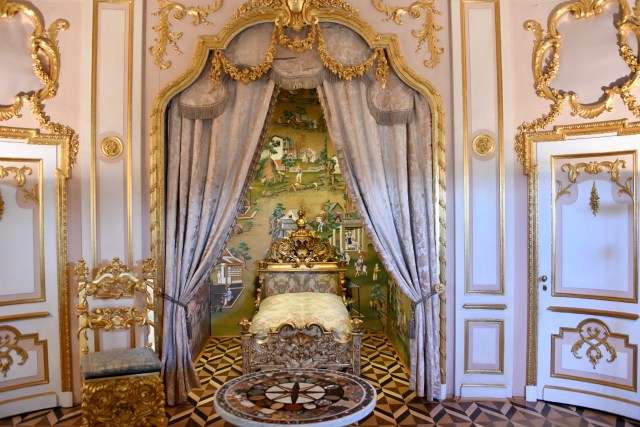
For some reason the men’s beds were always smaller than the women’s?? So – this was Peter’s with his ‘throne’ just to the left (you, of course, know what ‘throne’ this was!!)

And now to the really beautiful part. The ‘backyard’ with the sweeping waterway to the Gulf of Finland. There is quite a ceremony that goes with the turning on of the fountains – all at once at 11AM daily. There are no pumps – all is done hydraulically with a complex system partially created by Peter, who was something of a scientist.

The palace aviary.

Our happy little group;-)

Needless to say, after the somewhat miserable rain of the first day, we were all ecstatic about this beautiful day to explore the magnificent grounds of Peterhof;-). Can hardly wait to see what tomorrow brings.

E & G thoroughly enjoying St. Petersburg

St. Petersburg, Russia – Catherine’s Palace

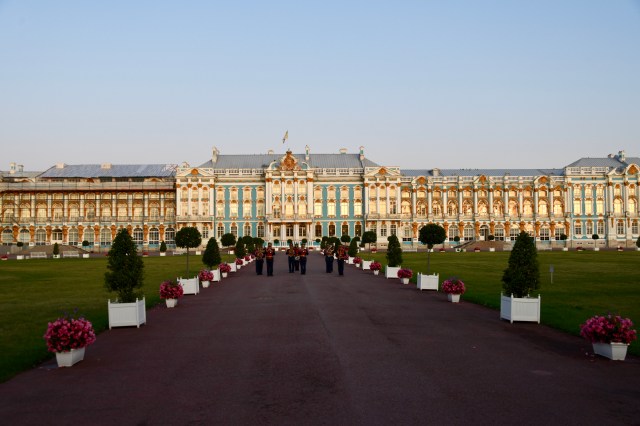
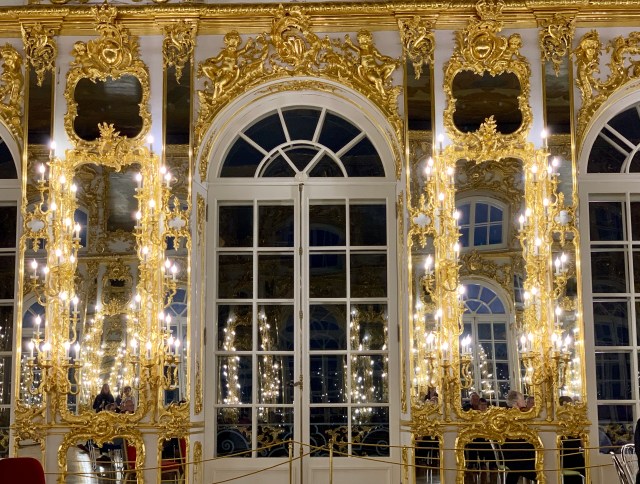
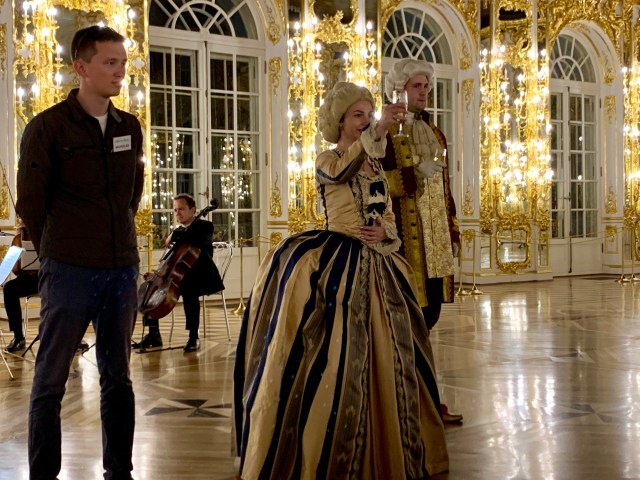
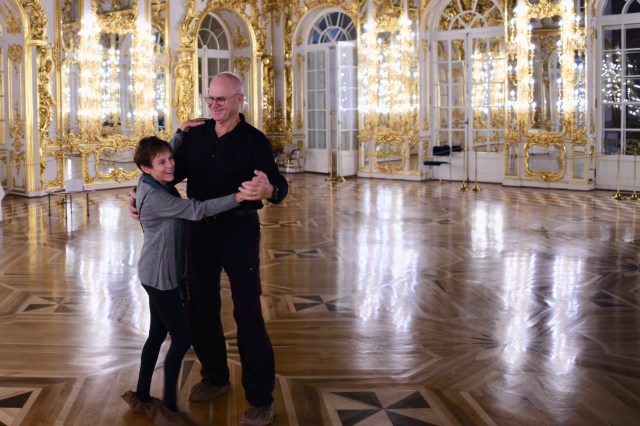
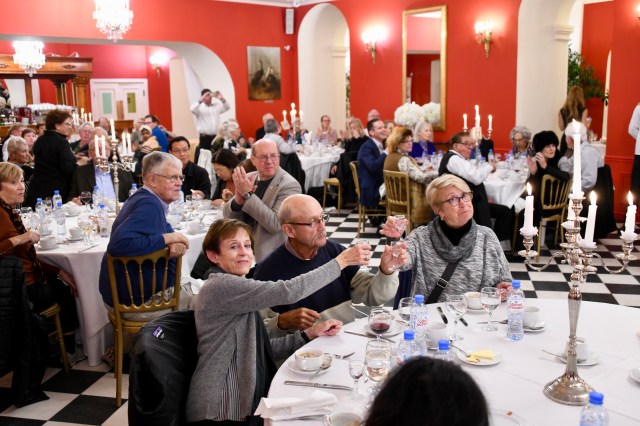
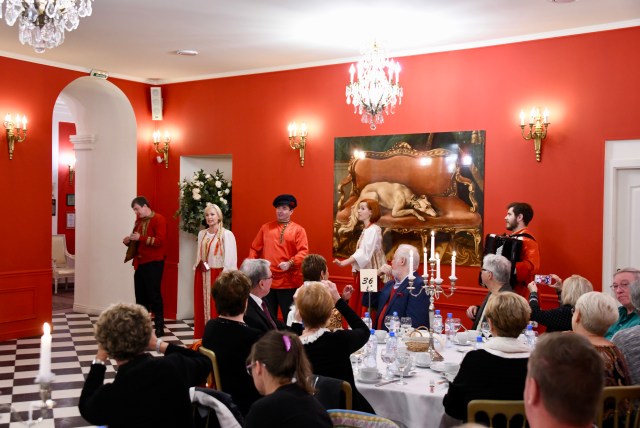
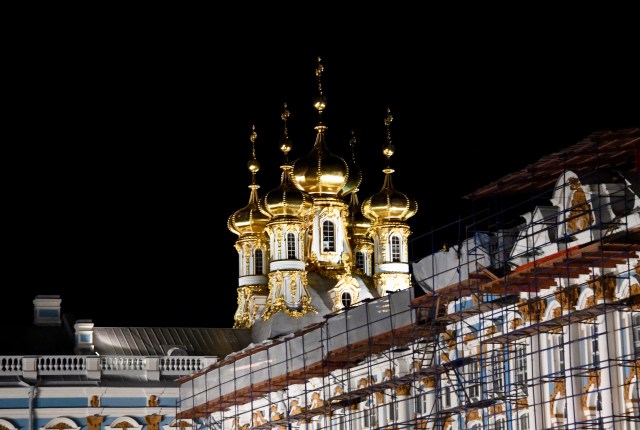
About 15 miles south of St. Petersburg is the small town of Pushkin. Here Peter the Great began the building of a summer palace and called the area Tsarskoye Selo, or Czar’s Village. The main attraction of the area is the Catherine Palace (named for Peter’s wife, Catherine I), thought by some to be the most enjoyable palace to tour/visit. This night – we certainly thought that as we were formally welcomed, given a tour of the palace including the breathtaking Amber Room, celebrated the evening with champagne, dancing and music and were then provided an entertaining evening with a scrumptious dinner;-). Truly treated like ‘royal guests’!

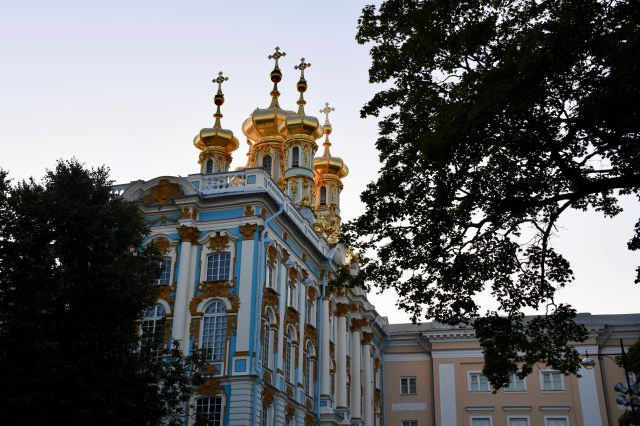
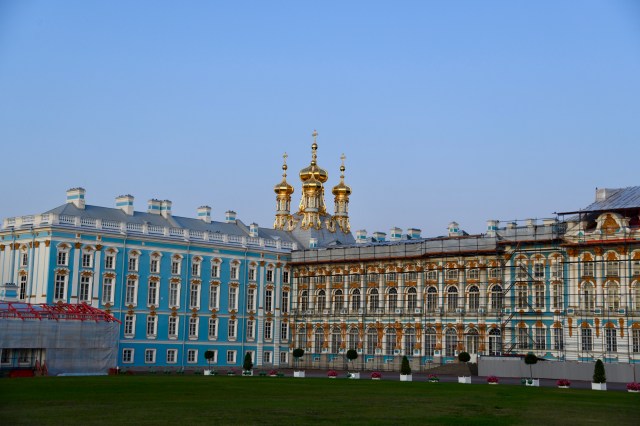
Peter & Catherine’s daughter, Elizabeth, expanded the Palace to make Russia’s Versailles.

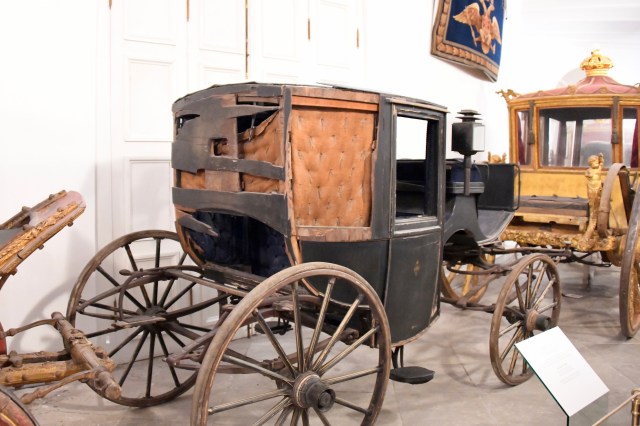
First, we must see the Royal coaches to pick one to arrive in. The one below would NOT be a good choice as this is the one Czar Alexander II was blown up in on the site of the Church on Spilled Blood;-(

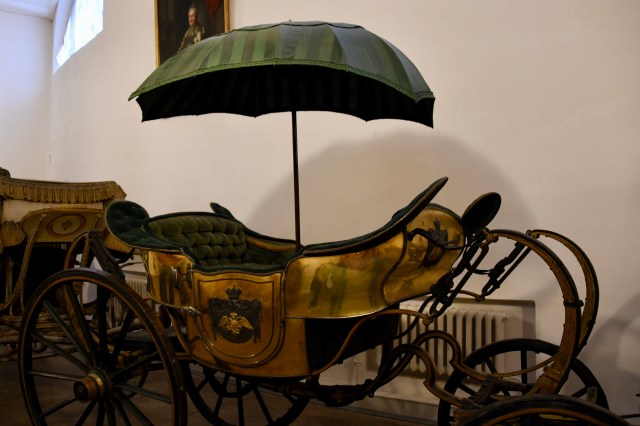
On a cold night this would not be a good choice.

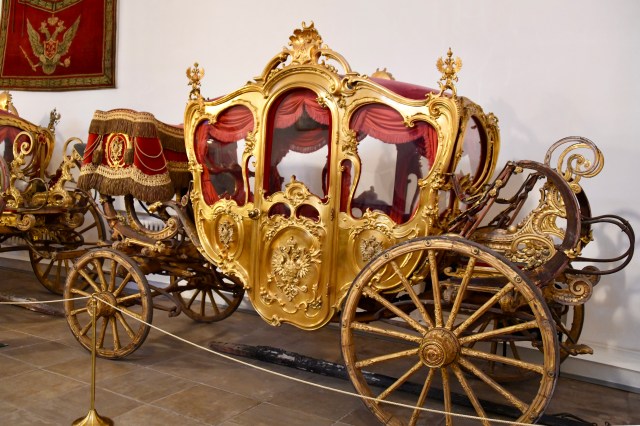
Ahhhh – perhaps this is the one!!

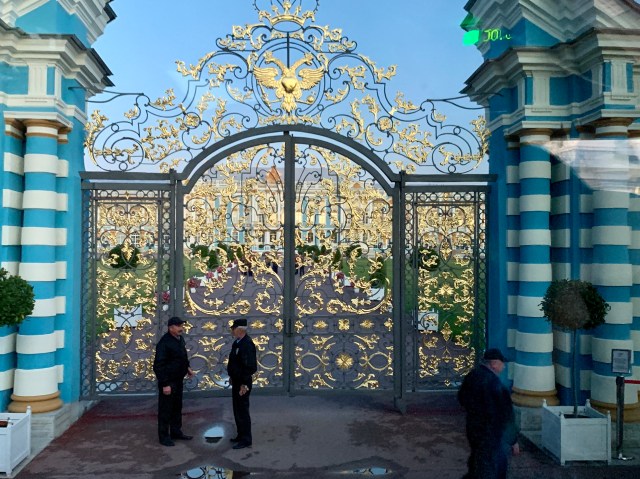
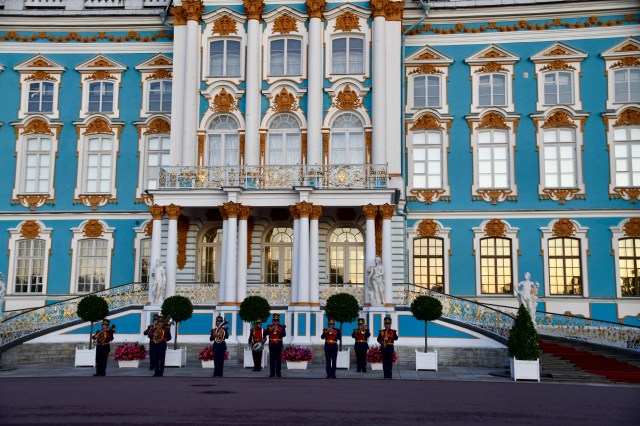
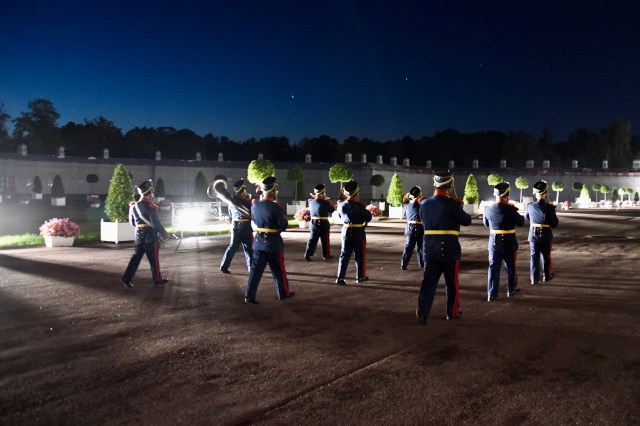
So – off to the front gates to be officially received – –

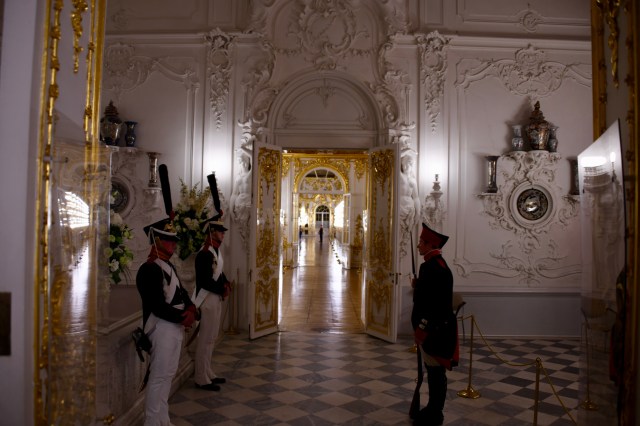
What pomp and circumstance!!

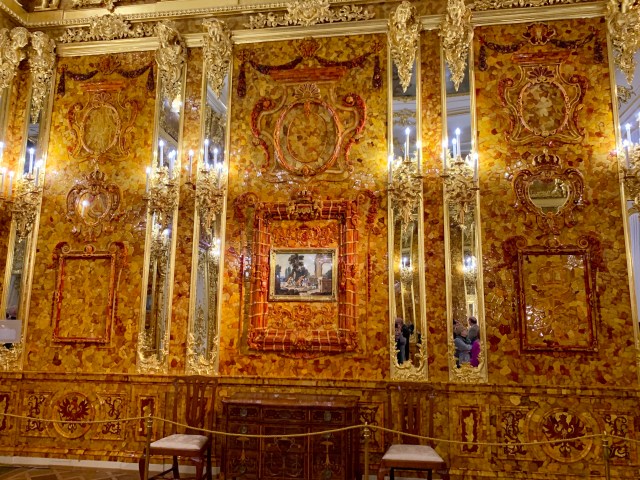
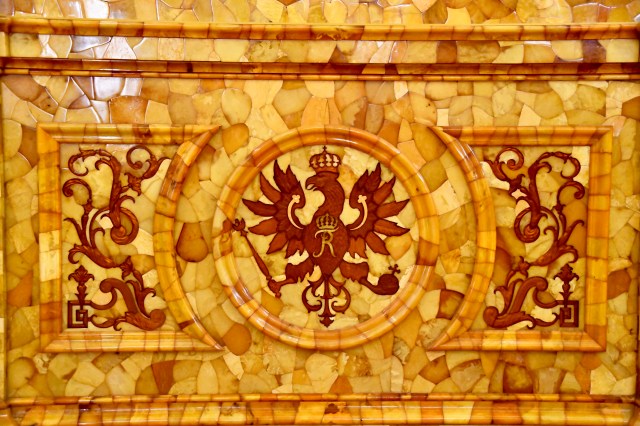
Now to the really good stuff – like the Amber Room. This jewel box of a room is slathered with six tons of amber mosaic. Originally commissioned by Frederick the Great of Prussia in the early 1700’s, he sent it to his then ally, Peter the Great. First installed in the Winter Palace in St. Petersburg but moved to Tsarkoye Selo in 1755 as ordered by Elizabeth. In 1944, the Nazi army completely dismantled the original Amber Room and shipped the pieces to Germany – never to be seen again. In 1979 Soviet authorities set about recreating the room relying on prior photos. The new room was unveiled in 2003.

Unbelievably beautiful!!

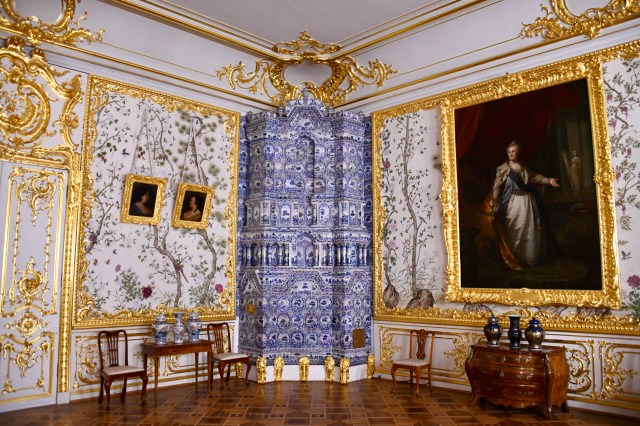
The various Baroque apartments were beautiful with no detail left undone – –

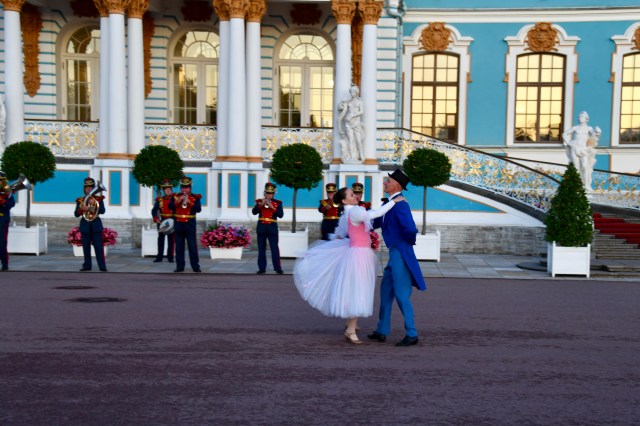
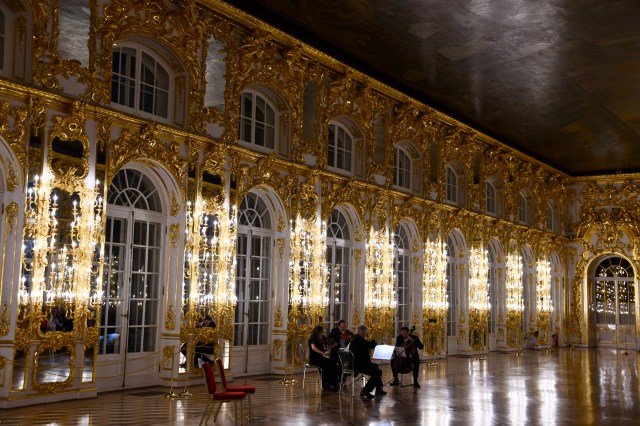
After the tour, it is time for a little champagne, entertainment and perhaps a dance?!?

How Beautiful is this?!?!?

To the Emperor and Empress

And – here’s to us;-)

This way to dinner – please.

Here’s to a wonderful evening at Catherine Palace;-)
Time to say goodnight.

What a fabulous evening. And, now before we change back to pumpkins, it is time to head back to the ship.

E & G with glazed eyes

The Bucket List Item – St. Petersburg

A city willed into being (out of a swamp) by Peter the Great, St. Petersburg is a very European city. It showcases palaces, gardens, statues and arched bridges over graceful waterways. Three wonderful churches define the skyline as one enters the city.

The gold dome of St. Isaac’s Cathedral glitters over the city. While perhaps reminding Americans of the US Capital building, the dome is the 4th largest in the world. The church built between 1818 and 1858 emphasizes the one piece granite columns shipped from a Finnish quarry 150 miles away. A beautiful sight even on a rainy day – –

St. Isaac’s Cathedral towers over the city.

The Church on Spilled Blood is perhaps the more anticipated look of the Russian church. It is built on the place where a revolutionary assassinated Czar Alexander II in 1881 – thus the name. Exuberantly decorated with its gilded top of onion domes, it is a perfect photo opportunity – EXCEPT for all the electric and phone lines;-(

.

A REALLY rainy day – but it didn’t stop us!

Third is the Kazan Cathedral – a functioning house of worship (the prior two are basically museums today) for the Orthodox. The sweeping exterior portico is patterned after St. Peter’s in Rome and is another city landmark.

One of the most stunning and notable sights along the Neva is the Peter and Paul Fortress, with its slender golden spire. This is the sight of the birth of St. Petersburg when in 1703 Peter the Great began building this fortress to secure territory he had won in battle with the Swedes. The centerpiece of the fortress is the cathedral, whose dome can be seen behind the spire. This was the first church built in St. Petersburg and is the final resting place of the Romanov czars, who ruled Russia from 1613 – 1917.

An awesome fortress protecting the city.

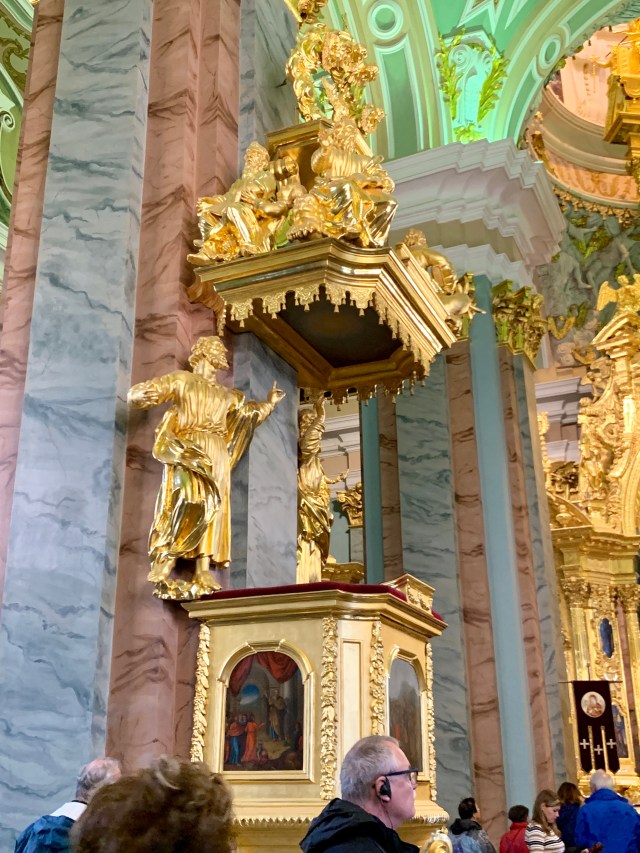
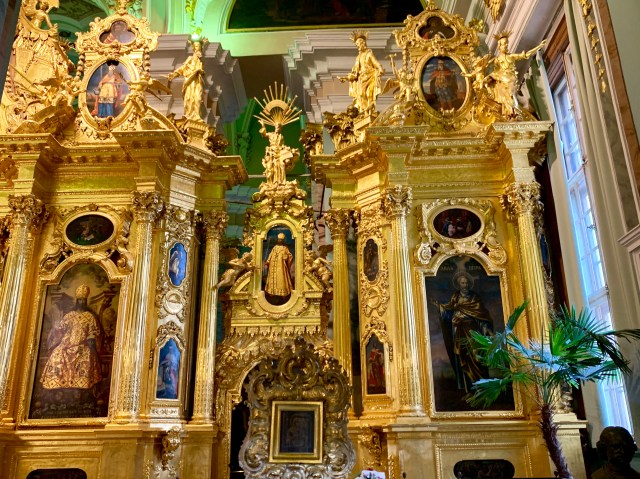
This early 18th century cathedral was designed in Baroque style by a Swiss-Italian architect imported by Peter the Great to introduce European culture to Russia. Therefore, not surprisingly, the interior is NOT typical Russian. Here rests Peter the Great in the lower right corner and Catherine II the Great in the upper left. Elizabeth (ruling between Peter and Catherine) is in the lower left corner.

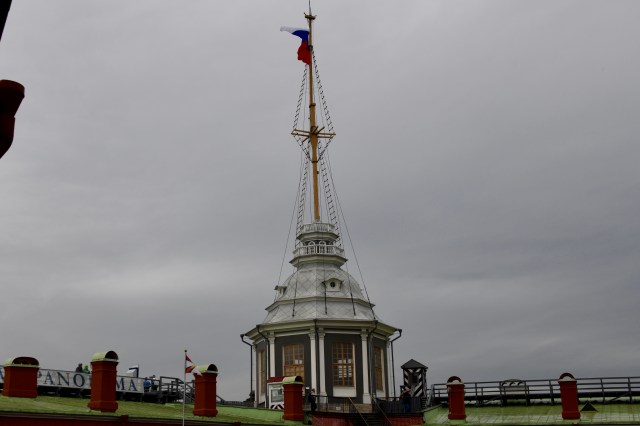
Back outside in the rain, one is able to see the watchtower frequented by Catherine as an escape to watch the ships go by. Also, from this deck the cannons shoot at noon daily and can be heard around the city!!

Beware the noon blast!!

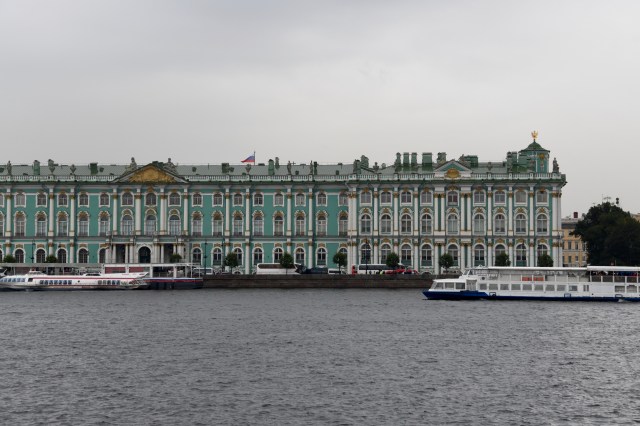
One more stop along the Neva to catch a glimpse of the St. Isaac’s Dome towering over the Winter Palace and the Hermitage (to be seen on another day).

So ends the first day in St. Petersburg. A Grand – very European – city created by Peter the Great and enhanced by Elizabeth and Catherine the Great.

E & G looking excitedly for more